


Peptides are one of the fastest-growing corners of recovery and longevity, and one of the most oversold. You have probably seen the claims: heal any injury, build muscle without the work, turn back the clock. The reality is more interesting and more honest than either the hype or the "it's all a scam" backlash.
- Most recovery and performance peptides have a real mechanism and encouraging animal data, with human outcome research still developing.
- A few (sermorelin, tesamorelin, elamipretide) are already approved medicines for specific conditions.
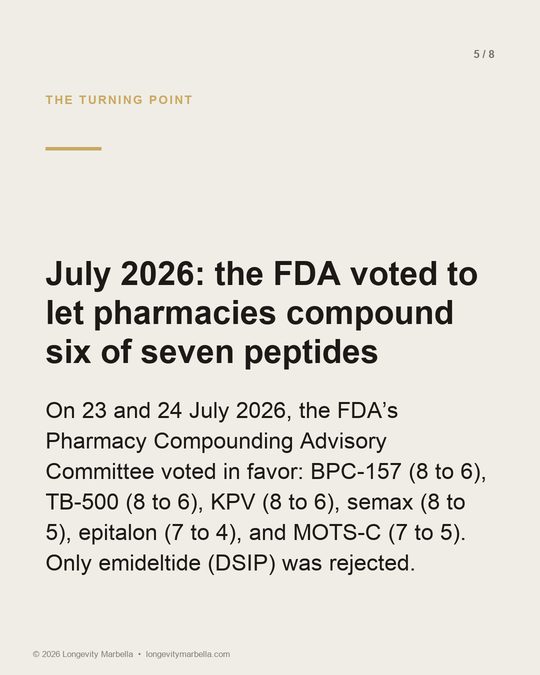
- The regulatory picture is opening up: in July 2026 an FDA advisory committee voted in favor of six of seven peptides, including BPC-157, TB-500 and MOTS-C, for legal pharmacy compounding.
- The main practical risk is unregulated product quality, which proper sourcing and supervision address.
- If you use or are considering peptides, medical supervision is the smartest way to do it safely. Most are on the WADA list, relevant only for tested athletes.
The short version is this. Most of these compounds have a real, plausible biological mechanism and encouraging early data. Very few have the rigorous human trials that would let anyone promise you results. And the biggest practical risk usually is not the molecule at all, but what you actually get when you buy it.
Here is the straight guide: what each peptide is, how it works, what the science genuinely supports today, and where each one sits as the regulatory picture shifts under it.
What is the honest big picture?
Real biology, thin human evidence, and product quality as the main risk. Three things hold true across most recovery and performance peptides:
- Real mechanisms, early human data. Most have a genuine, plausible biological rationale and encouraging animal data. What is still catching up is rigorous human outcome research, and it is catching up slowly for a structural reason rather than a scientific one: without a legal route to market there is no sponsor, and without a sponsor the trials do not get funded. So the honest label is promising and largely untested, which is not the same as disproven.
- The regulatory picture is moving. A few related compounds are already approved medicines. And in July 2026 the FDA's Pharmacy Compounding Advisory Committee voted in favor of six of seven peptides it reviewed, including BPC-157, TB-500 and MOTS-C, recommending they be made legal for pharmacies to compound. Regulators are opening these up, not dismissing them.
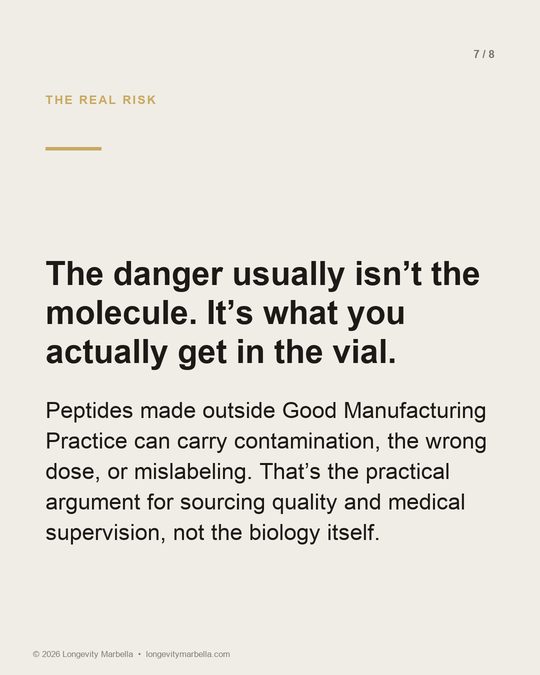
- Product quality is the practical risk. The biggest day-to-day danger for most people is not the molecule but the source: peptides made outside Good Manufacturing Practice can carry contamination, the wrong dose, or mislabeling. This is exactly what proper sourcing and medical supervision address.
For completeness on the sporting side, most of these peptides are on the World Anti-Doping Agency list, which is relevant only if you compete in a tested sport.
Which peptides are actually approved medicines?
A handful are approved, but for specific medical conditions, not for performance. These are genuine, regulator-approved peptide medicines. That does not make them performance drugs, and the recovery and athletic claims attached to them are largely unproven, but they sit in a very different category from gray-market compounds.
- Sermorelin and Tesamorelin (Egrifta) are GHRH analogs (medicines that mimic the body's own growth-hormone-releasing signal). Tesamorelin is approved to reduce visceral fat (the deep fat around the organs) in a specific patient group; both are promoted off-label for body composition and connective-tissue healing, where the evidence is far weaker. Read our detailed review: Sermorelin and Tesamorelin explained.
- SS-31 (elamipretide) is a mitochondrial peptide (one that acts on the mitochondria, the tiny power plants inside cells) recently granted accelerated approval for Barth syndrome, a rare inherited condition. In healthy people, a single infusion improved muscle mitochondrial energy production but did not reduce muscle fatigue, so its performance value is unproven. It is one of the few not on the WADA list.
The unapproved, gray-market peptides
These are the compounds most people mean by "peptides," and where the science and the sourcing risk are both real. Each has a specific mechanism and encouraging early data. The honest common thread: human outcome research is still developing, largely because none of these compounds has had a legal route to market and so none has ever had a sponsor to fund a trial, and buying them unregulated is the main practical risk, which is why medical oversight matters most here.
- BPC-157. A peptide derived from a protein in the stomach that acts on real repair pathways such as angiogenesis (the growth of new blood vessels), with strong, consistent animal data and an encouraging early human signal. Recommended for legal pharmacy compounding by an FDA advisory committee in July 2026. Full review: BPC-157 for injury recovery.
- TB-500 / thymosin beta-4. A fragment of a natural wound-healing protein that drives cell migration (moving repair cells into the injured area) and new blood vessels. Encouraging mechanism, early human data, a favorable FDA advisory committee vote in July 2026, and one specific safety point (a link to certain cancers) that makes oversight worthwhile. Full review: TB-500 and thymosin beta-4.
- GHK-Cu. A copper peptide widely used in approved topical cosmetic products, where it stimulates collagen and skin repair. The injectable version is less proven and needs care over copper. Full review: GHK-Cu copper peptide.
- CJC-1295 and Ipamorelin. Two growth-hormone-stimulating peptides, almost always used together, that reliably raise growth hormone and IGF-1 (insulin-like growth factor 1, a hormone that carries out many of growth hormone's effects). Human outcome data are still limited, and they warrant monitoring of blood sugar and the pituitary gland. Full review: CJC-1295 and ipamorelin.
- MOTS-C. A peptide made inside the mitochondria (the cell's power plants) that switches on AMPK, an energy-sensing switch in cells, and acts as an exercise mimetic (a compound that copies some effects of exercise). Interesting biology, early human data, and a favorable FDA advisory committee vote in July 2026 on legal pharmacy compounding. Full review: MOTS-C.
- Follistatin (FS-344). A myostatin blocker (myostatin is a natural brake on muscle growth) that produces dramatic muscle growth in animal gene-therapy studies; the injected peptide people buy is a different, less-tested route. Full review: Follistatin (FS-344).
- AOD-9604. A growth-hormone fragment marketed for fat loss. It went through human trials for obesity and, despite a reassuring safety profile, did not show meaningful efficacy.
Where is the regulation heading?
Sharply in the right direction, and July 2026 is the reason. On 23 and 24 July 2026 the FDA's Pharmacy Compounding Advisory Committee voted in favor of six of the seven peptides it reviewed, recommending they be added to the 503A list, the register of substances pharmacies are allowed to compound. BPC-157 (8 to 6), KPV (8 to 6), TB-500 (8 to 6), semax (8 to 5), epitalon (7 to 4) and MOTS-C (7 to 5) all got favorable votes. Only emideltide, also called DSIP, was rejected. The docket is FDA-2025-N-6895.
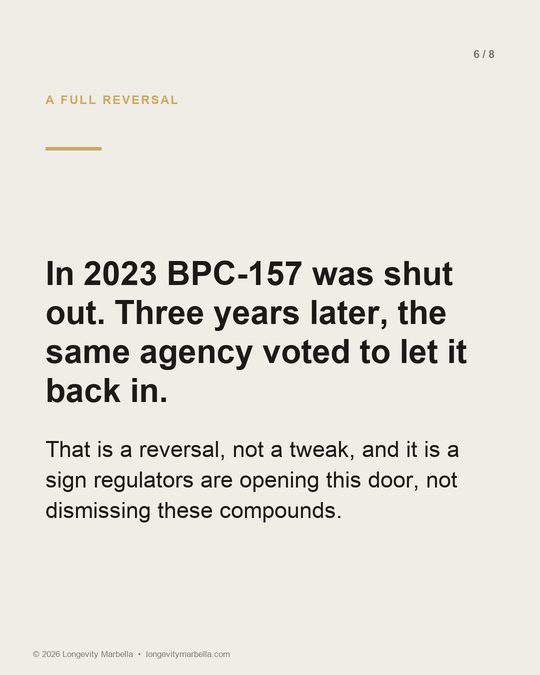
That is a reversal, not a tweak. In 2023 BPC-157 was placed on a restricted category and pharmacies were shut out of making it. Three years later the same agency's expert panel recommended letting them back in, and the FDA's own briefing paper accepted that compounded peptides "can serve an important role for patients whose medical needs cannot be met by an FDA-approved drug product." A legal route means verified identity, an accurate dose, and a doctor in the loop, which is precisely what the current online market does not provide.
It is worth being clear about why this moved at all. These compounds have been in wide use for years without a prescription, bought online by people whose problems conventional care had not solved, and a majority of the committee decided the sensible response to that is a supervised route rather than a closed door. It also creates the conditions for the trials that both sides of this argument say they want. Anyone who has been using these compounds in the dark is exactly who stands to gain from proper evidence.
Two things to be precise about. The FDA's own scientific reviewers recommended against all seven, judging the efficacy evidence insufficient for the indications proposed. That evidence is missing largely because a compound with no legal route to market has no sponsor to fund a trial, so the absence is a product of the restriction rather than a verdict on the molecules. Which is the whole argument: not that these compounds work, but that they have never been through the process that would establish whether they do. And the FDA still decides: rulemaking runs into 2027, and none of it changes Spanish or European law. Full analysis: the July 2026 FDA peptide vote, explained.
Until the rules actually change, the practical point stands unchanged: an unapproved compound has no regulator vouching for its quality or its dose. That remains the strongest argument for using these only with medical guidance.
Do the basics still come first?
Yes, and they do most of the work. Whatever you decide about peptides, the foundations are worth getting right first:
- An accurate diagnosis of what is actually wrong
- Structured rehabilitation and sensible load management
- Sleep, and nutrition with adequate protein
For specific musculoskeletal problems, established options such as physiotherapy, and in selected cases regenerative treatments, are well supported. Peptides, where appropriate, sit on top of these foundations rather than replacing them. Getting those foundations assessed properly is the core of our longevity clinic in Marbella.
Considering peptides and want proper medical guidance and bloodwork instead of guesswork? Talk to us.
Message us on WhatsAppHow do we approach peptides?
We give you a straight, individualized read, neither hype nor a flat no. The mechanisms are real, the early data are encouraging, large numbers of people already use these compounds, and regulators are now reviewing several of them. Our role is not to sell them or wave them away, but to tell you what the evidence supports, what the risks are, and how to reduce them. If this is tied to broader men's health goals, our men's health consultation is a sensible place to start.
A candid word on our role. We do not sell peptides, and we do not prescribe them. What we offer is rarer, and harder to buy: the knowledge to understand them properly. Many people have already decided to use a compound like this on their own terms, and for them the honest question is not whether to use it, but whether to do it blindly or intelligently. We can tell you what the evidence genuinely supports and what it does not, how to judge quality and sourcing, and what to monitor in your own body. There is no shortage of confident advice online, much of it from people who will happily sell you the compound as well. What a physician adds is different in kind: a real understanding of the physiology, of what a molecule is doing inside you and whether it belongs there at all, plus the training to recognize and treat a complication if one arises. That is precisely the moment the confident voices tend to fall quiet and refer you to a doctor. We would rather be the doctor you begin with than the one you are sent to once something has gone wrong.