


Most peptides in this series are gray-market compounds with thin evidence. Sermorelin and tesamorelin are not. They are real prescription medicines with a genuine regulatory history, and that changes the whole conversation.

- Both are GHRH analogs (medicines that mimic the body's own growth-hormone-releasing signal) that bind pituitary GHRH receptors and stimulate the body's own pulsatile growth hormone release, which is more physiologic than injecting growth hormone directly. Sermorelin is a GHRH(1-29) fragment; tesamorelin is a stabilized full GHRH(1-44) analog.
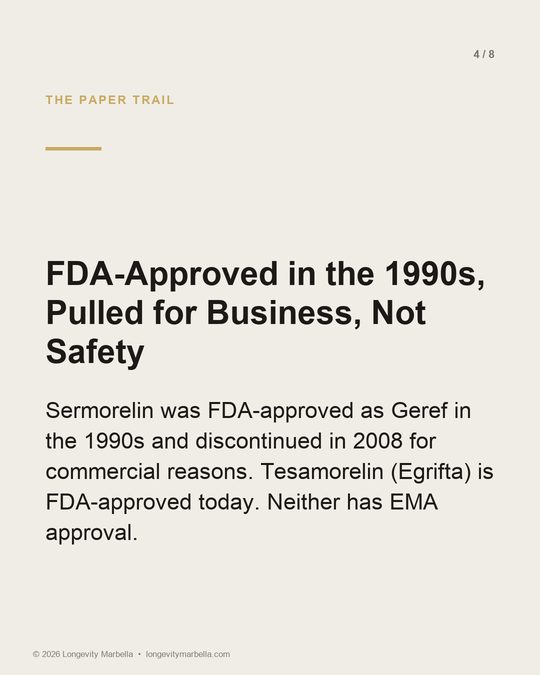
- Both have a real regulatory history, which sets them apart from gray-market peptides. Sermorelin was FDA-approved (as Geref) in the 1990s but discontinued in 2008 for commercial reasons; today it is available only as a compounded medication, prescribed off-label. Tesamorelin is currently FDA-approved (not by the EMA or TGA).
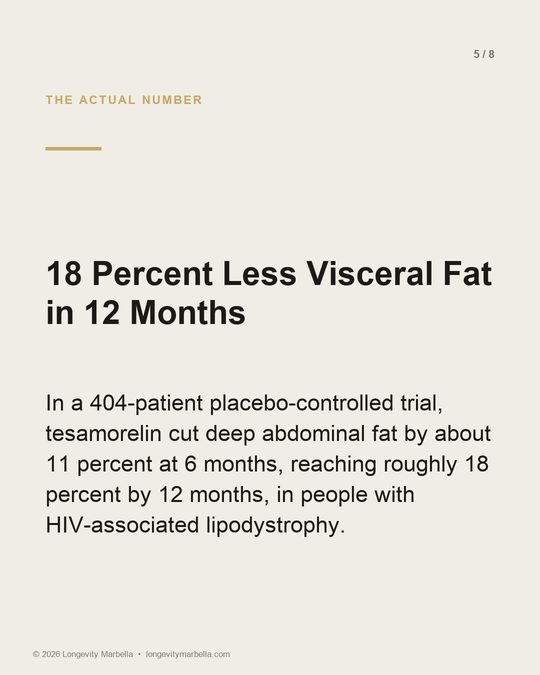
- Tesamorelin is approved to reduce excess visceral abdominal fat (the deep fat around the organs) in HIV-associated lipodystrophy, where its pivotal trial of 404 patients showed about an 18 percent reduction (close to a fifth of that deep fat).
- The popular anti-aging, performance, and general-recovery uses are largely off-label and less proven than the approved indications.
- Where appropriate, a doctor adds value through honest assessment, the correct indication, and proper monitoring. As GHRH analogs they are on the WADA Prohibited List, relevant only if you compete in a tested sport.
Here is the honest version. Both work by nudging your own pituitary to release growth hormone rather than injecting the hormone itself. Their strongest evidence is tied to a couple of specific, approved uses. Almost everything the marketing adds on top, the anti-aging and general-recovery pitch, is off-label and far less proven.
So the useful question is not "do they work?" but "work for what, and how well?" Let's separate the two.
How do they actually work?
They press your own dimmer switch instead of swapping in a brighter bulb. Both are GHRH analogs: medicines that mimic growth-hormone-releasing hormone (GHRH), the natural signal your hypothalamus uses to tell the pituitary to release growth hormone. They do not supply growth hormone directly; they prompt your body to make more of its own.
Mechanistically, the molecule binds the GHRH receptor on the somatotroph cells of the anterior pituitary, the gland's growth-hormone furnace. That receptor is a G-protein-coupled receptor, the furnace's call-for-heat contact: activating it raises intracellular cyclic AMP, the ignition signal inside the cell, which triggers the somatotrophs to synthesize and release growth hormone. The released growth hormone then drives the downstream effects, including production of insulin-like growth factor 1 (IGF-1) in the liver and other tissues.
Why this matters: acting one step upstream is more physiologic than injecting growth hormone directly. Growth hormone is still released in the natural pulsatile pattern, and the normal negative-feedback loops (somatostatin and IGF-1 feedback) stay in place to limit overshoot. The body keeps its hand on the thermostat and throttles back once it has had enough. That preserved feedback is a real safety and physiology advantage over straight growth hormone replacement, and a large part of why these became legitimate medicines.
Takeaway: they switch on your own growth hormone rather than replacing it, which keeps your natural safety brakes in place.
The two molecules differ in structure, which explains their different profiles:
- Sermorelin is GHRH(1-29), the first 29 amino acids of natural GHRH: the working front end of the signal, the shortest stretch that still trips the call-for-heat contact at full strength. This N-terminal fragment retains the full biological activity of the parent hormone, but it is broken down quickly, giving it a short half-life of only a few minutes.
- Tesamorelin (brand name Egrifta) is a stabilized analog of the full GHRH(1-44) sequence, modified with an added trans-3-hexenoic acid group on the N-terminus, in effect insulation fitted over that exposed front end. That modification protects it from rapid enzymatic breakdown, giving it greater stability and a longer-lasting action, which is what made it suitable as an approved daily injectable.
Why are these different from gray-market peptides?
Because they have a real regulatory history, which most peptides sold online do not:
- Sermorelin was approved by the US Food and Drug Administration (as a product called Geref) in the 1990s. The branded product was discontinued in 2008 for commercial reasons, not for safety. Today it is available only as a compounded medication (mixed to order by a specialist pharmacy), prescribed off-label. It is not approved by the European Medicines Agency.
- Tesamorelin is currently approved by the US Food and Drug Administration for a specific condition. It is not approved by the European Medicines Agency or by Australia's Therapeutic Goods Administration.
That history is the whole point. Tesamorelin went through controlled trials with real safety and efficacy data, and it is a quality-controlled licensed product rather than something made outside a regulated supply chain. Sermorelin, though no longer branded, was studied and approved as a finished medicine before it was pulled. Same molecule, very different paper trail. Many of the peptides in our full peptides guide have none of that history.
Takeaway: these are licensed medicines with a paper trail, not compounds a lab mixed and marketed on a hunch.
What is tesamorelin actually approved for?
One specific job. Tesamorelin (Egrifta) is FDA-approved to reduce excess abdominal fat in people with HIV-associated lipodystrophy, a condition in which HIV medicines can drive a buildup of deep visceral fat (the fat that sits around the organs). A review in Drugs describes it as the first, and at the time only, treatment indicated for reducing excess abdominal fat in this specific patient group.
The evidence is solid. In a 12-month randomized, placebo-controlled trial of 404 patients, tesamorelin reduced visceral fat by about 11 percent versus placebo over the first 6 months, with continued treatment to 12 months reaching roughly 18 percent (close to a fifth of that deep belly fat), improved related body composition measures, and was generally well tolerated, with no significant disturbance of blood sugar. That is a real, measured benefit in a defined population, not a marketing promise.
What it is not is a general fat-loss drug for the healthy population. Reducing one kind of fat in one medical condition is a long way from the broad "lean you out and turn back the clock" framing that surrounds it online. It is a precision tool for a named problem, not a lifestyle upgrade.
Takeaway: tesamorelin has strong evidence for one narrow indication, and that evidence does not transfer to healthy people chasing body recomposition.
What about sermorelin, and the off-label gap?
Sermorelin was first approved as a growth-hormone secretagogue (a medicine that prompts the body to release its own growth hormone). Beyond that original indication, the uses promoted to wellness audiences, such as body-fat reduction and connective-tissue healing, are off-label. They borrow the credibility of a once-approved medicine and stretch it toward outcomes that are far less firmly established.
A 2026 review in Sports Medicine examining approved and unapproved peptide therapies makes the useful point: being approved for one purpose does not validate every recovery or performance claim attached to it. This does not mean the broader uses help no one. It means those specific uses have not been through the same testing as the approved ones, and the reason matters: sermorelin is an old molecule with no commercial owner motivated to fund new indication trials, so nobody has run them. Thin evidence because a question was never funded is a different thing from thin evidence because a question was asked and answered badly, and the two get reported identically.
Takeaway: the anti-aging and recovery claims lean on a once-approved name rather than on data that tested those claims, and that data does not exist because no one funded it. Treat it as an open question, not a closed one.
Are they safe?
Better characterized than gray-market compounds, but not risk-free. Because these are studied medicines, their side-effect profiles are reasonably well described. Reported effects for both include:
- Facial flushing
- Headache and dizziness
- Hypoglycemia (low blood sugar)
In the tesamorelin trials, most serious adverse events were injection-site reactions or effects already known to be associated with growth hormone therapy. That is a real advantage over unregulated compounds, where the safety picture is often unknown. But "better characterized" is not "no risk." These act on the growth hormone axis, so they call for proper medical assessment (including who should not take them at all) and ongoing monitoring. One practical note: as GHRH analogs they are on the World Anti-Doping Agency Prohibited List, relevant only if you compete in a tested sport.
Takeaway: the risks are known and manageable, but only with medical assessment and monitoring behind them.
Wondering whether there is a genuine indication for you, or how the growth hormone axis should be monitored? Our specialist can give you an honest, oversight-led read.
Message us on WhatsAppOur position
Sermorelin and tesamorelin are a more credible category than gray-market peptides. They have a real regulatory history, real trial data, a characterized safety profile, and a quality-controlled product, and they work through a well-understood, physiologic mechanism. That is a solid foundation, and we treat it as one. The strongest evidence lives inside their specific indications; the wider anti-aging and body-recomposition claims are off-label, less proven, and best weighed on their own merits.
Where these medicines are appropriate, the value we add is straightforward: an honest assessment, the correct indication, and proper monitoring of the growth hormone axis over time. That is exactly the kind of decision that belongs with a doctor, in our case a board-certified endocrinologist, who can judge whether a GHRH analog fits your situation and manage it properly. You can see how we work in our men's health consultation. This article is educational and is not an offer to prescribe or supply any medicine.
If you are weighing other recovery compounds, we have written companion honest reviews, including BPC-157 for injury recovery, what the evidence actually shows.
A candid word on our role. These two are different from the gray-market peptides. They are medicines a physician can prescribe where there is a genuine indication. What we will not do is hand them out for unproven anti-aging use. What we offer is an honest assessment, the correct indication, and proper monitoring. There is no shortage of confident advice online, and much of it comes from people who will happily sell you the compound as well. What a physician adds is different in kind: a genuine understanding of the physiology, of what a molecule is actually doing inside you, whether it belongs there at all, and the point at which it stops helping and starts to harm, together with the training to recognize, diagnose and treat a complication if one arises. That is the part that matters most, because it is precisely the moment the confident voices tend to fall quiet and refer you to a doctor. We would simply rather be the doctor you begin with than the one you are sent to once something has already gone wrong.