


You have a tendon that will not settle, or a gut that keeps flaring, and someone has mentioned BPC-157. Here is the honest version.
- BPC-157 acts on several genuine repair pathways (angiogenesis, growth factor signaling, lower inflammation) and shows consistent healing in animal studies.
- Human research is still early: a 2025 review found mostly animal studies plus one small, encouraging human report, with no randomized trials yet.
- Animal safety looks reassuring; for most people the bigger real-world risk is contamination or mislabeling in unregulated products.
- Regulation is opening up: in July 2026 an FDA advisory committee voted 8 to 6 to recommend legal pharmacy compounding of BPC-157.
- If you are using it or considering it, honest information and quality control are the smartest ways to reduce risk.
BPC-157 is a synthetic peptide with genuine biological promise and a lot of loud marketing around it. What it is: a compound that acts on real tissue-repair pathways and heals reliably in animals. What it is not: a proven human medicine. There are no randomized human trials yet, and most of what you can buy is unregulated.
So is it worth your attention? Below is what the science actually shows, what we do not know, and how the legal picture is changing right now. No hype, and no flat dismissal either.
What is BPC-157, and how does it work?
It is a stable synthetic peptide that appears to switch on several repair pathways at once. BPC-157 (body protection compound-157) is derived from a protective protein found in human gastric juice. In laboratory and animal studies, it acts on the exact pathways involved in tissue repair:
- New blood vessel growth (angiogenesis). It upregulates the VEGFR2 receptor and the nitric oxide pathway, adding more order desks where the grow-new-vessels signal lands and strengthening the relay line behind them, helping build the new blood supply that healing tissue needs. This matters most in poorly vascularized tissues such as tendon and ligament, which are notoriously slow to heal.
- Growth factor signaling. It increases expression of the growth hormone receptor on tendon cells, giving them more desks where growth hormone's order lands, and supports the FAK-paxillin pathway, an internal relay, both tied to cell migration, proliferation, and the remodeling of injured tissue.
- Lower inflammation. It dampens pro-inflammatory cytokines, which may help move a stalled, chronically inflamed injury toward repair.
- Cytoprotection. It appears to protect cells and the gut lining from a range of insults, the property it was first studied for.
Taken together, that is a coherent, plausible set of mechanisms for a healing agent, which is a big part of why interest has grown so fast.
Does the animal evidence hold up?
Yes, and this is the genuinely promising part. Across two decades of preclinical research, BPC-157 has shown consistent, positive healing effects in animal models of tendon, ligament, skeletal muscle, and bone injury. A 2019 review in Cell and Tissue Research concluded the studies showed "consistently positive and prompt healing effects" across many soft-tissue injuries, while noting almost all of it was done in small rodent models.
A 2026 review in Pharmaceuticals went further, mapping the evidence across tendon, ligament, and muscle injury and, unusually, across the difficult junctions between them: where tendon meets bone, muscle meets tendon, and muscle attaches to bone. It reported healing whether the peptide was given by injection or by mouth, without the specialized delivery systems conventional growth factors require. Two honest caveats sit beside that:
- Much of the work comes from a single research group.
- It is almost entirely animal data, and the authors themselves conclude robust human trials are still lacking.
The signal is real. The catch is the species: strong results in rodents do not automatically carry over to people.
What does the human evidence actually show?
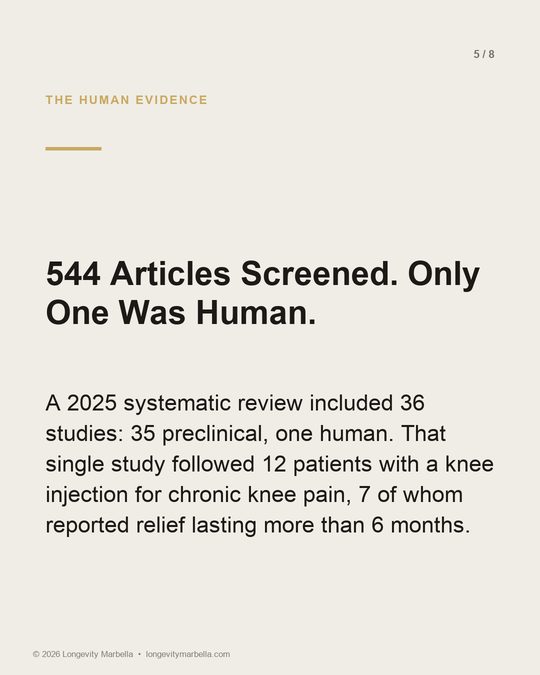
Very little yet, and that is the crux. A 2025 systematic review in HSS Journal (the musculoskeletal journal of the Hospital for Special Surgery) gathered everything published on BPC-157 relevant to sports medicine. After screening 544 articles, the reviewers included 36 studies, of which 35 were preclinical (animal) and only one was human.
That single human study was small and uncontrolled: of 12 patients given a knee injection for chronic knee pain, 7 reported relief lasting more than 6 months. That is a hint, not proof. There are no randomized controlled trials (the gold-standard test that rules out chance and placebo) in people, and the available evidence sits at the lowest tiers of the evidence ladder. The reviewers were explicit that the lack of clinical outcome and safety data prevents any evidence-based treatment recommendation.
In plain terms: the animal evidence is strong, the early human signal is encouraging, but the formal human research is still catching up. That gap is the honest heart of the BPC-157 story.
Is BPC-157 safe?
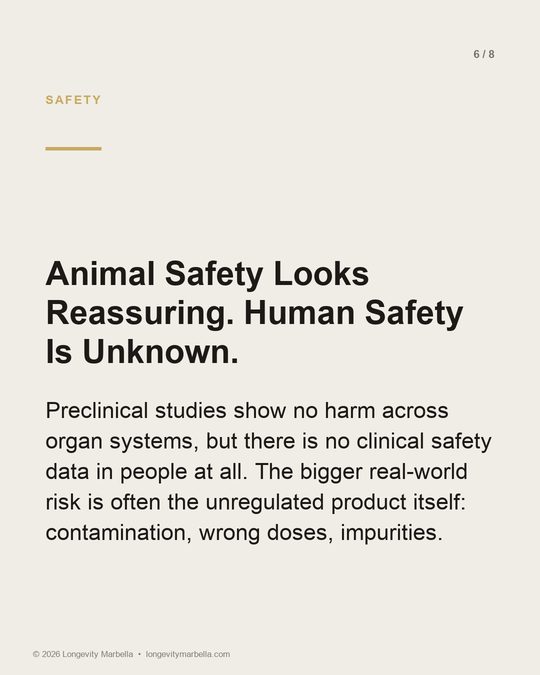
Animal safety looks reassuring; human safety is essentially unknown. BPC-157 is metabolized in the liver, has a short half-life of under 30 minutes, and is cleared by the kidneys. Preclinical studies have not shown harm across the organ systems examined. But the same systematic review found no clinical safety data at all, so the real-world risk in humans, especially with repeated use, is simply unknown.
There is a second, separate risk that has nothing to do with the molecule itself. Because BPC-157 is unregulated, the products people buy online are not quality-controlled. That opens the door to contamination, wrong amounts in the vial, and impurities: a real concern with anything made and sold outside a licensed pharmaceutical supply chain. Think of it as ordering a drug with no label you can trust.
Already using BPC-157, or seriously considering it? Our specialist can help you weigh the evidence for your situation and watch your health while you do, no product and no prescription involved.
Message us on WhatsAppIs BPC-157 legal, and is that changing?
Yes it is changing, and in July 2026 it changed for the better.
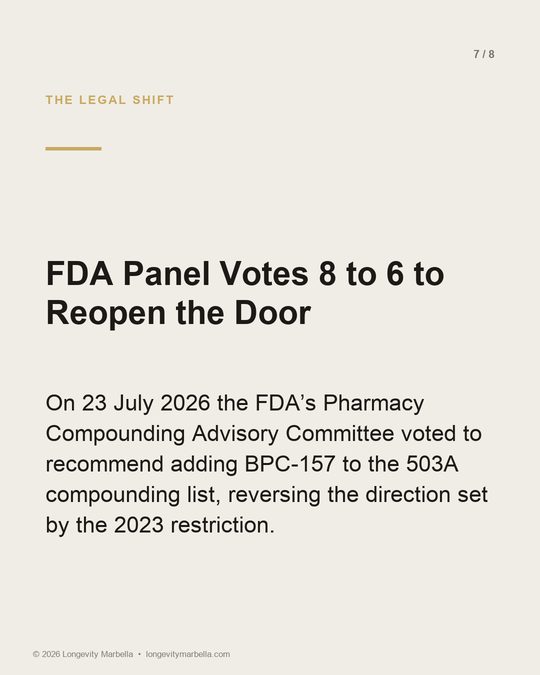
On 23 July 2026 the FDA's Pharmacy Compounding Advisory Committee voted 8 to 6 to recommend that BPC-157 be added to the 503A list, the register of substances compounding pharmacies are allowed to prepare. The indication assessed was ulcerative colitis, under docket FDA-2025-N-6895. When the result was read out the room applauded, and the chairman of the American Academy of Peptide Medicine called it a step toward safe, supervised access for patients and providers. BPC-157 was one of six peptides out of seven that the committee backed across the two days.
That is a genuine shift. In 2023 BPC-157 was placed on a restricted list and pharmacies were effectively shut out of making it. Three years later the same agency's expert committee has recommended letting them back in. The FDA still has the final word and formal rulemaking runs into 2027, but the agency's own guidance notes that it "generally follows the recommendations" of its advisory committees. The panel has five further peptides scheduled before the end of February, so this looks like a direction of travel rather than a one-off.
The strongest case for it came from the FDA's own briefing paper, which accepted that compounded peptides "can serve an important role for patients whose medical needs cannot be met by an FDA-approved drug product," and that the problems the agency has actually seen trace back to the quality of the compounded product. That is precisely what a legal route fixes. Today BPC-157 is bought from online sellers under no pharmaceutical quality control whatsoever, and testing keeps turning up wrong doses, contaminants, or a different compound in the vial. Move it into a licensed pharmacy and you get verified identity, an accurate dose, and a physician who knows you are taking it.
It should also unlock the research. A compound with no legal prescribing route has no commercial sponsor, and without a sponsor nobody funds trials. Open the route and the incentive to run proper human studies arrives with it. FDA reviewers told the committee they wanted stronger efficacy data before backing BPC-157 for colitis. So do we. The reason that data does not exist is that a compound with no legal route has no sponsor to fund a trial, which makes the missing evidence a consequence of the restriction rather than a case for keeping it.
There is a human reason this shifted. BPC-157 has been in wide use for years without a prescription, bought online by people whose injuries conventional care had not fixed, and the panel treated that as the actual situation to make rules for rather than an inconvenience to ignore. Anyone in that position deserves proper evidence, and a legal route is what makes producing it possible.
One thing has not changed. If you compete in tested sport, BPC-157 is prohibited, and the US Anti-Doping Agency notes that because it has not been properly studied in people, no safe dose has been established.
Our honest take
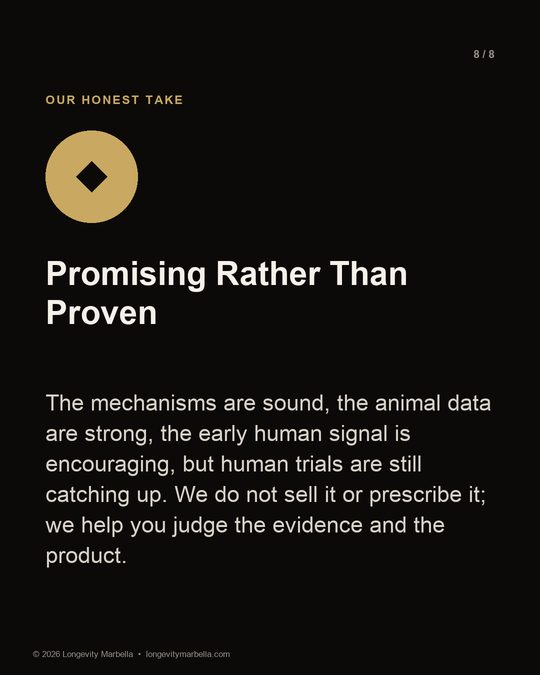
Promising rather than proven, and the biggest practical risk is usually the product, not the peptide. The mechanisms are sound, the animal data are strong and consistent, the early human signal is encouraging, plenty of people already use it, and regulators are now weighing its status. But the human trials are still catching up. For most people the biggest real-world risk is not the molecule but the unregulated, unverified products sold online. This is the kind of question we work through with people at our longevity clinic in Marbella.
That is where a doctor adds value. We give you the honest, balanced evidence rather than hype or a flat no. BPC-157 is promising and widely used, but we do not sell it or prescribe it. What we offer is practical, high-end information: an honest read of what the evidence supports, how to judge product quality, and what to watch for in your own health, so anyone considering or already using it can do so as intelligently and safely as possible, alongside the recovery fundamentals that always help. We are glad to talk it through individually.
A candid word on our role. We do not sell peptides, and we do not prescribe them. What we offer is rarer, and harder to buy: the knowledge to understand them properly. Many people have already decided to use a compound like this on their own terms, and for them the honest question is not whether to use it, but whether to do it blindly or intelligently. We can walk you through what the evidence genuinely supports and what it does not, how to judge quality and sourcing, the difference between a considered approach and a reckless one, and what to watch for in your own body. Online there is no shortage of confident advice, much of it from people who will happily sell you the compound too. What a physician adds is different in kind: a real grasp of the physiology, of what a molecule is actually doing inside you, whether it belongs there at all, and the point at which it stops helping and starts to harm, plus the training to recognize, diagnose, and treat a complication if one arises. That is the part that matters most, because it is exactly the moment the confident voices go quiet and tell you to see a doctor. We would rather be the doctor you begin with than the one you are sent to once something has already gone wrong.
If you are also weighing TB-500, we have written a companion honest review: TB-500 and thymosin beta-4 for recovery, what the evidence actually shows.