


You have probably seen CJC-1295 and ipamorelin sold as the shortcut to better recovery, deeper sleep, and a leaner body, almost always run together as a stack. Here is the honest part most sellers skip: each one really does push your body to release more of its own growth hormone, through two different pathways. The biology is genuine and the hormonal effect is reliable.
But raising a hormone in your blood is not the same as changing how you look, feel, or perform. That is where the story gets thinner than the marketing suggests, and where it pays to know exactly what has been proven and what has not.
Here is the straight version, no hype and no hand-waving.


- Both peptides reliably raise your own growth hormone and IGF-1, and the mechanism is well understood.
- The honest gap is human outcome data: faster recovery, better performance, and a leaner body are not yet proven.
- Neither is an approved medicine; the two things worth monitoring are glucose and IGF-1.
What exactly are CJC-1295 and ipamorelin?
CJC-1295 is a long-acting analog of growth-hormone-releasing hormone (GHRH), the brain's own signal to make growth hormone. Instead of adding growth hormone from outside, it leans on the pituitary gland to release more of your own. It is the slow, steady "background" part of the stack.
Ipamorelin flips a different switch. It is a selective agonist (an activator) at the growth-hormone-secretagogue receptor (GHSR1), the same receptor that ghrelin, the "hunger hormone," acts on. Hitting that receptor triggers growth hormone in pulses, and the appeal is its selectivity: it does the job with little knock-on effect on cortisol or prolactin.
Because they reach the same result by two separate routes, they are usually combined to raise growth hormone more than either does alone. That is the whole logic of the stack.
How do they actually work?
They were built to fit together, hitting the same target from two angles.
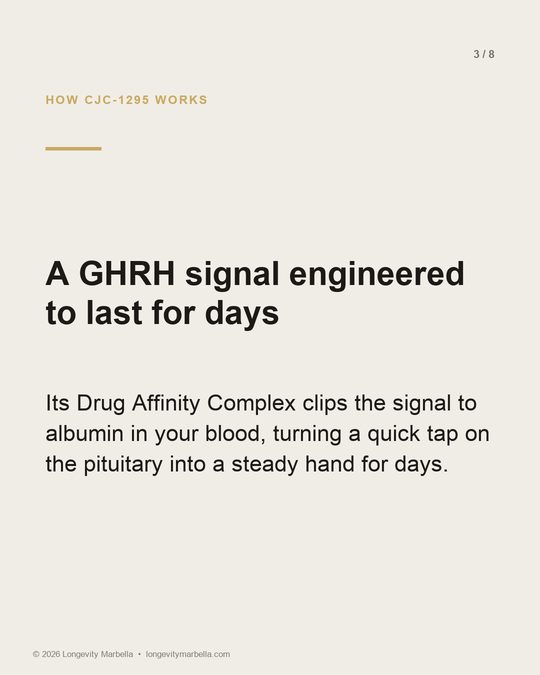
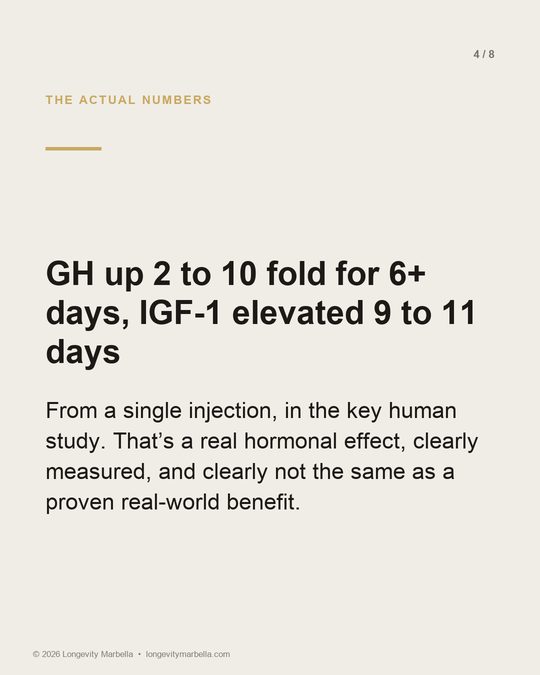
CJC-1295 is a GHRH signal engineered to last for days. Natural GHRH is chewed up within minutes, so on its own it is a quick tap on the shoulder. CJC-1295 adds a Drug Affinity Complex (DAC), a small chemical group that latches permanently onto albumin, the most abundant protein in your blood. Think of it as clipping the signal to a slow-moving carrier so it cannot be cleared quickly; instead of a tap, it becomes a steady hand on the pituitary's shoulder for days. In the key human study (Teichman 2006), a single injection under the skin raised growth hormone roughly 2 to 10 fold for more than 6 days (that is 2 to 10 times the starting level), and IGF-1, the downstream marker of growth-hormone activity made mostly in the liver, stayed elevated for 9 to 11 days. Important framing: those are hormone levels rising in the blood, not a proven real-world benefit. That long tail is why CJC-1295 is dosed infrequently.
One catch worth knowing: those numbers are for the DAC version, the one carrying that albumin clip. Much gray-market powder sold as "CJC-1295" is actually the shorter-acting no-DAC form (mod GRF 1-29), which does not last for days, so the figures above do not apply to it. If you cannot confirm which one you have, you cannot assume the long-acting profile.
Ipamorelin is a clean, pulsed trigger. It binds the growth-hormone-secretagogue receptor and tells the pituitary's somatotroph cells (the ones that make growth hormone) to fire off a pulse. Older drugs in this class were messy, spilling over into cortisol (the stress hormone) and prolactin. Ipamorelin is the tidier tool: it prompts a pulse with little of that spillover, roughly mirroring how the body releases growth hormone naturally, in bursts rather than a flat line.
Together they raise growth hormone more than either alone. The two mechanisms complement rather than repeat each other. CJC-1295 holds a steady background drive on the GHRH pathway; ipamorelin layers a clean pulse on top through the ghrelin-receptor pathway. Push both switches at once and growth hormone and IGF-1 rise more than with either alone. That two-lever synergy is the whole appeal of the stack.
Do they actually deliver the results people want?
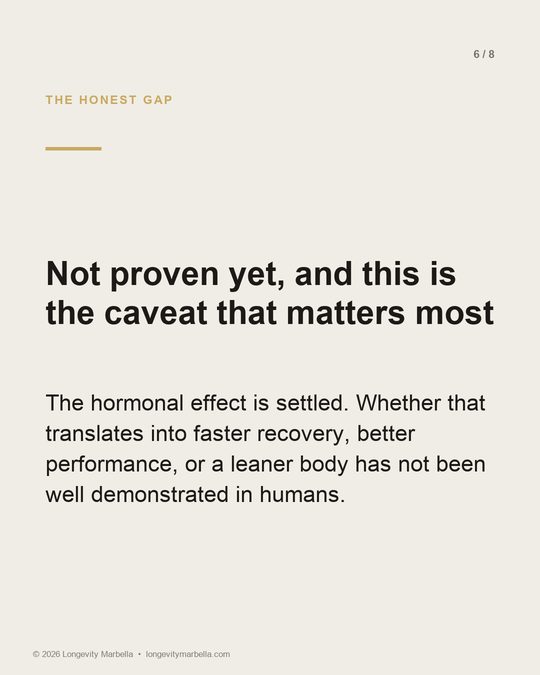
Not proven yet, and this is the caveat that matters most. The hormonal effect is settled: these peptides reliably raise growth hormone and IGF-1, and we know why. Whether that rise turns into faster recovery, better performance, or a leaner body has not been well demonstrated in humans.
A 2026 review in Sports Medicine looking at approved and unapproved peptide therapies notes that human data for these growth-hormone peptides remain thin, and that the specific benefits people are chasing are not yet established. For ipamorelin, some published safety information covers only about a week, far too short to judge use over months.
Put bluntly: the biology checks out and the signal is real, but going from "growth hormone and IGF-1 went up" to "this measurably helped me recover or perform" is a leap that still needs good long-term human trials. That is the main reason keeping an eye on your health matters for anyone who chooses to use these peptides.
What should health oversight watch?
Sustained growth-hormone stimulation has predictable physiology, and a clinician's job is to watch it, not wave it away. Two things are worth tracking:
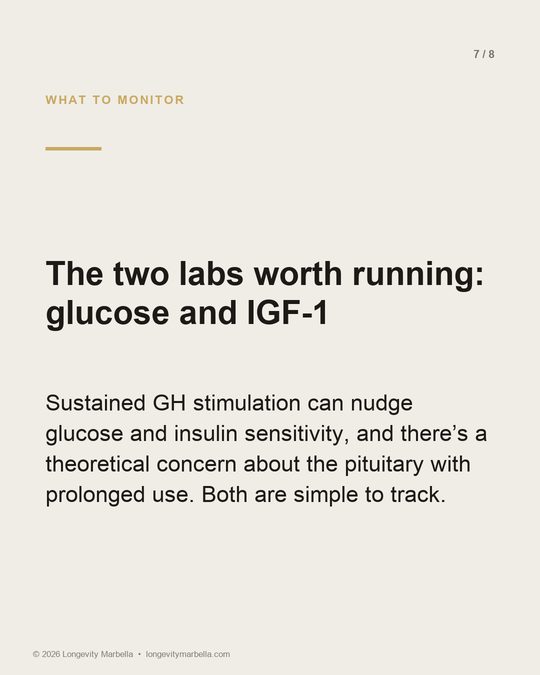
- Glucose and insulin sensitivity. Growth hormone shifts how the body handles blood sugar, so steady stimulation can nudge glucose metabolism and insulin sensitivity in the wrong direction. Periodic glucose and related testing catches that early, before it becomes a problem.
- The pituitary and IGF-1. There is a theoretical worry that long, strong stimulation could drive somatotroph hyperplasia or adenomas, meaning overgrowth of the growth-hormone-producing cells. The practical guardrail is keeping IGF-1 in a sensible range rather than redlining it, so the system is not pushed too hard for too long.
There is also a separate quality issue that has nothing to do with the molecules themselves. Because these peptides are unregulated, anything bought outside a licensed supply chain is not quality-controlled, which opens the door to contamination, impurity, or the wrong dose and identity in the vial. Knowing your source and staying under medical oversight is the simplest way to shrink that risk.
The two labs worth running are glucose and IGF-1; both are simple to track.
Already using these peptides, or seriously considering them? We can help you monitor glucose and IGF-1 and read what your labs are telling you, with no product to sell you.
Message us on WhatsAppAre they legal, and can athletes use them?
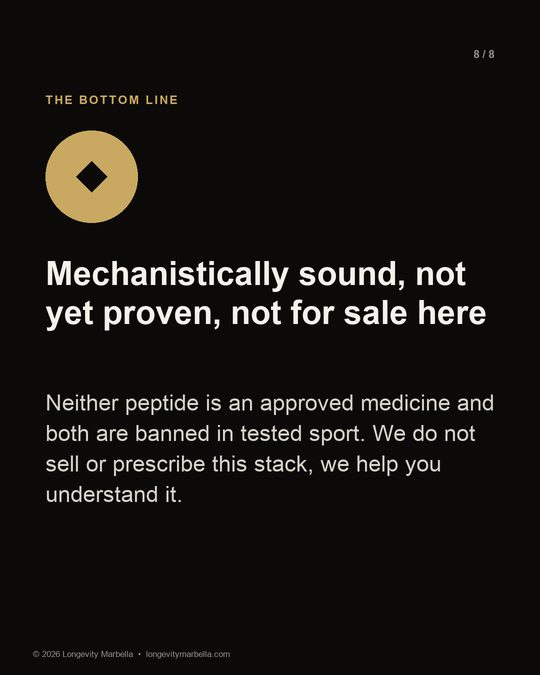
Neither is an approved medicine, and both are banned in tested sport. They have no marketing authorization from the US FDA, the European EMA, or Australia's TGA; they are used as unregulated compounds, not licensed prescription drugs. That status is also the reason the human outcome data is thin, and the two facts are usually reported as if only one of them existed. A compound with no legal route to market has no commercial sponsor, and without a sponsor nobody funds a large human trial, because there is no product at the end of it to recover the cost. The landscape is now moving: in July 2026 an FDA advisory committee recommended six of the seven peptides it reviewed for legal pharmacy compounding, with five more scheduled before the end of February. Neither CJC-1295 nor ipamorelin was among them, but the direction of travel for this whole class has changed. See the July 2026 FDA peptide vote, explained. Both are on the World Anti-Doping Agency Prohibited List, which matters only if you compete in a tested sport.
Our take
We have no interest in overselling these compounds or dismissing them. The pharmacology is genuine and well understood: CJC-1295 and ipamorelin reliably raise growth hormone and IGF-1 through two complementary mechanisms, and plenty of people use them. The honest gap is human outcome data. So the fair verdict is mechanistically sound, not yet proven for the specific results people are chasing. And it is worth being exact about what that means, because it is routinely misreported: no large trial has tested those results, which is not the same as a trial testing them and finding nothing. Nobody has funded the trial. That is a gap in the research record, not a finding against the compound.
That is exactly where a doctor adds value. This combination is popular, but we do not sell it or prescribe it. What we offer is practical, high-end information: an honest read of what the evidence supports, how to judge product quality, and what to watch for in your own health, such as glucose and IGF-1, so that anyone considering or already using it can do so as intelligently and safely as possible, alongside the recovery and performance fundamentals that always help, such as training, sleep, and nutrition. We are here to give you a straight, individualized view, neither hype nor a flat no. Because these compounds sit on the growth-hormone axis, they often come up in a wider men's health consultation. For the broader context, see our full peptides guide.
This article is educational and is not an offer to supply CJC-1295, ipamorelin, or any growth-hormone peptide.
A candid word on our role. We do not sell peptides, and we do not prescribe them. What we offer is rarer, and harder to buy: the knowledge to understand them properly. Many people have already decided to use a compound like this, and for them the honest question is not whether to use it, but whether to do it blindly or intelligently. That is where we are useful. We can tell you what the evidence genuinely supports and what it does not, how to judge quality and sourcing, and what to monitor in your own body. Not a product, and not a prescription. There is no shortage of confident advice online, much of it from people who will happily sell you the compound too. What a physician adds is different in kind: a real understanding of what a molecule is doing inside you, whether it belongs there at all, and the point at which it stops helping and starts to harm, plus the training to recognize and treat a complication if one arises. That is precisely the moment the confident voices tend to fall quiet and refer you to a doctor. We would rather be the doctor you begin with than the one you are sent to once something has already gone wrong.
- CJC-1295 is a long-acting GHRH analog; its albumin-binding Drug Affinity Complex extends its half-life to several days, sustaining a rise in growth hormone and IGF-1 (GH up roughly 2 to 10 fold for over 6 days, IGF-1 elevated 9 to 11 days).
- Ipamorelin is a selective ghrelin-receptor (GHSR1) agonist that triggers pulsatile GH release with little effect on cortisol or prolactin. Stacked together they raise GH and IGF-1 through two complementary mechanisms.
- The mechanism and hormonal effect are well established; the honest gap is human outcome data for recovery, performance, and body composition.
- Medical supervision monitors what sustained GH stimulation can affect, for example glucose, insulin sensitivity, and IGF-1, and uses a verified source to avoid unregulated-product quality risks.
- Neither is approved by the FDA, EMA, or TGA; the regulatory landscape is evolving. They are on the WADA Prohibited List, relevant only if you compete in a tested sport.