


Imagine a molecule that flips on the same metabolic switches as a hard workout, without the workout. That is the pitch behind MOTS-c, one of the most talked-about compounds in the whole peptide scene, sold for metabolism, weight loss, exercise capacity, and endurance.
You want three honest answers: how does it actually work, what does the science really show, and where does it stand legally? Here they are up front. The biology is genuinely interesting. The animal data are encouraging. The human evidence is still thin. And the legal status is shifting under everyone's feet right now.
So the real question is not whether MOTS-c is exciting. It is whether the excitement has run ahead of the evidence. Here is the version without the sales pitch.

- MOTS-c is a peptide written into your own mitochondrial DNA that acts like an "exercise mimetic," activating AMPK and fat burning.
- Animal data are strong; human evidence is mostly observational, so it is promising rather than proven. Not proven means not yet funded and run, not tested and failed.
- For most people the bigger risk is not the molecule but the unregulated, unverified product sold online.
What is MOTS-c, exactly?
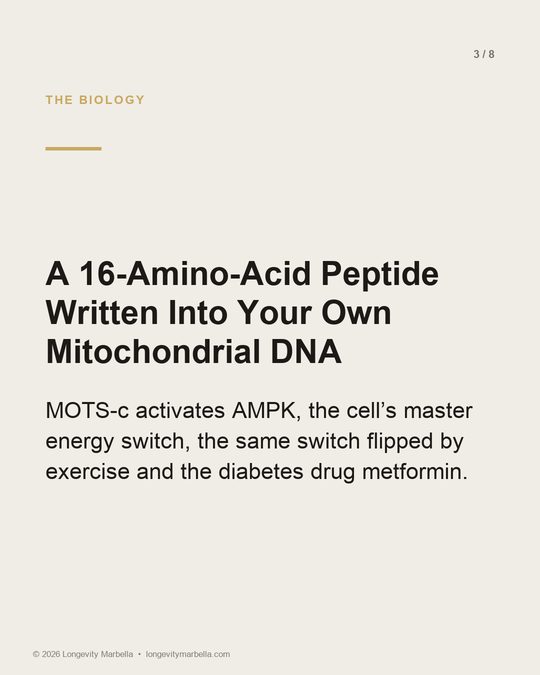
It is a tiny signaling peptide, just 16 amino acids long, written into the mitochondrial genome itself. MOTS-c (mitochondrial open reading frame of the 12S rRNA type-c) sits inside the 12S ribosomal RNA region. Mitochondria are the power plants of our cells, and for decades that is all we thought they were. Finding out they also broadcast signaling peptides like MOTS-c reframed them as something closer to a control room. The excitement comes down to one idea: MOTS-c appears to act as an "exercise mimetic," flipping on many of the same metabolic programs a hard workout does, without the workout.
How does MOTS-c work?
In lab and animal studies, it adjusts several of the settings that decide how the body's engine burns fuel. Think of each cell as a small engine: it can run fuel-hungry and sluggish, or tuned and efficient. MOTS-c appears to be a tuning signal.
- AMPK activation. MOTS-c switches on AMP-activated protein kinase (AMPK), the cell's master energy sensor. Think of it as the fuel gauge wired to the engine management system: when it reads low, the engine switches from storing fuel to burning it. Exercise flips this switch, the diabetes drug metformin flips this switch, and MOTS-c appears to flip the same one, which is the core reason it behaves like exercise in a molecule.
- Folate cycle and purine synthesis. MOTS-c is thought to slow down one of the cell's parts factories: the folate cycle and de novo purine synthesis, the assembly line that builds new DNA components. When that line slows, one of its unused parts, a molecule called AICAR, piles up on the factory floor, and that pile-up is precisely what trips the fuel-gauge switch above. The engine does not know a factory slowed down; it just sees the signal and starts burning.
- Fatty-acid oxidation and insulin sensitivity. Downstream of AMPK, the engine starts burning fat as fuel more readily (fatty-acid oxidation) and responds to insulin with less resistance (insulin sensitivity). In engine terms: better combustion, and a throttle that answers the pedal again. If an engine converted 95 percent of its fuel and you retuned it to 98, that is the kind of gain we mean: not a different engine, the same engine running the way it was designed to. Its main workshop is skeletal muscle, the body's largest metabolic tissue and its biggest engine block.
- Stress-responsive gene regulation. Under metabolic stress, MOTS-c leaves the mitochondria and travels into the cell nucleus, where it helps dial stress-response and antioxidant genes up or down. A peptide born in the power plant walking into the head office to rewrite instructions is a striking example of how mitochondria talk back to the rest of the cell.
Put together, these add up to a coherent, plausible playbook for a metabolic agent, which is a big part of why interest has caught fire so fast.
Bottom line: the mechanism is elegant, and that is exactly why it is easy to oversell.
What do the animal studies show?
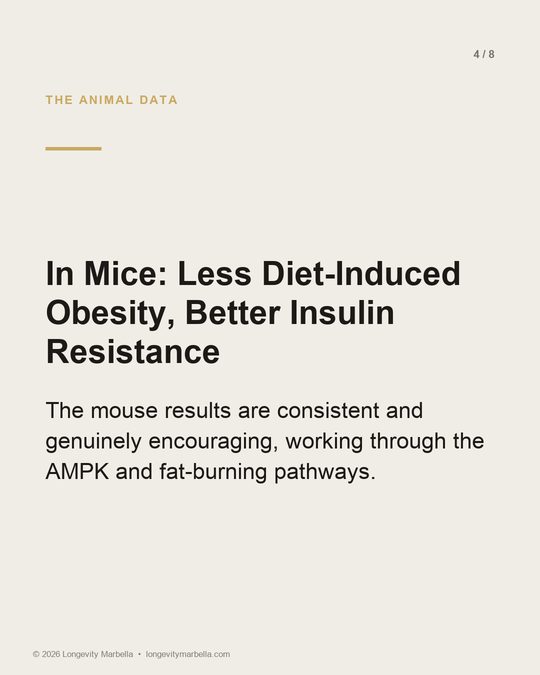
In mice, the results are consistent and genuinely encouraging. In preclinical models MOTS-c prevented diet-induced obesity and improved insulin resistance, including resistance driven by aging and by a high-fat diet, working through the AMPK and fat-burning pathways above.
So the signal is real. The catch, as so often, is that the cheering section is made of mice.
Does it work in people?
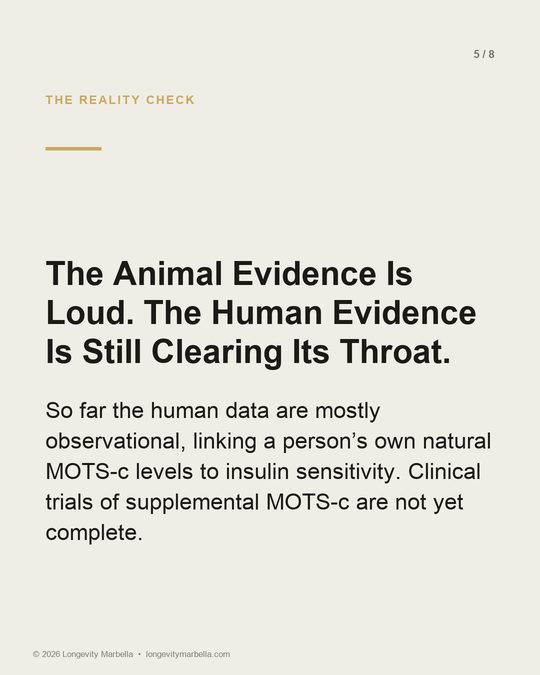
Honestly, we do not yet know, and this is the crux of the whole story. So far the human data are mostly observational studies that line up a person's own naturally occurring (endogenous) MOTS-c levels against their insulin sensitivity. That is an encouraging clue, but it is a snapshot, not a trial: it tells you the two travel together, not that dialing MOTS-c up on purpose moves the needle.
Formal clinical trials of supplemental MOTS-c as a treatment are not yet complete, so there is still no convincing human evidence that it improves recovery, athletic performance, endurance, or metabolic disease. In plain terms: the animal evidence is loud, but the human evidence is still clearing its throat. That gap is the whole reason supervision and monitoring matter for anyone who chooses to use it.
Is MOTS-c safe?
Animal data are reassuring, but human safety is essentially unmapped, so two separate risks deserve attention.
- The molecule itself. Because MOTS-c leans on the folate cycle and purine (nucleotide) biosynthesis, there is a theoretical question about whether long-term use could nudge nucleotide production off course. The consequences of holding the AMPK switch on for years in otherwise healthy people are simply not well studied. These are reasons to keep watch, not alarms to sound.
- The product (the bigger risk for most people). Because MOTS-c is unregulated, the vials people buy online are not quality-controlled. Grey-market, non-pharmaceutical-grade material is a coin flip: it can carry endotoxin, heavy-metal or other contamination, impurities, and a label that does not match what is in the bottle. That is a real concern with anything made and sold outside a licensed pharmaceutical supply chain.
If you are already using or seriously considering MOTS-c, a doctor can help you read your own labs, judge product quality, and know what to monitor. We do not sell or prescribe it, only oversee your health around it.
Message us on WhatsAppIs MOTS-c legal or FDA-approved?
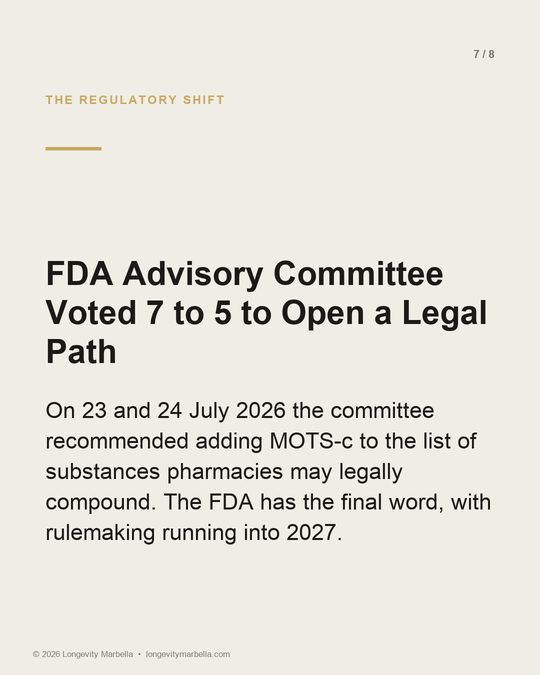
Not approved yet, and moving in the right direction. At its meeting on 23 and 24 July 2026 the FDA's Pharmacy Compounding Advisory Committee voted 7 to 5, with two abstentions, to recommend adding MOTS-c to the 503A list of substances pharmacies may legally compound, under docket FDA-2025-N-6895. The uses put before the committee were ambitious, and they tell you how seriously this molecule is now being taken: insulin resistance, obesity, osteoporosis, vascular calcification, metabolic regulation and longevity.
MOTS-c was one of six peptides out of seven the committee backed over two days, part of a broader unwinding of the 2023 restrictions. The FDA makes the final call and rulemaking continues into 2027, but the agency generally follows its committees, and five more peptides are already scheduled for review before the end of February.
Where does that leave the science? With better prospects than it had. FDA reviewers said they wanted more evidence before backing any of the proposed indications, and that evidence should exist. The reason it does not is structural: no legal route means no sponsor, and no sponsor means no funded human trial. The committee recommended access on the strength of the safety argument: pharmacy-grade material of verified identity beats unregulated vials bought online, which is the specific harm the FDA told the committee it actually encounters with peptides. For a molecule whose case rests on genuinely interesting mechanism and good animal data, a legal route is what turns that into fundable human research.
And it moved for a reason worth stating plainly. MOTS-c has been bought and injected for years by people chasing metabolic results outside any medical channel, and the committee treated that as the situation to make rules for. Those are the people with the most to gain from real trials, which is exactly what a legal pathway makes fundable.
For completeness, MOTS-c is on the World Anti-Doping Agency Prohibited List, which matters only if you compete in tested sport.
Our take
Promising, not proven, and the product is the part to worry about most. The mechanism is one of the most elegant in this whole class, the animal data are encouraging, the buzz is loud, and regulators have now voted to open a legal route to it. But the human outcome trials are still catching up. And for most people the biggest practical risk is not the peptide at all: it is the unregulated, unverified product sold online. This is exactly the kind of question we work through with people at our longevity clinic in Marbella.
That is exactly where a doctor earns their keep. To be clear about our role: we do not sell it or prescribe it. What we offer is practical, high-end information: an honest read of what the evidence supports, how to judge product quality, and what to watch for in your own health, so that anyone considering or already using it can do so as intelligently and safely as possible, alongside the metabolic fundamentals that always help, such as exercise, nutrition, protein, and sleep. We are here to give you a straight, individualized view, neither hype nor a flat no. This article is educational and not an offer to prescribe or supply MOTS-c.
For the wider context on this class of compounds, see our full peptides guide.
A candid word on our role. We do not sell peptides, and we do not prescribe them. What we offer is rarer, and harder to buy: the knowledge to understand them properly. Many people have already decided to use a compound like this on their own terms, and for them the honest question is not whether to use it, but whether to do it blindly or intelligently. That is where we are useful. We can educate you on what the evidence genuinely supports and what it does not, on how to judge quality and sourcing, on the difference between a considered approach and a reckless one, and on what to monitor in your own body. Not a product, and not a prescription. There is no shortage of confident advice online, and much of it comes from people who will happily sell you the compound as well. What a physician adds is different in kind: a genuine understanding of the physiology, of what a molecule is actually doing inside you, whether it belongs there at all, and the point at which it stops helping and starts to harm, together with the training to recognize, diagnose and treat a complication if one arises. That is the part that matters most, because it is precisely the moment the confident voices tend to fall quiet and refer you to a doctor. We would simply rather be the doctor you begin with than the one you are sent to once something has already gone wrong.
- MOTS-c is a 16-amino-acid peptide encoded inside the mitochondrial 12S rRNA that activates AMPK (the cell's master energy switch), is thought to slow the folate cycle and purine synthesis (how cells build new DNA building blocks), and promotes fatty-acid oxidation (fat burning) and insulin sensitivity, acting as an exercise mimetic on skeletal muscle.
- In mice it prevented diet-induced obesity and improved insulin resistance, encouraging and consistent preclinical data.
- Human research is still early: the data so far are mainly observational correlations, with clinical treatment trials not yet complete, so it is promising rather than fully proven.
- Animal data look encouraging; for most people the bigger real-world risk is contamination or mislabeling in unregulated products.
- Regulation is opening up: in July 2026 an FDA advisory committee voted 7 to 5 to recommend legal pharmacy compounding of MOTS-c. If you are considering it, medical supervision and quality control are still the smartest way to reduce risk.