

You have probably seen GHK-Cu on a serum bottle and in a longevity forum in the same week, promising firmer skin in one place and joint repair in the other. So which claims actually hold up?

- GHK-Cu is a naturally occurring copper-binding tripeptide (glycyl-L-histidyl-L-lysine) that declines with age.
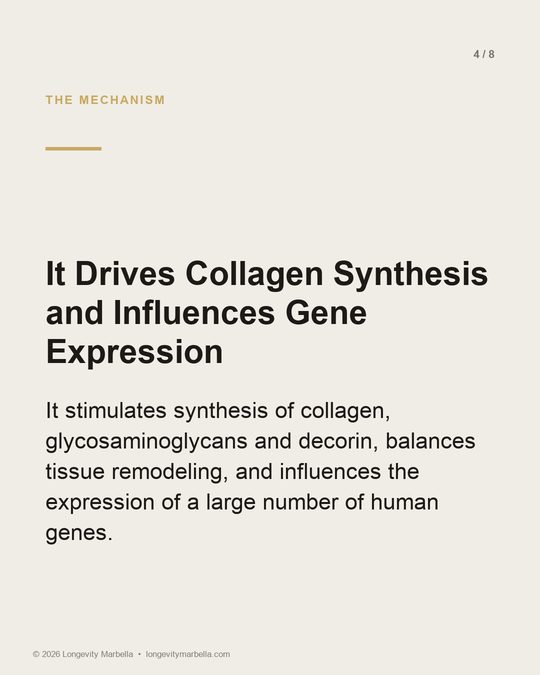
- Its mechanism is well described: it delivers copper into cells, drives synthesis of collagen, glycosaminoglycans and decorin, balances tissue remodeling, has antioxidant and anti-inflammatory activity, promotes angiogenesis, and influences a large number of human genes.
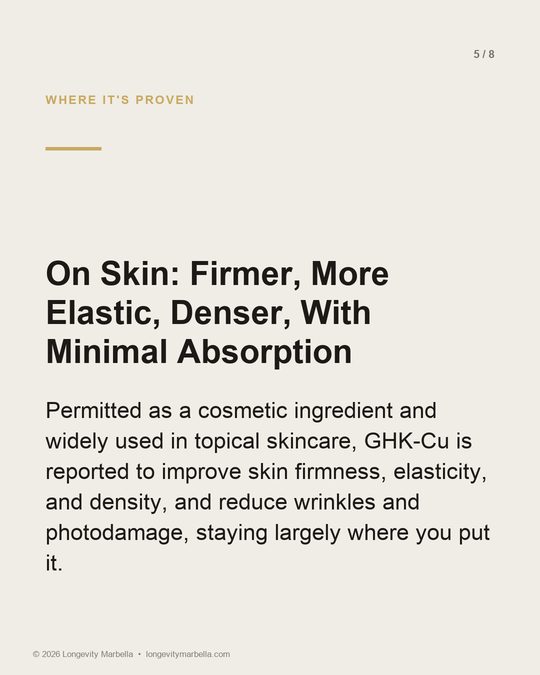
- Topical use is permitted and well supported, reported to improve skin firmness, elasticity, and density while reducing wrinkles and photodamage, with minimal systemic absorption.
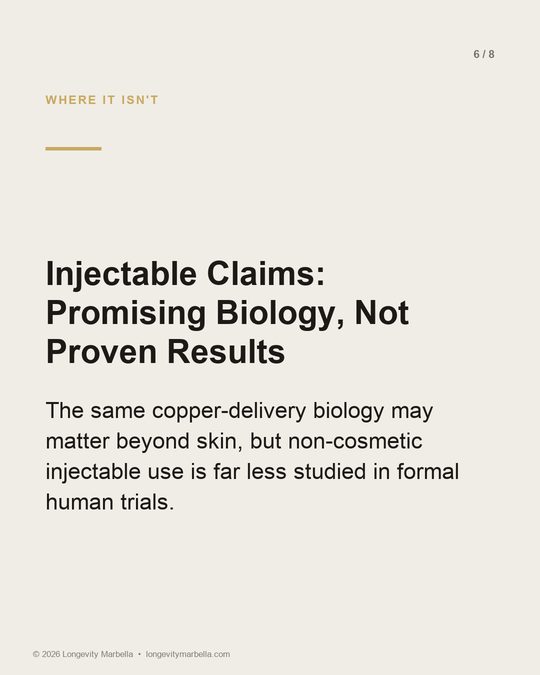
- Broader injectable uses rest on the same real biology but earlier clinical evidence; the main practical issue is product quality and the copper an injectable delivers.
- Unlike most peptides discussed here, GHK-Cu is not on the WADA Prohibited List. If you use it beyond a topical cream, medical supervision and quality control are the smartest way to reduce risk.
Here is the honest split. On the skin, the copper peptide has a real, well-mapped mechanism and reasonable evidence behind it. As an injectable for healing and longevity, the biology is plausible but the human data is thin, and the biggest question is not the molecule at all. It is the quality of what you would be putting in your body.
This is the balanced version, cream versus needle, and where each one really stands.
What is GHK-Cu?
GHK-Cu is the glycyl-L-histidyl-L-lysine copper complex, a small copper-binding tripeptide that occurs naturally in your body. Levels are high in youth and decline with age, which is much of why it draws interest in skin and tissue maintenance. It was first isolated from human plasma, and decades of research have since mapped out a broad, coherent mechanism of action.
In short: a natural copper carrier that your body makes less of as you get older.
How does GHK-Cu work?
Everything traces back to one property: it binds and carries copper. From that, a wide set of repair effects follows. A comprehensive 2015 review in BioMed Research International by Pickart and colleagues describes GHK as a natural modulator of multiple cellular pathways in skin regeneration. Its main actions are:
- Copper delivery into cells. GHK-Cu binds copper and helps shuttle it into cells, where copper acts as an essential cofactor: the enzymes that build and remodel tissue are the factory machines, and copper is the part they need fitted before they run. This controlled delivery is the engine behind everything else.
- Building the skin matrix. It stimulates both the synthesis and the breakdown of collagen, glycosaminoglycans, and the proteoglycan decorin, the structural and regulatory components that give skin its firmness, elasticity, and resilience: a production line refit, worn stock out, new stock in.
- Balancing tissue remodeling. It modulates the matrix metalloproteinases, the strip-out crew that clears old matrix, and their tissue inhibitors, the supervisors holding that crew in check, helping tip the balance toward orderly repair rather than breakdown.
- Antioxidant and anti-inflammatory activity. It helps quench reactive oxygen species and dampen inflammatory signaling, both of which support a healthier repair environment.
- Angiogenesis and repair-cell recruitment. It promotes the growth of new blood vessels and helps recruit the cells that carry out tissue repair, improving the supply and workforce that healing tissue needs.
- Broad gene-expression effects. Perhaps most strikingly, GHK has been shown to influence the expression of a very large number of human genes, many of them tied to tissue remodeling, repair, and antioxidant defense, which is why its effects are so wide-ranging.
In short: bind copper, deliver it into cells, and a coherent chain of repair effects follows. That breadth is why GHK-Cu has stayed popular for so long.
Does GHK-Cu work on the skin?
Yes, and this is the most established part of the story. GHK-Cu is permitted as a cosmetic ingredient and widely used in topical skincare, and in that role it appears safe. Applied to the skin it has minimal systemic absorption, so the copper largely stays where you put it. Through the mechanisms above, cosmetic GHK-Cu is reported to improve skin firmness, elasticity, and density, and to reduce wrinkles and photodamage.
On the skin, used as intended, it is a reasonable and well-supported choice.
What about injectable GHK-Cu for hair, healing, and longevity?
Here the honesty has to sharpen. Some people use GHK-Cu as an injectable for tissue repair, recovery, hair, and general longevity. The rationale is real: the same copper-delivery and matrix-building biology that works in skin may matter in other tissues. But this broader use is far less studied in formal human trials than the topical cosmetic use.
Treat the injectable claims as promising biology, not proven results. The mechanism is genuine; the clinical evidence for non-cosmetic uses is still catching up.
Already considering GHK-Cu beyond a cream and want a doctor to help you judge product quality and what to monitor in your own health? We are glad to talk it through.
Message us on WhatsAppIs GHK-Cu safe?
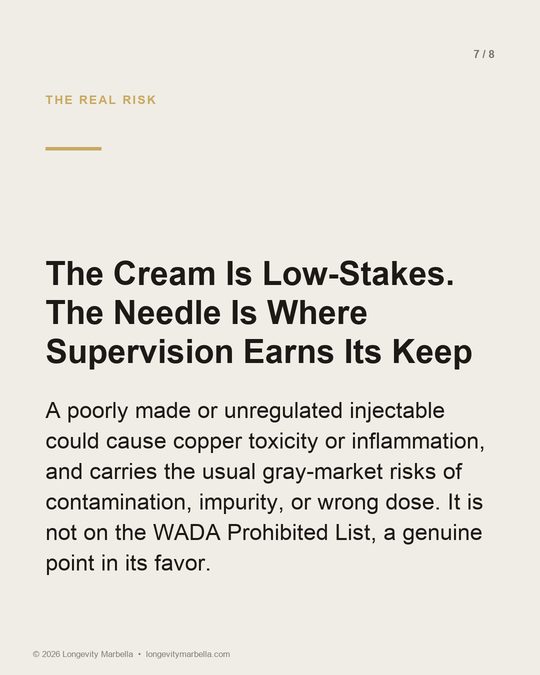
It depends entirely on how you use it. As a topical cosmetic, it is permitted and appears safe, with minimal systemic absorption. An injectable is a different proposition, because it delivers copper directly into your body rather than onto the skin surface. A poorly made or unregulated injectable could cause copper toxicity or inflammation, since copper is essential in small amounts and harmful in excess, and it carries the usual gray-market risks of contamination, impurity, or wrong dose.
None of that is a reason to dismiss the molecule. It is simply why, if you use GHK-Cu beyond a topical cream, medical oversight and quality awareness matter. Understanding product identity and purity, and knowing what to watch for in your own health, is what turns those theoretical risks into manageable ones.
The cream is low-stakes. The needle is where supervision earns its keep.
Is GHK-Cu banned in sport?
No. Unlike most peptides discussed in this area, GHK-Cu is not on the World Anti-Doping Agency list, a genuine point in its favor if you compete in a tested sport.
Our take
GHK-Cu is genuinely interesting: a naturally occurring copper peptide with a real, well-mapped mechanism, used by very large numbers of people, and permitted and well supported for topical cosmetic use. The broader, non-cosmetic uses rest on sound biology but earlier clinical evidence, so call those promising rather than established. Established by whom, though, is the fair question: the injectable has no legal route to market, so no company has a reason to fund the trial that would settle it. Missing evidence here reflects who was willing to pay for research, not a study that looked and found nothing. For most people the biggest practical question is not the molecule but the quality of an unregulated injectable and the copper it delivers. This is the kind of judgment we help people make at our longevity clinic in Marbella.
That is exactly where a doctor adds value. We do not sell GHK-Cu or prescribe it. What we offer is practical, high-end information: an honest read of what the evidence supports, how to judge product quality, and what to watch for in your own health, so that anyone considering or already using it can do so as intelligently and safely as possible, alongside the skin and recovery fundamentals that always help. This article is educational and is not an offer to supply any compound, and decisions are best made individually. We are here to give you a straight, balanced view.
If you want the wider context on this whole category, see our full peptides guide.
A candid word on our role. We do not sell peptides, and we do not prescribe them. What we offer is rarer, and harder to buy: the knowledge to understand them properly. Many people have already decided to use a compound like this on their own terms, and for them the honest question is not whether to use it, but whether to do it blindly or intelligently. That is where we are useful. We can educate you on what the evidence genuinely supports and what it does not, on how to judge quality and sourcing, on the difference between a considered approach and a reckless one, and on what to monitor in your own body. Not a product, and not a prescription. There is no shortage of confident advice online, and much of it comes from people who will happily sell you the compound as well. What a physician adds is different in kind: a genuine understanding of the physiology, of what a molecule is actually doing inside you, whether it belongs there at all, and the point at which it stops helping and starts to harm, together with the training to recognize, diagnose and treat a complication if one arises. That is the part that matters most, because it is precisely the moment the confident voices tend to fall quiet and refer you to a doctor. We would simply rather be the doctor you begin with than the one you are sent to once something has already gone wrong.