
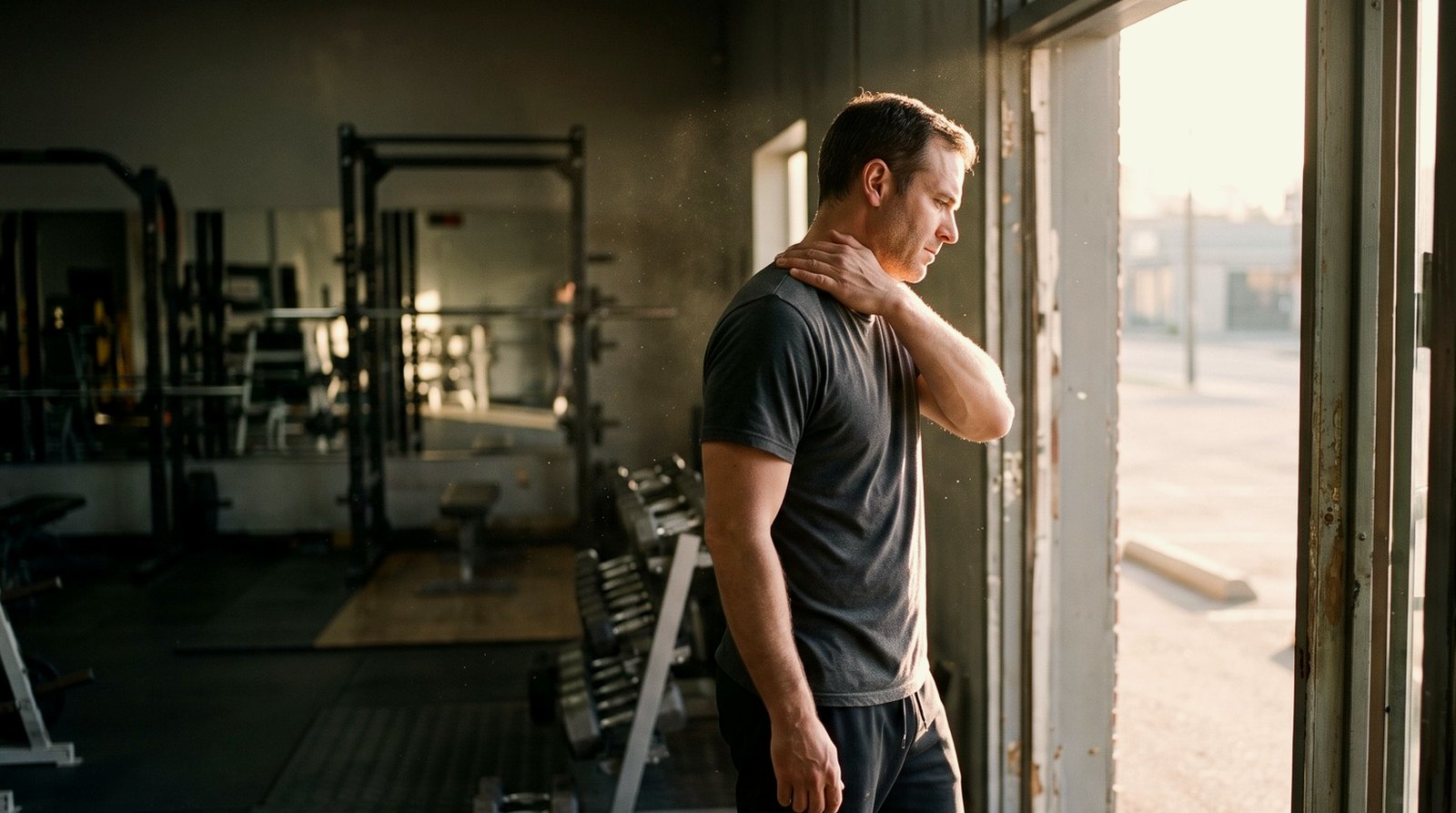

If you are nursing a strained tendon or muscle and reading about TB-500, you have probably seen it sold as a near-miracle for soft-tissue recovery, often paired with BPC-157. Here is the honest version, without the hype.
- TB-500 is a synthetic fragment of thymosin beta-4, a natural protein that drives cell migration, angiogenesis, and wound repair.
- The mechanism and animal data are encouraging; human outcome research for recovery is still early.
- A specific point: thymosin beta-4 is linked to several cancers. Causation from injection is unproven, but it is a real reason for medical oversight, especially long-term.
- Regulation is opening up: in July 2026 an FDA advisory committee voted 8 to 6 to recommend legal pharmacy compounding of TB-500.
- If you are using it or considering it, medical supervision and quality control are the smartest way to reduce risk.
TB-500 is built on a real piece of healing biology, and the mechanism is genuinely encouraging. But it is not the proven recovery drug the marketing suggests. The animal data look good; the human outcome data are still thin. And there is one safety point, specific to this peptide, that most sellers will not mention.
That last point is the one worth reading to the end for, so let's take it in order: what TB-500 actually is, what the evidence does and does not show, and the catch that makes medical oversight worth having.
What is TB-500, and how does it work?
TB-500 is a short synthetic fragment of a natural wound-healing protein.
Thymosin beta-4 (Tβ4) is a natural protein built from 43 amino acids (the building blocks of proteins) and one of the body's main regulators of actin, the internal scaffolding that lets cells move. After an injury, platelets and immune cells release Tβ4 to help launch repair. TB-500 is a short synthetic fragment, about 7 amino acids long, built around the central actin-binding region of that protein, the part most linked to cell migration and wound healing.
That mechanism gives it a plausible, attractive profile for tissue repair:
- Cell migration. By regulating actin, it helps the cells that do the healing, such as endothelial cells, keratinocytes, and fibroblasts, move into the injured area.
- New blood vessels (angiogenesis). It promotes formation of the new blood supply that repairing tissue depends on.
- Less inflammation and scarring. In wound models it reduced inflammation and improved the organization of new collagen, meaning better-quality repair.
One distinction the marketing tends to skip: most of the actual research is on the full natural protein, thymosin beta-4, not the fragment. A 2026 review in Sports Medicine notes that "very little is known about TB-500" itself, the short fragment people actually buy.
The biology is real. The catch is that the fragment you can buy is the least-studied version of it.
What does the animal and lab evidence show?
This is the encouraging part, and it is fair to give it credit. In preclinical models, thymosin beta-4 has shown broad regenerative effects:
- It accelerated healing of full-thickness skin wounds in mice, including diabetic, steroid-treated, and aged animals, with less scarring and better collagen organization.
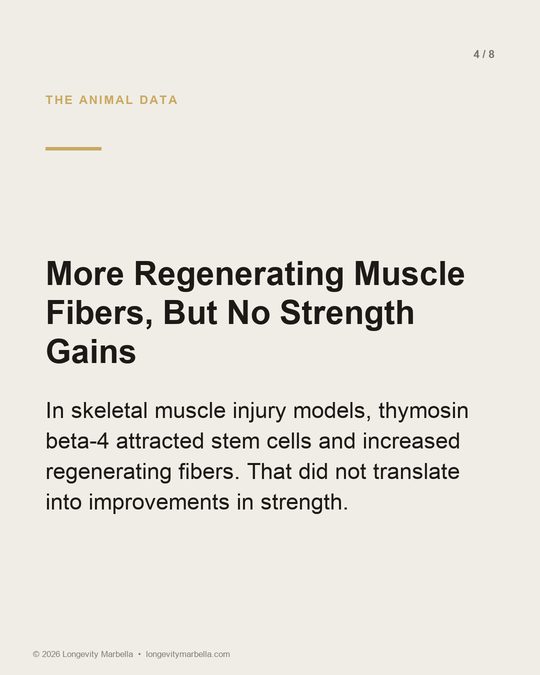
- In skeletal muscle injury models, it attracted muscle stem cells to the injury and increased the number of regenerating fibers. Notably, this did not translate into improvements in strength.
There are also a few human studies, but for unrelated conditions: thymosin beta-4 eye drops looked safe and helpful in a rare corneal disease, and a trial in heart attack patients found it safe with mixed results. None of this tested it as an injury-recovery or performance aid.
Bottom line: strong signal in animals, but nothing yet that tests it for the injury you actually have.
What about the human evidence for recovery?
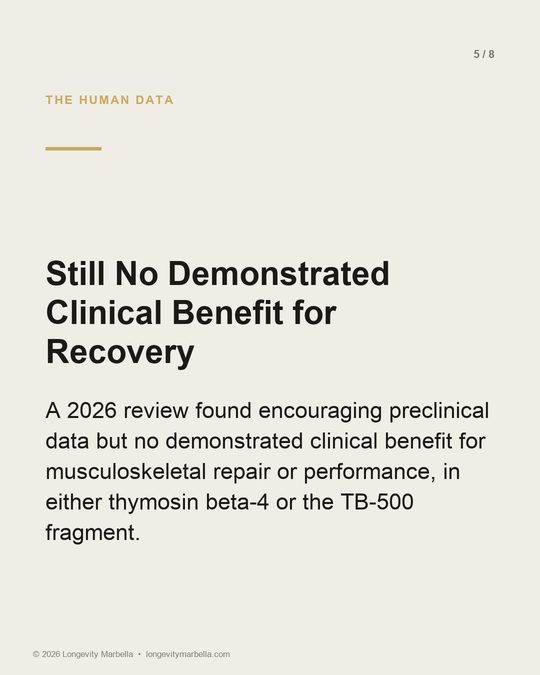
For the use you most likely want it for, the human research is still early. That same 2026 Sports Medicine review found encouraging preclinical data but, so far, no demonstrated clinical benefit of thymosin beta-4 or TB-500 for musculoskeletal repair or athletic performance, and the fragment itself has had little direct study. The distinction that keeps getting lost: those trials have not been run, rather than run and failed. There has never been a legal route to sell this as a medicine, so there has never been a sponsor to pay for one.
The mechanism and animal signal are promising. The formal human outcome data have not caught up.
Weighing TB-500 for your own injury and want a straight, unbiased read on whether it makes sense and what to watch for? Our specialist is happy to talk it through.
Message us on WhatsAppIs TB-500 safe? The one point that matters
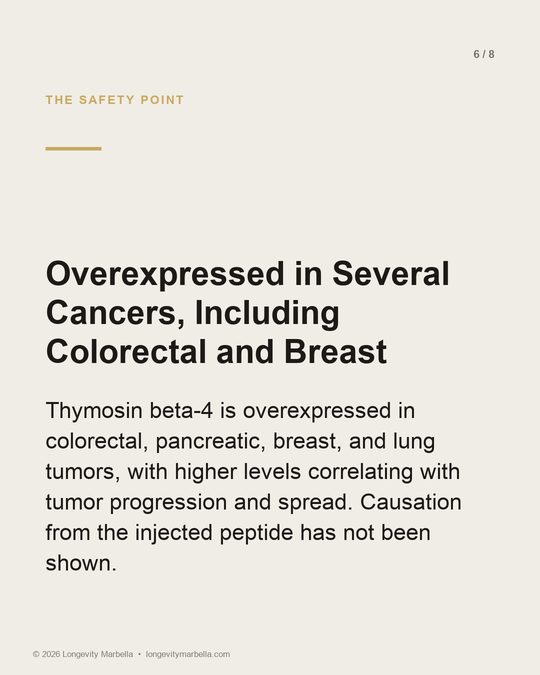
This is the part that deserves genuine attention, and it is the main reason TB-500 is best used with medical oversight rather than casually. Thymosin beta-4 is overexpressed in several cancers, meaning tumors carry far more of it than healthy tissue, including colorectal, pancreatic, breast, and lung tumors, and higher levels correlate with tumor progression, spread, and worse outcomes. Repairing a building needs a crew that can move in and new supply lines to feed it, and this protein promotes both: cell migration and new blood vessels. A tumor grows by hiring the same crew and the same lines.
To be precise and fair: a causal role for injected thymosin beta-4 in causing cancer in humans has not been established. But the reviewers were clear that the theoretical risk of promoting a hidden tumor or accelerating an existing one warrants real caution, especially with long-term use. For an unproven recovery aid, that is a serious thing to weigh.
On top of that, like other gray-market peptides, TB-500 is sold without quality control, so contamination, impurity, and incorrect dosing are separate risks on their own.
The cancer-association signal is the reason to involve a doctor, not a supplement store.
Is TB-500 legal? The picture is changing
It is changing, and July 2026 was the turn.
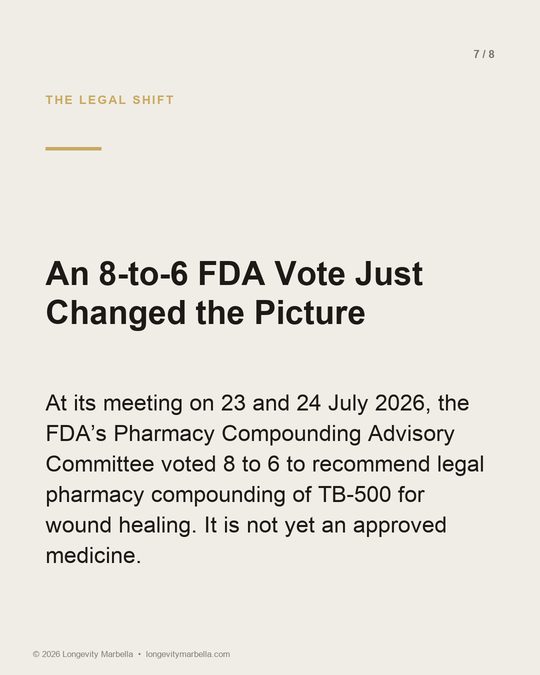
At its meeting on 23 and 24 July 2026 the FDA's Pharmacy Compounding Advisory Committee voted 8 to 6 to recommend adding TB-500 to the 503A list of substances pharmacies may legally compound, for wound healing, under docket FDA-2025-N-6895. It was one of six peptides out of seven the committee backed over the two-day meeting, and the BBC described the outcome as clearing a major regulatory hurdle toward prescription availability.
What moved the committee was not fresh trial data, and it is worth being straight about that. It was the argument that people are already using TB-500 bought from sellers who answer to nobody, and that a pharmacy is a far safer place to get it. The FDA made a version of the same point in its own briefing, accepting that compounded peptides "can serve an important role for patients whose medical needs cannot be met by an FDA-approved drug product," and that the adverse events it has seen come from the quality of the compounded product rather than from compounding itself.
FDA reviewers told the committee they could not identify a completed human clinical study of TB-500 for wound healing. That gap is real and it needs closing. It is worth being precise about why it is open: there has never been a legal route to supply this compound as a medicine, so there has never been a sponsor with a reason to fund a trial. Meanwhile the safety concerns on the record are mechanistic rather than demonstrated in people. A regulated route is what turns an absence of data into data, which is what everyone in this argument claims to want.
It is also worth noticing why this moved. TB-500 has been used for years by people whose injuries were not healing, bought from websites because there was nowhere else to buy it, and the committee treated that as the real world it had to make rules for. Those are exactly the people who deserve to know whether it works, and a legal route is the only way that question ever gets answered.
The FDA takes the final decision and rulemaking runs into 2027, though the agency generally follows its advisory committees. If you compete in tested sport, TB-500 stays on the World Anti-Doping Agency list.
Why it can feel like it works even without proof
People often report feeling better on peptides like this, and that feeling is real, but it is not proof the molecule caused it. Recovery has a strong natural timeline, and the placebo and contextual effects of an injected treatment, amplified by enthusiastic social media, can be powerful. Honest medicine has to separate "I felt better" from "this drug caused it," and for TB-500 the controlled human evidence to make that link does not yet exist.
Our honest take
We find the biology genuinely interesting: the mechanism is real, the compound is widely used, and regulators are now reviewing it rather than dismissing it. Two things keep us measured rather than enthusiastic. The human outcome data are still early, and the cancer-association signal means this is a peptide that genuinely benefits from medical judgment. For most people the practical risks are the unregulated product itself and using it with no screening or monitoring.
That is exactly where a doctor helps. We do not sell it or prescribe it. What we offer is practical, high-end information: an honest look at what the evidence shows, how to judge product quality, and what to watch for in your own health, including anything that would make the cancer concern more relevant, so anyone considering or already using it can weigh it intelligently. A straight, individualized view, neither hype nor a flat no. You can see how we work in our longevity clinic in Marbella.
If you are also looking into BPC-157, we have written a companion honest review: BPC-157 for injury recovery, what the evidence actually shows.
A candid word on our role. We do not sell peptides, and we do not prescribe them. What we offer is rarer, and harder to buy: the knowledge to understand them properly. Many people have already decided to use a compound like this on their own terms, and for them the honest question is not whether to use it, but whether to do it blindly or intelligently. That is where we are useful. We can educate you on what the evidence genuinely supports and what it does not, on how to judge quality and sourcing, on the difference between a considered approach and a reckless one, and on what to monitor in your own body. Not a product, and not a prescription. There is no shortage of confident advice online, and much of it comes from people who will happily sell you the compound as well. What a physician adds is different in kind: a genuine understanding of the physiology, of what a molecule is actually doing inside you, whether it belongs there at all, and the point at which it stops helping and starts to harm, together with the training to recognize, diagnose and treat a complication if one arises. That is the part that matters most, because it is precisely the moment the confident voices tend to fall quiet and refer you to a doctor. We would simply rather be the doctor you begin with than the one you are sent to once something has already gone wrong.