


Women describe it in almost identical words. Nothing changed. Same food, same walking, same wardrobe, and yet the waistband is different and the arms are softer, and the scale is only a kilo or two different, which somehow makes it more infuriating rather than less.
Not sure where you are in this? One-minute check.
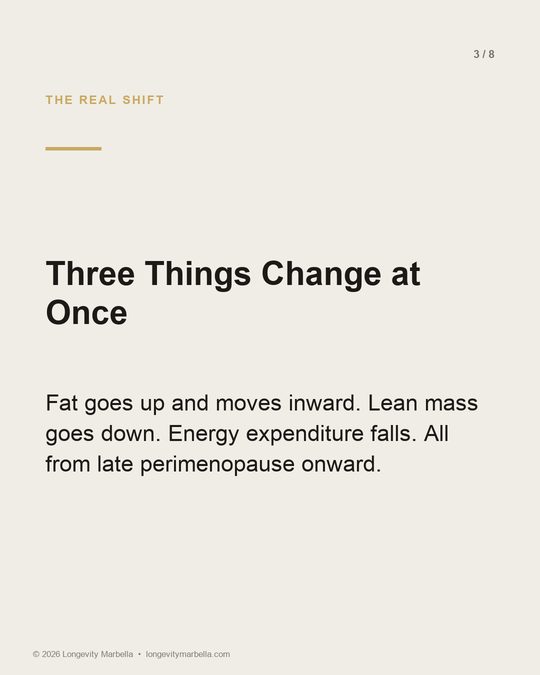
- Fat goes up and it moves inward, lean mass goes down, and energy expenditure falls.
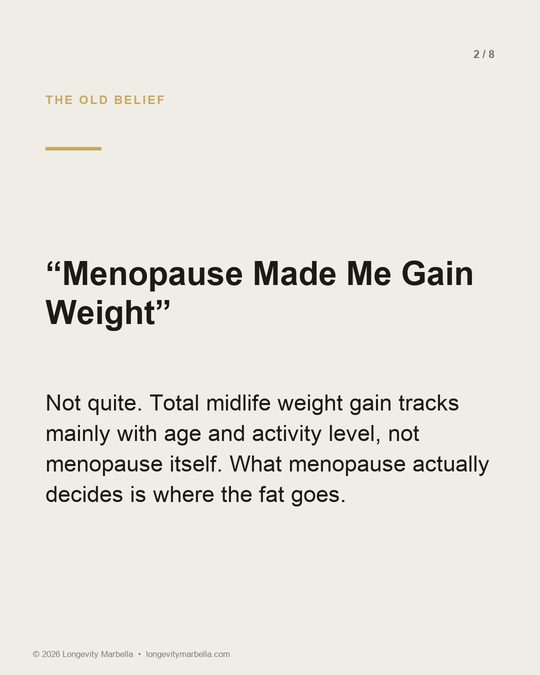
- Total midlife weight gain tracks mainly with age and activity level. The redistribution toward visceral fat is specifically menopausal.
- These changes and the insulin resistance that follows raise the risk of type 2 diabetes.
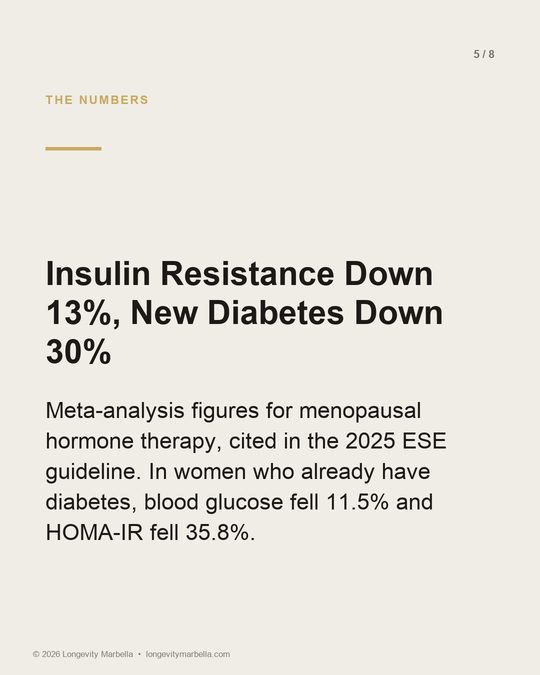
- Meta-analysis figures cited in the 2025 ESE guideline: on hormone therapy, insulin resistance down 13 percent and new diabetes down 30 percent.
- On fat, hormone therapy helps. On muscle, it does not. Only you can build the muscle.
They are not imagining it, and they are not describing weight gain. They are describing a change in composition, and composition is the thing that matters to health.
Two women at 68 kilos can be metabolically decades apart.
What Actually Changes, and When
The 2025 clinical practice guideline of the European Society of Endocrinology is specific about the timing and the direction:
Body composition changes become apparent from the stage of late perimenopause; fat mass (total and visceral) increases, lean mass decreases and energy expenditure decreases during the menopausal transition.
Read that as three separate events happening at once, because that is what makes it hard to out-exercise.
- Fat goes up, and it moves. Not only more of it, but redistributed toward the abdomen, into and around the organs.
- Lean mass goes down. Muscle, which is your largest consumer of glucose and your reserve for illness.
- Energy expenditure falls. Partly because muscle is what burns, so losing it lowers the baseline.
The guideline goes on to the consequence women are rarely told: these changes, and the rise in insulin resistance that follows them, increase the risk of type 2 diabetes. Insulin resistance means more insulin is needed for the same effect: more throttle, same speed.
The problem was never the number on the scale. It was what the number stopped being able to see.
Visceral Fat Is a Different Substance
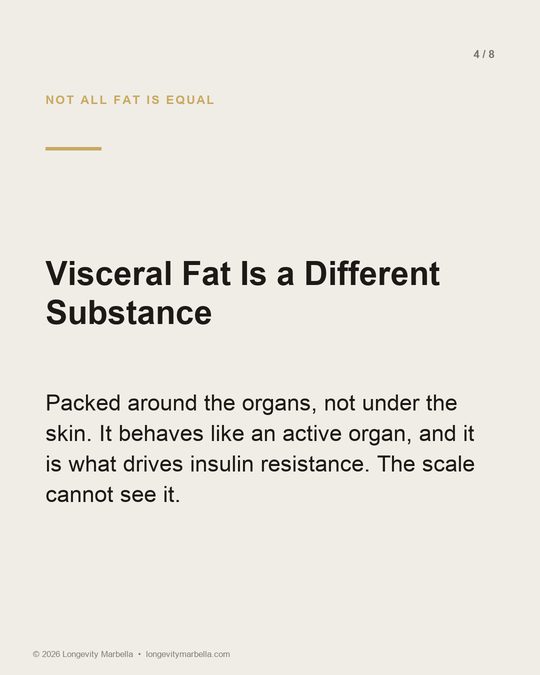
Subcutaneous fat is what you can pinch. Visceral fat is packed around and between the abdominal organs, and it behaves less like storage and more like an active organ, releasing free fatty acids and inflammatory signals into the portal circulation, the vein feeding the liver: not fuel resting in the tank but dripping into the fuel line, so the liver receives it first.
This is why waist circumference tells you more than weight, and why two women of the same weight and height can have entirely different metabolic futures. A tape measure around the waist is cruder than a scan and far more informative than a scale.
Baseline body fat and ethnicity both change how large these shifts are, so the same transition does not do the same thing to every woman.
The Honest Version of "Menopause Made Me Gain Weight"
Here is where careful reading matters, because the popular version overstates one half and understates the other.
Total weight gain across midlife tracks mainly with age and activity level, not with menopausal status as such. Women gain weight in their forties and fifties whether or not their periods have stopped, and in the SWAN cohort physical activity was the factor that related to changes in weight and waist circumference in midlife women.
The redistribution, however, is specifically menopausal. That is the ESE finding above, and it is the part worth acting on.
So the accurate sentence is not "menopause made me gain weight". It is: midlife made me gain a little weight, and menopause decided where it went and what it did to my insulin.
What Hormone Therapy Does, and Where It Stops
This is a case where the honest answer is genuinely good news in one direction and a flat no in the other, and both halves have to be said.
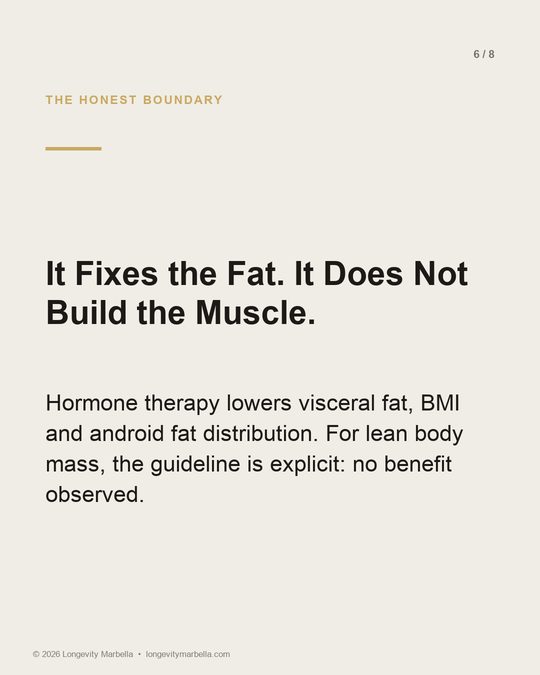
On fat, it helps. The guideline states that hormone therapy exerts a favorable effect on body composition, with a decrease in visceral adipose tissue, body mass index and android fat distribution. In the KEEPS trial, increases in weight and waist circumference were prevented across four years, whether the estrogen was given orally or through the skin.
On muscle, it does not. The same guideline sentence ends with the qualifier that matters: but there is no benefit observed for lean body mass. And in its list of open questions, the ESE states plainly that randomized trial data are still needed on the effects of hormone therapy on sarcopenia, the age-related loss of muscle.
Estrogen can change where the fat goes. Only you can build the muscle.
Two further details, because the choice of preparation is not neutral here. The metabolic benefit of estrogen is partly offset by some progestogens: women on estrogen alone had a lower risk of incident diabetes than women on conjugated estrogens or estradiol combined with medroxyprogesterone acetate, while dydrogesterone and micronized progesterone may not adversely affect glucose metabolism. And on lipids, oral estrogen lowers LDL cholesterol and Lp(a) and raises HDL more than the transdermal route, but it also raises triglycerides, which makes transdermal the safer choice for a woman who already has high triglycerides.
Well-controlled diabetes, incidentally, is not a contraindication to hormone therapy. Transdermal is the preferred route.
Why the Muscle Half Is the One That Decides How You Age
If hormone therapy will not build muscle, it is worth being clear about what is at stake in the muscle you keep.
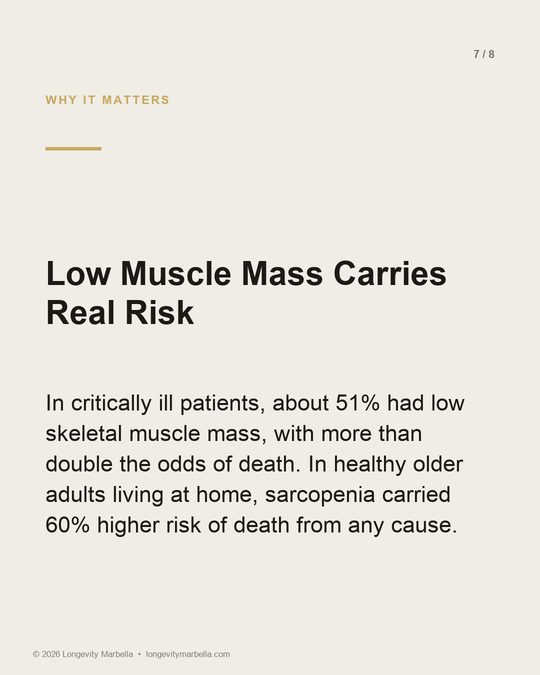
A 2023 systematic review in Frontiers in Nutrition pooled 38 studies and 6,891 critically ill patients: about 51 percent had low skeletal muscle mass, and those patients had a pooled odds ratio for death of 2.35 (95% CI 1.91 to 2.89), meaning their odds of dying were more than doubled. Outside hospital the pattern holds. A meta-analysis in Maturitas following 7,367 older adults living independently at home found that sarcopenia carried a hazard ratio of 1.60 for death from any cause (95% CI 1.24 to 2.06), roughly 60 percent higher risk over follow-up.
These are observational studies and part of the association runs backwards: people who are already frail have less muscle. But muscle, unlike your age and your genes, is an account you can still pay into.
What to Measure Instead of Weighing Yourself
Weight and BMI cannot tell muscle from fat, which is precisely the distinction that changes through this transition. The measurements that can:
- Segmental bioimpedance analysis. Reports lean mass and fat mass limb by limb and gives a visceral fat estimate, so you can see whether a stable weight is hiding muscle loss.
- Ultrasound. Visceral fat and muscle thickness can be visualized directly, in the room, without radiation.
- Grip strength. Function, not just tissue. Cheap, quick and repeatable, and it is the number that tends to move first.
- Waist circumference. Crude, free, and more informative than the scale.
- DXA can be ordered when a formal bone or body composition measurement is needed. It is arranged through the imaging services we work with and read here alongside your other results.
None of this is exotic. What it does is turn a vague complaint about clothes fitting differently into a set of numbers you can act on and then re-measure in six months.
See what the scale cannot: muscle, visceral fat and thyroid, measured in one appointment.
The Body Composition AssessmentWhat Actually Moves These Numbers
- Resistance training, at least twice a week. The only reliable lever on lean mass. It is not optional in this decade, it is the treatment.
- Enough protein, spread through the day. Muscle needs raw material and intake tends to fall precisely when requirements rise.
- Keep moving daily. Physical activity was the variable that related to changes in weight and waist in midlife women in SWAN.
- Treat the insulin resistance you can measure, rather than the weight you can see.
- If you are taking hormone therapy anyway, know that it is working on your visceral fat and your glucose while you work on your muscle. It is not doing the second job for you.
Where These Figures Come From
- European Society of Endocrinology. Clinical practice guideline on menopausal hormone therapy, 2025. Sections on body composition, diabetes and lipids, and the stated research gaps on sarcopenia.
- Kronos Early Estrogen Prevention Study (KEEPS), cited within the above for weight and waist circumference across four years.
- Sternfeld B, Wang H, Quesenberry CP Jr, et al. Physical activity and changes in weight and waist circumference in midlife women: findings from the Study of Women's Health Across the Nation. Am J Epidemiol, 2004;160:912.
- Yang H, Wan X-X, Ma H, et al. Prevalence and mortality risk of low skeletal muscle mass in critically ill patients: an updated systematic review and meta-analysis. Frontiers in Nutrition, 2023;10:1117558.
- Liu P, Hao Q, Hai S, et al. Sarcopenia as a predictor of all-cause mortality among community-dwelling older people: a systematic review and meta-analysis. Maturitas, 2017;103:16-22.