


Nothing hurts. Nothing shows in the mirror. There is no symptom to bring you to a doctor, and that is precisely the problem, because the losing happens quietly and then one day a wrist breaks on a marble floor and the whole thing is retrospective.
Not sure where you are in this? One-minute check.
- Bone loss begins during the menopausal transition and is fastest from one year before the final period through two years after it.
- More fractures happen in women whose score sits between -1.0 and -2.5 than in the osteoporosis range below -2.5.
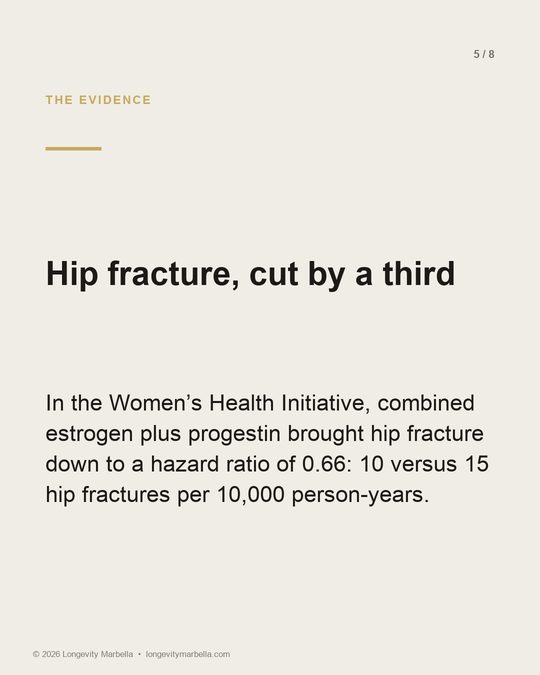
- In the Women's Health Initiative, estrogen plus progestin cut hip fracture: HR 0.66, 10 versus 15 hip fractures per 10,000 person-years.
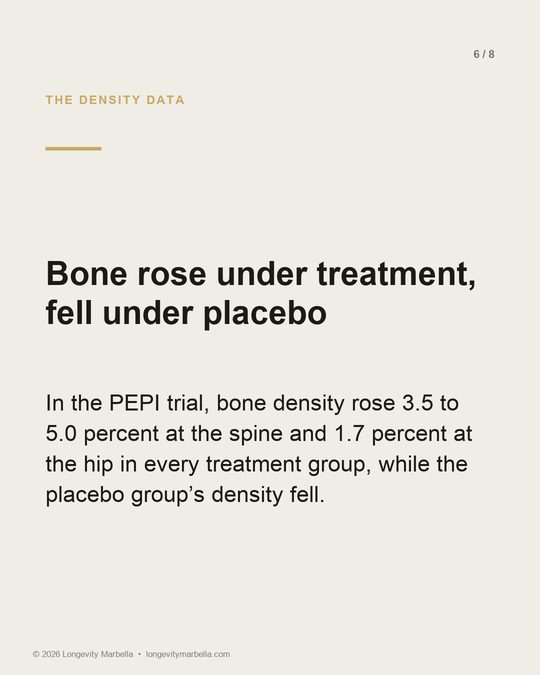
- In the PEPI trial, bone density rose 3.5 to 5.0 percent at the spine and 1.7 percent at the hip in every treatment group while placebo fell.
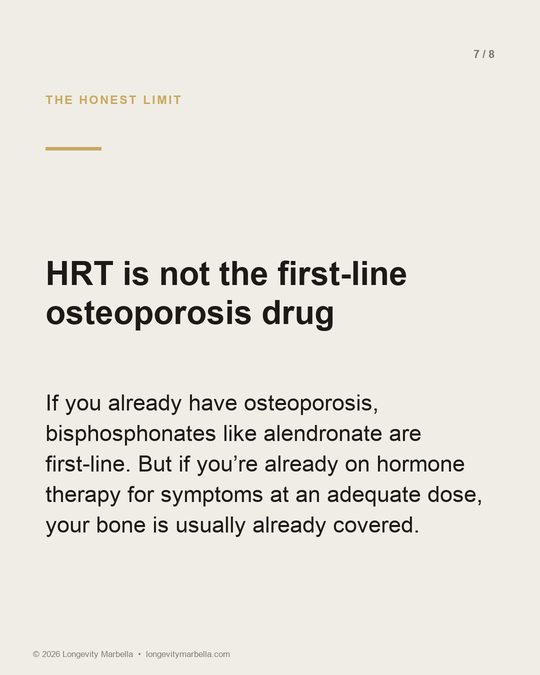
- HRT is not first-line treatment for established osteoporosis, but if you are taking it for symptoms, your bone is already covered.
Osteoporosis is not a disease of old age that arrives at eighty. It is largely built in your fifties, in a window that opens before your periods stop.
The bone you keep through your fifties is the bone you still have at eighty.
The Window, and Why It Is So Easy to Miss
Bone is living tissue, constantly broken down and rebuilt. Estrogen restrains the breakdown. When estrogen falls, the restraint goes and the demolition runs ahead of the rebuilding.
The timing is specific and it surprises people. Bone loss begins during the menopausal transition, while you are still having periods. The annual rate of loss appears highest from about one year before your final period through to two years after it.
You are losing it fastest during the years you are still calling it "the change", and before any scan is usually offered.
By the time a bone density scan is routinely suggested, that window has often closed.
What the Numbers Mean
Bone density is measured by DXA, dual-energy x-ray absorptiometry, a short low-dose scan. The result is a T-score: a surveyor's report comparing your bones with a healthy young adult's in standard deviations, each whole point one full step below that benchmark.
- Between -1.0 and -2.5: low bone mass, often called osteopenia.
- At or below -2.5: osteoporosis.
- A fragility fracture, meaning a break from a fall from standing height or less, at the spine, hip, wrist, upper arm or pelvis, diagnoses osteoporosis on its own, whatever the score says.
Here is the counterintuitive fact that should change how you read your own result. Women with a T-score at or below -2.5 have the higher individual risk. But more fractures happen in women whose score sits between -1.0 and -2.5, simply because far more women are in that group. A reassuring-sounding "just a bit of osteopenia" is where most fractures are actually coming from.
Risk is therefore not read off the score alone. The FRAX tool combines your bone density at the hip with clinical risk factors to estimate your ten-year probability of fracture, and it is available with country-specific thresholds, Spain included.
What Hormone Therapy Actually Does to Fractures
This is one of the few benefits of HRT proven in a large randomized trial rather than inferred, and the trial in question is the same Women's Health Initiative usually quoted to frighten people.
In the estrogen-only arm, for women who had had a hysterectomy, the reductions were similar: hip fracture hazard ratio 0.61 and vertebral fracture 0.62.
The 2025 Cochrane review pooling the long-term evidence reached the same place with different arithmetic. Combined continuous therapy probably reduces all clinical fractures, relative risk 0.78 (95% CI 0.71 to 0.86), about 78 fractures for every 100 expected without it, and estrogen-only therapy relative risk 0.73 (95% CI 0.65 to 0.80), about 73 per 100, both rated moderate-certainty evidence. Of all the WHI outcomes, fracture reduction is among the most solid.
Observational data agree at scale. In the Million Women Study, over a million women, current users of hormone therapy had a lower risk of any fracture than non-users, relative risk 0.62 (95% CI 0.58 to 0.66), and the protection held across every formulation, every route and every pattern of use.
And on density itself, the PEPI trial randomized 875 women and measured them for three years. Bone density rose by 3.5 to 5.0 percent at the spine and 1.7 percent at the hip in every treatment group, while in the placebo group it fell by 1.8 and 1.7 percent. Adding a progestogen did not reduce the benefit.
The Honest Limits
Three things worth knowing before you decide about hormones for your bones.
HRT is not first-line treatment for established osteoporosis. If you already have osteoporosis, bisphosphonates such as alendronate are the first-line drug, because they have the efficacy, the cost and the long-term safety data. Hormone therapy is not a substitute for that conversation.
But if you are taking it anyway for symptoms, you are already covered. A separate bone drug is usually not needed at adequate dose: transdermal estradiol at 25 micrograms a day or more, or oral estradiol at 0.5 mg a day or more. Even ultra low dose transdermal at 14 micrograms shows skeletal benefit, though at that dose density is worth monitoring if you are high risk.
Stopping is less catastrophic than you may have been told, and the data conflict. One trial found bone density fell in the year after estrogen was stopped, by 4.5 percent at the spine, while the larger PEPI follow-up found women who stopped lost bone at the same rate as women who had never taken it, about 1 percent a year. Most studies show that women who took estrogen in the past still have higher density than women who never did.
What Else Moves the Needle
Hormones are one lever. These are the others, with their real effect sizes rather than the wishful ones.
- Exercise, mostly by preventing falls. A meta-analysis of 43 randomized trials in 4,320 postmenopausal women found exercise increased lumbar spine density by 0.85 percent and trochanter density by 1.03 percent. Small. But a meta-analysis of 10 trials found exercise reduced overall fractures from 10.9 percent to 4.8 percent, relative risk 0.49. The fracture benefit is far larger than the density benefit, because most fractures start with a fall. Strength and balance work earns its place; supervised programs outperform unsupervised.
- Stopping smoking. In a study of female twins discordant for smoking, a pack a day through adult life was associated with a 5 to 10 percent lower bone density. Smoking may also cancel out the skeletal benefit of estrogen therapy.
- Calcium and vitamin D, as a floor not a treatment. About 1,200 mg of elemental calcium daily from diet plus supplement if needed, and 800 international units of vitamin D. If your diet already gets you there, supplements add nothing.
- Avoiding heavy alcohol.
- Protein and weight. Adequate protein, roughly 0.8 g per kg of body weight daily, and enough calories. Malnutrition is bad for bone.
What does not work: vitamin K supplementation, folate and vitamin B12, isoflavone supplements, fluoride, and whole-body vibration platforms. Each has been tested and none is recommended.
Who Should Be Scanned, and When
A DXA is worth having earlier than the standard age-based schedule if you have a fragility fracture already, an early menopause, a family history of hip fracture, low body weight, long-term steroid use, or a condition that affects absorption such as coeliac disease. It is also the right move before you decide about hormone therapy, because it turns an abstract argument into your own number.
A DXA is arranged when it is needed, through the imaging services we work with, and the result is read here in the context of everything else about you. It is arranged when it is needed, through the imaging services we work with, and the result is read in the context of everything else about you rather than handed over as a printout.
A scan does not build bone. But it tells you how much time you have.
If you are in the transition now, this is the window. It does not stay open.
Message us on WhatsAppWhere These Figures Come From
- Rossouw JE, Anderson GL, Prentice RL, et al. Risks and benefits of estrogen plus progestin in healthy postmenopausal women. JAMA, 2002;288:321.
- Anderson GL, Limacher M, Assaf AR, et al. Effects of conjugated equine estrogen in postmenopausal women with hysterectomy. JAMA, 2004;291:1701.
- Long-term hormone therapy for perimenopausal and postmenopausal women. Cochrane Database of Systematic Reviews, 2025.
- Banks E, Beral V, Reeves G, et al. Fracture incidence in relation to the pattern of use of hormone therapy in postmenopausal women. JAMA, 2004;291:2212.
- Effects of hormone therapy on bone mineral density: results from the Postmenopausal Estrogen/Progestin Interventions (PEPI) trial. JAMA, 1996;276:1389.
- Howe TE, Shea B, Dawson LJ, et al. Exercise for preventing and treating osteoporosis in postmenopausal women. Cochrane Database Syst Rev, 2011.
- Kemmler W, Häberle L, von Stengel S. Effects of exercise on fracture reduction in older adults. Osteoporos Int, 2013;24:1937.
- Hopper JL, Seeman E. The bone density of female twins discordant for tobacco use. N Engl J Med, 1994;330:387.
- Cranney A, Jamal SA, Tsang JF, et al. Low bone mineral density and fracture burden in postmenopausal women. CMAJ, 2007;177:575.
- LeBoff MS, Greenspan SL, Insogna KL, et al. The clinician's guide to prevention and treatment of osteoporosis. Osteoporos Int, 2022;33:2049.