


You have probably filed muscle under fitness: something for athletes, or for looking good on the beach. The science tells a bigger story. Muscle is arguably the organ of longevity, the reserve your body draws on to survive serious illness and to keep its independence as you age.
- In 6,891 critically ill patients, about half had low muscle mass, and it more than doubled the odds of death (odds ratio 2.35).
- The certainty of that ICU evidence was graded low, so treat it as a strong signal, not a final verdict.
- The pattern repeats outside hospital: sarcopenia raised all-cause mortality by about 60% in older adults.
- The data are observational, so low muscle is a powerful marker of risk, not proven to be the sole cause.
- Unlike age and genes, muscle is modifiable. Resistance training and adequate protein are the main levers.
- Preserving muscle is a low-downside investment in resilience and recovery, best planned with a doctor.
Think of it as a savings account you can only spend when life goes wrong. The people who walk in with more in reserve tend to come through better. And here is the part worth holding on to: unlike your age or your genes, this is an account you can keep adding to at almost any age.
The clearest signal comes from the place where the stakes are highest, the intensive care unit. Start there, and the reason muscle matters for the rest of your life comes into focus.
What does the evidence actually show?
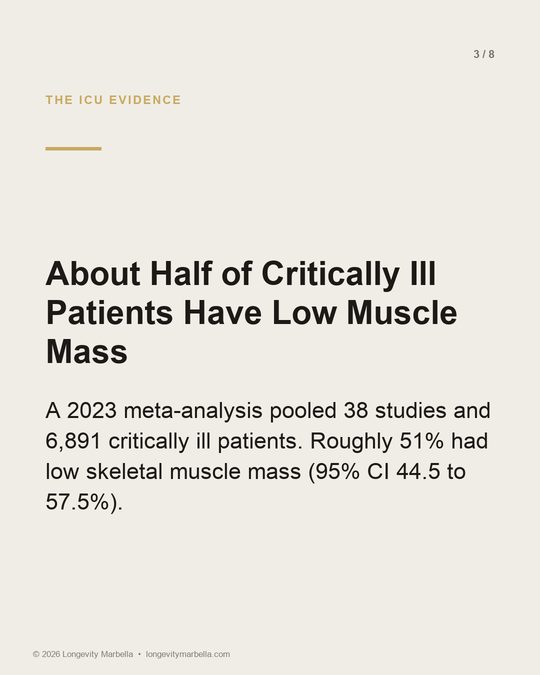
The short answer: in the sickest patients, low muscle mass is both common and closely tied to survival. A 2023 systematic review and meta-analysis in Frontiers in Nutrition pooled 38 studies and 6,891 critically ill patients to ask how often low muscle mass shows up in the ICU, and whether it matters for who lives.
Two findings stand out:
- It is extremely common. About 51% of critically ill patients had low skeletal muscle mass (95% confidence interval 44.5 to 57.5%). Roughly half.
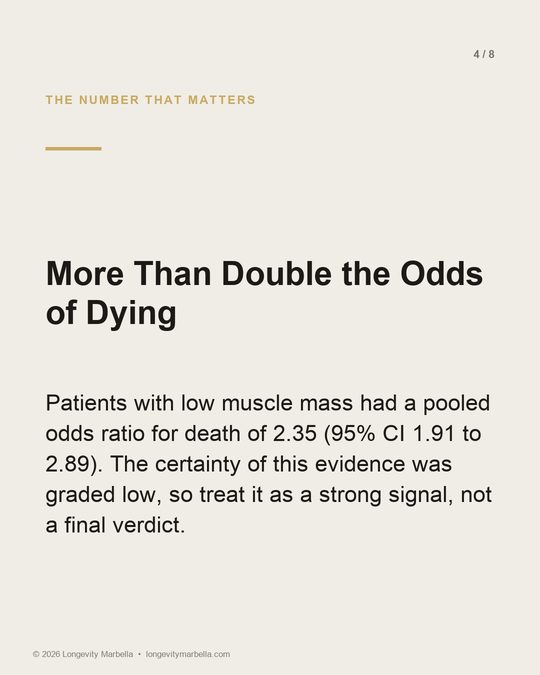
- It tracks closely with survival. Patients with low muscle mass had a pooled odds ratio for death of 2.35 (95% CI 1.91 to 2.89), more than double the odds of dying compared with those who had normal muscle mass. (An odds ratio just compares risk between two groups; 2.35 means the odds were about 2.35 times as high.) The link held for deaths in the ICU (about 2.27) and within one year (about 2.60), across the different scanning methods used.
One honest caveat, which the authors themselves make: the overall certainty of this evidence was graded as low, because the included studies varied and there were signs of publication bias. Treat this as a strong, consistent signal, not a final verdict.
Why does illness burn through muscle so fast?
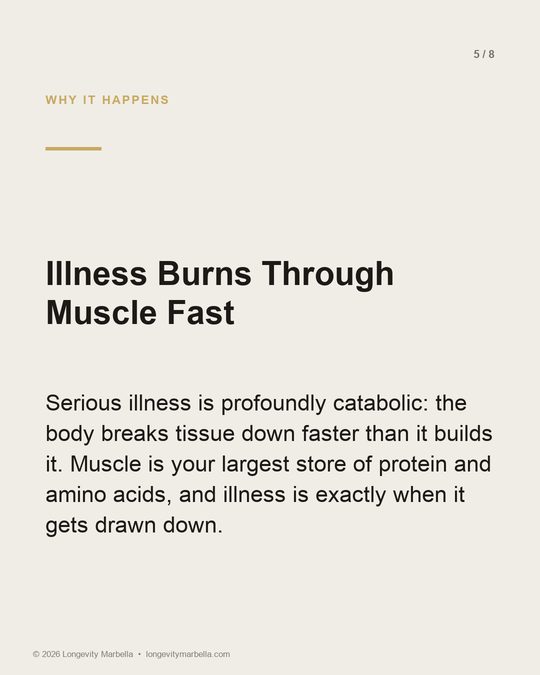
Because serious illness is profoundly catabolic: your body breaks tissue down faster than it builds it. During critical illness, several things pile up at once:
- Appetite and nutrition often fall short.
- Patients are immobile, especially on a ventilator.
- The stress response actively dismantles muscle to supply amino acids to the rest of the body.
In this meta-analysis, patients with sepsis had an even higher prevalence of low muscle mass. This reframes what muscle is for. Beyond movement, it is your largest store of protein and amino acids, that metabolic savings account, and serious illness is exactly when it gets drawn down.
Muscle is a reserve you build in good health and spend in bad.
Is this only about the intensive care unit?
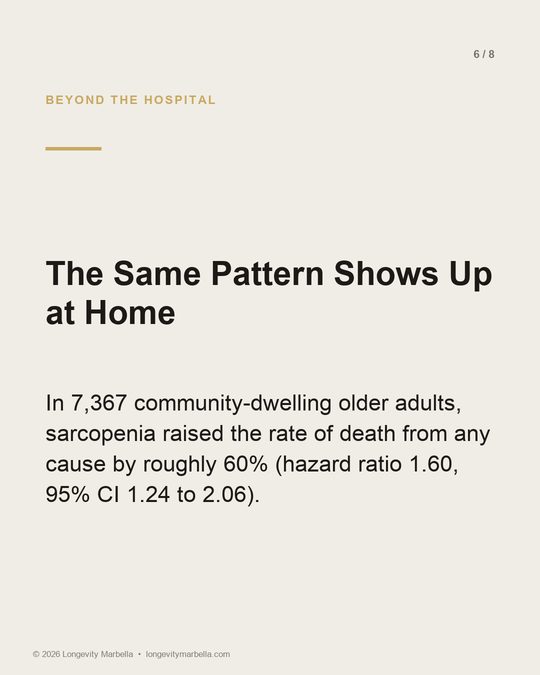
No. The same pattern shows up in everyday life. A separate meta-analysis in Maturitas followed 7,367 community-dwelling older adults (older people living independently at home, not in hospital) and found that those with sarcopenia (the age-related loss of muscle) had a roughly 60% higher rate of death from any cause over follow-up (pooled hazard ratio 1.60, 95% CI 1.24 to 2.06; a hazard ratio of 1.60 means about 60 percent higher risk over the study period). The effect was even larger in shorter studies and when muscle was measured by simpler methods.
So the signal is not a quirk of the ICU. From the hospital to the home, lower muscle keeps showing up alongside worse outcomes.
What does this prove, and what does it not?
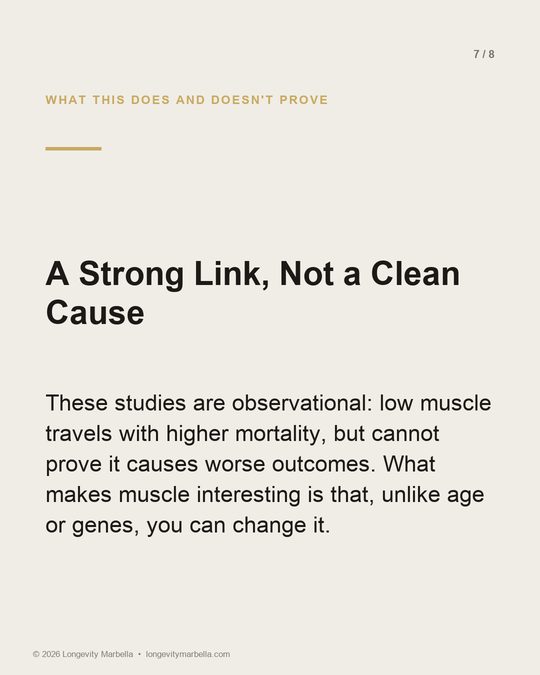
It proves a strong link, not a clean cause. These studies are observational. They show that low muscle mass reliably travels with higher mortality, but they cannot prove the low muscle is what causes the worse outcome. Some of the association is almost certainly reverse: people who are already sicker or frailer also tend to have less muscle.
What makes muscle interesting is that, unlike your age or your genes, you can change it. You cannot build a new set of chromosomes, but you can build muscle at almost any age. That is no guarantee against serious illness, and no honest article would promise that. It does mean preserving muscle is a sensible, low-downside investment in your resilience, your independence, and your ability to recover when something goes wrong.
How do you build armor for older age?
Two levers carry most of the evidence, and both are refreshingly simple:
- Resistance exercise. Regularly challenging your muscles, with weights, bands, or your own body weight, is the most direct way to build and keep them. Major public-health bodies, including the World Health Organization and the US Physical Activity Guidelines, recommend muscle-strengthening work on at least two days a week, alongside cardiovascular exercise.
- Adequate protein. Muscle needs raw material. Getting enough quality protein, spread across the day, supports the muscle that training stimulates. Protein needs may rise with age, precisely when intake tends to fall, which is worth discussing with your doctor.
Gain muscle, lose fat, and know where both stand before you change anything. For most people the right next step is not heroic, it is consistent. Because the details depend on your age, your health, and where you are starting from, this is exactly the kind of plan that rewards a proper assessment over guesswork.
Training and protein are the foundation, but not the whole story. Muscle is also shaped by things you can measure and, where appropriate, improve: hormones such as testosterone, and your broader metabolic health (how your body handles blood sugar, weight, and energy). A longevity assessment shows where those stand, and for men in particular a men's health evaluation can check whether hormones are quietly working against you.
Muscle quality and quantity, measured by ultrasound at the quadriceps. The Body Composition Assessment
Want to build strength and protect the muscle that carries you through the years ahead? We can help you turn the evidence into a plan built around you.
Message us on WhatsApp