


You were handed a prescription. Maybe a tablet, maybe a patch. Almost certainly nobody explained why that one and not the other, because from the outside it looks like a packaging choice.
Not sure where you are in this? One-minute check.
- A tablet passes through the liver first. A patch does not. That single difference is most of the story.
- A 2023 systematic review found bone, glucose and cholesterol broadly similar, and no apparent difference in breast cancer, endometrial disease or cardiovascular risk.
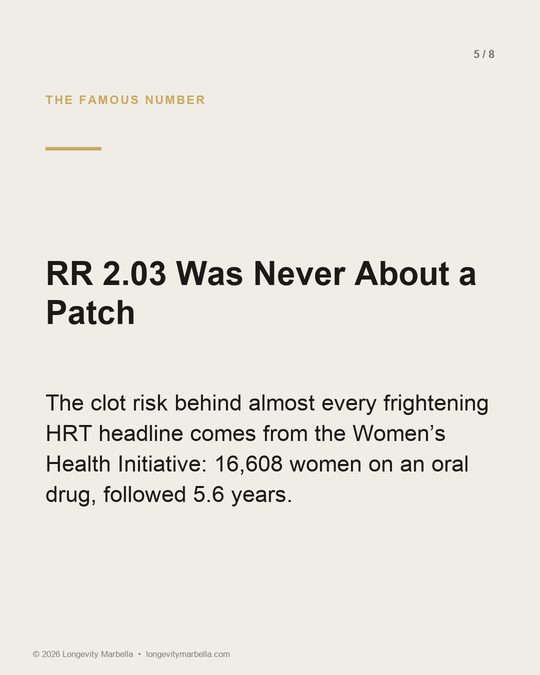
- Blood clots in the veins are clearly different. The famous RR 2.03 came from the Women's Health Initiative: 16,608 women, an oral drug, an older population.
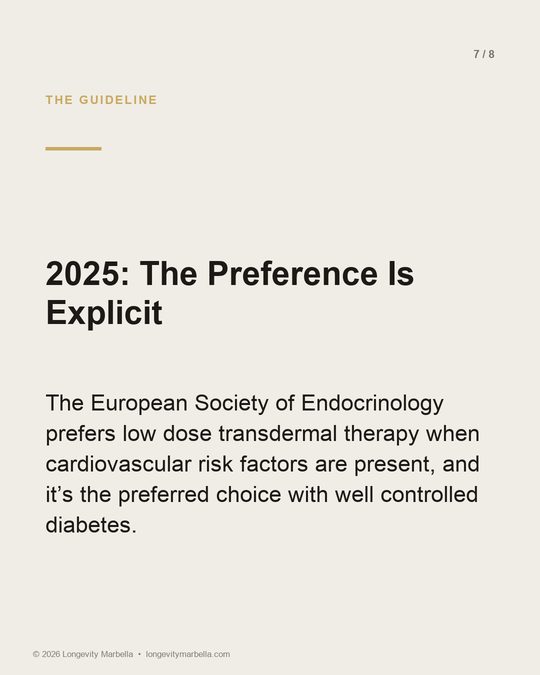
- The 2025 European Society of Endocrinology guideline prefers low dose transdermal therapy when cardiovascular risk factors are present.
It is not a packaging choice. It is the decision that shapes your risk profile more than almost anything else in the regimen, and it turns on a single piece of anatomy: your liver.
Through the skin or through the stomach. Two different treatments, two different risks.
The Liver Is the Whole Story
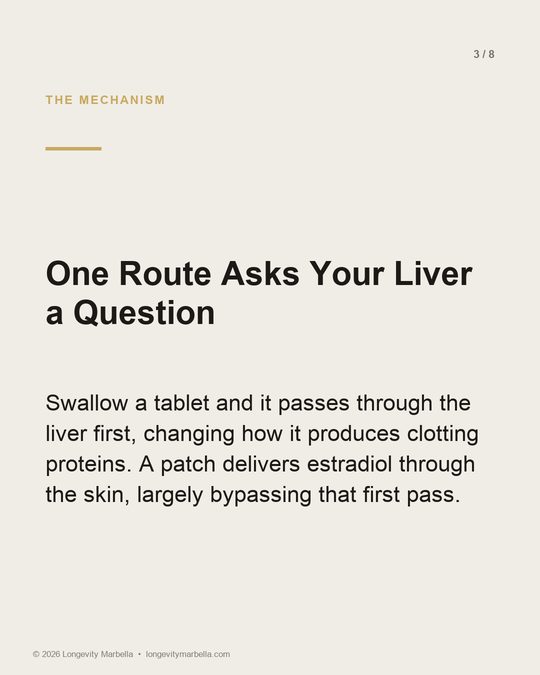
Swallow a tablet and it is absorbed from your gut into the portal vein, which runs directly to the liver. Think of the liver as a customs post on the only road inland: everything you swallow is inspected and processed there before it reaches the rest of you. Pharmacologists call this first-pass hepatic metabolism, and for estrogen the inspection has a specific consequence: confronted with a concentrated shipment of hormone, the liver changes its output of the proteins that make blood clot.
A patch, a gel or a spray delivers estradiol through the skin straight into the general circulation. It reaches the liver eventually, diluted, along with everything else in the blood. That surge of concentrated hormone through liver tissue never happens.
One route asks your liver a question. The other does not.
Everything that follows is downstream of that difference.
What the Evidence Actually Shows
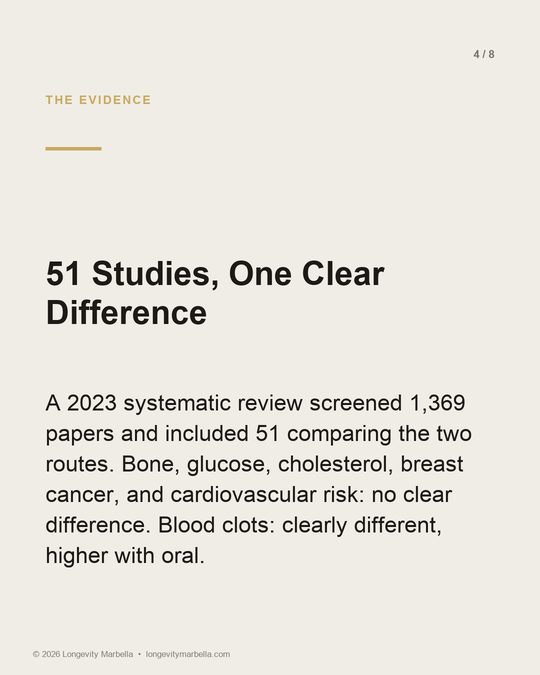
The most useful summary is a systematic review published in Archives of Gynecology and Obstetrics in 2023. The authors searched the literature from January 1990 to December 2021, screened 1,369 papers, and included 51 that directly compared the transdermal and oral routes in postmenopausal women.
Their conclusion is worth reading carefully, because it is more restrained than the marketing you will find elsewhere:
- Bone density, glucose metabolism and cholesterol: broadly similar. Both routes improve these, and the review found no clear advantage either way.
- Breast cancer, endometrial disease and cardiovascular risk: no apparent difference between routes on the available evidence.
- Venous thromboembolism, meaning blood clots in the veins: clearly different. This was the one outcome where the evidence was unambiguous, and the risk is higher with the oral route.
The authors' own summary is that clot risk is the clearest and strongest clinical difference between the two routes, and that it supports transdermal therapy as the safer of the two.
And now their limitation, which they state themselves. Most of the included studies were observational rather than randomized, and the majority of the randomized trials carried a high or medium risk of bias. The authors describe the overall evidence as limited and of low quality, and call for better trials. That is an honest scientist writing, and it is why we describe transdermal as the more prudent default rather than as proven superiority on every outcome.
Why the Famous Risk Numbers Are About a Tablet
This is the part that changes how you should read every frightening headline about HRT.
The Women's Health Initiative is the study behind almost all of them. A 2025 Cochrane review pooled the long-term hormone therapy evidence and drew most of its data from it. In the combined therapy arm, 16,608 postmenopausal women followed for an average of 5.6 years:
The same review found the combined oral regimen probably increased breast cancer risk (RR 1.27, 95% CI 1.03 to 1.56), may have increased stroke (RR 1.39, 95% CI 1.09 to 2.09), and increased gallbladder disease requiring surgery (RR 1.64, 95% CI 1.30 to 2.06). It probably made little or no difference to coronary events (RR 1.17, 95% CI 0.95 to 1.44), and it reduced all clinical fractures (RR 0.78, 95% CI 0.71 to 0.86).
In the estrogen-only arm, 10,739 women who had had a hysterectomy followed for about seven years, the picture was gentler: probably little or no difference in coronary events, venous thromboembolism or breast cancer, an increase in stroke and gallbladder disease, and again a clear reduction in fractures (RR 0.73, 95% CI 0.65 to 0.80).
Two things follow, and both matter to you.
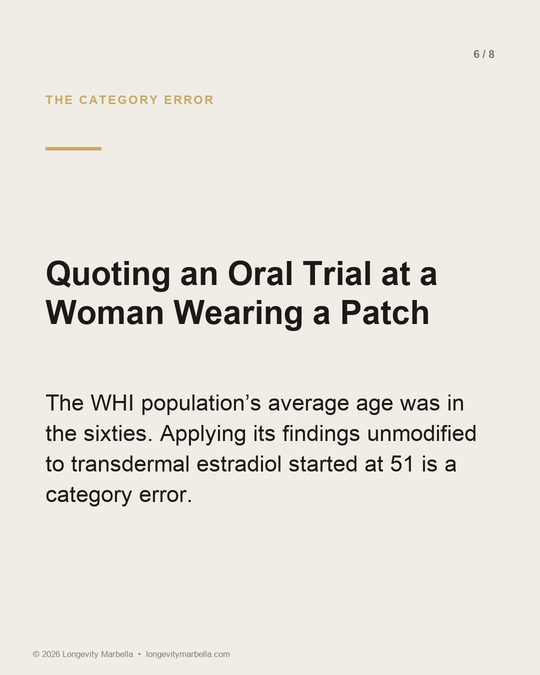
First, that was an oral drug. Every one of those numbers describes swallowed conjugated equine estrogen, not transdermal estradiol. Quoting them at a woman wearing a patch is a category error, however often it is done.
Second, that was an older population. Cochrane names this as the review's main limitation: only about 30 percent of the women were aged 50 to 59 at baseline, which is precisely the group most likely to want hormone therapy for symptoms.
Where the Guideline Is Explicit
The 2025 European Society of Endocrinology clinical practice guideline on menopause does not hedge on this. Its position, in its own terms:
- Low dose transdermal therapy is preferred when cardiovascular risk factors are present.
- In women with well controlled diabetes, which the guideline states is not a contraindication to hormone therapy, transdermal estrogen is the preferred choice.
- Transdermal estrogen was associated with a lower risk of developing high blood pressure than oral estrogen. Therapy should not be started while hypertension is uncontrolled.
- Hormone therapy is not to be used to prevent stroke, by either route.
Read as a whole, the guideline treats the transdermal route as the sensible default for the woman who has anything else going on, and that describes most women in their fifties.
What This Means in Your Consultation
Practically, the questions that decide the route are these. A personal or family history of blood clots. Migraine, particularly with aura. Blood pressure. Weight. Whether you smoke. Whether you have diabetes or your triglycerides run high. Gallbladder history. Whether you are on anything else that loads the liver.
None of that is exotic. It is the ordinary internal medicine that hormone prescribing often skips, and it is exactly where a specialist background changes what you are handed.
A patch is not a fashion. It is a decision about your liver, made in advance, on purpose.
Where the Route Does Not Decide It
Two honest caveats, so you are not oversold.
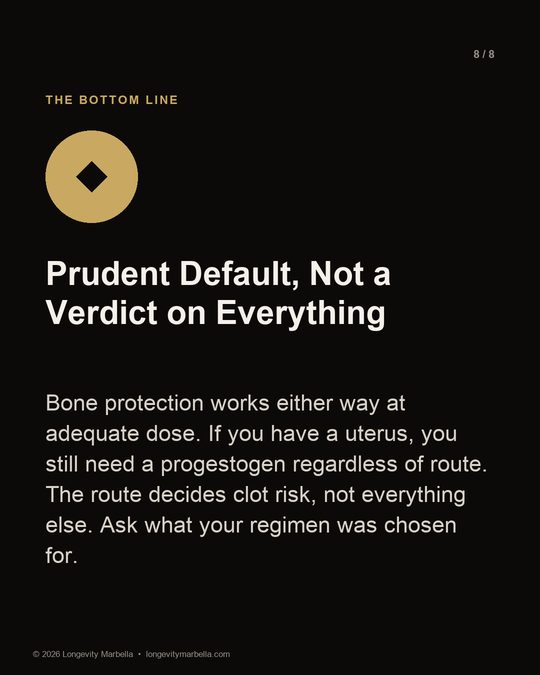
Bone works either way, at adequate dose. Transdermal estradiol at 25 micrograms a day or more, or oral estradiol at 0.5 mg a day or more, is generally enough that a separate bone drug is not required. Even ultra low dose transdermal at 14 micrograms shows skeletal benefit, though bone density is worth monitoring at that dose if you are at high fracture risk.
If you have a uterus you still need a progestogen, whichever route the estrogen takes. The progestogen protects the lining of the womb. The route of the estrogen does not change that requirement.
And local symptoms need local treatment. Vaginal dryness, painful sex and recurrent urinary infections respond far better to low dose vaginal estrogen than to any systemic route. If those are your problem, raising your patch dose is the wrong lever.
If nobody explained why you are on the form you are on, that is worth a conversation with someone who will.
Message us on WhatsAppWhere These Figures Come From
- Šprem Goldsštajn M, Mikuš M, Ferrari FA, et al. Effects of transdermal versus oral hormone replacement therapy in postmenopause: a systematic review. Archives of Gynecology and Obstetrics, 2023;307:1727.
- Long-term hormone therapy for perimenopausal and postmenopausal women. Cochrane Database of Systematic Reviews, 2025.
- European Society of Endocrinology clinical practice guideline for evaluation and management of menopause and the perimenopause. European Journal of Endocrinology, 2025;193(4).
- Rossouw JE, Anderson GL, Prentice RL, et al. Risks and benefits of estrogen plus progestin in healthy postmenopausal women. JAMA, 2002;288:321.