


The hot flashes wake you at night. Your sleep is broken, your mood is not your own, and the closeness you used to feel has faded. You want relief. But every time HRT comes up, so do the breast cancer headlines, and the fear wins.
Not sure where you are in this? One-minute check.
- HRT cuts hot flashes and night sweats by about 70 to 90 percent (most women get major relief), the most effective option available for those symptoms.
- Starting early (within about 10 years of menopause, usually before 60) keeps the risks low.
- Started early, it does not raise heart risk, and, in long-term follow-up of the WHI study, did not raise overall mortality (the risk of dying from any cause).
- It protects bone and reduces fractures while you take it.
- Combined HRT slightly raises breast cancer risk (about 1 extra case per 1,000 women a year); estrogen only and vaginal estrogen carry lower or no added risk.
- Patches and gels avoid the small clot risk that some pills carry.
- It is an individual decision, best made with a doctor.
Here is what you may not have been told plainly: those headlines came from a study of older women who started hormones late in life. For most women who start near menopause, modern HRT is both safe and highly effective, and the risks are smaller and more nuanced than the scare stories suggest.
You deserve the honest version, not the frightening one and not the salesy one. Below is what the evidence actually says, in plain language, so you can decide with your eyes open.
The quick version
- For hot flashes and night sweats, HRT is the most effective treatment there is, and most women get major relief.
- Timing matters most: started near menopause (within about 10 years, usually before 60), the risks stay low.
- The breast cancer fear is overstated. Any added risk is small, depends on the type, and vaginal estrogen adds none.
- Started early, HRT does not raise heart risk, and long-term data show no rise in the risk of dying from any cause.
- It is a personal decision. The right type, dose, and timing are matched to you, with a doctor.
Relief is possible, and you do not have to figure this out alone.
Message us on WhatsAppDoes HRT actually work?
Yes, and this part is not in doubt. HRT reduces hot flashes and night sweats by around 70 to 90 percent, so most women get major relief. For those symptoms it is the single most effective treatment available. It also helps with sleep, mood, and the vaginal and urinary changes of menopause, and it improves quality of life for many women.
What exactly is HRT?
HRT (hormone replacement therapy, also called MHT) simply replaces the hormones, mainly estrogen (the main female hormone), that fall during menopause. That drop is what drives hot flashes, night sweats, sleep problems, and vaginal dryness.
There are a few forms, and the differences matter:
- Estrogen only, for women who have had a hysterectomy.
- Estrogen plus progestogen, for women who still have a uterus (the progestogen protects the womb lining).
- Vaginal estrogen, a low dose used just for dryness and urinary symptoms, with very little absorbed into the body.
It can be taken as pills, through the skin (patches, gels, sprays), or vaginally.
Is it too late for me to start?
If you are near menopause, this is the best window there is. When you start HRT matters more than almost anything else.
The evidence, including long-term follow-up from the large Women's Health Initiative study, points to a clear window. Women who begin HRT within about 10 years of menopause, usually before age 60, get strong symptom relief while the risks stay low. Starting much later, in your late 60s or 70s, is where the risk picture turns less favorable. Doctors call this the "timing hypothesis," and it now shapes modern guidelines.
A randomized trial called ELITE showed this in the arteries themselves. Picture an artery as a pipe: with age its inner wall can slowly thicken, the way deposits build up inside a pipe, and that thickening of the carotid artery wall is an early sign of hardening arteries. In 643 postmenopausal women, estradiol slowed that thickening when treatment was started within 6 years of menopause, but it had no such effect when started 10 or more years out. The same hormone, a very different result depending on when it began.
Download these slides as a PDF HRT for Menopause, The Evidence in Full PDF, the complete, referenced version to read or printIs HRT bad for my heart?
Not when it is started early. For years HRT was feared as bad for the heart. The newer, more careful reading of the evidence is more nuanced:
- Started early (within that 10 year window), HRT shows no increase in heart disease, and overall mortality is not raised, with a more favorable picture the earlier a woman starts.
- Started late (in your 70s, or more than 10 years after menopause), the risk of heart problems can go up.
In late 2025 the FDA removed the decades-old boxed warnings (the strongest, most prominent safety warnings on a medicine) about cardiovascular disease, breast cancer, and dementia from many menopausal hormone therapy products, reflecting a more reassuring modern reading of the evidence. The warning about endometrial cancer (cancer of the womb lining) stayed in place for estrogen-only therapy. Separately, in long-term follow-up of the Women's Health Initiative study, hormone therapy did not raise overall mortality, with a more favorable picture in women who started younger. HRT is still not prescribed as a heart medicine, but in the right window it is not the heart villain it was once made out to be.
Does HRT protect my bones?
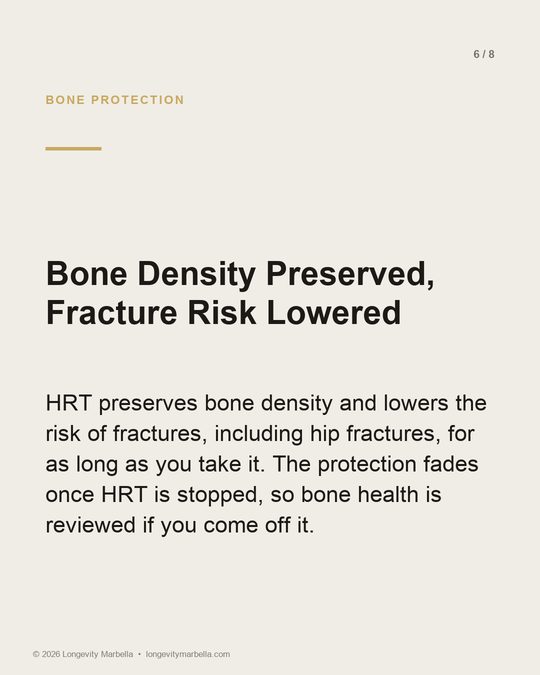
Yes, and it is one of HRT's clearest benefits. HRT preserves bone density and lowers the risk of fractures, including hip fractures, for as long as you take it. For a recently menopausal woman who also has symptoms, that bone protection is a real bonus. The protection fades once HRT is stopped, so bone health is reviewed if you come off it.
Does HRT cause breast cancer?
This is the fear that stops most women, so here is the honest answer: any added risk is small, and it depends heavily on the type.
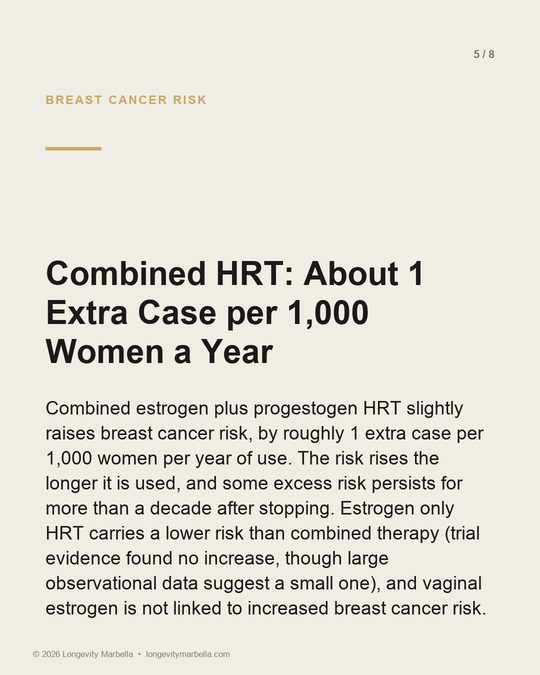
- Combined estrogen plus progestogen HRT slightly raises breast cancer risk, by roughly 1 extra case per 1,000 women per year of use. The risk rises the longer it is used, and some excess risk persists for more than a decade after stopping.
- Estrogen only HRT carries a lower risk than combined therapy. Trial evidence found no increase, though large observational data suggest a small one, so any added risk is modest.
- Vaginal estrogen is not linked to increased breast cancer risk.
Put in perspective, the increase from combined HRT is modest, and it sits alongside real benefits for symptoms, bones, and quality of life. This is not zero risk, but the size of it is small and should be weighed against what HRT can do for you personally. It is a number to understand together, not a headline to be frightened by.
Want your own breast cancer risk looked at honestly? Ask us for a personal risk review.
Message us on WhatsAppAre patches safer than pills?
For blood clot risk, often yes, and this is where good prescribing makes a real difference.
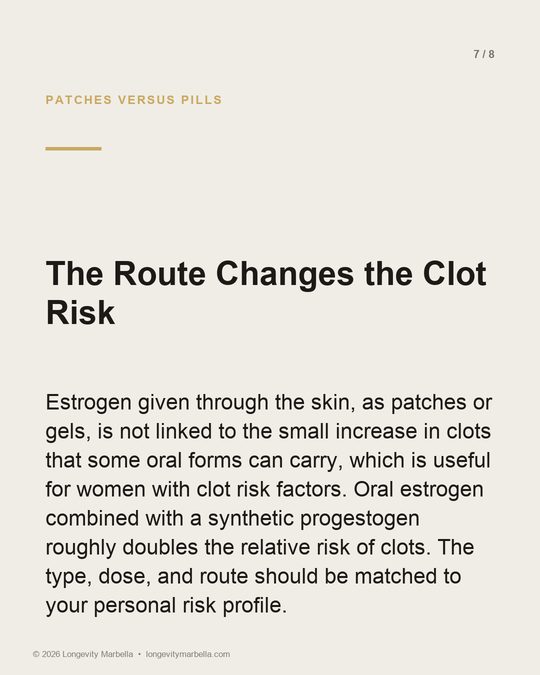
- Estrogen through the skin (patches, gels) is not linked to the small increase in blood clots that some oral forms can carry. It is often preferred for women who have clot risk factors such as obesity or a previous clot.
- Oral estrogen combined with a synthetic progestogen roughly doubles the relative risk of clots. Relative risk compares rates, not counts: the clot rate runs about twice as high, while the rise stays the small increase named above.
So the same hormone can be safer or riskier depending on which pipe it enters through, mouth or skin. The type, dose, and route should be matched to your personal risk profile.
So, is HRT safe for me?
For the right woman, at the right time, in the right form, yes, and it is highly effective. It is not a blanket "safe" or "dangerous." For a healthy woman with bothersome symptoms who starts within about 10 years of menopause, the benefits are strong and the risks are small and manageable. For an older woman starting many years later, the balance shifts. On the biggest question of all, an 18-year follow-up of more than 27,000 women in the Women's Health Initiative found that hormone therapy did not raise the risk of dying from any cause, from heart disease, or from cancer.
That is exactly why this is a personal decision made with a doctor, based on your age, your timing, your symptoms, and your own health history. Matching the type, dose, route (pill, patch, or gel) and timing to you as an individual is precisely what a specialist consultation is for. You can read more about our approach to HRT and menopause care.
How we decide with you
You are not handed a prescription and sent away. The decision is made together, and then watched. At Longevity Marbella your care is led by a doctor double board-certified in Internal Medicine and Endocrinology. Endocrinology covers the hormones themselves. Internal Medicine covers the systems HRT can touch: your breast health, your blood and clotting risk, your heart, and your bones.
Having both perspectives on the same case means your treatment is not simply prescribed and left alone. It is monitored, and if something needs attention it can be caught early and acted on quickly, often before it would surface elsewhere. That combination of hormone expertise and whole-body vigilance is what turns HRT from a prescription into properly supervised care.
Ready to feel like yourself again? Let's look at what is right for you, together.
Message us on WhatsApp