


There are now a very large number of men taking a weekly injection for weight, and almost none of them have had their testosterone measured before, during, or after. That is a strange gap, because the relationship between body fat and testosterone is one of the better understood in endocrinology, and it runs in both directions.
Not sure if this applies to you? One-minute check.
- Fat tissue converts testosterone into estrogen, and insulin resistance and inflammation suppress production, which is why weight loss should raise it.
- A 2025 meta-analysis could pool only four studies, roughly 220 men, mostly observational, with statistical heterogeneity above 90 percent.
- Bioavailable testosterone rose significantly and HbA1c fell. Free testosterone did not reach significance.
- The drugs analyzed were liraglutide and exenatide, older members of the class.
- The practical move: get a baseline measured before or early in treatment.
This article is about what actually happens to a man's hormones when the weight comes off with GLP-1 therapy, what the newest evidence does and does not show, and the part that gets missed by treating weight and hormones as two separate appointments with two separate doctors.
First, why carrying excess weight lowers testosterone
This is the part most men are never told. Low testosterone in a heavier man is frequently not a failure of the testicles. It is the system upstream being turned down.
Three things drive it:
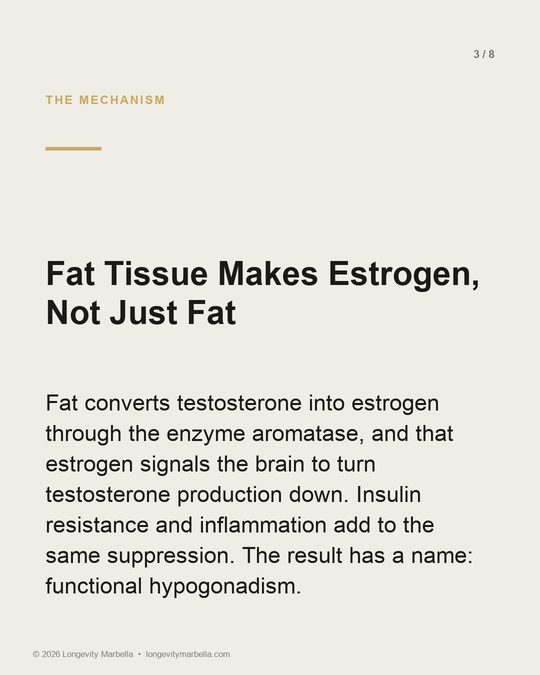
- Fat tissue converts testosterone into estrogen. It does this through an enzyme called aromatase. The more fat tissue, the more conversion. The brain runs this system like a thermostat, reading the hormone level in the blood, and that estrogen registers as a room already warm. So the thermostat turns the heating down: the brain reduces the instruction it sends to the testes.
- Insulin resistance suppresses the same signal. The hormonal chain running from brain to testes is sensitive to metabolic stress, and it responds by dialing down.
- Inflammation from excess adipose tissue adds to the same suppression.
The clinical term for the result is functional hypogonadism. Functional, because the machinery works. It has simply been switched down by a metabolic problem sitting on top of it. That word matters enormously, because functional problems can improve when you fix what caused them.
What the 2025 meta-analysis found
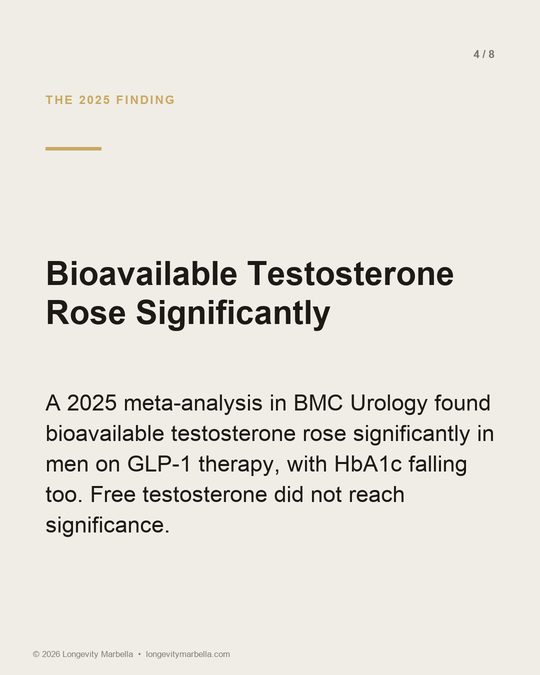
A systematic review and meta-analysis published in BMC Urology in 2025 pooled the studies measuring testosterone in men before and after GLP-1 receptor agonist treatment.
- Bioavailable testosterone rose significantly (p < 0.001). Bioavailable means free testosterone plus the loosely albumin-bound portion, in other words the fraction that can actually reach tissue.
- HbA1c fell significantly (p < 0.001), the expected glycemic benefit, and with no heterogeneity between studies on that outcome.
- Free testosterone did not reach statistical significance (p = 0.051), nor did sex hormone binding globulin (p = 0.120).
Now the honest part, because it changes how you should read that
We are not going to sell you a headline. This analysis pooled four studies, roughly 220 men. Most were observational rather than randomized. Statistical heterogeneity exceeded 90 percent on several outcomes, meaning the studies disagreed with each other substantially, and the authors' own sensitivity analyses failed to explain it away.
There is a second limitation that matters more for you than any of that. The drugs in this analysis were liraglutide and exenatide. Three of the four studies used liraglutide, one used exenatide. Semaglutide, the molecule in Ozempic and Wegovy, was not in the pooled analysis. Neither was tirzepatide, the molecule in Mounjaro. Those are the drugs most men are actually taking today.
So the accurate statement is this: GLP-1 therapy is associated with a rise in the biologically active fraction of testosterone, in a small and inconsistent body of evidence, using older drugs in the class. It fits a well established mechanism, and weight loss by any route is long known to improve testosterone in men whose levels were suppressed by obesity. It is a good signal. It is not a settled fact, and anyone telling you otherwise is selling something.
The half of this that nobody joins up
Here is where the interesting problem lives, and it is the reason this article exists.
GLP-1 drugs produce substantial weight loss, and a meaningful share of what is lost is lean mass, not fat. We have written about that separately in GLP-1 weight loss and muscle loss, including what genuinely mitigates it.
Now put the two facts side by side:
- Losing fat tends to improve testosterone, which helps you hold onto muscle.
- Rapid weight loss tends to cost you muscle, and low testosterone makes that worse.
These two processes are running at the same time, in the same man, pulling in opposite directions. Which one wins depends on things that are entirely manageable: how fast the weight comes off, protein intake, whether resistance training is happening, and where the hormones actually sit while it is going on.
Nobody can tell you which way it is going without measuring. And in practice, almost nobody measures. The weight loss prescription and the hormone assessment happen in different buildings, if the second happens at all.
What this means if you are on one of these drugs
Three practical points.
Get a baseline before or early in treatment. Total testosterone, sex hormone binding globulin, albumin, and calculated free testosterone, so that changes can be interpreted later against something real. A single reading taken eight months in tells you very little. Two readings tell you a direction. More on what a complete panel includes in what a proper men's health blood panel measures, and on why the free value matters more than the headline number in free testosterone versus total testosterone.
Protect muscle deliberately, from day one. Not as an afterthought once the scale has moved. Muscle is the tissue that determines how you function and how you age, which we covered in why muscle matters.
Do not assume you need testosterone therapy. This is the point where an honest clinic separates itself from a prescription mill. If your low testosterone is being driven by weight and insulin resistance, the correct first move is to treat that, and to watch whether the hormone recovers on its own. In a good number of men it does, at least partly. Starting testosterone therapy in a man whose levels were about to recover anyway is a decision with consequences, including for fertility, and it is not one to make casually.
Why this belongs with one doctor, not two
Weight and hormones are treated as separate specialties by the market, and they are not separate systems in the body.
A clinic that prescribes GLP-1 drugs and never measures hormones will not see the man whose testosterone was suppressed the whole time, or the man losing more muscle than he should. A clinic that prescribes testosterone and does not manage metabolic health will happily put a man on lifelong hormone therapy for a problem his waistline was causing.
Care here is directed by a doctor double board-certified in Internal Medicine and Endocrinology, which means the weight, the metabolic markers and the hormone axis are read as one picture by one person, and the plan can move as the numbers move. That is not a marketing distinction. It is the difference between managing an interaction and ignoring it.
You can see how the two sides work in practice on our medical weight loss and testosterone therapy pages.
Does Ozempic or Mounjaro raise testosterone?
Possibly, but not directly and not proven for those specific drugs. A 2025 meta-analysis found GLP-1 therapy raised bioavailable testosterone in men, though the pooled studies used liraglutide and exenatide rather than semaglutide or tirzepatide. The most likely mechanism is indirect: losing fat and improving insulin sensitivity relieves the suppression that obesity places on the testicular axis. Weight loss itself, by any method, is well established as a way to improve testosterone in men with obesity-related low testosterone.
Why does obesity lower testosterone?
Excess fat tissue converts testosterone into estrogen through the enzyme aromatase, and that estrogen feeds back on the brain to reduce the signal that tells the testes to produce testosterone. Insulin resistance and inflammation suppress the same axis. The result is called functional hypogonadism, meaning the testes are capable but the system driving them has been turned down. It is often at least partly reversible when the underlying metabolic problem improves.
Will I lose muscle on a GLP-1 drug?
Some lean mass loss accompanies almost all substantial weight loss, and GLP-1 therapy is no exception. It is largely mitigated by adequate protein intake, resistance training, and a rate of loss that is not reckless. This matters more if your testosterone is already low, because testosterone is one of the signals that helps you retain muscle while in a calorie deficit.
Should I start testosterone therapy while losing weight?
Not automatically. If low testosterone is being driven by obesity and insulin resistance, treating the metabolic problem may raise it without hormone therapy at all, and that is the better outcome where it is achievable. The decision depends on how low the levels are, whether symptoms are present, your fertility plans, and how the numbers move as weight comes off. It requires measurement over time rather than a single reading.
How strong is the evidence that GLP-1 drugs raise testosterone?
Moderate at best, and worth being honest about. The 2025 meta-analysis pooled only four studies with roughly 220 men, most of them observational rather than randomized, and statistical heterogeneity exceeded 90 percent on several outcomes, meaning the studies disagreed substantially. Bioavailable testosterone rose significantly, but free testosterone did not reach significance and neither did SHBG. It is a promising signal that fits an established mechanism, not a settled fact.