


You want real answers from your bloodwork, not a rushed "everything looks normal" while you still feel tired, flat and far from your best. That instinct is right. If a panel left you with more questions than answers, the problem is rarely the blood draw.


Not sure if this applies to you? One-minute check.
- A single normal number can be technically true and still miss what you are feeling.
- A proper panel covers hormones including free testosterone, metabolic health, organ function, inflammation, key nutrients and prostate health.
- The point is not the length of the list. It is selecting what matters for you, and reading it correctly.
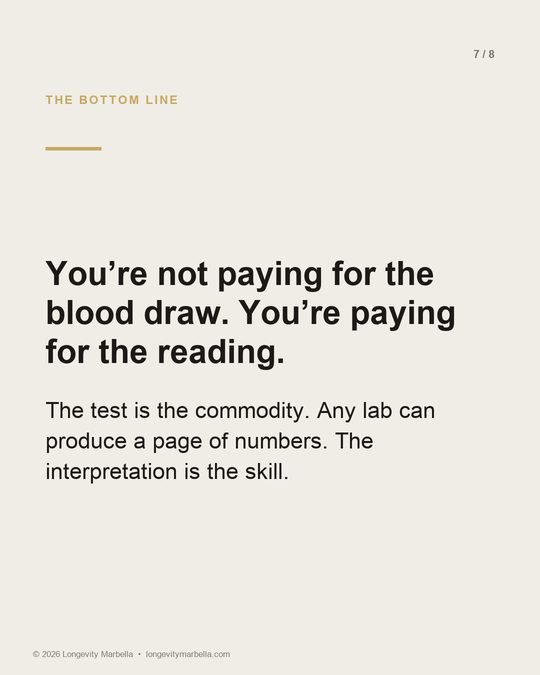
- You are not paying for the blood draw. You are paying for the reading.
Here is the honest reassurance: what actually changes your results is not a longer list of tests. It is measuring the right markers, including free testosterone, and then reading them the way a specialist reads them, together and against how you actually feel.
A wide "normal" range, read without real expertise, hides far more than it reveals. Below is what a proper men's health panel covers, why interpretation beats any single number, and how we turn a page of results into a plan.
The quick version
- A standard GP panel uses wide "normal" ranges built to catch disease, not to explain why you feel off.
- Which markers get measured matters as much as the numbers. The right hormone, metabolic, blood, inflammation, nutrient and prostate markers, chosen for you.
- Free testosterone is the biologically active fraction your body can use. A "normal" total can hide a low free level, which is often exactly what a symptomatic man is feeling.
- Interpretation beats any single number. The same results can be dismissed as "normal" by one doctor and become a clear plan in the hands of another.
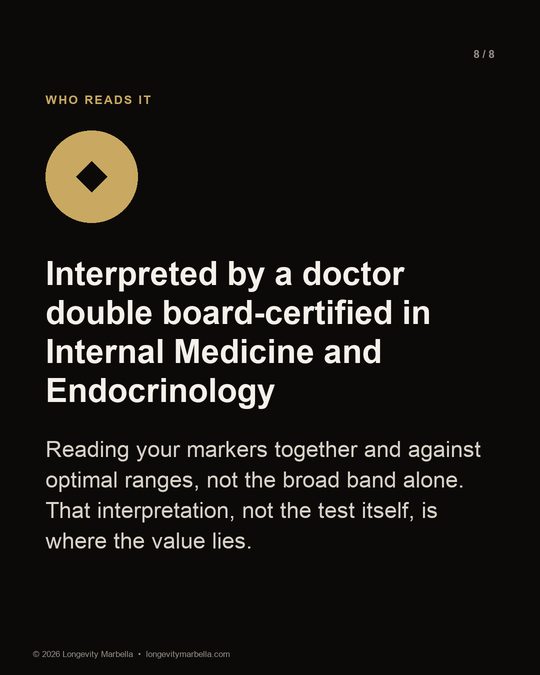
- Your panel is read by a doctor double board-certified in Internal Medicine and Endocrinology, against optimal ranges and your symptoms, not the broad band alone.
The test is the commodity. The interpretation is the skill.
Collecting a blood sample was never the hard part. Any laboratory can produce a page of numbers. The difference is the doctor who knows which markers to look at, how they influence each other, and what they mean for you specifically. That judgment is not printed in the reference range beside the result. It comes from formal specialist training and the experience of having read a great many cases.
You are not paying for the blood draw. You are paying for the reading.
Why "normal" misleads
Reference ranges are deliberately wide, and they vary from one laboratory to another depending on the assay and the population each lab uses. You can sit at the very bottom of "normal" and still feel far from yourself. Two markers that look unremarkable on their own can, read together and against your symptoms, tell a clearer story.
How the sample is taken matters too. Testosterone is best measured in the morning while fasting, and a low result is generally confirmed on a repeat sample before any conclusion is drawn.1 Then there is the question of which testosterone gets measured at all. Most of it travels bound to a protein called SHBG and is inactive: fuel held in the reserve tank. Only the small unbound portion, free testosterone, is the active form your body can actually use, the fuel actually reaching the engine. So a total testosterone that reads "normal" can be a full gauge on the tank while still sitting on top of a low free (active) level.
A single "normal" number can be technically true and still miss what you are feeling.
Not sure your panel covers the right markers, including free testosterone? Let us build the right one for you.
Message us on WhatsAppWhat proper interpretation actually involves
A specialist reads your results the way they are meant to be read:
- in relation to one another, never in isolation
- against optimal ranges for a man your age and your goals, not only the broad "normal" band
- in the context of your symptoms, history and how you actually feel
- separating what is driving your symptoms from what is merely incidental
- knowing what to act on, what to monitor, and what to leave alone
This is clinical judgment: the product of formal training, in this case double board-certification in Internal Medicine and Endocrinology, and of the experience of having read a great many cases. It is why the same results can be dismissed as "normal" by one doctor and become a clear, actionable plan in the hands of another.
Knowing what to measure in the first place
Expertise begins before the blood is drawn, in choosing the right markers. A thorough men's health panel typically spans:
- Hormones: total testosterone, with free testosterone added when SHBG is altered or total sits near the lower limit, alongside SHBG, estradiol, LH and FSH, and thyroid markers
- Metabolic health: fasting glucose, HbA1c, insulin and a full lipid profile
- Blood and organ function: full blood count including hematocrit, plus kidney and liver markers
- Inflammation: markers such as hs-CRP
- Key nutrients: vitamin D, B12, iron studies
- Prostate health: PSA where appropriate
Free testosterone matters most of all here, because it is the biologically active fraction.12 Much of mainstream practice measures only total testosterone and treats any in-range result as the final word, even in a symptomatic man whose total sits at the low end of normal. We do the opposite: we measure free testosterone, estimate it by a validated method, and read it against your symptoms rather than taking a single total at face value.2 PSA testing is considered selectively, as an individual decision that weighs the benefits and limitations, rather than ordered reflexively for every man.3
The point is not the length of the list. It is selecting what matters for you, and reading it correctly.
The foundation of everything
Whether your goal is energy, body composition, performance or long-term health, it begins with a correctly chosen and correctly interpreted panel. Every plan we build, from testosterone therapy to medical weight loss to longevity care, rests on that reading, not on guesswork.
How it works
Following your consultation, the doctor identifies exactly which markers you need and directs you to a trusted private clinic or laboratory for the blood draw. Once your results are back, they are interpreted with you in depth, by telemedicine or in person, and translated into a clear, personalized plan, with follow-up to track your progress.
Already have results that came back "all normal"? Have them properly interpreted against optimal ranges and your symptoms.
Message us on WhatsAppFrequently Asked Questions
How is a men's health blood panel different from my GP's blood test?
A standard test screens broadly using wide reference ranges. A men's health panel selects the markers that explain how you feel and perform, and a specialist reads them against optimal ranges, so the results become answers rather than a vague "all normal."
Who interprets the results?
A doctor double board-certified in Internal Medicine and Endocrinology, reading your markers together and against optimal ranges. This interpretation, not the test itself, is where the real value lies.
Why does interpretation matter so much?
Because the same numbers can be missed or understood depending on who reads them. Recognizing the patterns that explain low energy, libido or metabolic health takes formal training and experience, not a reference range.
Do I need to fast before testing?
Some markers are best measured fasting, and testosterone is best drawn in the morning. You will be given clear instructions beforehand, and your sample is taken at a trusted private clinic or laboratory.
What happens after the results?
You receive a clear explanation of what they mean and a personalized plan, with follow-up to track progress over time.
This article is for general information only and is not medical advice. Which tests are appropriate for you, and what your results mean, is determined by a qualified doctor after individual assessment. Laboratory reference ranges vary by assay and population, and every result must be read in clinical context.
References. 1. Bhasin S, Brito JP, Cunningham GR, et al. Testosterone Therapy in Men With Hypogonadism: An Endocrine Society Clinical Practice Guideline. J Clin Endocrinol Metab. 2018;103(5):1715-1744. doi:10.1210/jc.2018-00229. 2. Keevil BG, Adaway J. Assessment of free testosterone concentration. J Steroid Biochem Mol Biol. 2019;190:207-211. doi:10.1016/j.jsbmb.2019.04.008. 3. US Preventive Services Task Force. Prostate Cancer: Screening. Final Recommendation Statement, 2018. uspreventiveservicestaskforce.org.
Get the full picture, properly interpreted.
Speak with our specialist about a thorough men's health assessment and what your results actually mean, by telemedicine or in person across the Costa del Sol.
A letter from the doctor. A few times a year, when the evidence genuinely changes, I write it down and send it. No schedule, no noise, and you can leave the list whenever you like.