

If you have ever been told your testosterone is "normal" while you were quietly losing strength, this study explains how both things can be true at the same time. A 2025 paper in Aging Clinical and Experimental Research measured 557 healthy Danish men and compared two ways of reading the same hormone. The difference between them matters for any man watching his strength slip.
Not sure if this applies to you? One-minute check.
- A 2025 study measured 557 healthy Danish men aged 23 to 92.
- Calculated free testosterone tracked lean mass, grip strength, leg power and physical function in older men. Total testosterone largely did not.
- Most testosterone in blood is bound to sex hormone binding globulin and is inactive while bound, which is how a normal total can hide a low free fraction.
- This is association, not cause, but it explains how a normal result and lost strength can both be true.
What the researchers actually did
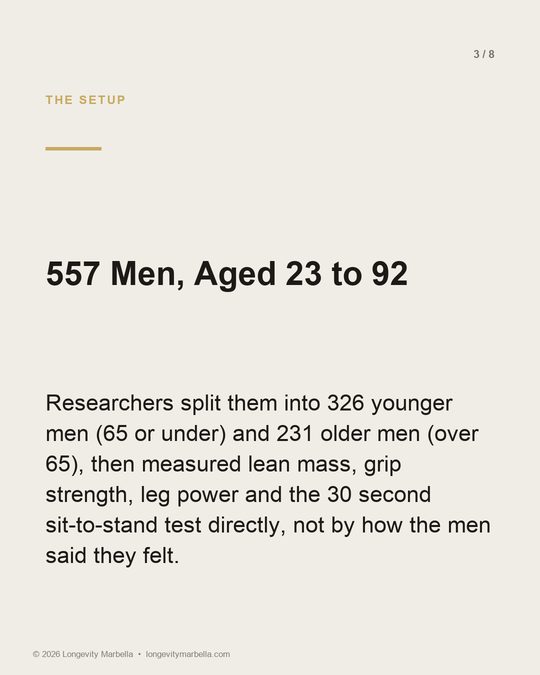
The team measured 557 men aged 23 to 92, split into 326 younger men aged 65 or under and 231 older men over 65. Rather than relying on how the men felt, they measured the body directly:
- Appendicular lean mass and skeletal muscle index, the muscle in the arms and legs, scaled to body size.
- Handgrip strength, a simple squeeze test that predicts a surprising amount about long-term health.
- Leg extension power, how forcefully the leg can be driven out, which is force and speed together rather than slow strength.
- The 30 second sit to stand test, how many times a person can rise from a chair in half a minute.
They then measured total testosterone, sex hormone binding globulin and albumin, and from those calculated free testosterone. Every result was adjusted for age, body mass index and body fat percentage, which turns out to matter a great deal.
Total and free testosterone are not the same number
Most of the testosterone circulating in your blood is cargo still in transit, not deliveries made. It travels bound to a carrier protein called sex hormone binding globulin, the way goods travel sealed inside a truck, and while it is bound it does nothing. Only the small unbound portion, the free testosterone, is off the truck, able to enter a cell and act.
Sex hormone binding globulin tends to rise with age: more trucks, more hormone sealed inside. So an older man can carry a respectable total testosterone result, a count of everything in circulation, while the biologically active fraction, the part off the truck, has fallen. The number on the report looks reassuring. The hormone is not reaching the tissue. That gap is what this study set out to measure.
What they found
In the older men, calculated free testosterone was positively associated with skeletal muscle index, percentage lean mass, grip strength, leg power and sit to stand performance. Total testosterone was not, with the single exception of leg power.
The sharpest detail is what happened once body fat was accounted for. Total testosterone's link to grip strength weakened until it no longer reached statistical significance. Its link to muscle index disappeared altogether. Free testosterone's associations held.
When every muscle measure was pooled into one overall picture of muscle status, free testosterone and the free testosterone index were significantly associated with it in older men. Total testosterone was not.
In the younger men, the pooled model found nothing significant either way. That is informative in itself: this looks like a problem of aging rather than a rule that applies to every man at every age.
What this does and does not prove
This was a snapshot of men at a single point in time, so it shows association, not cause. It cannot tell you that raising free testosterone builds muscle, and we are not going to pretend otherwise. Men who carry more muscle may simply run different hormone profiles.
The blood samples were also drawn without fasting and not exclusively in the morning, which departs from testing guidelines, and testosterone was measured by immunoassay rather than mass spectrometry. Free testosterone was calculated using the Vermeulen equation rather than measured directly by equilibrium dialysis. Those are real limitations, though the Endocrine Society, the European Society of Endocrinology and the Danish Endocrinology Society all endorse the Vermeulen calculation when direct measurement is impractical, which in ordinary clinical practice it usually is.
So this is one good study consistent with a body of earlier work, not a final answer.
Why we measure free testosterone
This is where it changes what happens in a consultation.
A man in his sixties arrives tired, weaker than he was, losing ground in the gym, and his total testosterone comes back inside the reference range. He is told everything is fine. Nobody calculated his free testosterone, and nobody measured his sex hormone binding globulin, which was the number that would have explained him.
We look at the full picture rather than the single headline value: total testosterone, sex hormone binding globulin, albumin, and free testosterone calculated from them, read alongside what you are actually experiencing. A normal total testosterone does not close the question, and this study is a clear illustration of why. More on what a thorough panel includes here: what a proper men's health blood panel measures, and on the symptom side, signs of low testosterone in men.
That is not a promise of treatment. Plenty of men with symptoms turn out not to need hormone therapy at all, and establishing that properly is worth as much as any prescription. But the assessment has to be complete before anyone can say either way. If treatment is appropriate, how it is done and monitored is covered in our TRT page.
The wider point about muscle
Grip strength and sit to stand are not gym vanity metrics. They are among the better predictors of how independently a person will live in later decades, which is exactly why researchers keep reaching for them. Muscle is not decoration, and we have written about that evidence separately in why muscle matters.
If your strength is changing and a standard test came back normal, that deserves a second look rather than a shrug.
What is free testosterone?
Free testosterone is the fraction of testosterone in your blood that is not bound to carrier proteins and can therefore enter cells and act. Most of your testosterone is bound to sex hormone binding globulin and is biologically inactive while it stays bound.
Can my total testosterone be normal while my free testosterone is low?
Yes, and it becomes more common with age, because sex hormone binding globulin tends to rise as men get older. More of the hormone is bound and unavailable to tissue, while the total figure still reads as acceptable.
Does this study prove that raising free testosterone builds muscle?
No. It was cross-sectional, meaning it looked at men at one moment rather than following them over time, so it establishes association rather than cause. It does show that free testosterone tracks muscle mass, strength, power and physical function in older men more closely than total testosterone does.
Should I ask for free testosterone to be measured?
If you have symptoms and a normal total testosterone result, it is a reasonable question to raise with the doctor treating you. Calculating it requires sex hormone binding globulin and albumin alongside total testosterone, and the free value is then computed from them.
Does this apply to younger men too?
Less so, on this evidence. In men aged 65 and under the pooled analysis found no significant relationship between either hormone measure and overall muscle status. The clearer signal was in the older group.