
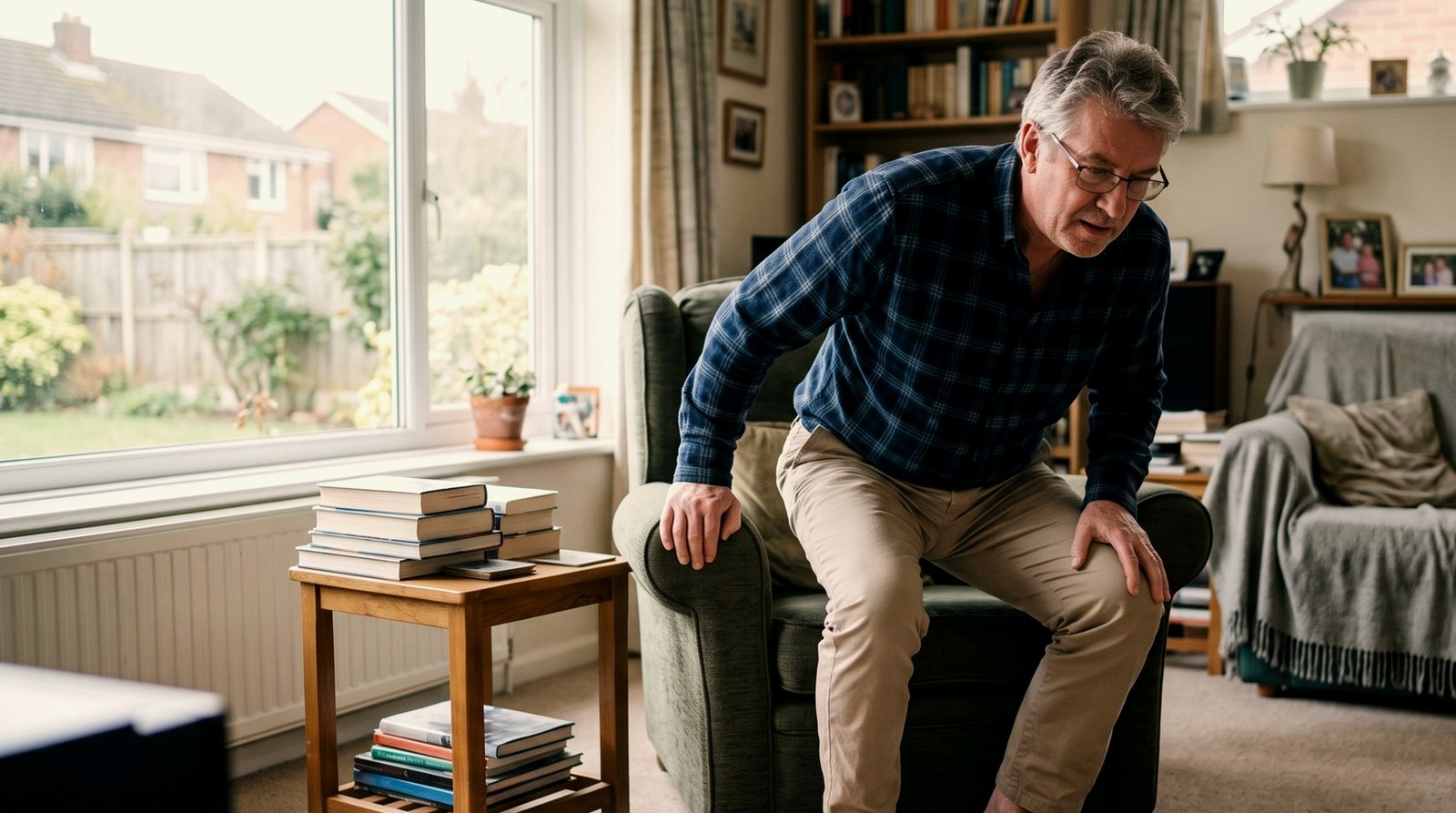

You want the weight gone. You do not want to end up smaller but softer, tired, and weaker, watching your arms and legs thin out along with your waist. That fear has a name people search for constantly: skinny-fat. And it is a fair thing to worry about on a GLP-1 drug.
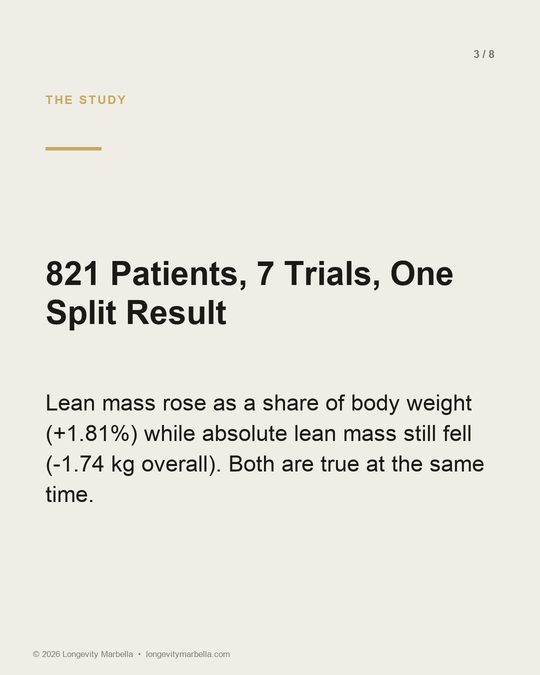
- A 2026 meta-analysis of 7 RCTs (821 patients) found lean mass improved as a proportion of body weight (+1.81%), but absolute lean mass still decreased (-1.74 kg overall). Both are true at once.
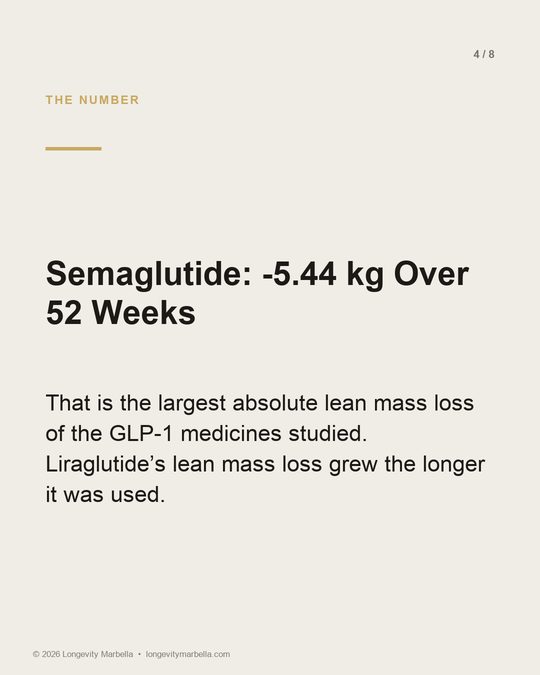
- Semaglutide showed the largest absolute lean mass loss of the medicines studied, -5.44 kg over 52 weeks; liraglutide's lean mass loss grew with duration of use.
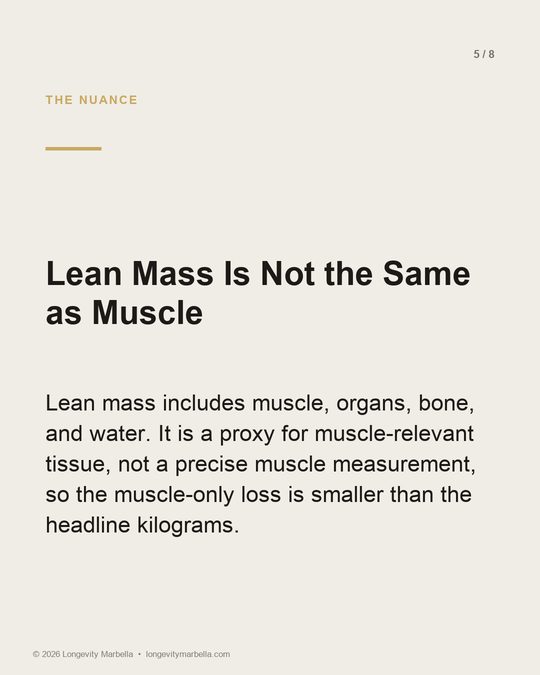
- "Lean mass" includes muscle, organs, bone, and water. It is a proxy for muscle-relevant tissue, not a pure muscle measurement, so the muscle-only loss is smaller than those figures.
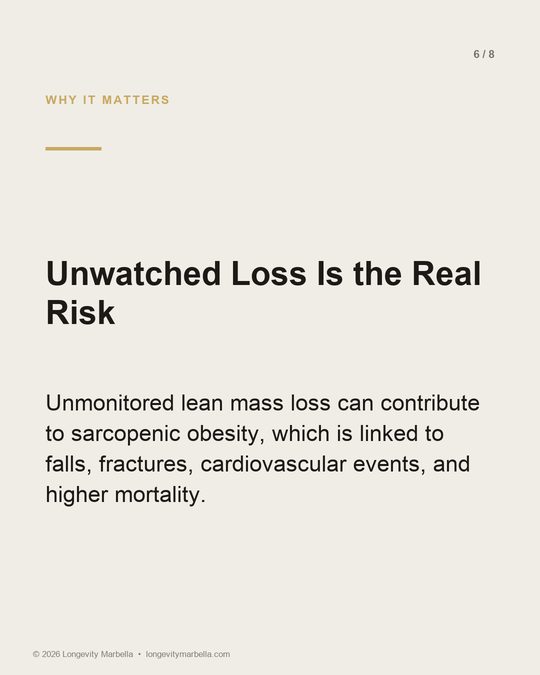
- Unmonitored lean mass loss matters because it can contribute to sarcopenic obesity, linked to falls, fractures, cardiovascular events, and higher mortality.
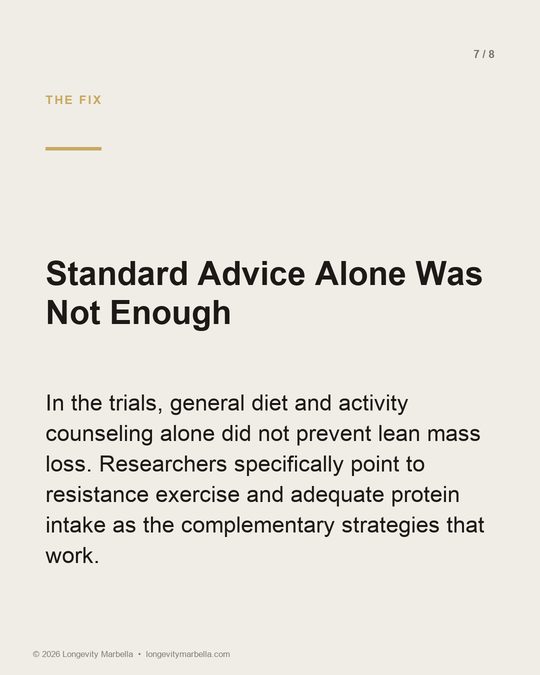
- Standard diet and activity advice alone did not prevent lean mass loss in the trials. The authors specifically recommend resistance exercise and adequate protein intake as complementary strategies during treatment.
- The evidence does not support avoiding GLP-1 medicines because of this. It supports pairing them with monitoring and muscle-protective strategies, which is what a supervised protocol does.
Here is the honest part. Yes, some of the weight you lose on Ozempic, Wegovy, or Mounjaro can come from lean tissue, not only fat. The scale cannot tell the difference. So the worry is not imaginary.
But here is the part that should settle your nerves: that muscle loss is largely preventable. Not with a secret hack, with three things a good plan builds in from day one, and that the research points to directly. Let us walk through what actually happens to your muscle, and how you keep it.
- Yes, some lean mass can be lost while you are on a GLP-1 drug. The scale weighs fat, muscle, and water together, so weight loss is never purely fat.
- It is largely preventable. Muscle loss is not an unavoidable side effect of these medicines, it is what happens when weight comes off without support.
- Three things protect your muscle: enough protein, regular resistance training, and body-composition monitoring so you catch losses early.
- Standard "eat well and stay active" advice was not enough in the trials. It takes a real, structured plan, not a leaflet.
- We build all three into a supervised, prescription-based protocol, so you lose fat and keep your strength.
Does a GLP-1 drug really take muscle, or is that a myth?
It can take some, but far less than the headlines suggest, and the "melts your muscle" panic is overblown. A 2026 systematic review in the International Journal of Obesity pooled 7 randomized controlled trials and 821 patients to measure exactly this. It looked only at GLP-1 receptor agonists at their approved obesity doses (liraglutide 3 mg daily, semaglutide 2.4 mg weekly, and tirzepatide 5, 10, or 15 mg weekly) against placebo.
Two findings sound contradictory until you see why they both fit:
- Lean tissue went up as a share of body weight, by 1.81% (95% CI 1.1 to 2.52; high-certainty evidence). You end up as a leaner-built version of yourself.
- Total lean mass in kilograms still went down, by 1.74 kg on average (about 3.8 lb; 95% CI -3.04 to -0.45), a 3.06% drop.
Both are true. Fat simply falls faster than lean tissue, so you get a bigger slice of a smaller pie even while the raw kilograms of lean tissue tick down. The size of that dip varied widely between studies (I² = 98%, which the authors flag honestly), so your result depends on the drug, dose, duration, and you.
The drug-specific number that grabs headlines: semaglutide showed the largest absolute lean-mass loss of any medicine studied, about 5.44 kg over 52 weeks (roughly 12 lb; 95% CI -7.07 to -3.81). Liraglutide's loss was small under a year (around 1.05% of lean mass) but was about 4.27% (roughly 2.65 kg) with use beyond 52 weeks, though that longer-term figure rests on a single small study, so treat it as a signal rather than a settled number. The longer you treat and the more you lose, the wider the lean-mass dip tends to be, which is exactly why monitoring matters.
Want to lose the fat and protect your muscle? Let us build the plan around that.
Message us on WhatsAppIs "lean mass" the same as the muscle I care about?
Not exactly, and that matters in your favor. The body scans used in these trials measure "lean mass," or fat-free mass, which is a mixed bag: it includes skeletal muscle, but also organs, bone, and body water. Reading a 1.74 kg or 5.44 kg lean-mass drop as pure muscle is like weighing a moving truck and calling it all furniture. Some of what you lose is genuinely muscle-relevant tissue worth protecting, but the pure muscle-only figure is smaller than those headline kilograms.
Why does this actually matter, beyond how I look?
Because muscle is protective, and losing too much of it unwatched is the real risk, not vanity. Losing some lean mass while losing more fat is normal for almost any big weight loss, drug or not. The concern is only when lean-mass loss is large enough, or goes unwatched long enough, to tip someone toward sarcopenic obesity: too much fat plus too little muscle. That combination is linked to worse metabolic health, more falls and fractures, more cardiovascular events, and higher mortality. We unpack why muscle is protective in Muscle Is a Survival Organ.
The takeaway is simple: protecting muscle here is not cosmetic, it is a clinical variable worth tracking, which is precisely why we track it.
Is the muscle I lose harmful, or a normal part of getting leaner?
For most people it is a normal, adaptive response, and your muscle can even improve in quality. A 2024 review in Circulation used sharper imaging (MRI) than standard body scans and asked whether the muscle change on GLP-1 treatment is maladaptive (harmful), adaptive (a proportionate response to weight loss), or enhanced. Its verdict for most people: adaptive. The muscle lost roughly matches the weight lost and normal aging, and because these drugs cut the fat stored inside the muscle, its quality often improves even as its size comes down. Think of marbling in a steak: trim the fat woven through it and what is left is leaner, higher-grade tissue.
Two facts keep it in proportion:
- Some lean-mass loss is the rule for any real weight loss. Across diet, behavior, and drug-based approaches it made up about 6% to 26% of the weight lost, overlapping with bariatric (weight-loss) surgery at roughly 19% to 24%.
- GLP-1 receptors are the ignition a drug key turns, and human muscle has none, so these drugs cannot act on it directly. Any effect is indirect, driven mostly by eating less and losing weight, which is exactly why the loss responds to protein and training.
So both extremes are wrong: the "melts your muscle" panic and the "muscle never matters here" shrug. The measured take, from a 2025 Nature Reviews Endocrinology commentary, is that muscle loss should not be the price of fat loss, and it matters most in older adults, the pre-frail, and anyone starting with low muscle. Those groups need careful candidate selection, closer monitoring, and active muscle protection.
Not sure whether you are in the higher-risk group? A quick consult can tell you, and give you a plan that keeps your strength.
Message us on WhatsAppLose the fat. Keep the muscle.
Protein, resistance training, and monitoring, working together. That is the whole answer, and it works. Here is the finding that should shape how these drugs are prescribed: in all 7 trials, both groups got standard diet and activity advice, and the treated groups still lost lean mass. General advice at a routine prescription visit was not enough on its own. The authors are specific: preserving muscle needs "complementary strategies, such as resistance exercise and adequate protein intake," used alongside the medicine, not instead of it.
The 2025 Nature Reviews Endocrinology commentary sharpens the how:
- Adequate protein. Give your body a steady supply of the raw material it uses to hold muscle while you eat less overall.
- Resistance training. Lifting signals your body to keep the muscle it is using. Pairing structured exercise with a GLP-1 drug is widely recommended to support fat loss while protecting lean mass.
- Creatine and aerobic work. Discussed alongside training and protein as practical ways to help hold onto lean mass during weight loss. On the safety of creatine, see Does Creatine Damage Your Kidneys?
This is a mitigation, not a magic guarantee. The evidence does not say protein and training erase lean-mass loss, only that they are what works against it. A newer class of muscle-preserving drugs (such as bimagrumab, which blocks the myostatin and activin pathway, in effect releasing one of the body's brakes on muscle) is being tested alongside GLP-1 treatment, but these are still investigational and not part of standard care. They do show that the field now treats muscle preservation as central, not an afterthought.
None of this changes the core efficacy and safety picture, which we cover in Mounjaro & Wegovy: How Safe and How Effective Are They?, or how the next generation compares in Retatrutide vs Mounjaro vs Wegovy.
This is exactly why a specialist-guided GLP-1 protocol is more than a prescription. Body-composition tracking through treatment, plus structured nutrition and resistance-training guidance, are what turn "lost weight" into "lost fat, with muscle protected as far as the evidence allows."
Fat, muscle, and change over time, measured before and during treatment. The Body Composition Assessment
If you are going to do this, do it the right way: prescription medicine, supervised, with your muscle protected.
Message us on WhatsApp