


You did not come here to be lectured. You came because something is not right, and because you would rather have it looked at properly, in private, by someone who has seen it before.
Not sure if this applies to you? One-minute check.
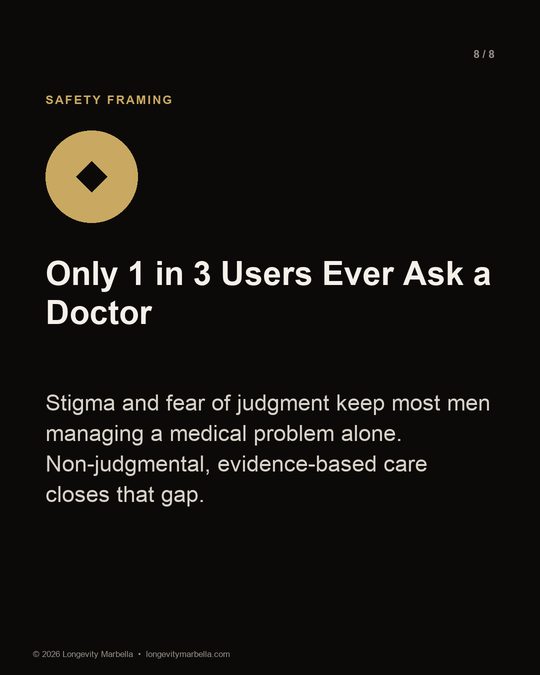
- Steroid use is common, but only about 1 in 3 users ever seek medical care about it.
- Steroids switch off the body's own testosterone thermostat (the HPG axis), which is why your own testosterone and sperm shut down during use.
- Health effects span sex drive, fertility, the heart, liver, blood, tendons, mood, and skin, with severity tied to dose, duration, and which compounds were used.
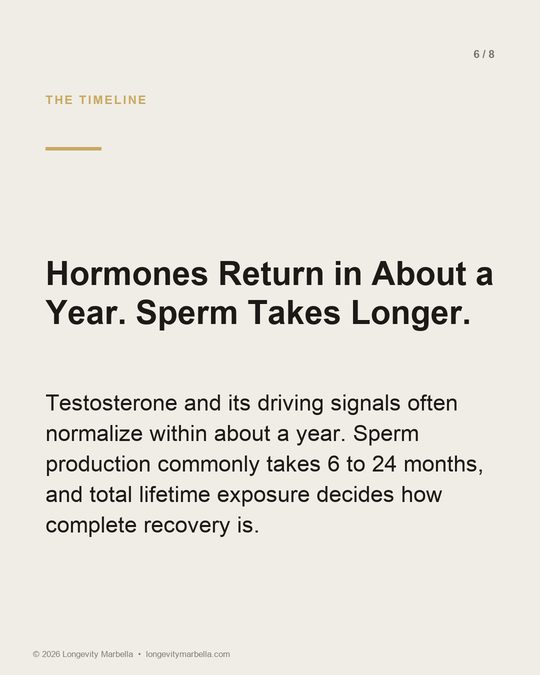
- Hormonal recovery is often faster (about a year) than sperm recovery (6 to 24 months); more total use means slower, sometimes incomplete, recovery.
- There is no one-size-fits-all protocol. The right approach depends on exposure history, current hormone levels, and whether fertility is a near-term goal.
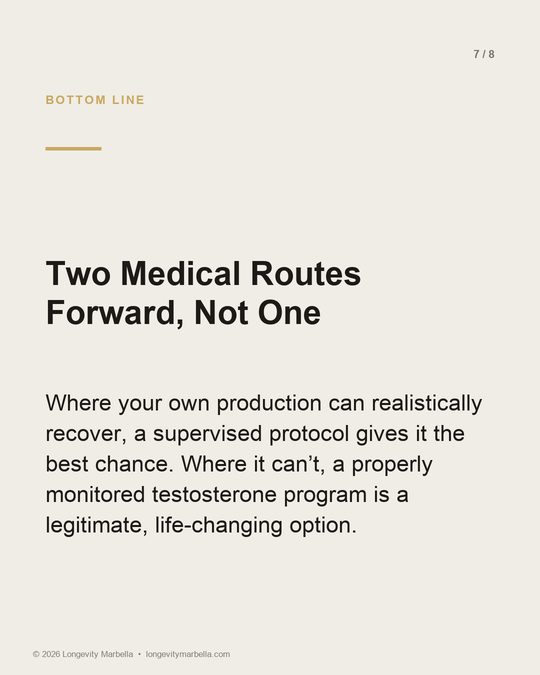
- Two things are actively treated here: recovery of your own testosterone production, and recovery of fertility. Where recovery is not realistic, a properly monitored testosterone program is the other legitimate route. All of it decided with a specialist rather than alone.
Here is the honest version, and the good news underneath it: most of what you are worried about can be checked, and a lot of it can be improved. Coming off is the hardest part, and it is also the most treatable.
You do not have to sort this out alone, and nobody here is going to judge you for how you got here.
The quick version
- Long-term use can affect your heart, your hormones, and your fertility. That is the honest bottom line.
- Almost all of it can be measured with a simple set of blood tests and a few checks, so you actually know where you stand.
- Much of it improves once you have a plan. Heart and blood changes often ease after stopping, and low hormones can be managed.
- Coming off is the hardest part for most men, and it is the part medicine handles best.
- Entirely confidential, and free of moralizing. Clear measurements, an honest read, and a plan that belongs to you.
Discreet, and handled by a specialist. If something is not right, it can be measured this week and answered properly.
Message us on WhatsAppWhat are steroids actually doing in there?
Short answer: they switch off your body's own testosterone, and that one thing explains almost everything else.
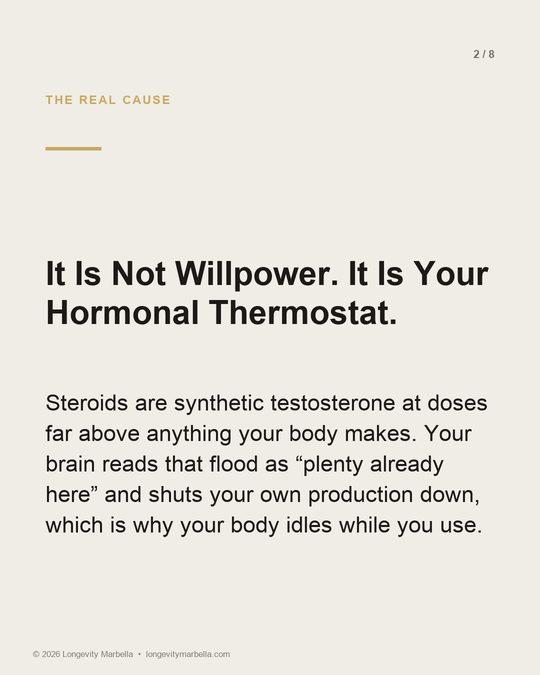
Think of your testosterone system as a thermostat. Your brain reads how much testosterone is around and tells the pituitary gland (a small gland at the base of the brain) to release two signals, LH and FSH, which tell the testes to make testosterone and sperm. Doctors call this loop the HPG axis (the brain to testes control system).
Anabolic-androgenic steroids are synthetic testosterone at doses far above anything your body makes on its own. To the thermostat, that flood of outside hormone reads as "plenty already here," so it shuts your own production down. LH and FSH collapse, and the testes stop making testosterone and sperm. That is why the body idles while you use, and why stopping does not flip the switch back on the next morning. The system has to be coaxed back into starting.
Will my heart, liver, and the rest be okay?
Short answer: some effects reverse after you stop, some build up with years of use, and every one of them can be measured. Here is the honest rundown, organ by organ.
The evidence here is mostly observational rather than from randomized trials, for obvious ethical reasons, but the pattern across many independent studies is consistent.
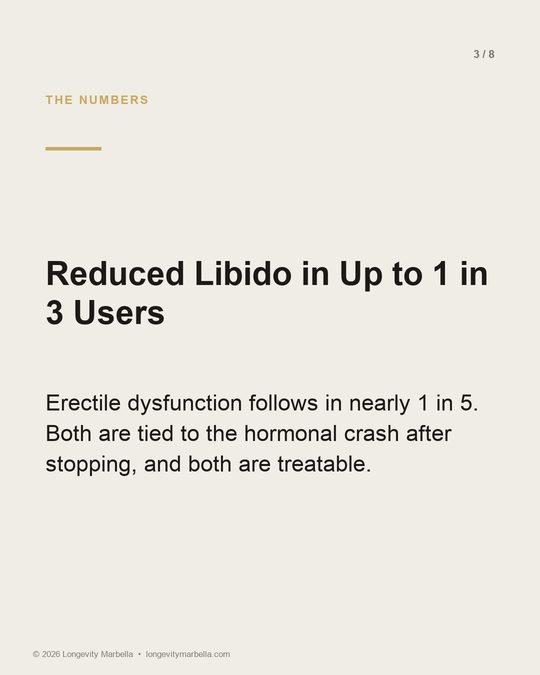
- Sex drive and erections. In the sexual-medicine review by Majzoub and Canguven, citing a meta-analysis by Corona and colleagues, reduced libido (low sex drive) was reported in up to about a third of users (31%, pooled from seven studies), and erectile dysfunction (trouble getting or keeping an erection) in up to 19%, nearly one in five, across six studies. A 2018 survey of 231 users by Armstrong and colleagues at the Mayo Clinic (Translational Andrology and Urology) puts a sharper edge on it: while using, most men reported normal function, but after stopping, 27 percent reported erectile dysfunction they had never had before and 57 percent reported reduced libido, with the highest rates in men who had used for more than ten years or more than forty weeks a year. This is self-reported survey data rather than a clinic examination, and it is still the clearest signal available. Both are tied to the hormonal crash after stopping, and both are treatable.
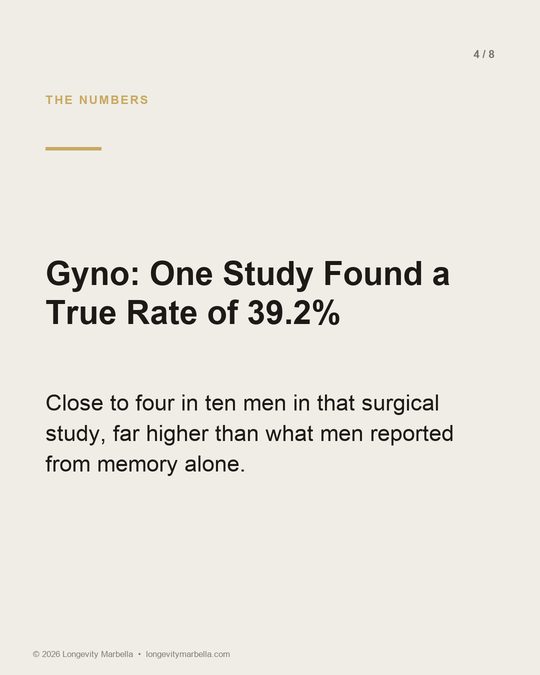
- Gyno. Gynecomastia (breast tissue growth in men) is common and easy to miss. One detailed surgical study in that review found a true rate of 39.2%, close to four in ten, nearly ten times higher than what men reported from memory alone. Timing decides what can be done about it. The European Academy of Andrology guidelines (Kanakis and colleagues, Andrology, 2019) note that once breast tissue has been present beyond about a year, fibrosis and hyalinization, scarring and hardening of the tissue, make spontaneous regression unlikely even after the cause is removed, which is when surgery becomes the realistic route rather than medication. The same guidelines make a point worth acting on: a proper workup cannot be completed while the compounds are still being used.
- Fertility. Sperm production falls, sometimes to zero, in a meaningful share of users. For most men this recovers over time, covered below.
- Heart. Imaging shows real changes in heart structure after even a single typical cycle: more muscle, thicker walls, a modest dip in pumping efficiency. These often reverse after stopping. Years of use is where it turns serious, and in 2025 the size of that risk was measured properly for the first time. It has its own section below, and the imaging evidence in full is in what anabolic steroids do to the heart, and what stopping changes.
- Liver. Most of the risk sits with oral steroids modified to survive the liver (the 17-alpha-alkylated agents). Effects run from mild rises in liver enzymes (blood markers of liver stress) to cholestasis (bile backing up), blood-filled cysts, and, rarely, tumors.
- Blood. Steroids thicken the blood, raising the red cell count and making it clot too readily. Both partly reverse after stopping.
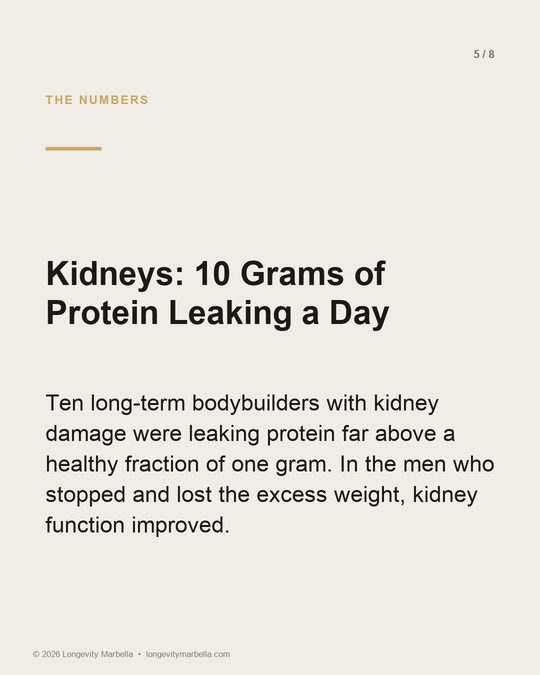
- Kidneys. This is the one people forget, and it can be the most serious. Heavy, long-term use damages the kidney's filters, both directly and through the pressure the rest of this list creates: raised blood pressure, thickened blood, and the sheer filtering load of carrying a large amount of extra muscle. In a kidney study by Herlitz and colleagues, ten long-term bodybuilders who developed kidney problems were found on biopsy to have focal segmental glomerulosclerosis (scarring of the kidney's filtering units), some of it the aggressive collapsing type, alongside scarring of the surrounding tissue. Their kidneys were leaking protein heavily, averaging around 10 grams a day when a healthy figure is a fraction of one gram, and their kidney function was clearly reduced. The important part is what happened next: in the men who stopped, lost the excess weight, and were followed, kidney function and protein leakage stabilized or improved, and the one man who went back to steroids relapsed. Caught early and acted on, this is often recoverable. Ignored, it is how people end up on dialysis.
- Tendons. Muscle outpaces the tendons anchoring it, and long-term users rupture tendons more often over a lifetime, especially in the upper body.
- Mood and sleep. Depression, anxiety, irritability, and disrupted sleep are common and can linger in some men after stopping. Heavy, long-term use has also been tied to changes on brain imaging and mild effects on memory in some studies.
- Skin and hair. Acne, oily skin, and pattern hair loss are common and only partly reversible. Scarring acne and hair loss may not fully resolve.
Every item on this list is measurable. A single properly chosen panel replaces years of quiet guessing.
Message us on WhatsAppThe heart, and why this is an internist's question
Short answer: the cardiovascular risk is real and now well measured, it is largely silent, and almost all of it is modifiable once someone is actually looking.
In March 2025, Circulation published the study this field had been missing. Windfeld-Mathiasen and colleagues took 1,189 men sanctioned for anabolic steroid use in Danish fitness centers between 2006 and 2018, matched each against fifty men of the same age from the general Danish population, 59,450 controls in total, and followed everyone for an average of eleven years through the national registries.
The men were, on average, 27 years old when the clock started. That is the detail to hold on to while reading what follows, because these are not events in old age.
Compared with matched controls, the AAS group had roughly three times the rate of heart attack (adjusted hazard ratio 3.00, 95% confidence interval 1.67 to 5.39) and a similar excess of coronary procedures, stenting or bypass (2.95, 1.68 to 5.18). Venous thromboembolism, blood clots forming in the veins, ran about two and a half times higher (2.42, 1.54 to 3.80), and arrhythmias, disturbances of heart rhythm, roughly twice (2.26, 1.53 to 3.32). Heart failure was three and a half times more common (3.63, 2.01 to 6.55). The largest figure of all was cardiomyopathy, disease of the heart muscle itself: close to nine times the rate of matched controls (8.90, 4.99 to 15.88).
Read that honestly and it says two things at once. This is an association drawn from an observational cohort, not a trial, and the authors are candid about the limits: they had no information on how much anyone used or for how long, and men sanctioned for doping differ from the general population in ways registries cannot capture, alcohol and smoking among them. Nobody can tell you from this study what your personal risk is.
But the second thing it says is the useful one. Every single outcome on that list is preceded by findings that can be measured now, years before an event: blood pressure, a lipid profile that steroid use characteristically distorts, red cell mass and blood viscosity, rhythm, and the structure and function of the heart muscle itself on imaging. Cardiomyopathy at nine times the background rate is alarming as a statistic and reassuring as a target, because heart muscle that is changing can be seen long before it fails.
This is the point at which a hormone doctor alone is not enough. Interpreting that panel, deciding what needs imaging, and then actually treating what is found, blood pressure, lipids, thickened blood, rhythm, is internal medicine, which is the specialty of the adult body as a whole and of exactly this kind of long-run cardiovascular risk: its diagnosis, its prevention, and its treatment. Endocrinology answers what your hormones are doing. Internal medicine answers what a decade of them has done to everything else, and what to do about it now. Being double board certified in both is not a credential detail here; it is the reason this assessment can be done in one place, by one physician, without you being handed between clinics and repeating your history to strangers.
If you have used, for a season or for fifteen years, this is worth knowing rather than wondering about. It is measured discreetly, it is explained plainly, and nothing about how you got here is of the slightest interest compared with what can be protected from here. We are here to help, and that is the whole of it.
The imaging studies behind this, what happens inside the heart muscle and the arteries and what changes when a man stops, are covered in full in what anabolic steroids do to the heart, and what stopping changes.
Will I get my body back after I stop?
Short answer: usually yes, though not on a fixed clock. Your hormones tend to come back first, sperm takes longer, and how much you used over the years matters most.
This is the part most men are never told. A cycle leaves the system idling like a stalled engine, and the job is a structured restart, not a quick jump.
The thermostat usually comes back on first, and the order is fairly consistent. A 2023 scoping review by Solanki and colleagues (Endocrine Connections) describes complete recovery of the brain signals, LH and FSH, expected over three to six months, with testosterone itself returning close to normal over months. Anawalt, writing in the Journal of Clinical Endocrinology and Metabolism in 2019, puts it more simply for the commonest case: men who used for under a year typically recover normal function of the whole brain-to-testes axis within a year of stopping.
Sperm takes longer, because rebuilding sperm-producing tissue is slower than restarting hormone secretion. The most precise figures come from the male contraceptive trials, where testosterone was given deliberately and then withdrawn under observation: recovery to 20 million sperm per milliliter was reached by 67 percent of men at 6 months, 90 percent at 12, 96 percent at 16 and effectively all by 24 months, with a median of three to six months. After nonmedical steroid use the published experience is thinner, mostly case series, and points to four to twelve months for many men, with some needing 24 to 30. Testicular size and libido follow their own clocks, months to years for the first and several months for the second, and libido often settles at a level below what it felt like during use, which is worth knowing in advance rather than discovering it and assuming something has gone wrong.
The biggest factor in how well and how fast you recover is your total lifetime exposure, how much you used and for how long. Men with lower total exposure tend to recover better. Men with years of high-dose, near-continuous use are more likely to see delayed, or in a meaningful subset, incomplete recovery. Knowing which group you are in starts with one blood test.
Why there is no one-size-fits-all fix
Short answer: three things decide the right path, how much you used, where your levels sit now, and whether you want kids soon.
An honest limitation, stated plainly: there are no large randomized trials and no formal guideline for recovery after nonmedical steroid use, because studying this population rigorously is genuinely hard. What exists is a pragmatic, evidence-informed approach built on those three questions.
That last one matters more than most men expect. If fertility is a near-term goal, starting testosterone replacement is usually the wrong move, since it suppresses your own production further rather than restoring it. The priority is helping the thermostat switch back on. In practice that means a personalized combination of clomiphene, which prompts the pituitary to start sending its own signals again, and hCG and hMG, which speak directly to the testes to restart testosterone and sperm production. Where bloodwork clearly calls for it, and only then, a medication that curbs the conversion of testosterone into estrogen may be added. To be transparent, none of these are officially licensed for this specific use. They are off-label, based on physiological reasoning and smaller studies, which is exactly why individualized specialist judgment beats a fixed protocol. If fertility is not an immediate goal and levels stay low after a fair period off, conventional testosterone therapy can be reasonable, chosen with a full understanding of what it means for future fertility.
What if I have used for years and can't seem to stop?
Short answer: that is not weakness, it is predictable physiology, and it is very treatable. There are two honest medical routes, and a specialist can tell you which one fits.
This is the situation textbooks rarely address, and the one we see most. Some men have used so long that stopping feels impossible. They come off, feel flat, weak, and unwell, and go back, because their own production has not restarted, and in some cases will not fully. That is not a moral failing. It is your body doing exactly what the biology predicts.
There are two honest routes, both medical. Where recovery of your own production is realistic, a supervised protocol gives it the best possible chance. Where it is not, for men whose levels stay genuinely low after a fair trial off, a properly monitored testosterone program is a legitimate and often life-changing way to feel like yourself again and to manage your long-term health risks, entered with a full understanding of what it means for fertility. What matters is that the choice is made with a specialist who can measure exactly where you stand, not carried alone and not assembled from what circulates online.
This is exactly the kind of problem we take on. A discreet, individualized men's health assessment of your hormones, heart, liver, and blood, an honest read on whether recovery or replacement is the better path, and a monitored plan either way. Nothing about how you got here is the subject of the appointment. Where you go from here is.
Coming off is the hardest part, and it is the part medicine handles best. Message the specialist directly and we will start with measurements, not assumptions.
Message us on WhatsAppThe two things worth treating, and who you would be speaking to
Short answer: recovery of your own testosterone production, and recovery of fertility. Both are treated here, personally, by a specialist in exactly this.
Most men arrive with one of two questions, and they are rarely asked out loud. The first is whether their own production will come back, or whether they are looking at a lifetime on replacement. The second, usually asked later and more quietly, is whether they can still have children.
Both are answerable, and both are treatable, but they are not the same problem and they are not treated the same way.
- Recovery of your own testosterone. Where the evidence and your own measurements say restarting is realistic, the work is to give the system its best possible chance rather than to replace it. That means measuring what is actually there, LH and FSH, testosterone and free testosterone, estradiol, and the markers that quietly reveal what the body has been through, then supporting the restart with medication chosen for your situation and monitored while it happens. Where a fair trial establishes that your own production will not return to a level that lets you feel and function well, a properly monitored testosterone program is a legitimate answer rather than a defeat, entered with full knowledge of what it means for fertility.
- Recovery of fertility. This is its own discipline and it changes the order of everything. If children are a realistic goal, starting testosterone first is usually the wrong move, because it suppresses the very system that makes sperm. The work here is to restart that system deliberately, guided by semen analysis alongside the hormone panel, and to know when to be patient and when to intervene. The published experience says most men recover, and it says plainly that not all do, which is precisely why this is measured rather than assumed.
What both routes have in common is that they are medical decisions made on evidence about you, not a protocol lifted from someone else's history. That is what a specialist is for.
You would be dealing with one physician throughout, double board certified in Internal Medicine and Endocrinology, which is the relevant combination here: endocrinology is the specialty of hormones, and everything else on the list above, the heart, the blood, the liver, the kidneys, the blood pressure, is internal medicine. Consultations are private, in English or Dutch, by video or in person, and nothing about them appears anywhere. Discretion is not a service feature here, it is simply how medicine is practised.
Why so few men get help, and why that is the real problem
Short answer: only about one in three ever asks a doctor, usually out of fear of judgment, so most men manage a medical problem from a forum instead.
The reasons are consistent across studies: stigma, fear of being lectured, and worry about legal or professional fallout. So a large group of otherwise well-advised men, including many who take advice from the best professionals in every other part of their lives, end up managing a genuinely medical problem, hormonal, sometimes affecting the heart or liver, on information they would never accept in any other context.
There is a further reason it goes unaddressed for years: the signs are visible in ordinary blood work, but only to someone looking for them. Anawalt lists the clues that identify undisclosed use with some reliability, and they are quiet ones: a very low HDL cholesterol, a very low sex hormone binding globulin, the protein that carries testosterone in the blood, and an unexplained rise in red cell count. A routine check reports each of those as an isolated oddity. Read together, by someone who knows what they mean, they tell a coherent story.
That gap is the real issue. Whatever led to steroid use, the physiology afterward is a medical question with medical answers: what your hormone levels actually are, how your heart and liver are holding up, what your realistic recovery timeline looks like, and whether your fertility needs support. You deserve clear, judgment-free answers to those questions, and getting them is easier than the years of worrying about them. That first message is the hardest part, and it is the one that changes everything.