


You have read the warnings. Maybe a friend mentioned a heart attack, or you saw a headline about the prostate, and now a quiet fear sits in the back of your mind. Is this treatment going to hurt me?
Not sure if this applies to you? One-minute check.
- The old "heart risk" warning came from weak evidence.
- The largest trial ever (5,200+ higher-risk men, ~3 years) found no rise in heart attacks, strokes, or cardiac deaths.
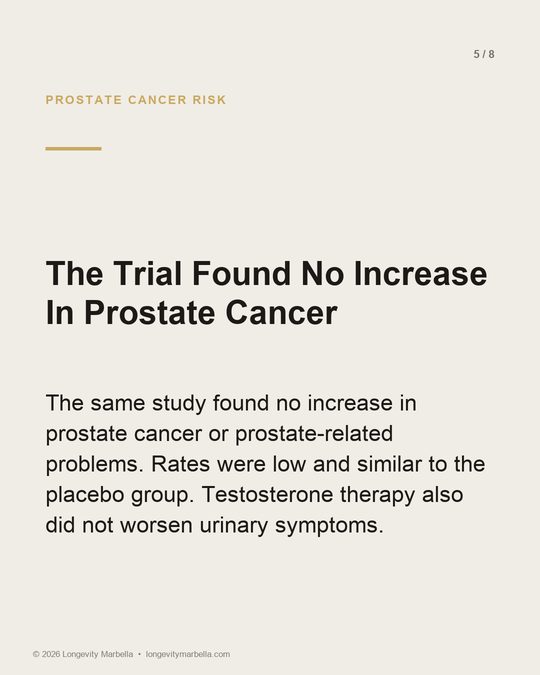
- No increase in prostate cancer or prostate problems.
- Bonus benefits: more energy, better libido, and reassurance about red-blood-cell levels.
- The trial noted a few smaller signals (atrial fibrillation, short-term kidney injury, lung clots, and a slight rise in fractures), not proven organ damage, and exactly what regular specialist monitoring is there to catch early.
- Safe for properly diagnosed men, prescribed and monitored by a doctor.
It is a fair question, and you deserve a straight answer. So here it is. For men who genuinely have low testosterone and are treated and monitored by a doctor, the best evidence we have says testosterone therapy is safe for the heart and the prostate.
The real danger is not testosterone itself. It is testosterone taken blind, without a diagnosis, without blood work, and without anyone watching. That is the exact opposite of how it is done here. Below is the full picture, in plain English, including the parts that sound scary.
The quick version
- The largest trial ever run (5,200+ higher-risk men, about 3 years) found no rise in heart attacks, strokes, or cardiac deaths.
- The same trial found no increase in prostate cancer or prostate problems.
- Modest rises in "thick blood" (hematocrit) were not linked to more clotting events in the trial, and your doctor tracks it closely.
- The old "heart risk" scare came from weak, outdated evidence, since overturned.
- This safety applies to properly diagnosed men, dosed to normal levels and monitored by a doctor, not to unsupervised, grey-market use.
Want to know if this is even the right treatment for you? A proper workup answers that before anything is prescribed.
Message us on WhatsAppWhere did the fear come from?
For years, testosterone therapy (often called TRT) carried a scary warning. Regulators worried it might raise the risk of heart attacks and strokes, based on a couple of older, weaker studies. That warning made a lot of men, and doctors, nervous.
The problem was that the evidence behind the warning was shaky. So researchers set out to settle the question properly.
Takeaway: the original scare was built on weak evidence, and it was tested head-on.
How was it finally tested?
A major trial known as TRAVERSE followed more than 5,200 men for about three years, the largest trial built to test testosterone's safety for the heart.
What makes it convincing is who was in it. These were not healthy young gym-goers. They were older men who already had heart disease or a high risk of it. If testosterone were going to cause heart problems, this is exactly the group where you would expect to see it.
Takeaway: if there were a hidden heart danger, this high-risk group would have exposed it.
Does testosterone cause heart attacks?
No. The trial found no increase in heart attacks, strokes, or heart-related deaths.
Men taking testosterone had essentially the same heart risk as men taking a dummy (placebo) treatment. In the highest-risk group you could pick, the therapy did not add danger. This was the result regulators had been waiting for, and it answered the original safety concern directly.
Takeaway: in the largest test ever run, TRT did not raise heart attack or stroke risk.
Will it give me prostate cancer?
No. The trial found no increase in prostate cancer or prostate-related problems.
The rates were low, and the same as the placebo group. Testosterone therapy also did not worsen urinary symptoms.
Takeaway: no rise in prostate cancer, and no worsening of urinary symptoms.
Still uneasy about your heart or prostate? Bring your worry to us, and get safe, supervised care built around your history.
Message us on WhatsAppAre there any upsides worth knowing?
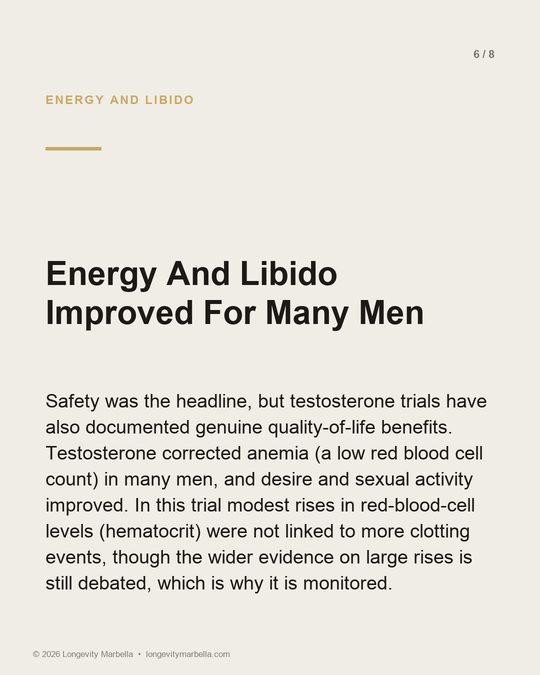
Safety was the headline, but testosterone trials have also documented genuine quality-of-life benefits:
- More energy. Testosterone corrected anemia (a low red blood cell count) in many men.
- Better sex drive. Desire and sexual activity improved.
- Reassurance on "thick blood." A rise in red-blood-cell levels (hematocrit) is a common worry, and in this trial modest rises were not linked to more clotting events. The wider evidence on large rises is still debated, which is why it is monitored.
Takeaway: alongside being safe, TRT improved energy and libido for many men.
But I saw some scary headlines. What about those?
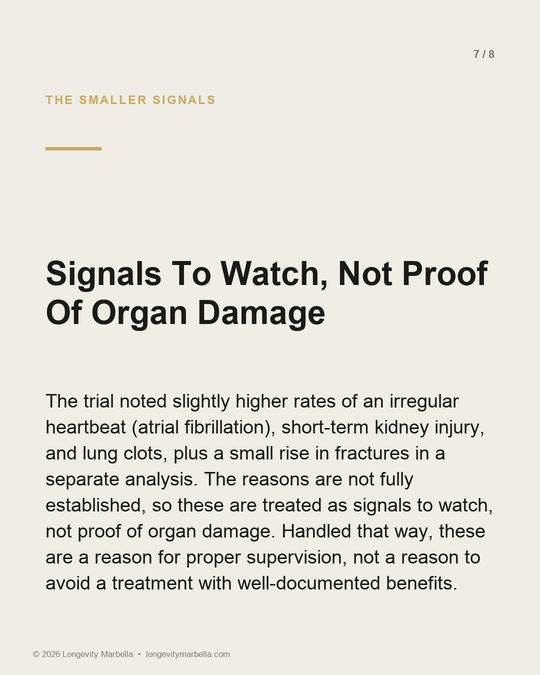
Being straight with you: alongside the reassuring heart and prostate results, the trial did note slightly higher rates of a few specific events in the testosterone group.
- An irregular heartbeat (atrial fibrillation).
- Short-term kidney injury.
- Clots in the lungs (pulmonary embolism).
- A small rise in fractures, in a separate analysis.
These are not the heart attacks the old headlines warned about. That main question was answered clearly, and the answer was no. The trial was not built to explain these smaller signals, and the researchers did not pin them on a single cause, so they are things to watch, not proof that testosterone harms an organ.
This is exactly where a specialist matters. With regular monitoring, anything like this is spotted early and acted on in time, well before it could become a problem. Handled that way, these are a reason for proper supervision, not a reason to avoid a treatment with well-documented benefits.
Takeaway: the small signals are things to monitor, and monitoring is precisely what catches them early.
So is it safe, or not?
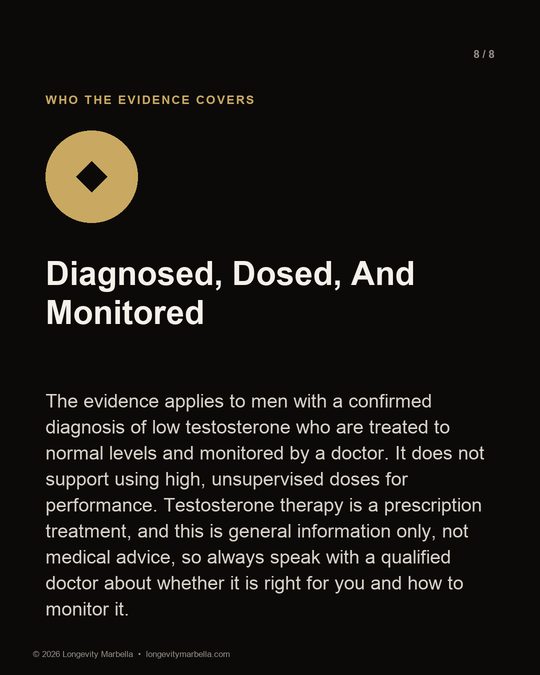
For the right person, yes. The key word is "right." This evidence applies to:
- Men with a genuine diagnosis of low testosterone (confirmed with blood tests and symptoms), not men chasing performance with unsupervised doses.
- Treatment dosed to a normal range and monitored by a doctor over time.
Used that way, the largest study to date says testosterone therapy is safe for the heart and prostate, and can meaningfully improve how men feel.
Takeaway: safe for properly diagnosed, dosed, and monitored men. The danger lives in the DIY version.
What does "monitored by a doctor" actually mean?
"Monitored" is not a vague reassurance. It is a specific routine, and it is what turns the trial evidence above into safe treatment in real life.
- Before you start: baseline blood tests, including your hematocrit (how thick your blood is, from the share made up of red cells) and, in men 40 and over, a PSA (a prostate marker).
- When we hold off: a hematocrit already above 48% (blood on the thick side to begin with), a recent heart attack or stroke, untreated severe sleep apnea, or an active prostate or breast cancer.
- Once you are on it: testosterone and hematocrit rechecked at around three to six months, then at least once a year, with PSA followed up too.
- The safety valve: a hematocrit climbing above 54% (blood that has become too thick) is the signal to pause and involve a blood specialist.
It is the same careful approach behind our testosterone therapy, and we walk through the full process in How Low Testosterone Is Diagnosed and Monitored.
Takeaway: this monitoring routine is the difference between safe treatment and a gamble.
This is the supervision that lets you feel confident on treatment. Ask us how the monitoring works for you.
Message us on WhatsAppWhy does the source of your testosterone matter?
Because the danger in this whole story is almost never the molecule. It is the setting.
There is no shortage of confident advice online, from influencers, coaches, and forums, much of it from people who will also sell you a protocol or the vials themselves. Naming the compounds and reciting doses is the easy part. What a physician brings is different in kind: a real understanding of the physiology, of who genuinely needs treatment and who does not, and the training to recognize, diagnose and treat what can go wrong, from a climbing hematocrit to blood pressure, fertility, estrogen, and cardiovascular strain.
That is precisely the moment the confident voices tend to fall quiet and tell you to see a doctor. We would rather be the doctor who set it up properly than the one you are sent to once something has already gone wrong.
Takeaway: grey-market, unmonitored use is the real risk. Proper supervision is what removes it.
Download these slides as a PDF Testosterone Therapy Safety, The Evidence in Full PDF, the complete, referenced version to read or print