


You want to feel well. You also want a family. You feel flat. Low energy, low drive, low mood. TRT could fix that. But you have heard it can make you infertile, and you still want children one day. So you are stuck.
Not sure if this applies to you? One-minute check.
- Standard testosterone therapy usually suppresses a man's own sperm production, because it switches off the brain signals (LH and FSH) the testicles need.
- This can cause a low sperm count (oligospermia) or no sperm (azoospermia), and the testicles may shrink somewhat.
- The Endocrine Society guideline advises against starting testosterone in men planning fertility soon.
- You often do not have to choose: hCG-based protocols, with hMG where needed, can help keep the fertility signal switched on.
- After stopping, sperm production usually recovers, but timing varies from months to over a year, and cannot be guaranteed.
- If you may want children, tell your doctor before starting, and choose a fertility-preserving protocol from the start.
Here is the honest core answer: yes, taking testosterone as therapy usually lowers your own sperm production. Many clinics gloss over that, and it is a real worry if you want a family now or later.
But there is a second, more hopeful half to the story. With the right protocol, you often do not have to choose between feeling well and protecting your fertility. Here is how it actually works, in plain language.
The quick version
- Yes, standard TRT usually suppresses your own sperm production. That is real, not a scare story.
- For most men this is reversible: sperm production usually returns after stopping, though timing varies.
- Fertility can often be protected from the start with the right protocol, built around hCG, with hMG added when it is needed.
- The single most useful thing you can do is tell your doctor you may want children before you start.
- This is exactly the kind of individualized plan our double board-certified specialist designs.
Worried TRT will cost you the chance to have children? Ask us how fertility can be protected.
Message us on WhatsAppWhy does testosterone therapy lower sperm production?
Because outside testosterone switches off the brain signals your testicles need to make sperm.
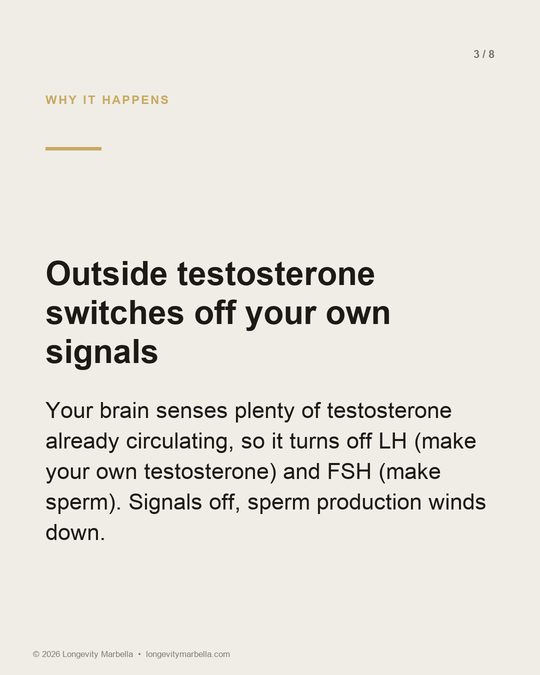
Picture a thermostat. Your brain constantly senses how much testosterone is in your blood. When the level looks right, it sends two signals down to the testicles: LH (make your own testosterone) and FSH (make sperm).
Take testosterone from an outside source and your brain senses plenty circulating. So it switches those two signals off, thinking the job is done. But the testicles need those signals to keep making sperm. Signals off, sperm production winds down.
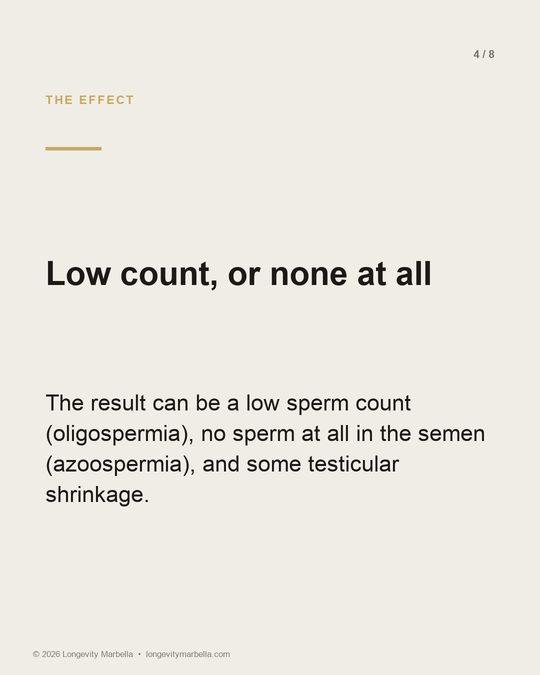
The result can be:
- A low sperm count (doctors call this oligospermia).
- In some men, no sperm at all in the semen (azoospermia).
- Some shrinking of the testicles, because they are no longer being told to work.
None of this means something has broken. It is the body responding exactly as designed to the outside supply.
Is this a real risk or just clinic caution?
It is well established in the medical literature, not a fringe worry.
- The Endocrine Society clinical practice guideline (Bhasin and colleagues, 2018, indexed on PubMed) recommends against starting testosterone therapy in men planning fertility in the near term, precisely because of this suppression. Read it at https://doi.org/10.1210/jc.2018-00229.
- A clinical case series (Sukegawa and Tsuji, 2020, on PubMed) followed men on testosterone who developed azoospermia or severe oligospermia, with their brain signals (the gonadotropins LH and FSH) strongly suppressed, exactly as the thermostat picture predicts. Sperm production generally recovered after stopping, but the time to recover was highly variable, and medicines such as hCG or clomiphene were used to help. Read it at https://doi.org/10.14989/ActaUrolJap_66_11_407.
How is fertility protected? (the part most clinics skip)
A doctor can design a protocol that helps keep the fertility signal switched on, instead of simply shutting it off and hoping for the best.
The tools, in plain terms. Which one applies depends entirely on whether you are currently on testosterone:
- hCG, the mainstay while you are on testosterone. It mimics the brain's own signal (LH) to the testicles. Even when the natural signal is quiet, the testicles keep getting the message to make testosterone and sperm. It is usually the first choice and often works on its own, alongside your therapy.
- hMG, added when more support is needed. This supplies the second signal, FSH, which drives sperm production directly. It is combined with hCG when your results call for it, sometimes from the start and sometimes added later. Closely related FSH preparations work in much the same way.
- Clomiphene, for men who are not on testosterone. Clomiphene works higher up, at the thermostat itself: it keeps the brain calling for heat, so LH and FSH keep flowing and your body raises its own testosterone. That is also why it is not the tool for men currently on TRT: outside testosterone has already switched the thermostat off, and clomiphene has no signal left to work through. It belongs to two situations instead, men who want to raise testosterone and protect fertility without going on TRT at all, and men coming off testosterone or anabolic steroids. In Spain, clomiphene is the pharmacy-grade option; enclomiphene, which is discussed a great deal online, is not available here.
- Aromatase inhibitors, only where genuinely warranted. These reduce the conversion of testosterone into estrogen. They have a poor reputation online, largely because they are self-prescribed and overused, and they are not part of every protocol. In experienced hands, at the right dose and only when your bloodwork clearly calls for it, they are a genuinely useful tool. They are never something to add on your own.
This is exactly the kind of individualized protocol our double board-certified specialist designs, chosen for your situation, your bloodwork, and your family plans, and monitored over time. It is not something to attempt alone or with grey-market products, where the dosing, the monitoring, and the safety net simply are not there.
Want a plan that does both: helps you feel well and helps protect fertility? Our specialist can design one for you.
Message us on WhatsAppIf I stop TRT, will my fertility come back?
For most men it usually recovers, but the timing cannot be promised in advance.
Recovery can take anywhere from a few months to over a year, and it genuinely varies from one man to another. Where recovery is slow, a restart protocol combining clomiphene, hCG and hMG can help support the return of sperm production. Once you are off testosterone, clomiphene becomes useful again, because the brain signal it works through is no longer suppressed. The exact combination and timing are personalized to you, which is one more reason to have a specialist involved, so that if the body is slow to restart, there is a considered plan to help it along.
What should I do before starting TRT?
Tell your doctor you may want children before you start. That one conversation opens options that are much harder to arrange later.
- Choose a fertility-preserving protocol from the start, built around hCG with hMG where needed, so you protect fertility rather than try to rescue it.
Both paths are far easier when planned in advance. This is a decision to make with a doctor who understands the physiology, not one to leave to chance.
For the wider picture of what supports healthy sperm and conception, see How to Improve Male Fertility. If you are weighing who should oversee your care, GP vs Endocrinologist for TRT explains why this kind of hormone work belongs with a specialist. And to understand the testing behind any of this, read How Low Testosterone Is Diagnosed and Monitored.