


You feel tired, flat, and not yourself, your libido has gone quiet, and you finally got tested, only to be told your testosterone is "normal" and sent on your way. If that is you, you are not imagining it, and you are not alone.
Not sure if this applies to you? One-minute check.
- Low testosterone is a diagnosis that needs both symptoms and confirmed low blood levels, not a single number.
- It is measured on a fasting morning sample and confirmed on a repeat; deficiency is defined as total testosterone below 300 ng/dL (about 10.4 nmol/L).
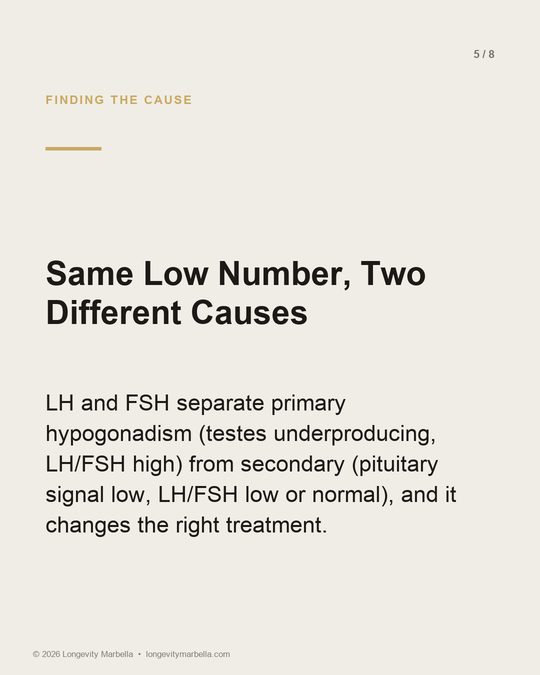
- LH and FSH separate primary hypogonadism (high LH/FSH, testes underproducing) from secondary (low or normal LH/FSH, pituitary signal low), which changes the right treatment.
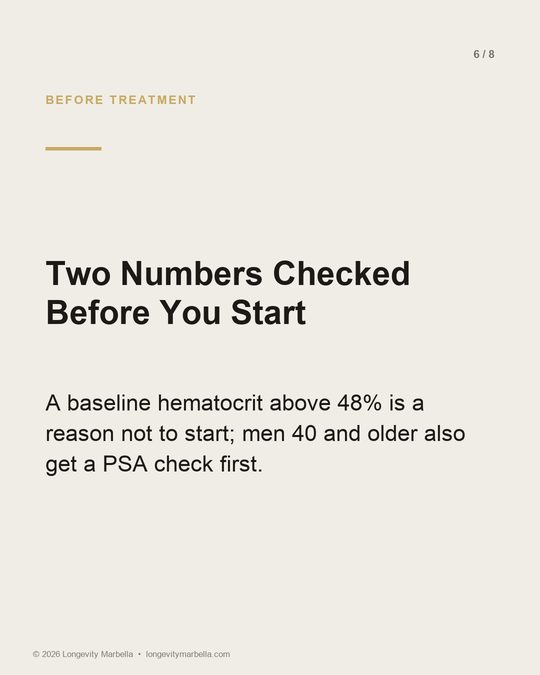
- Before starting, a baseline hematocrit and, in men 40+, a PSA are checked; a hematocrit above 48%, fertility plans, recent heart attack or stroke, untreated severe sleep apnea, or prostate or breast cancer are reasons to hold off.
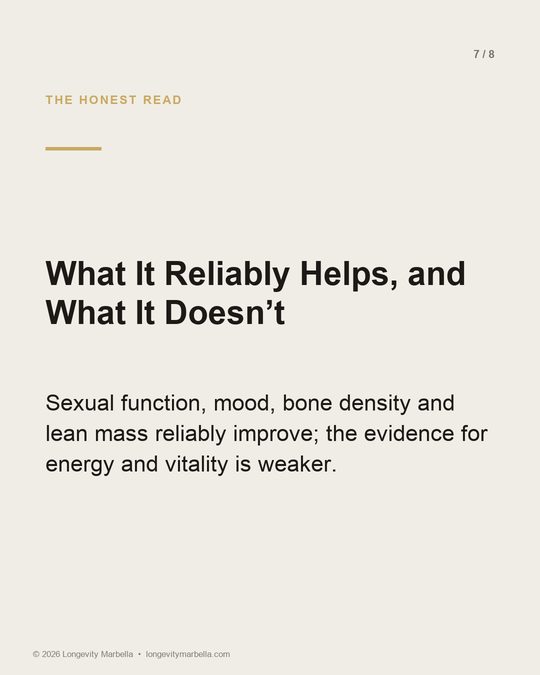
- Treatment reliably helps sexual function, mood, bone density and lean mass; evidence for energy and vitality is weaker.
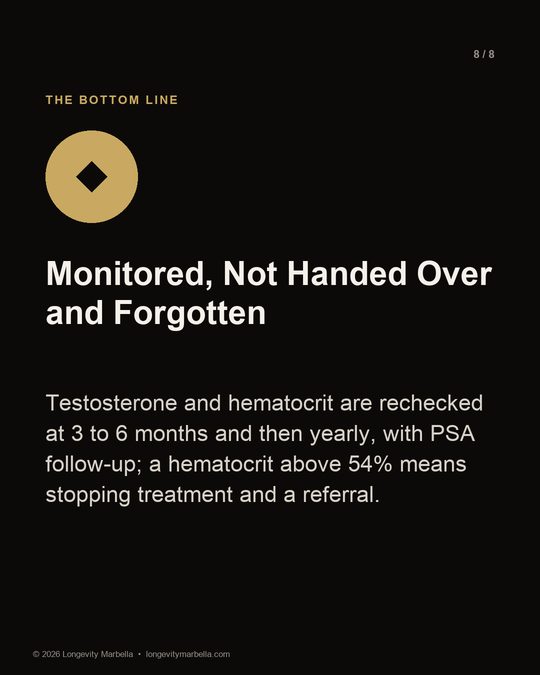
- On treatment, testosterone and hematocrit are rechecked at 3 to 6 months then yearly, with PSA follow-up; a hematocrit above 54% means stopping and referral.
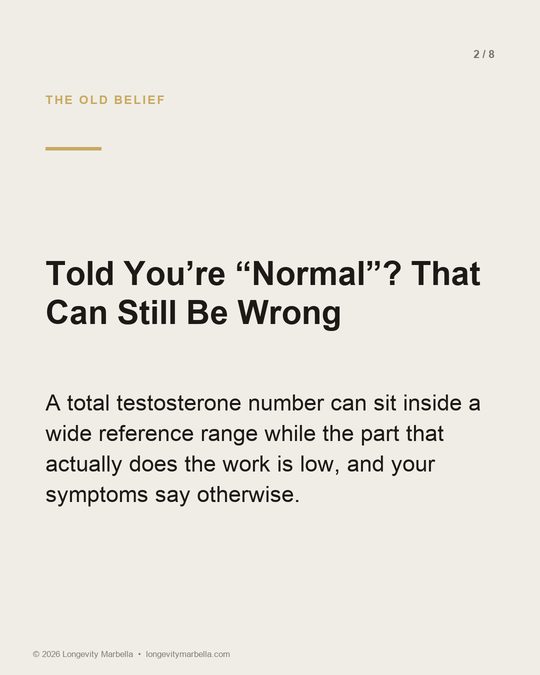
Here is the honest part most men are never told. "Normal" on a single lab line can miss a real problem. A total testosterone number can land inside a wide reference range while the part that actually does the work, your free testosterone, sits low, and while your symptoms say something is clearly off.
We test the way the guidelines actually intend, including free testosterone, and we read the result against how you feel, not just against a range. Here is how low testosterone is properly diagnosed and monitored, and where the usual approach falls short.
The quick version
- A single total-testosterone number can look "normal" and still miss a real deficiency.
- Most of your testosterone is bound and inactive; free testosterone, the biologically active part, is what matters, and it is often skipped.
- Your symptoms count. A diagnosis needs both the biochemistry and how you actually feel, not one figure on a screen.
- Proper testing is the answer: a fasting morning sample, confirmed on a repeat, with free testosterone and the right supporting markers.
- If treatment is right for you, it is monitored for safety over time, not handed over and forgotten.
Told your testosterone is "normal" but still feel awful? Let's get you tested properly, free testosterone included.
Message us on WhatsAppWhy do I feel low if my testosterone is "normal"?
Because low testosterone is a diagnosis, not a single number, and a wide "normal" range can hide a real deficiency.
Testosterone deficiency, or male hypogonadism, is defined as persistently low testosterone together with symptoms that fit.1 Both halves matter. The symptoms often blamed on low testosterone, low energy, low mood, poor concentration, reduced libido, loss of muscle and gain in body fat, have several possible causes, so a diagnosis is made when your symptoms and the biochemistry point the same way.12
The catch is that a wide reference range can absorb a man who genuinely has a problem. If your total lands at the low end of "normal" while your symptoms are loud, being told you are fine is not the end of the story. It is a signal to look harder, starting with the part of your testosterone that actually works.
What does "free testosterone" mean, and why does it matter?
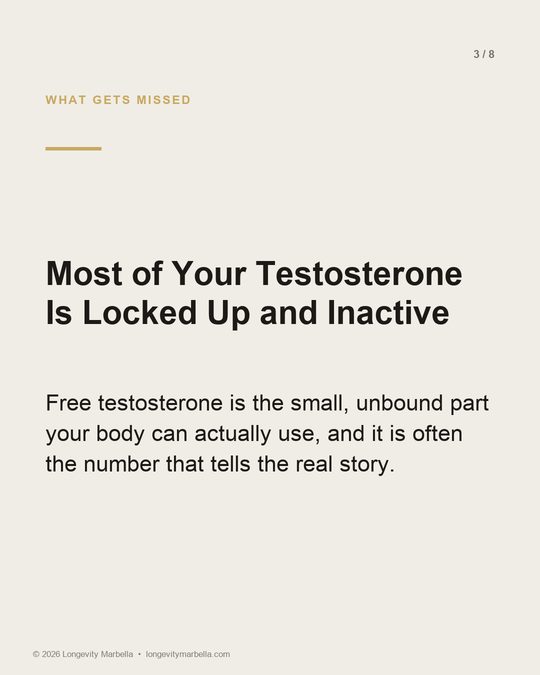
Most of the testosterone in your blood is locked up and inactive. Free testosterone is the small, unbound part your body can actually use, and it is often the number that tells the real story.
Most of your testosterone is bound to a carrier protein called SHBG and is inactive; only the small unbound fraction, free testosterone, is biologically active. Total testosterone counts the furnace's output; free testosterone is the warmth reaching the room, and SHBG decides how much is trapped between the two. When your total sits near the lower limit, or when SHBG runs high or low, an estimate of free testosterone by a validated method gives a truer read than the total alone.1
This is where careful practice parts ways with the routine approach. Much of mainstream medicine stops at total testosterone, and if that one number lands anywhere inside the range, the matter is treated as closed, even for a symptomatic man whose total sits at the low end. We do not stop there. We look at free testosterone, the biologically active fraction, and read it against your symptoms and the rest of your bloodwork, the way the guidelines intend.
The takeaway: a "normal" total with a low free testosterone and clear symptoms is exactly the picture the usual quick test misses.
Want real answers, not a wave-off? We measure free testosterone and read it against your symptoms, the way it should be done.
Message us on WhatsAppHow should low testosterone actually be tested?
With a fasting morning sample, confirmed on a repeat, plus free testosterone and the markers that find the cause. The blood side follows a specific method:
- A fasting, morning sample. Testosterone runs on a daily rhythm and peaks in the morning, so that is when it is measured for an accurate reading.1
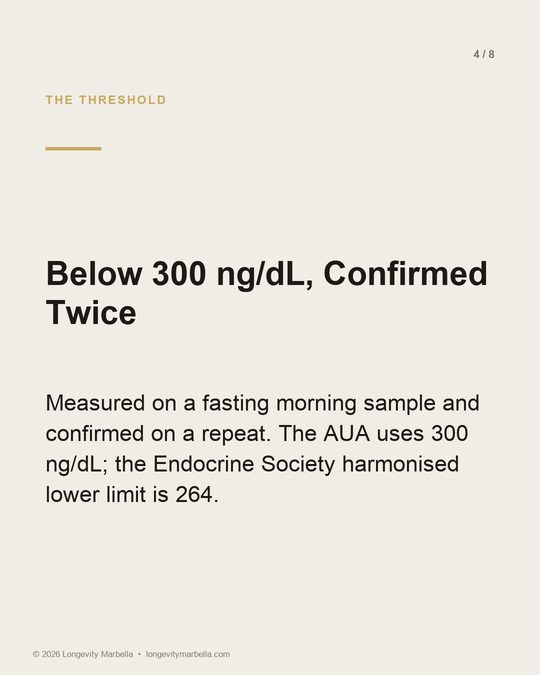
- Confirmed on a repeat. A single low result can be a blip. The American Urological Association defines deficiency as a total testosterone below 300 ng/dL (about 10.4 nmol/L), while the Endocrine Society uses a harmonized lower limit of 264 ng/dL, confirmed on a second morning test before any diagnosis is settled.13
- Free testosterone. The biologically active fraction, estimated by a validated method, especially when the total is borderline or SHBG is unusual.1
- LH and FSH to find the cause. These pituitary hormones separate the two very different forms of the condition, covered next.1
Does the cause matter? Primary versus secondary
Yes. Two men can have the same low testosterone for opposite reasons, and the difference changes what the right treatment is.1
- Primary hypogonadism. The testes themselves are underproducing, like a failing furnace, so the brain turns its thermostat call, LH and FSH, up high trying to compensate.
- Secondary hypogonadism. The signal from the brain and pituitary is the problem, a thermostat that no longer calls for heat, so LH and FSH are low or normal despite the low testosterone. When those are low, further evaluation, such as a prolactin level, looks for a treatable cause.
Identifying which form is present is not academic. It guides whether replacement is appropriate, whether fertility can be protected, and whether something else needs treating first.1
What has to be checked before starting treatment?
Treatment is never started on a low number alone. A proper baseline and a few safety checks come first.
- Hematocrit. How thick your blood is, from the share made up of red cells, because testosterone can raise it. A baseline above 48% is a reason not to start.1
- PSA in men 40 and older. A prostate marker, because prostate health has to be accounted for.1
- Reasons to hold off. Plans to conceive in the near future (testosterone suppresses natural sperm production), recent heart attack or stroke, untreated severe obstructive sleep apnea, or known prostate or breast cancer.1
This is the assessment a home test kit cannot do for you, and skipping it is how avoidable harm happens.
What does treatment reliably do, and what does it not?
In properly diagnosed men it reliably helps sexual function, mood, bone density, and lean mass; the evidence for energy and vitality is weaker, and honesty about that is part of good care.
Testosterone therapy has been shown to improve sexual function and depressive symptoms, and to increase bone density and lean body mass.1 It is also honest to say where the evidence is weaker: large trials found benefit for sexual function and some benefit for mood, but no clear benefit for vitality or walking distance, and the American College of Physicians advises discussing treatment mainly to improve sexual function rather than for energy, physical function, or cognition.14 On the safety question that worries most men, the large TRAVERSE trial found testosterone was noninferior to placebo for major cardiac events in men at high cardiovascular risk, though it recorded more atrial fibrillation and pulmonary embolism in the treated group.5 We cover that cardiovascular evidence in depth in Is Testosterone Therapy Safe?
How is testosterone therapy monitored?
By rechecking your levels and blood on a set schedule and adjusting to how you feel, not by handing over a prescription and forgetting it.
The goal is to bring testosterone into the mid-normal range and, above all, to improve how you actually feel, while watching for the predictable effects of treatment.1 In practice:
- Serum testosterone and hematocrit rechecked at around 3 to 6 months, then at least once a year.1
- PSA reassessed after starting and at least annually in older men.1
- A hematocrit above 54% (blood that has become too thick) is a signal to pause treatment and involve a blood specialist.1
None of this is exotic, but it has to be done consistently, which is why testosterone is best managed as an ongoing, supervised relationship rather than a one-off script. It is the same monitored approach behind our testosterone therapy. Everything above starts with reading the right markers correctly, which we cover in What a Proper Men's Health Blood Panel Actually Measures, and it is worth knowing who is best placed to oversee testosterone treatment before you begin.
Stop being brushed off. Talk to us about correct testing, an honest read on your results, and a safely monitored plan if treatment is right for you.
Message us on WhatsAppA candid word on the noise around testosterone. There is no shortage of confident advice online, from influencers, coaches, and forums, much of it from people who will also sell you a protocol or the vials themselves. Naming compounds and reciting doses is the easy part. What a physician brings is different in kind: a real understanding of the physiology, of who genuinely needs treatment and who does not, and the training to recognize and manage what can go wrong, a climbing hematocrit, blood pressure, fertility, estrogen, cardiovascular strain. That is precisely the moment the confident voices fall quiet and tell you to see a doctor. We would rather be the doctor who set it up properly than the one you are sent to once something has already gone wrong.