


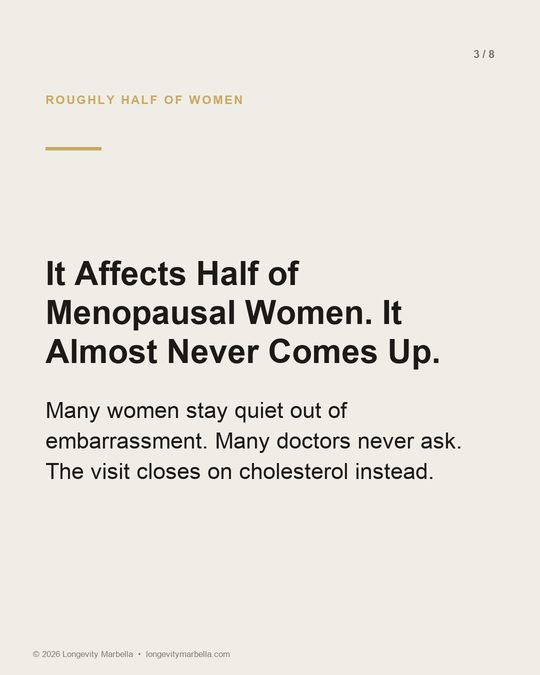
It rarely comes up in the appointment. There is a moment near the end where it could be said, and it is not said, and the visit closes on cholesterol instead. Meanwhile the discomfort is daily, intimacy has quietly become something to avoid, and you have started to wonder whether this is simply what the rest of life feels like now.
Not sure where you are in this? One-minute check.
- Genitourinary syndrome of menopause affects half of menopausal women and rarely comes up in the appointment.
- Waiting does not work for this.
- In the largest randomized trial, 302 women improved similarly on a vaginal estradiol tablet, a moisturizer, or placebo, which says the entry-level options all do something.
- Local vaginal estrogen typically brings improvement within two to four weeks, and a progestogen is generally not needed with it.
- Any bleeding after menopause must be investigated.
It is not. And the reluctance is not yours alone: surveys consistently find that many women do not raise these symptoms out of embarrassment, and that many clinicians never ask.
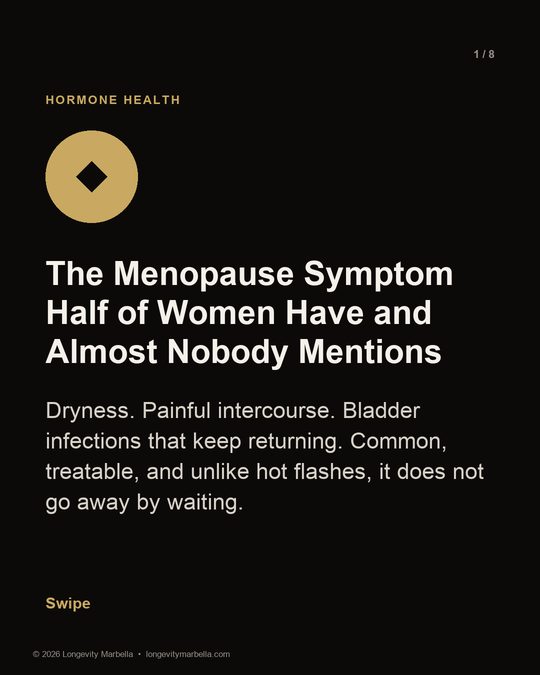
Dryness. Painful sex. Bladder infections that keep coming back. Treatable, and rarely treated.
What It Is, and Why the Name Changed
Doctors used to call this vaginal atrophy, which was both unflattering and too narrow. The modern term is genitourinary syndrome of menopause, usually shortened to GSM. The change was not cosmetic. It reflects the fact that falling estrogen affects a whole region, not one organ: the labia, the clitoris, the entrance to the vagina, the vagina itself, the urethra and the bladder.
That is why the symptoms cluster in three groups that women often do not realize are one problem:
- Genital. Dryness, burning, itching, irritation.
- Sexual. Loss of lubrication, discomfort or frank pain with intercourse, and the impaired function and avoidance that follow it.
- Urinary. Urgency, pain on passing urine, and recurrent urinary tract infections.
It affects around half of menopausal women. Among women taking adjuvant endocrine therapy or chemotherapy for breast cancer, the European Society of Endocrinology guideline puts the figure at 50 to 75 percent, with aromatase inhibitors causing more severe symptoms than tamoxifen.
The Part That Matters Most: This One Does Not Pass
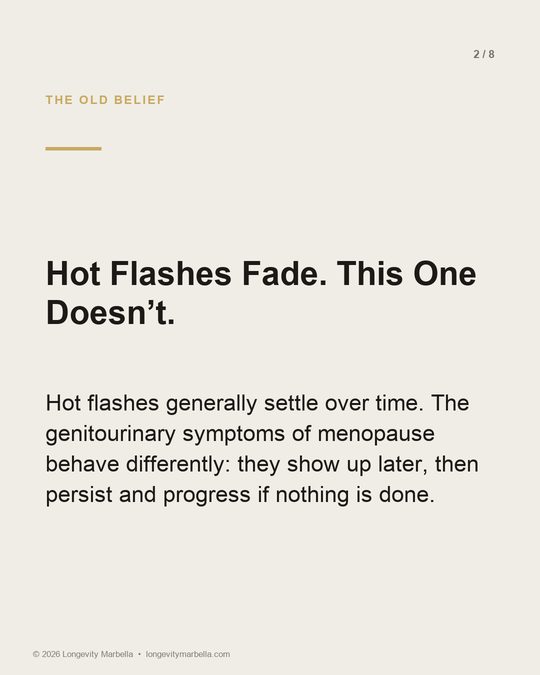
Hot flashes, for all their misery, generally fade. The genitourinary symptoms behave differently. They tend to appear later than the vasomotor symptoms, after the hot flashes have started to settle and after many women have concluded that menopause is behind them. Then they persist, and without treatment they progress.
Waiting works for hot flashes. Waiting does not work for this.
There is also some evidence that treating earlier is more effective than treating once the changes are advanced. That is an argument for raising it at the first sign rather than at the point where it has already reshaped your life.
First: The Non-Hormonal Options, and an Honest Result
First-line treatment is not a hormone. It is a vaginal moisturizer used regularly, typically two or three times a week regardless of sexual activity, together with a lubricant used at the time of sex. These are different products with different jobs, and women are often given one when they needed the other.
- Moisturizers are used on a schedule and are designed to stay. Hyaluronic acid and polycarbophil-based products are common.
- Lubricants are used only for sexual activity. Water-based, silicone-based and oil-based versions all exist. One practical warning: oil-based lubricants degrade latex condoms.
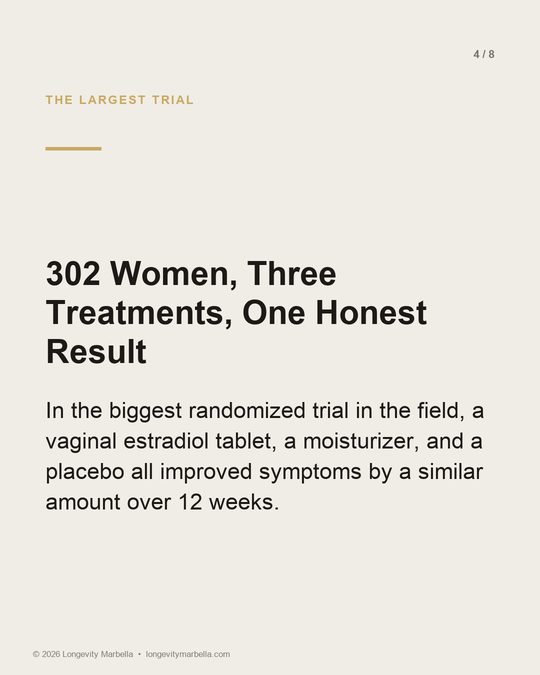
Now the honest result, because you will not hear it from anyone selling a product. The largest randomized trial in this field, published in JAMA Internal Medicine in 2018, assigned 302 postmenopausal women with vulvovaginal symptoms to a 10 microgram vaginal estradiol tablet, a vaginal moisturizer, or a dual placebo, for 12 weeks. All three groups improved by a similar amount, from roughly moderate to severe severity down to mild to moderate. There was no significant difference between them on the main outcome.
That trial has real limitations, and they matter. The placebo gel used was itself similar to products women buy over the counter, so it was not an inactive comparator. All groups were treated five days a week, which is not how these treatments are normally used. And a separate analysis of the same trial did find better menopause-specific quality of life in the estradiol group.
The sensible reading is this: for mild symptoms, moisturizers and lubricants are a genuinely reasonable first step and may be all you need. For moderate to severe symptoms, they usually are not enough, and the underlying tissue change is not corrected by them.
Second: Low-Dose Vaginal Estrogen, and the Warning That Was Removed
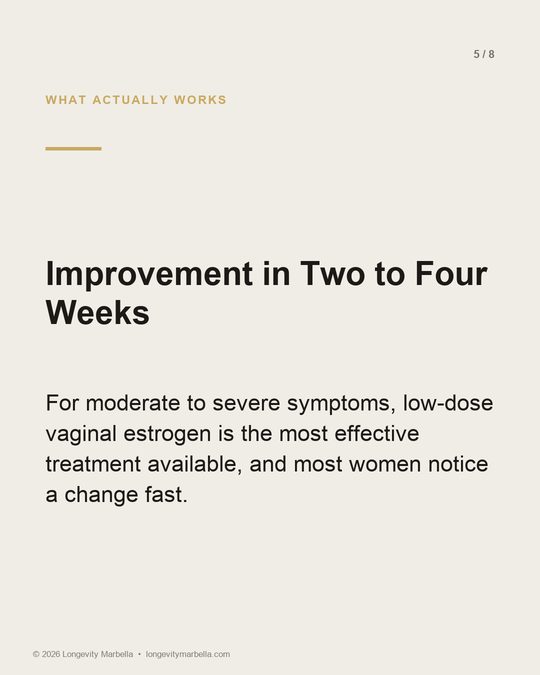
For moderate to severe symptoms that have not responded to moisturizers and lubricants, low-dose vaginal estrogen is the most effective treatment available.
It works because it repairs the tissue rather than coating it. Adequate treatment restores the normal acidic vaginal pH and the normal bacterial population, thickens the lining, increases natural secretions, and reduces dryness and the pain with intercourse that follows from it. It also reduces the frequency of urinary tract infections and overactive bladder symptoms, which is why recurrent cystitis in a postmenopausal woman should always prompt the question of whether her tissues have been assessed.
Most women notice improvement within two to four weeks.
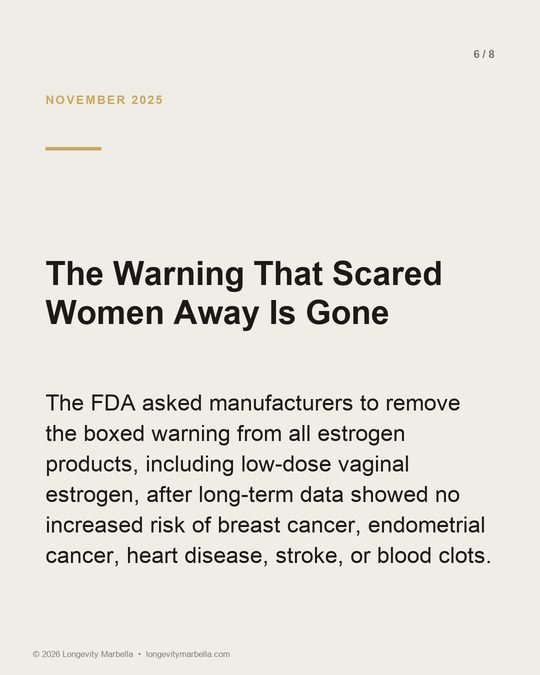
For years, the obstacle was not the drug. It was the label. Vaginal estrogen carried the same boxed warning as systemic hormone therapy, despite the very different exposure, and that warning frightened a great many women away from a treatment that would have helped them.
The safety picture behind that decision: long-term observational data, with a median duration of use up to three years, have not shown an increased risk of breast cancer, endometrial cancer, coronary artery disease, stroke or venous thromboembolism with low-dose vaginal estrogen. Endometrial safety has been shown in randomized trials of up to 52 weeks. What we still lack is long-term randomized data beyond a year, and that is worth saying plainly.
Two practical points that come up in every consultation:
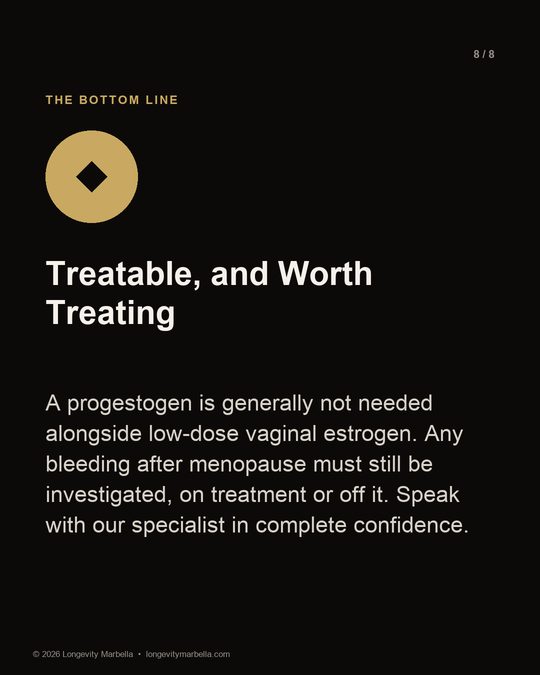
- A progestogen is generally not needed alongside low-dose vaginal estrogen to protect the womb lining. This surprises women who have been told otherwise.
- Any bleeding after menopause must be investigated, on treatment or off it. That rule does not bend.
Choosing the Preparation
There are creams, tablets, soft capsules and a ring, and in Europe estriol preparations as well. A systematic review of 19 randomized trials including more than 4,000 patients found creams, inserts and rings all similarly effective at relieving symptoms. So the choice is not about efficacy. It is about fit.
- Cream where the outer tissues are affected too, because it can be applied where the discomfort actually is.
- A tablet or soft capsule for clean, low-absorption dosing, usually daily for two weeks and then twice weekly.
- The ring for women who want to think about it once every three months rather than twice a week.
The preparations with the lowest systemic absorption are the 4 and 10 microgram estradiol tablets and capsules and the 7.5 microgram per day ring. For perspective on how small these doses are: serum estradiol on the low-dose ring runs around 5 to 10 picograms per milliliter, against roughly 5 in an untreated postmenopausal woman and 40 to 600 in a premenopausal woman across her cycle. On the ring, your blood level sits close to untreated, far below premenopausal.
If vaginal estrogen is not suitable or not wanted, there are alternatives with real trial support: vaginal DHEA, known as prasterone, approved in 2016 for painful intercourse due to menopause, and ospemifene, an oral tablet approved in 2013 for moderate to severe painful intercourse and vaginal dryness. Each has its own trade-offs, and ospemifene can cause hot flashes.
What We Do Not Recommend, and Why
Laser and radiofrequency devices are marketed heavily for this problem, including on this coast. We do not offer them, and the reason is the evidence.
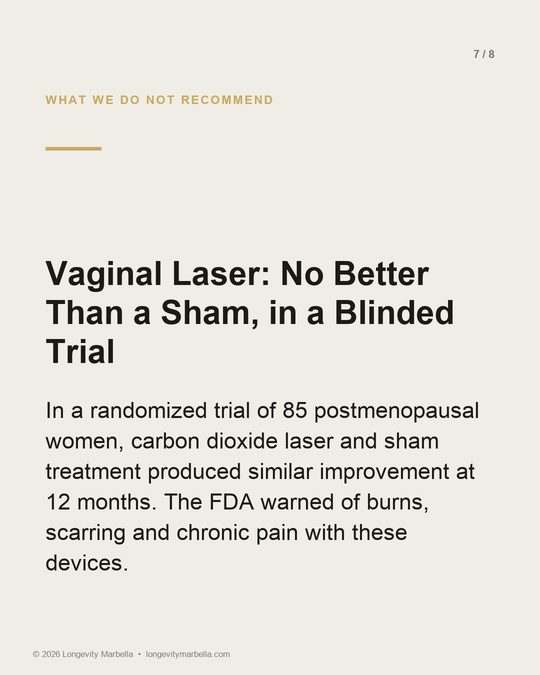
In a randomized trial of 85 postmenopausal women with vaginal symptoms, carbon dioxide laser and sham treatment produced similar improvement at 12 months, with similar quality of life scores and similar findings on vaginal biopsy, with both participants and assessors blinded. A second randomized trial of 49 women found the same. A trial comparing laser against estrogen cream also found similar symptom improvement, but better objective vaginal health scores in the estrogen group.
In July 2018 the FDA issued a safety communication warning about vaginal burns, scarring, pain during intercourse and chronic pain with these devices. They are not approved for this use.
A treatment that performs no better than a sham, in a blinded trial, at real cost and with real risk. That is not an elegant option. It is an expensive one.
After Breast Cancer
This is where the decision needs a specialist and an oncologist together, so here is the shape of it.
Non-hormonal moisturizers and lubricants are first-line for every woman with a history of breast cancer, and one prospective study of 101 women with hormone receptor-positive cancer found that a hyaluronic acid moisturizer improved vulvar and vaginal symptoms in 88 and 92 percent respectively over 12 weeks, though more frequent dosing was often required.
If that is not enough, the path depends on the treatment you are on. For women taking tamoxifen, who have completed endocrine therapy, or whose disease was hormone receptor-negative, low-dose vaginal estrogen or prasterone is often reasonable. A 2025 systematic review and meta-analysis in the American Journal of Obstetrics and Gynecology pooled eight observational studies of breast cancer survivors and found no association between vaginal estrogen and breast cancer recurrence, breast cancer-specific mortality, or overall mortality.
For women taking an aromatase inhibitor, most specialists advise against vaginal estrogen, because the entire purpose of that drug is to drive estrogen as low as possible, and the data here are genuinely conflicting. That conversation belongs with your oncologist, not with a website.
You do not have to introduce this subject. We will ask.
Message us on WhatsAppOne Thing Worth Knowing About Systemic HRT
Women on hormone therapy for hot flashes sometimes assume it will cover this too. Often it does not. Vaginal treatment outperforms systemic treatment for these particular symptoms, with reported efficacy of roughly 80 to 90 percent for vaginal therapy against about 75 percent for systemic therapy in observational data.
If you are on systemic HRT and still dry, still sore, still getting infections, the answer is usually to add low-dose local treatment, not to raise your systemic dose. The two are routinely used together.
When It Does Not Respond
If proper treatment does not work, the diagnosis deserves revisiting rather than the dose being pushed. Vulvodynia, pelvic floor muscle spasm and bladder pain syndrome all coexist with GSM and all cause ongoing pain once the tissue itself has been restored. Pelvic physiotherapy and, where there is narrowing, graduated dilators are part of proper care and are underused. Persistent discharge, bleeding after intercourse or urinary symptoms that do not settle require investigation in their own right.
Where These Figures Come From
- The 2020 genitourinary syndrome of menopause position statement of The North American Menopause Society. Menopause, 2020;27:976.
- Mitchell CM, Reed SD, Diem S, et al. Efficacy of vaginal estradiol or vaginal moisturizer vs placebo for treating postmenopausal vulvovaginal symptoms: a randomized clinical trial. JAMA Intern Med, 2018;178:681.
- Li FG, Maheux-Lacroix S, Deans R, et al. Effect of fractional carbon dioxide laser vs sham treatment on symptom severity in women with postmenopausal vaginal symptoms: a randomized clinical trial. JAMA, 2021;326:1381.
- Beste ME, Kaunitz AM, McKinney JA, Sanchez-Ramos L. Vaginal estrogen use in breast cancer survivors: a systematic review and meta-analysis of recurrence and mortality risks. Am J Obstet Gynecol, 2025;232:262.
- Suckling J, Lethaby A, Kennedy R. Local oestrogen for vaginal atrophy in postmenopausal women. Cochrane Database Syst Rev, 2006.
- European Society of Endocrinology clinical practice guideline for evaluation and management of menopause and the perimenopause. European Journal of Endocrinology, 2025;193(4).
- US Food and Drug Administration labeling change request, November 2025; FDA safety communication on energy-based devices, July 2018.