


You are not imagining it. You are not going crazy. If you are in your forties and the anxiety, broken sleep, irregular periods, brain fog and mood swings have crept up on you and made you feel like a stranger in your own body, there is very likely a real, physical reason for it.
Not sure where you are in this? One-minute check.
- The anxiety, broken sleep, irregular periods, brain fog and mood swings in your forties very likely have a real, physical reason.
- Perimenopause is the hormonal roller coaster before menopause, not menopause itself, and it is where you feel the most.
- A normal blood test in your forties is expected, and it does not rule out perimenopause.
- Help can begin in perimenopause itself, tailored to you and carefully monitored.
Maybe you already asked for help and were told your blood test was "normal," so it must be stress, or just age. You left feeling dismissed, and still exhausted.
Here is what nobody told you: a normal blood test does not rule out perimenopause. In fact, a normal result is exactly what we often expect to see. Perimenopause is real, it is common at your age, and it is very treatable. Let us explain why.
The quick version
- What you are feeling is real and physical, not "all in your head."
- Perimenopause commonly begins in your forties, sometimes in your late thirties.
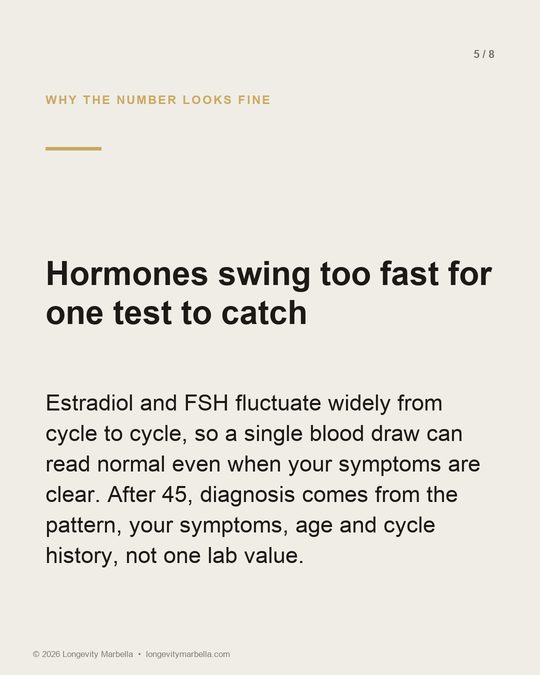
- A normal blood test does not rule it out. In your forties, that result is expected, because hormone levels swing from day to day.
- It is diagnosed from your symptoms, age and cycle pattern, not from one number on a lab report.
- It is very treatable. You do not have to wait until your periods stop to feel better.
You deserve to be listened to. Tell us what you have been experiencing, and we will take it seriously.
Message us on WhatsAppSo what is perimenopause, exactly?
It is the transition that leads up to menopause, and it is where most of the disruption actually happens. Menopause itself is a single point in time: twelve months after your last period. Perimenopause is everything before that, and it can last several years, often starting in your forties and sometimes your late thirties.
The key thing to understand is that your hormones do not decline in a smooth, tidy line. They fluctuate, sometimes sharply, from one cycle to the next. That instability is what drives the symptoms, and it is exactly why this phase is so often missed.
Bottom line: perimenopause is the hormonal roller coaster before menopause, not menopause itself, and it is where you feel the most.
Why are my tests normal if I feel this bad?
Because your hormones are swinging up and down, a single blood test taken on a single day can look completely normal even when you feel anything but. The number caught one moment on a moving target.
This is why, in women aged 45 and over, perimenopause is diagnosed from the pattern, your symptoms, your age and your menstrual history, and not from a hormone level. This is not our opinion; it is what national guidelines advise, because everyone knows those levels fluctuate too much to be reliable at this stage. Blood tests are mainly useful in younger women, for example to look at early or premature menopause, or to rule out other causes such as thyroid problems.
So if you were sent away because a test came back "normal," that result did not prove you are fine. Reading the whole picture correctly takes training and experience.
Bottom line: a normal blood test in your forties is expected, and it does not rule out perimenopause.
A "normal" test is not the end of the conversation. Relief is possible, and it can start now.
Message us on WhatsAppIs this really perimenopause? The symptoms are broader than you think
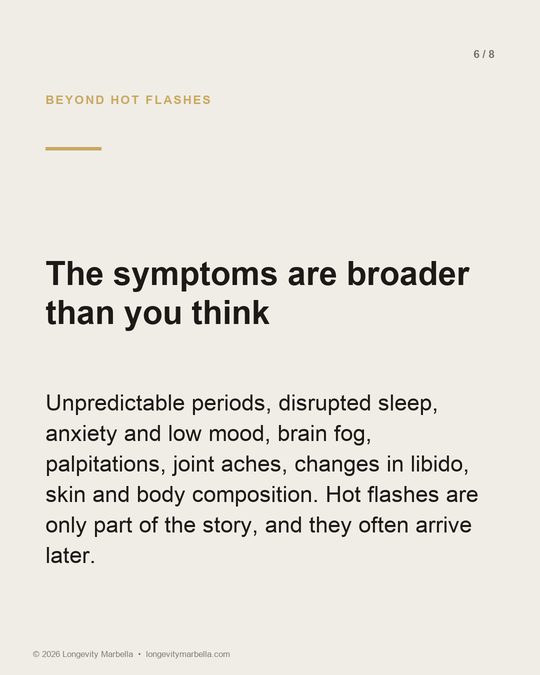
Hot flashes are only part of the story, and they often arrive later. The earlier, more confusing signs are the ones that catch women off guard:
- changing, unpredictable periods
- disrupted sleep and fatigue
- anxiety, irritability or low mood, sometimes for the first time in your life
- brain fog and trouble concentrating
- palpitations
- joint aches
- changes in libido, skin and body composition
The emotional symptoms in particular are so often mistaken for a primary mental-health problem, while the hormonal cause underneath is never even looked at. If your mood and anxiety shifted at the same time as your cycles and your sleep, that timing matters.
Bottom line: perimenopause is far more than hot flashes, and the anxiety and brain fog are part of it.
How is it treated, and how do you help?
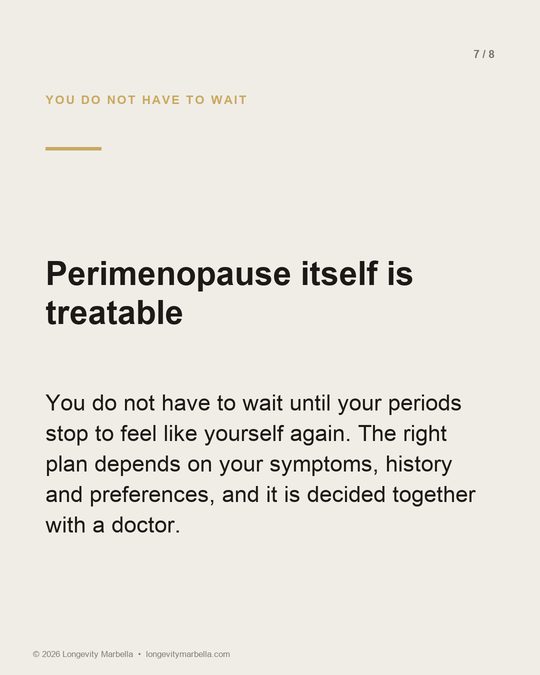
Perimenopause is treatable, and you do not have to wait until your periods finally stop to feel like yourself again. The right plan depends on your symptoms, your history and your preferences, and it is decided together with a doctor.
What we do differently is listen first. Our specialist reads the whole pattern, your symptoms, your age and your history together, instead of one lab value in isolation, then builds a plan that fits you and monitors it properly. You can read more about our approach to HRT and menopause care.
If you have been told everything is "normal" but you know something has changed, you are very likely right. This transition is real, it is physical, and it deserves to be taken seriously.
Bottom line: help can begin in perimenopause itself, tailored to you and carefully monitored.
Let us build a plan that actually fits you, and takes what you are feeling seriously.
Message us on WhatsAppFrequently Asked Questions
What is perimenopause?
The transition leading up to menopause, when hormone levels fluctuate before periods stop for good. It can last several years and often begins in your forties.
How is it different from menopause?
Menopause is the point twelve months after your last period. Perimenopause is the years of hormonal change before that, when most symptoms actually occur.
Why did my blood test come back normal?
In perimenopause, hormones such as estradiol (a form of estrogen) and FSH (a pituitary hormone that signals the ovaries) fluctuate widely from one cycle to the next, so a single blood test can read normal even when your symptoms are clear. For this reason, in women aged 45 and over, perimenopause is diagnosed from the pattern of symptoms, age and menstrual history rather than a hormone level. Blood tests are mainly useful in younger women, for example to assess early or premature menopause, or to rule out other causes such as thyroid problems.
What age does perimenopause start?
Most often in your forties, though it can begin in the late thirties. Its length varies from a few years to longer.
Can I get help before my periods stop?
Yes. Perimenopause itself is treatable, with a plan tailored to your symptoms and history and decided with your doctor.
This article is for general information only and is not medical advice. Whether and how perimenopause is treated is determined by a qualified doctor after individual assessment. Our menopause care is overseen by a physician double board-certified in Internal Medicine and Endocrinology.
References. 1. National Institute for Health and Care Excellence (NICE). Menopause: identification and management. NICE guideline NG23, updated 2024. Diagnosis of perimenopause and menopause in women aged over 45 is based on symptoms and menstrual history without routine FSH testing, because hormone levels fluctuate during the perimenopause; FSH may be considered in women aged 40 to 45, or under 40, with menopause-associated symptoms. nice.org.uk/guidance/ng23. 2. Avis NE, Crawford SL, Greendale G, et al. Duration of menopausal vasomotor symptoms over the menopause transition (Study of Women's Health Across the Nation, SWAN). JAMA Intern Med. 2015;175(4):531-539. Median total duration of frequent hot flashes and night sweats was 7.4 years (half of women had them for longer than this, so symptoms often last several years, not months). doi:10.1001/jamainternmed.2014.8063 (PMID 25686030). 3. The Menopause Society. Perimenopause (patient education). The menopausal transition usually begins in the forties, can start in the late thirties, and commonly lasts several years. menopause.org. Source attribution for items 2 and 3 includes PubMed.
Think it might be perimenopause?
A specialist can read the whole pattern, your symptoms, your age and your history together, not just one lab value in isolation. Speak with our specialist about what you are experiencing and what can help, on a private video call or a concierge home visit across the Costa del Sol.
A letter from the doctor. A few times a year, when the evidence genuinely changes, I write it down and send it. No schedule, no noise, and you can leave the list whenever you like.