


You did the sensible thing. The estrogen went on, the night sweats settled, the sleep came back. And still something has not returned. The drive is flat. The word you want does not arrive when you reach for it. You feel, in a way that is hard to say out loud, less like yourself than you used to be.
Not sure where you are in this? One-minute check.
- After menopause the ovary continues to secrete testosterone, and replacing it is rarely even discussed.
- The European Society of Endocrinology guideline supports transdermal dosing aimed at premenopausal physiological levels. Not a dose above it.
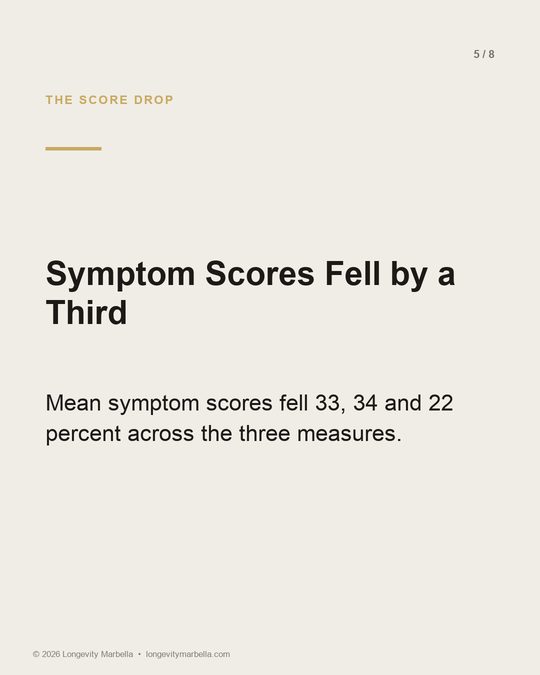
- In a 2025 study of 510 women already on HRT, four months of transdermal testosterone was followed by improvement: 52 percent libido, 47 percent mood, 39 percent cognition.
- Short-term safety data are reassuring. It is not a bone treatment, not a general tonic, and not a substitute for estrogen.
- A proper diagnosis first, and estrogen optimized before testosterone is added.
For a proportion of women, the missing piece is the hormone almost nobody thinks to replace.
Testosterone is treated in public conversation as a men's hormone. It is not. Women produce it too, in the ovaries and in the adrenal glands, and they depend on it. What follows is the honest position: where the evidence is solid, where it is only promising, and where the marketing has run considerably ahead of the science.
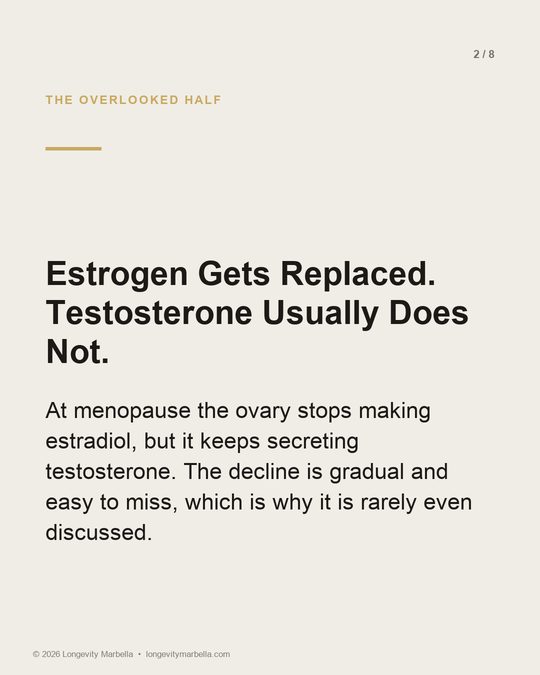
Estrogen gets replaced. Testosterone usually does not, even when it is the hormone you are missing.
The Hormone That Does Not Stop at Menopause
Here is a fact that surprises most women, and a good number of doctors. At menopause the ovary stops producing estradiol, the main form of estrogen, because the follicles that made it are gone. But the ovary continues to secrete testosterone. Production does not switch off at the final period. It declines gradually with age instead, beginning years earlier, which is why the fall is so easy to miss.
That gradual decline is part of why testosterone deficiency in women is rarely diagnosed. There is no dramatic event to point to. There is only a slow subtraction: desire, drive, confidence, mental sharpness, the sense of being fully present in your own life.
It is also why a single blood test does not settle the question. Testosterone levels in women are low by design and sit close to the lower limit of what many laboratory assays can reliably measure, like weighing a single letter on a bathroom scale, and they vary through the day. The diagnosis is clinical. The blood test is there to guide the dose and to keep you inside a safe range, not to hand you a verdict.
What the Evidence Actually Supports
This is where precision matters, because you deserve the real answer rather than the flattering one.
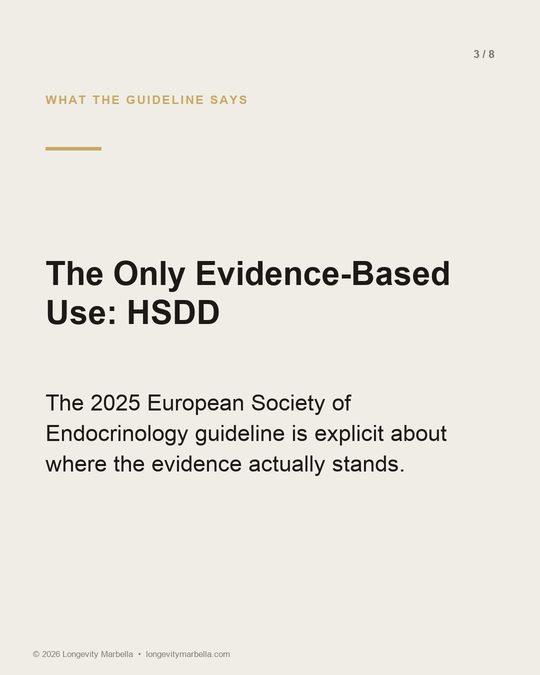
The European Society of Endocrinology clinical practice guideline on menopause and the perimenopause, published in 2025, is explicit. Hypoactive sexual desire disorder in postmenopausal women is the only evidence-based indication for testosterone therapy in women. Hypoactive sexual desire disorder, usually shortened to HSDD, means persistently low sexual desire that causes you genuine personal distress. The distress matters. Low desire that does not trouble you is not a disease.
The same guideline sets three conditions on how it should be given, and each one is doing real work:
- The dose should aim at premenopausal physiological levels. The goal is to return you to the range of a healthy younger woman, not to push beyond it. This is replacement, not enhancement.
- The transdermal route is preferred, meaning through the skin as a cream or a gel, because it has a neutral effect on the cholesterol profile. Oral androgens can worsen lipids.
- Short-term safety data are reassuring, and the guideline says so plainly. It also says that long-term safety warrants further investigation. Both halves of that sentence are true and you should hear both.
For the practical detail of dosing and monitoring, that guideline refers clinicians to the Global Consensus Position Statement on the Use of Testosterone Therapy for Women, published by Davis and colleagues in the Journal of Clinical Endocrinology and Metabolism in 2019. It remains the reference document internationally.
Replacement to a healthy young woman's range. Not a dose above it. That single distinction separates careful endocrinology from the clinics that make women hairy and hoarse.
What the Newest Data Suggest, and What They Do Not Prove
The interesting question, and the one women actually ask, is whether testosterone does anything for mood and for the mental fog that so many describe during and after the transition.
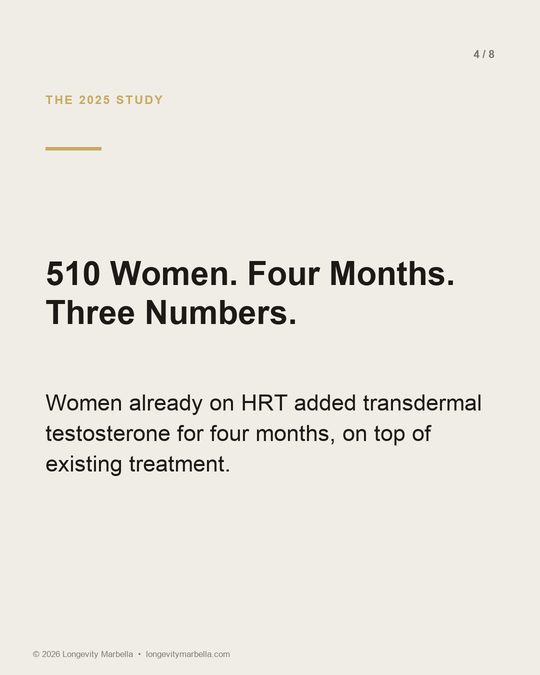
A study published in Archives of Women's Mental Health in 2025 looked at exactly this. Researchers at a specialist menopause clinic in the United Kingdom followed 510 women who were already taking HRT and who still had persistent low libido together with cognitive and low mood symptoms. Each was treated with transdermal testosterone cream or gel for four months, and symptoms were scored before and after using a modified version of the Greene Climacteric Scale, a standard menopause symptom questionnaire.
All nine mood and cognitive symptoms measured improved significantly over the study period. Mood improved more than thinking did.
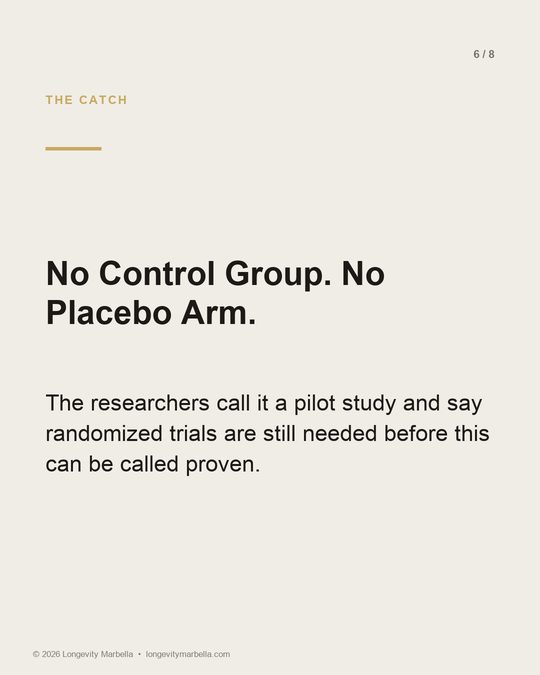
Now the limitation, stated before the sales pitch and not after it. This was a retrospective cohort study with no control group and no placebo arm. The authors themselves describe it as a pilot and call for randomized trials. Symptom questionnaires improve substantially on placebo alone in menopause research, so some part of that improvement is not the drug. This study cannot tell us how much.
What it does tell us is that the effect is worth taking seriously, that mood may respond more readily than cognition, and that the benefit appears to extend beyond desire alone. That is a reasonable basis for a carefully monitored trial of treatment in the right woman. It is not a basis for prescribing testosterone to every woman with a tiring week behind her.
What Testosterone Is Not For
Being clear about this protects you.
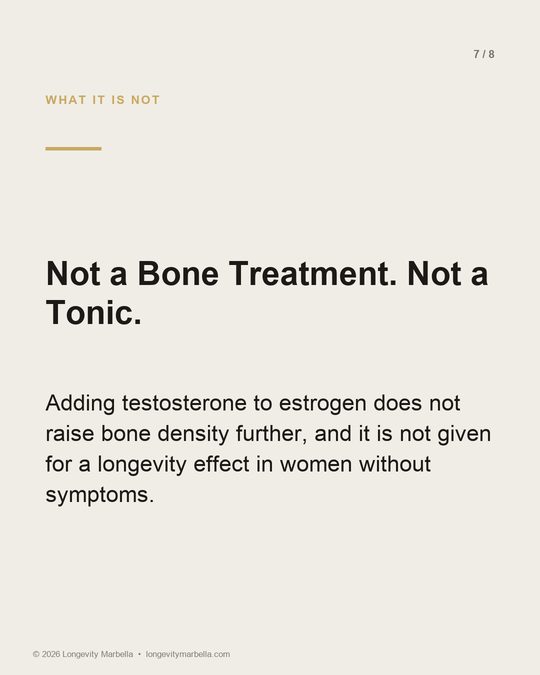
It is not a bone treatment. Adding an androgen to estrogen therapy does not appear to increase bone density more than estrogen on its own, and androgens carry virilizing effects, meaning masculinizing changes such as unwanted hair growth, acne, and deepening of the voice. If bone is your concern, the answer is a bone strategy, not testosterone.
It is not a general tonic. There is no good evidence for prescribing it to women with no symptoms in the hope of a longevity benefit.
It is not a substitute for estrogen. Testosterone is considered in women who are already on appropriate hormone therapy and still have a specific unresolved problem. It is an addition to a well-built regimen, not a shortcut around one.
What Careful Prescribing Looks Like
This is where the difference between a specialist and a prescription pad becomes visible, and it is the part we take seriously.
- A proper diagnosis first. Low desire has many causes. Untreated vaginal dryness that makes intercourse painful, poor sleep, thyroid disease, depression, certain antidepressants, relationship strain. Treating those is often the real answer, and giving testosterone instead simply postpones it.
- Estrogen optimized before testosterone is added, including local vaginal treatment where it is needed.
- A baseline blood profile, then measurement on treatment to confirm you remain within the premenopausal physiological range rather than above it.
- Review at three to six months. If the symptom that justified treatment has not improved, treatment stops. A drug that is not working is not continued because it felt promising.
- Watching for the signs that mean the dose is too high, principally acne, unwanted hair growth, and any change in the voice. Voice change may not fully reverse, which is precisely why the ceiling on dose is not negotiable.
Who Should Not Take It
Testosterone is not appropriate in pregnancy or breastfeeding, in women with an active hormone-sensitive cancer without oncology input, or in women with untreated significant liver disease. Women with a history of breast cancer need a decision made together with their oncologist. If you have unexplained bleeding after menopause, that must be investigated before any hormone is started, whatever the hormone.
Strong evidence for desire. Encouraging but unproven for mood and clarity. Wrong tool for bone. Right dose, right route, or not at all.
How We Decide With You
A consultation about testosterone begins with the question of whether testosterone is the answer at all. We look at your full hormonal picture, at your existing regimen, at sleep, thyroid, mood, medication, and at the local symptoms that so often go unmentioned and that quietly destroy desire on their own.
If testosterone is the right addition, it is prescribed transdermally, at replacement dose, with blood monitoring, and with a defined point at which we judge whether it worked. If it is not the right addition, we say so, and we treat the thing that actually is the problem.
If you are already on HRT and still do not feel like yourself, that is worth a proper conversation.
Message us on WhatsAppWhere These Figures Come From
- European Society of Endocrinology clinical practice guideline for evaluation and management of menopause and the perimenopause. European Journal of Endocrinology, 2025;193(4).
- Davis SR, Baber R, Panay N, et al. Global Consensus Position Statement on the Use of Testosterone Therapy for Women. J Clin Endocrinol Metab, 2019;104:4660.
- Glynne S, et al. Effect of transdermal testosterone therapy on mood and cognitive symptoms in peri- and postmenopausal women. Archives of Women's Mental Health, 2025;28:541.