


"Idiopathic" is medicine's most elegant way of saying nobody knows. It is an honest word when it is earned. The trouble is that it is often applied before the search has finished, and in male infertility that happens more than it should.
Not sure if this applies to you? One-minute check.
- In 214 men with idiopathic infertility, 23.8% had testosterone below 3.5 ng/mL, against 4.5% of 224 men with normal semen.
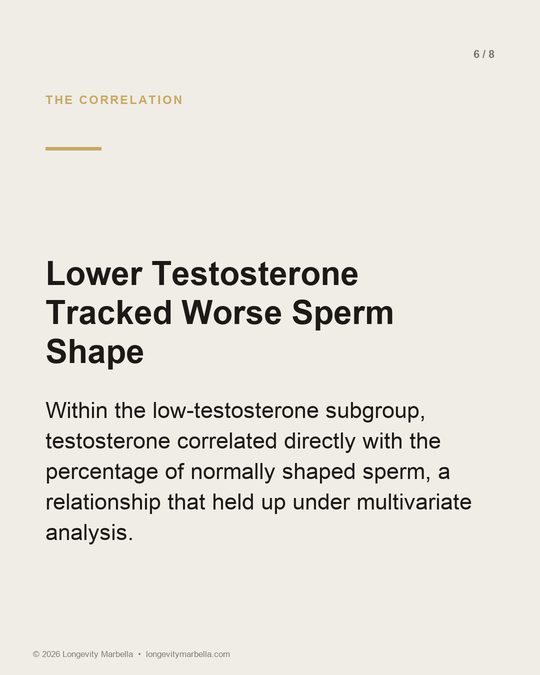
- Within the low-testosterone subgroup, testosterone correlated with the percentage of normally shaped sperm (R = 0.430, p = 0.020).
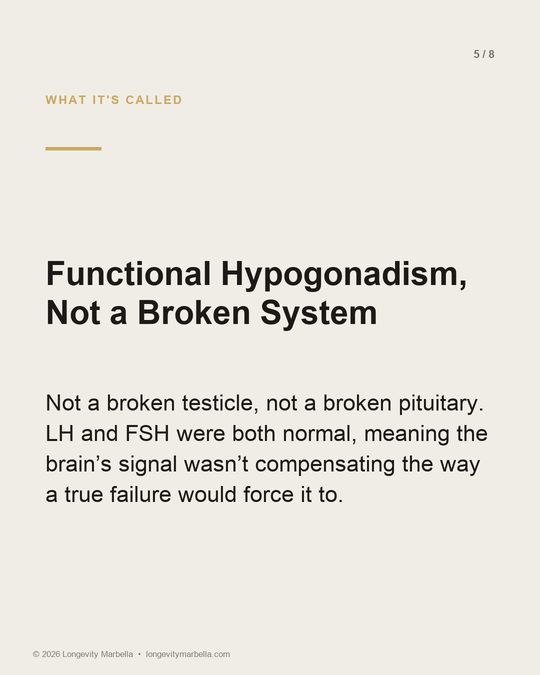
- The authors call this functional hypogonadism: a system running low without one dramatic cause.
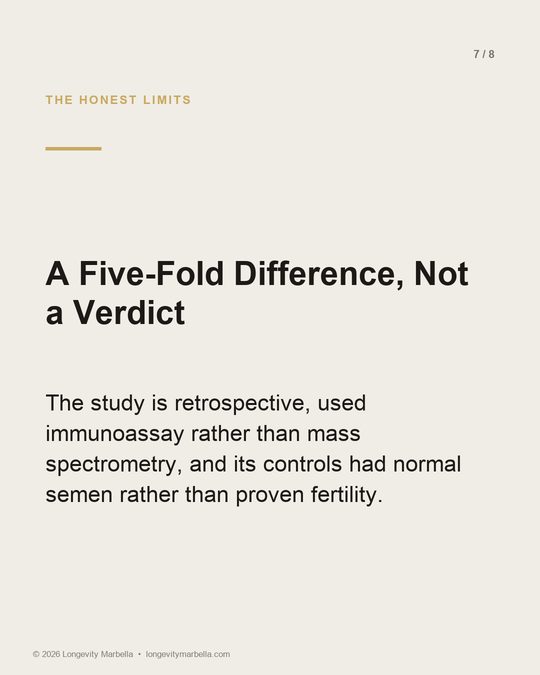
- The study is retrospective, used immunoassay rather than mass spectrometry, and its controls had normal semen rather than proven fertility.
- Unexplained is a label, not a finding. It is worth knowing which subgroup you are actually in.
A 2024 study in Endocrine went looking inside that label, and what it found is worth your attention if you have ever been handed it.
What they did
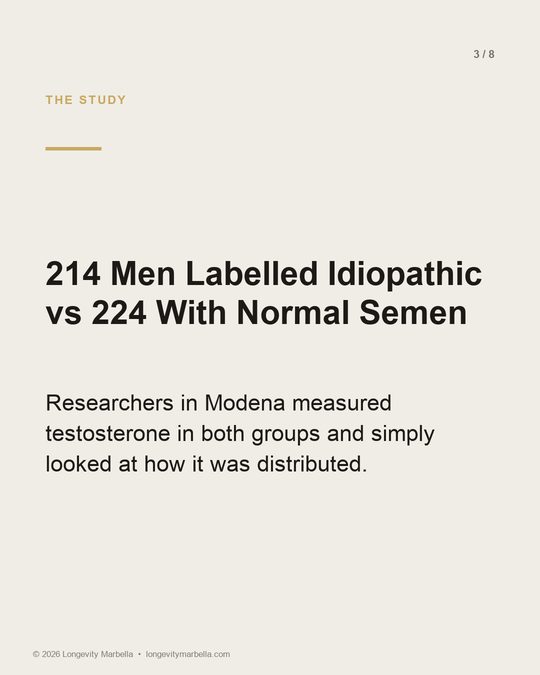
Researchers in Modena compared 214 men with idiopathic infertility, average age 38.2, against 224 men with entirely normal semen analyses, average age 33.7. Idiopathic here meant something specific and strict: at least one abnormal semen parameter, gonadotropins (the brain's signalling hormones, LH and FSH) sitting in the normal range, and every known cause of male infertility already excluded. These were, on paper, the men with nothing findable.
Then they simply measured testosterone in both groups and looked at how it was distributed.
The number that should not be there
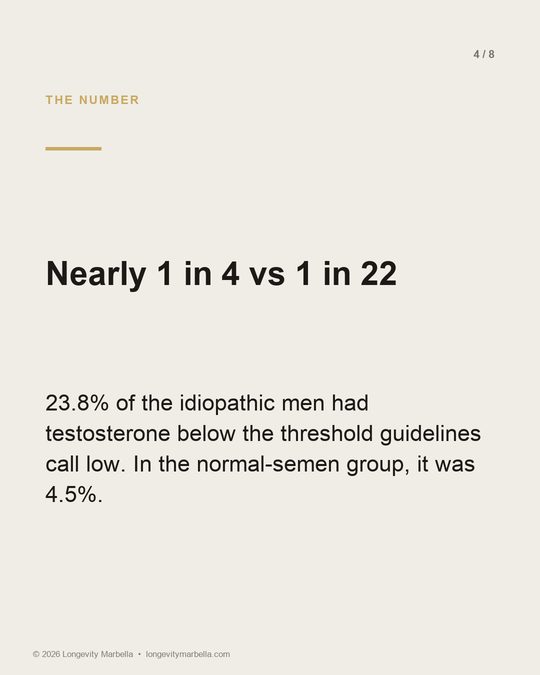
23.8% of the idiopathic men had a total testosterone below 3.5 ng/mL, the threshold scientific societies use to flag low. Among the men with normal semen, that figure was 4.5%.
Read that again, because it is the whole article. Roughly one in four men carrying a label that means "we found nothing" had a hormone level that most endocrinologists would not call nothing. In the comparison group it was about one in twenty-two.
The authors give this a name: functional hypogonadism. Not a broken testicle, not a broken pituitary, but a system running below where it should be, without a single dramatic cause to point at. It is the kind of finding that only appears if somebody bothers to measure.
And within that group, testosterone tracked sperm shape
In the subgroup whose testosterone was under 3.5 ng/mL, there was a significant direct correlation between testosterone and the percentage of normally shaped sperm, and it survived multivariate stepwise linear regression, the statistical check that the link holds when other factors are accounted for (R = 0.430, standard error 0.3, p = 0.020).
In plain terms: among the men who were low, the lower they were, the fewer normally formed sperm they had. That relationship did not appear in the men whose testosterone was adequate, which is exactly what you would expect if the hormone matters most when it is scarce.
Morphology, the shape of the sperm, is the parameter that most often gets shrugged at. This finding suggests that in a specific subgroup it is not random noise but a signal with an address.
Where this study is honest, and where it is limited
The authors are refreshingly clear about their own weaknesses, and so should we be.
It is retrospective and real-world, built from routinely collected data with no design set in advance. Some men in the idiopathic group may still have had an undetected varicocele or a history of undescended testicle. The testosterone was measured by immunoassay rather than mass spectrometry, which is less accurate at exactly the low end where this study lives. The 3.5 ng/mL cutoff is supported by the literature but is not proven to be the perfect dividing line. And the control group had normal semen without proven fertility, which is not quite the same thing as fertile.
None of that erases a five-fold difference. It does mean the number is an invitation to look, not a verdict.
The odd combination at the center of this
To understand why a quarter of these men are interesting, it helps to know what "idiopathic" required them to have. Entry to the case group meant an abnormal semen parameter, FSH between 1 and 12 IU/L, LH between 1 and 9 IU/L, and testosterone above 2.1 ng/mL. In other words, the brain's two signalling hormones were behaving perfectly normally.
That combination is peculiar. LH is the signal that tells the testis to make testosterone, the way a thermostat calls the furnace for heat. If testosterone is low and LH is normal rather than raised, the thermostat is not calling harder the way it would if the furnace itself were failing: something upstream is content with an output that is objectively low.
The field has a name for this too: functional hypogonadotropic hypogonadism, meaning gonadotropin levels, the thermostat side of the system, that sit "inappropriately" inside the reference range while the gland they are addressing does not respond optimally. A thermostat that reads normal in a cold room is normal in name only: not the same as right.
The blood in this study was drawn to a standard worth noting: after an overnight fast, at 8am. Testosterone follows a daily rhythm and falls across the day, so a level taken mid-afternoon is not comparable to one taken at eight in the morning. A great many men have been reassured by a number that was never drawn in a way that could answer the question.
The treatment argument the authors are really making
The reason they went looking matters. Men with idiopathic infertility are frequently offered exogenous FSH, an empirical stimulation of the testis, and the results across trials have been mixed. The authors make a pointed observation about why.
Male infertility treatment, they write, is "still stuck in the 90s", when fixed doses were given to everyone regardless of the individual, an approach abandoned long ago on the female side of reproductive medicine in favour of personalisation. Their argument is that a heterogeneous category cannot sensibly share one protocol. If idiopathic infertility is really several different conditions wearing one label, then a single fixed treatment will work for some men, do nothing for others, and produce exactly the muddled average the trials keep reporting.
Their proposal is that the standard schedule may have a clear rationale in roughly the 24% with low testosterone, and that the remaining three quarters are a different problem needing a different answer. The practical point is knowing which quarter you are in before anyone chooses a plan.
Why nobody caught it
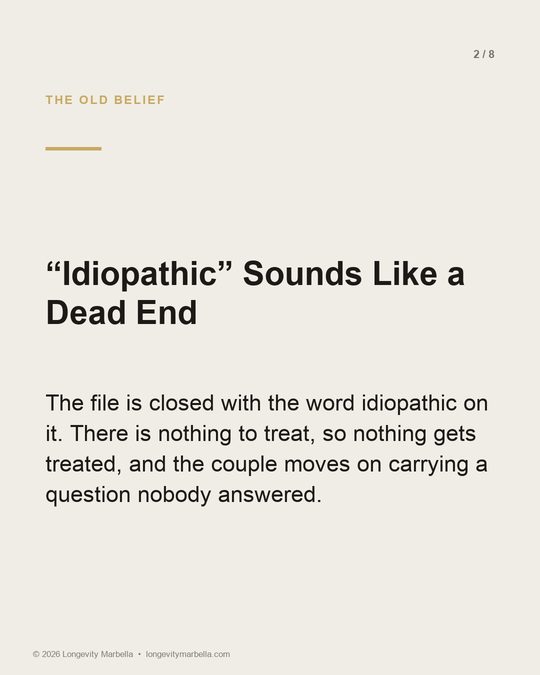
There is no villain in this story, which is what makes it worth telling. A man presents with an abnormal semen analysis. His FSH and LH come back normal. At that point the standard pathway has done its job: the pituitary is working, the obvious causes are excluded, and the file is closed with the word idiopathic on it.
Testosterone, in that sequence, is often either not drawn at all or drawn without much weight attached, because the question being asked was about fertility rather than about hormones, and because a level that is low-normal rarely triggers alarm on a report designed to flag the extremes.
This study's contribution is to show what that habit costs. The men were there. The blood was drawable. The finding was a five-fold difference. It simply required someone to treat testosterone as part of the fertility question rather than a separate department.
Why this matters when it is your own file
Being told your infertility is unexplained is a peculiar kind of dead end. There is nothing to treat, so nothing gets treated, and the couple moves to assisted reproduction carrying a question nobody answered.
This study makes a narrower and more useful point. Inside the group called unexplained there are subgroups, and at least one of them is defined by a hormone you can measure in a morning blood draw. The authors argue that these men may respond differently to treatment than the rest of the idiopathic population, and that testosterone should be part of how the label is subdivided rather than a box ticked and forgotten.
Which brings us to the ordinary, unglamorous point underneath all of this: a diagnosis is only as good as the measuring that preceded it. The single most common reason a man's hormonal picture looks unremarkable is that nobody looked at it properly, at the right time of day, with the right panel, read by somebody who reads them for a living.
Frequently Asked Questions
Does a low testosterone reading mean I am infertile?
No. Testosterone and fertility are related but not interchangeable. This study found that a low reading was far more common among men whose infertility had no other explanation, and that within that group it tracked with sperm shape. It is a reason to investigate properly, not a diagnosis on its own.
What does functional hypogonadism mean?
It describes a testosterone level below the expected range without a single structural or genetic cause to point at. The system is running low rather than broken, and the reasons are often multiple and partly reversible, which is precisely why it deserves an assessment rather than a shrug.
Was this a large study?
It compared 214 idiopathic infertile men with 224 men with normal semen analyses, which is respectable for this question but not enormous. It was also retrospective, meaning the data were collected during routine care rather than for the study, so it points a direction rather than settling the matter.
Should testosterone be measured in every infertility work-up?
The authors of this study argue it deserves a more central place than it currently holds, because it identifies a subgroup that may behave differently. What time of day it is drawn, what else is drawn alongside it, and who interprets it all change the answer you get.
This article is for general information only and is not medical advice. Fertility and hormone treatments should be guided by a qualified doctor based on your own assessment.
Reference. Spaggiari G, Costantino F, Dalla Valentina L, et al. "Are they functional hypogonadal men? Testosterone serum levels unravel male idiopathic infertility subgroups." Endocrine 2024;84:757-767 (doi:10.1007/s12020-024-03717-3).
Ready to find out which group you are in?
Speak with a double board-certified specialist in Internal Medicine and Endocrinology about a proper hormonal and fertility assessment, by secure video or at your residence across the Costa del Sol.
A letter from the doctor. A few times a year, when the evidence genuinely changes, I write it down and send it. No schedule, no noise, and you can leave the list whenever you like.