


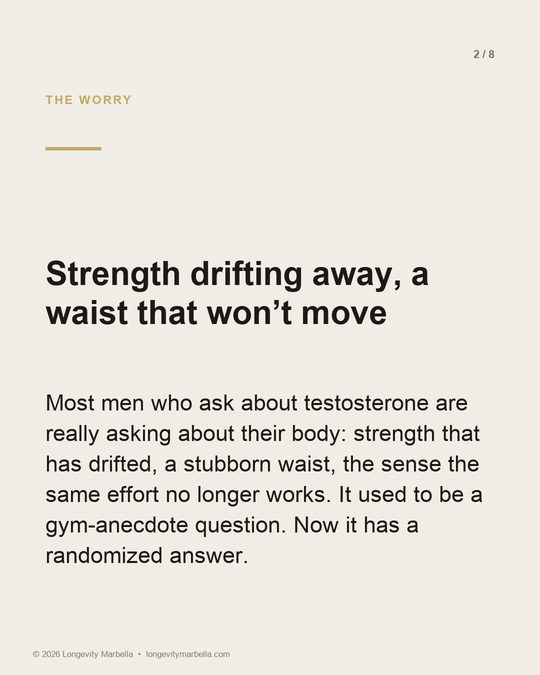
Most men who ask about testosterone are really asking about their body: strength that has drifted away, a waist that will not move, and the sense that the same effort no longer produces the same result. That is a fair question to bring to a doctor, and it now has a proper answer from randomized trials rather than from the internet.
Not sure if this applies to you? One-minute check.
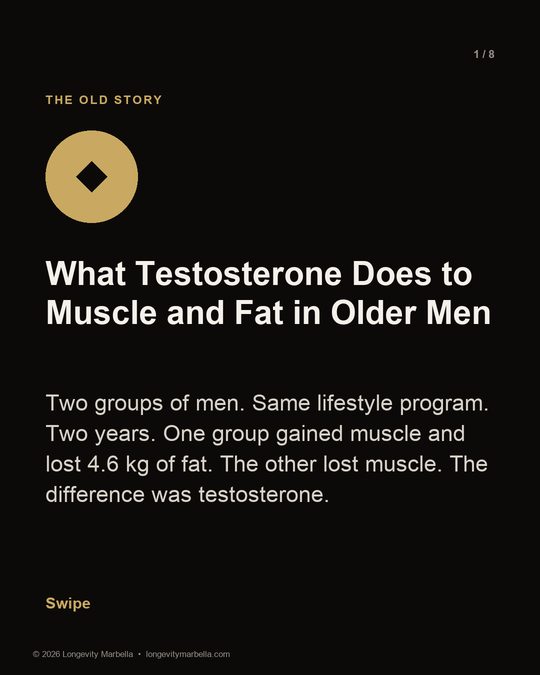
- 1,007 men aged 50 to 74, two years, testosterone against placebo, both groups on the same lifestyle program.
- The testosterone group gained 0.4 kg of muscle and lost 4.6 kg of fat. Placebo lost 1.3 kg of muscle and 1.9 kg of fat.
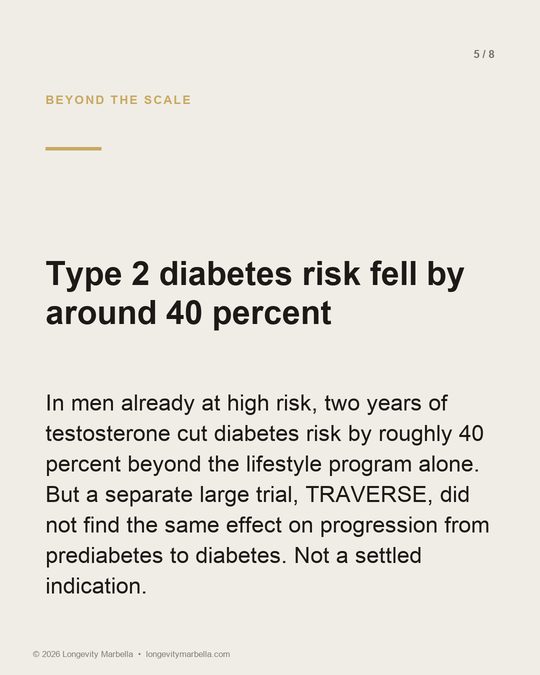
- The risk of developing type 2 diabetes fell by around 40 percent.
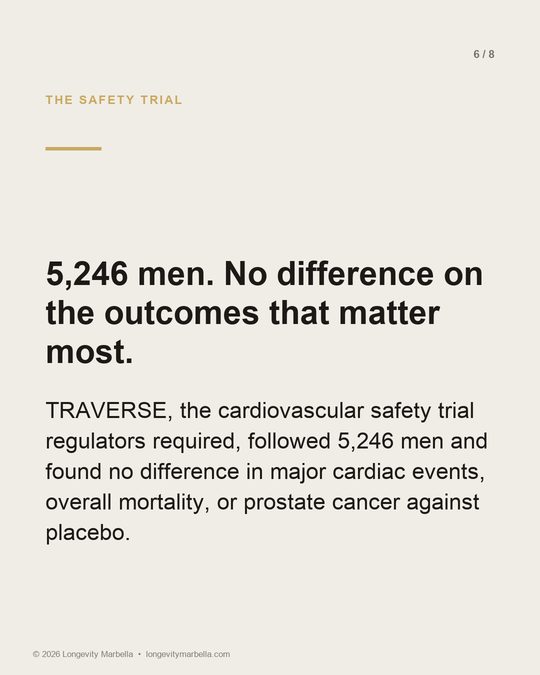
- No difference in major cardiac events, overall mortality or prostate cancer, and blood thickness is the reason monitoring exists.
A 2025 review in Drugs and Aging pulled the three large testosterone trials together. This article is about what they found on the specific question of muscle and fat, and where the honest limits sit.
The number worth knowing
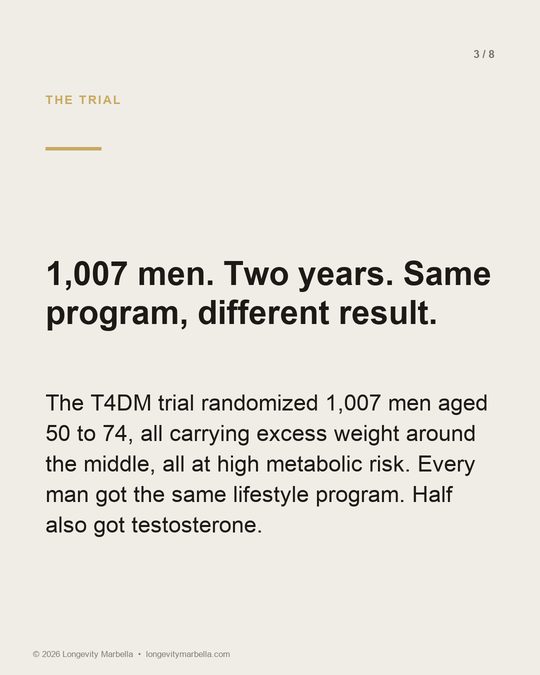
The T4DM trial randomized 1007 men aged 50 to 74, all carrying excess weight around the middle, all at high metabolic risk. Every man in the trial received a lifestyle program. Half also received testosterone, half received placebo. It ran for two years.
Here is what happened to their bodies:
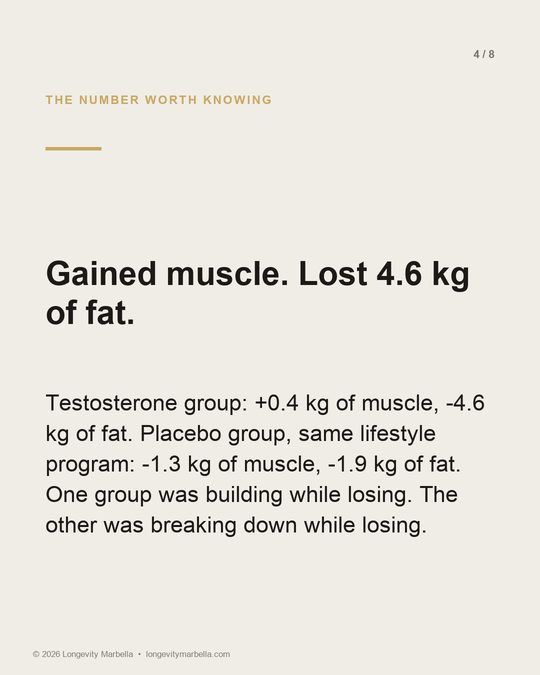
- Testosterone group: gained an average of 0.4 kg of muscle and lost 4.6 kg of fat.
- Placebo group, same lifestyle program: lost 1.3 kg of muscle and lost 1.9 kg of fat.
Read those two lines again, because the interesting part is not the fat number. It is that one group was building while losing and the other was breaking down while losing. Same program, same two years, opposite direction on the tissue that actually matters for how you function.
This is what body recomposition looks like when it is measured properly rather than claimed. And it is the reason we treat muscle as a clinical variable rather than a cosmetic one, a point we made separately in why muscle matters.
What else the trials found
The same trial found that two years of testosterone treatment reduced the risk of developing type 2 diabetes by around 40 percent, beyond the effect of the lifestyle program alone, in men who were already at high risk. It also improved sexual function and bone density.
Two things stop that from being a headline. First, the formal analysis found the effect was driven mainly by the reduction in fat mass, which tells you the hormone was working through body composition rather than by magic. Second, the larger TRAVERSE trial did not find the same effect on progression from prediabetes to diabetes. So the diabetes signal is promising rather than settled, and that is how we read it.
The earlier Testosterone Trials, in 788 men aged 65 and over, found improvements in sexual function, anemia and bone mineral density, with some benefit to mood and walking distance, and no meaningful effect on overall cognition or vitality. Real benefits, modest ones, in a carefully selected group.
On safety, briefly
TRAVERSE, the cardiovascular safety trial the regulator required, followed 5246 men and found no difference in major cardiac events, overall mortality or prostate cancer against placebo. That is the reassurance the field had been waiting two decades for. We have covered it in full, including the signals that did appear, in is testosterone therapy safe, so this article will not repeat it.
The part that argues for supervision, not against treatment
Two findings from these trials are worth stating plainly, because they are the reason this is a medical treatment rather than a supplement.
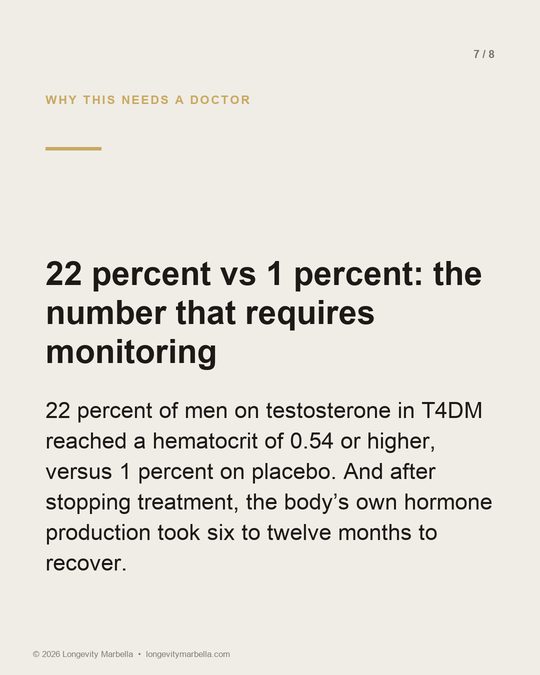
Blood thickness. In T4DM, 22 percent of men on testosterone reached a hematocrit of 0.54 or higher, red cells filling more than half the blood's volume, like engine oil run too thick, against 1 percent on placebo. In practice this frequently resolved on repeat testing, and only about 5 percent of the treated group were withdrawn for it. But 22 percent is not a rounding error. It is a number that requires somebody to be checking.
Your own production shuts down, like a generator switched off while grid power is connected. If children may be part of your plans, this is the paragraph to read twice. When treatment stopped in T4DM, the restart was slow: recovery of the body's own hormonal axis took six to twelve months. That is not a reason to avoid treatment. It is a reason to understand what you are starting, and to have that conversation before the first injection rather than afterwards.
Neither of these is an argument against testosterone therapy. Both are arguments against unsupervised testosterone therapy, which is a different thing entirely.
The question nobody has answered yet
The review raises one open question that is unusually relevant right now.
GLP-1 and related weight loss drugs are extraordinarily effective. Semaglutide produced 14.9 percent body weight loss in trials, tirzepatide 20.9 percent, retatrutide 24.2 percent. But alongside the fat, a substantial amount of lean mass goes too, with possible consequences for frailty later in life.
Testosterone is an anabolic hormone. T4DM showed it can shift the balance of what is lost. So the obvious question is whether it can protect muscle during rapid pharmaceutical weight loss.
That has not yet been tested in a randomized trial, so for now it stands as a well-founded open question. The review names it as a question requiring future trials. What can be recommended today, on current evidence, is resistance exercise and adequate protein during weight loss. We wrote about how these two treatments interact in what GLP-1 weight loss does to your testosterone.
Who this is actually for
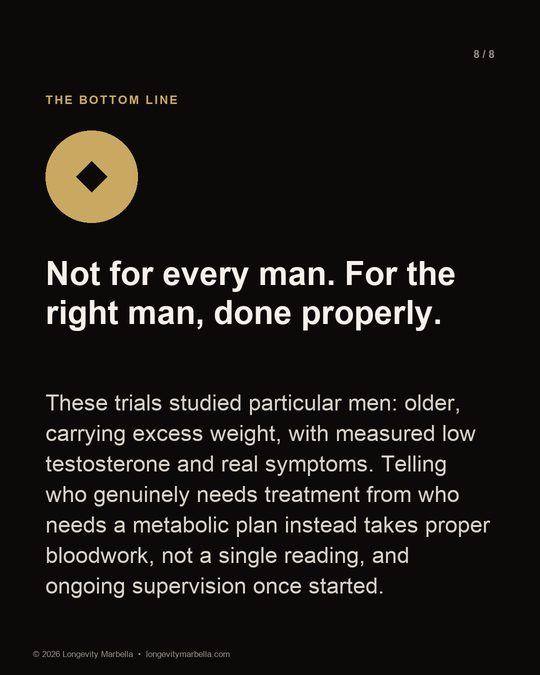
These trials studied particular men: older, carrying excess weight, with measured low testosterone and real symptoms. They do not say that every man over fifty should be treated, and the review is explicit that where low testosterone is driven by weight, comorbidities or medication, the first move is to address those causes.
That is our position too. Some men who arrive asking about testosterone leave with a metabolic plan and no hormone prescription, and their numbers recover. Others have genuinely low levels with symptoms that warrant treatment. Telling those two apart is the job, and it takes proper bloodwork rather than a single reading. What that involves is set out in what a proper men's health blood panel measures, and if treatment is appropriate, how we run and monitor it is on our TRT page.
Does testosterone actually build muscle in older men?
Yes, and this comes from randomized evidence rather than gym anecdote. In the T4DM trial of 1007 men aged 50 to 74, all of whom were on a lifestyle program, the men receiving testosterone gained an average of 0.4 kg of muscle mass and lost 4.6 kg of fat over two years. The men on the same lifestyle program with placebo lost 1.3 kg of muscle and 1.9 kg of fat. Testosterone changed the composition of the weight lost, not just the amount.
Does testosterone therapy help prevent type 2 diabetes?
In one large trial it did. T4DM enrolled men at high risk, with a large waist and either impaired glucose tolerance or newly diagnosed type 2 diabetes, and found that two years of testosterone treatment reduced the risk of type 2 diabetes by around 40 percent beyond the lifestyle program alone. Importantly, the separate TRAVERSE trial did not find the same effect on progression from prediabetes to diabetes, so this is not a settled indication and testosterone is not a diabetes drug.
What happens to my own testosterone production if I stop?
It recovers, but slowly. In T4DM, recovery of the body's own hypothalamic-pituitary-testicular axis took six to twelve months after treatment stopped. That is worth understanding before starting, particularly for any man who may want children, and it is one reason the decision deserves a proper assessment rather than a quick prescription.
What needs to be monitored during testosterone therapy?
Hematocrit, the thickness of your blood, is a key one. In T4DM, 22 percent of men on testosterone reached a hematocrit of 0.54 or above, compared with 1 percent on placebo. It frequently resolved on repeat testing and only about 5 percent of the treated group were withdrawn for it, but it illustrates why this treatment requires ongoing bloodwork rather than a prescription and a handshake. Cardiovascular markers, PSA and estradiol are also followed.
Can testosterone protect muscle during GLP-1 weight loss?
It is a reasonable question and it has not yet been answered by a randomized trial. A 2025 review in Drugs and Aging identifies precisely this as an open research question, noting that incretin-based weight loss drugs remove a substantial amount of lean mass alongside fat, and that testosterone is an anabolic agent. What can be recommended now, on current evidence, is resistance exercise and adequate protein intake during weight loss.