


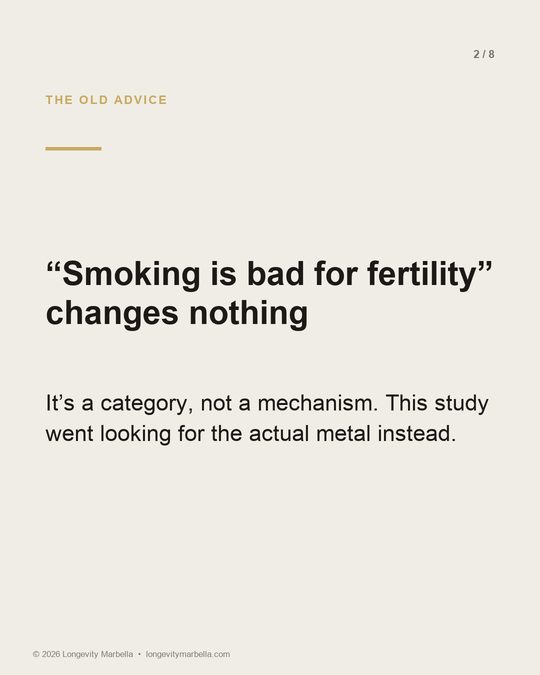
"Smoking is bad for your fertility" is the kind of advice that changes nothing, because it is a category, not a mechanism. A 2024 study in Biological Trace Element Research did something more uncomfortable and more persuasive: it went looking for the actual metal.
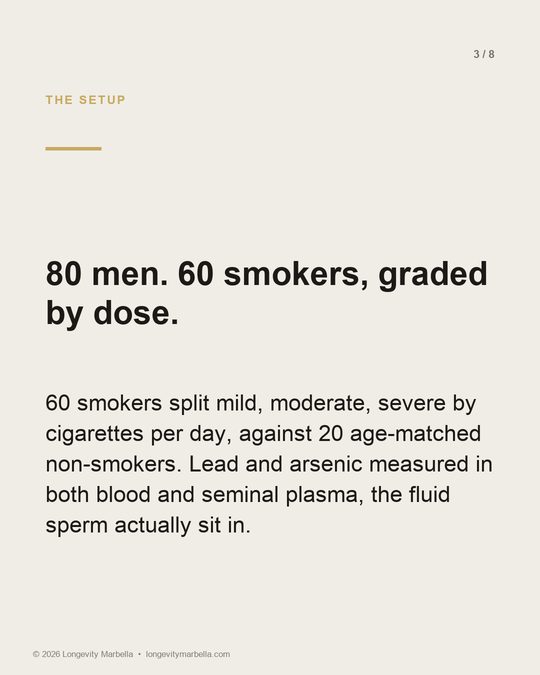
- 80 men: 60 smokers graded by cigarettes per day, and 20 age-matched non-smokers.
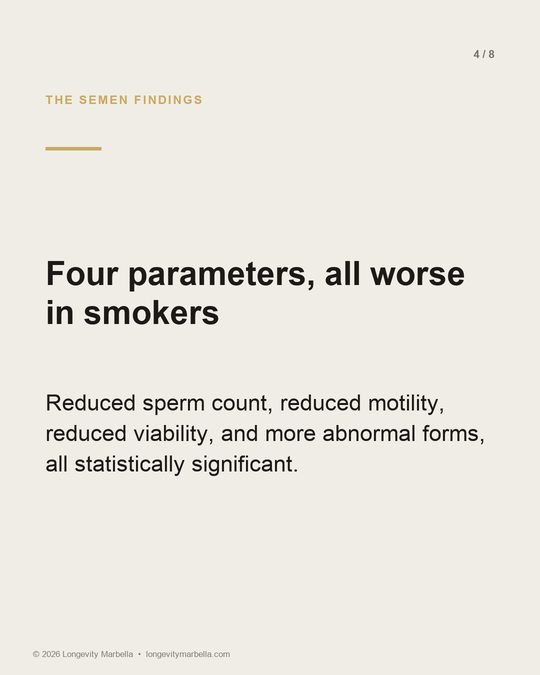
- Smokers had lower sperm count, motility and viability, and more abnormal forms.
- Lead was higher in smokers in both serum and seminal plasma, and seminal lead correlated negatively with sperm count (r = -0.320).
- Seminal arsenic was higher in smokers, correlated with abnormal forms (r = 0.414) and inversely with viability (r = -0.264).
- 80 men is small, and correlation does not prove that removing the exposure restores the parameter.
What they did
The team studied 80 adult men: 60 smokers and 20 age-matched non-smokers. The smokers were graded by cigarettes per day into mild, 1 to 10; moderate, 11 to 20; and severe, more than 20. Semen was analyzed to the 2010 WHO laboratory manual, and lead and arsenic were measured by atomic absorption spectrophotometry in both serum and seminal plasma, the fluid the sperm actually sit in.
That last detail is what separates this from the usual smoking study. Measuring a toxin in blood tells you about exposure. Measuring it in seminal plasma tells you it arrived where it could do harm.
The semen findings
Compared with non-smokers, smokers had significantly reduced sperm count (p = 0.001), reduced motility (p = 0.025), reduced viability (p = 0.034), and a greater proportion of abnormal forms (p = 0.002). Those small p values mean chance is a poor explanation for the gaps.
Four parameters, all in the wrong direction, which by itself is unremarkable. The interesting part is what they found alongside it.
The metals, and where they landed
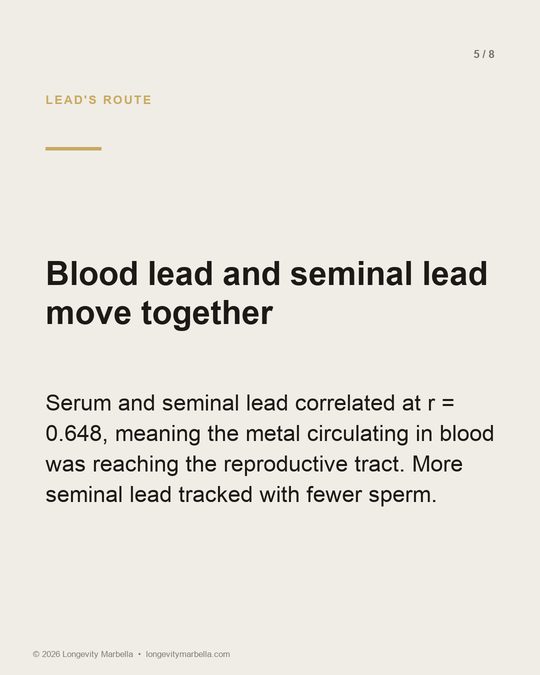
Smokers had significantly higher lead in both serum (p = 0.002) and seminal fluid (p = 0.001) than non-smokers. Serum lead and seminal lead moved together closely (r = 0.648, p < 0.001), meaning the metal circulating in blood was reaching the reproductive tract rather than staying put.
Seminal lead correlated negatively with sperm count (r = -0.320, p = 0.004). More lead in the fluid, fewer sperm in it.
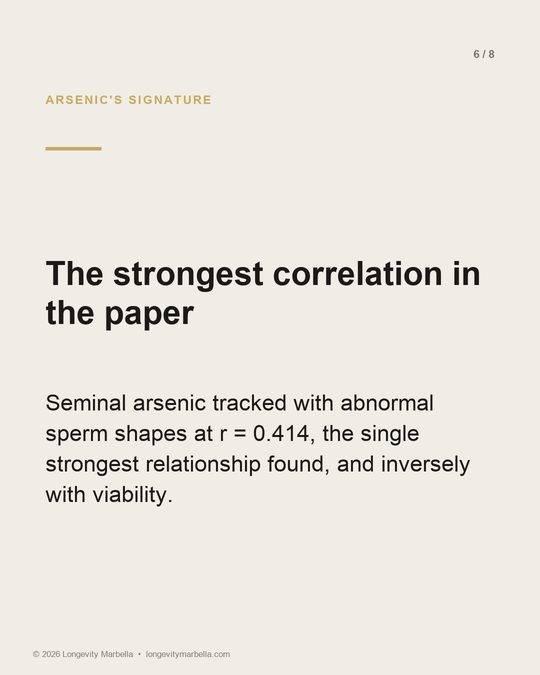
Smokers also had substantially higher seminal arsenic (p = 0.024), and arsenic had its own signature. Sperm viability was inversely related to seminal arsenic (r = -0.264, p = 0.042), and seminal arsenic correlated with abnormal sperm shapes (r = 0.414, p = 0.001), the strongest single correlation in the paper.
Lead and arsenic also rose together in smokers (r = 0.298, p = 0.012), which is what you would expect if a single source were delivering both.
Why measuring in seminal plasma is the point
Seminal plasma is the fluid the sperm are suspended in and travel through. A toxin in blood has been absorbed; a toxin in seminal plasma has crossed into the reproductive tract and is sitting in direct contact with the cells in question.
The correlation of 0.648 between serum lead and seminal lead is the study's quiet backbone. Blood is the mains, seminal plasma the tap in the room that matters: when lead rises in one it rises in the other, which is the evidence that what is circulating is arriving. Without that, you would have two separate observations. With it, you have a route.
The measurement was made by atomic absorption spectrophotometry, a standard laboratory method for quantifying specific metals, and the semen was analyzed against the 2010 WHO laboratory manual, which is the reference standard for what counts as normal.
The dose part, which is the part that matters
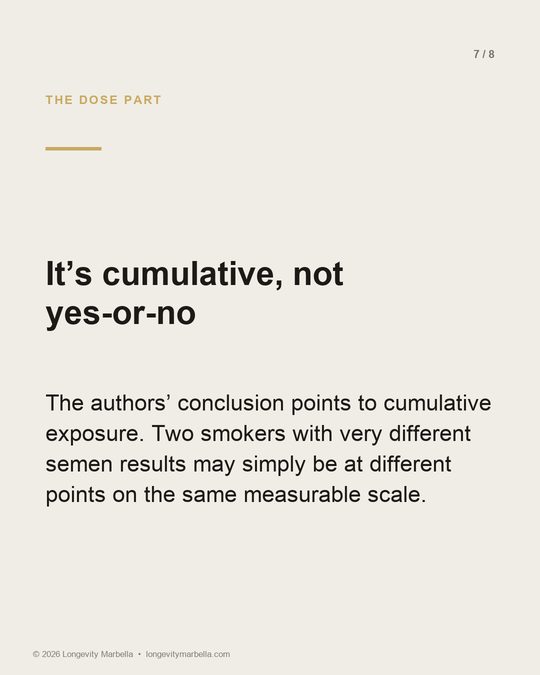
The smokers were not treated as one group. They were split by consumption into mild, 1 to 10 cigarettes a day; moderate, 11 to 20; and severe, more than 20, and the authors' conclusion refers explicitly to the cumulative effect of smoking.
That grading is why the paper is more than a disapproval. It treats tobacco as a dose-dependent exposure with a measurable burden, in the same way an occupational medicine physician would treat any other metal exposure. The relevant question stops being whether a man smokes and becomes how much, for how long, and what is currently detectable as a result.
It also quietly explains a pattern any doctor sees: two smokers with very different semen analyses. If the mechanism runs through accumulated metal burden rather than through the act of smoking itself, then duration and intensity should separate them, and in this dataset they did. The corollary is that the man who smokes little and the man who smokes heavily are not sharing a diagnosis; they are at different points on the same measurable scale, which is a far more useful thing to know than a yes or no on a history form.
What the authors conclude, and how far it goes
Their conclusion is careful: semen parameters are adversely affected by smoking through high levels of heavy metals such as lead and arsenic, and these effects relate to the cumulative exposure, which is why the cigarettes-per-day grading mattered.
The honest limits: 80 men is a small study, and correlations of this size, while statistically significant, describe tendencies rather than destinies. Correlation between a metal and a parameter does not by itself prove that removing the metal restores the parameter. And the study looked at a single population at a single moment; it did not follow men who quit.
What the correlations do and do not license
Four relationships were reported and it is worth being disciplined about how much weight each can carry.
The strongest was between seminal arsenic and abnormal sperm forms at r = 0.414. In plain terms, a correlation of that size describes a clear tendency across a group while leaving a great deal of individual variation unexplained. It is entirely possible to be a heavy smoker in this dataset with better morphology than a lighter one. Group tendencies are not individual predictions, and any honest reading of this paper has to say so.
What the pattern gains its force from is coherence. Lead moved with lead across two compartments. Lead tracked with count. Arsenic tracked with viability and with shape. Lead and arsenic rose together in smokers. Each of those alone would be a modest observation; arriving together, in the direction the underlying biology predicts, they make a considerably more persuasive case than any one of them does.
Exposure is a category, not a character flaw
It is worth separating the medicine from the moralising, because they get tangled and the tangle makes men defensive rather than curious.
Occupational medicine has measured heavy metal burden for a century without any implication about the worker's character. This paper applies exactly that framework to tobacco: a measurable quantity of lead and arsenic, arriving by a known route, detectable in the relevant compartment, in proportion to dose. Framed that way it becomes a clinical variable like any other, which is a considerably more useful thing to have in a consultation than disapproval.
Why this version of the message lands differently
Told that smoking harms fertility, most men file it under general disapproval. Told that lead is measurable in the fluid surrounding their sperm, in proportion to what they smoke, and that the more of it there is the fewer sperm there are, the conversation changes character. It stops being a moral position and becomes a physical one, with a number attached.
There is a second, quieter implication for anyone being assessed for fertility. Standard semen analysis reports count, motility and shape. It does not report why. Two men with identical bad numbers can be arriving there by completely different routes, and only one of those routes is a packet a day.
This is the case for assessment rather than assumption: the numbers tell you what is happening, and the history, the exposures and the rest of the panel tell you why it is happening. Only the second one tells you what is worth doing about it.
Frequently Asked Questions
Does quitting smoking reverse this?
This study did not follow men who quit, so it cannot answer that. It established that the metals are present in seminal fluid in proportion to smoking and that they track with worse parameters. Reversibility is a separate question that this design was not built to test.
Where do lead and arsenic in cigarettes come from?
Tobacco smoke contains thousands of compounds, among them heavy metals including lead and arsenic. This study measured them in serum and in seminal plasma and found both elevated in smokers relative to non-smokers.
How strong were these relationships?
Statistically significant but modest in size. The strongest was between seminal arsenic and abnormal sperm forms (r = 0.414). Correlations of this magnitude describe a real tendency across a group rather than predicting any individual's result.
Should heavy metals be measured in a fertility work-up?
This study does not recommend routine testing, and it would be overreaching to claim it does. What it supports is taking exposure history seriously as part of understanding why a semen analysis looks the way it does.
This article is for general information only and is not medical advice. Fertility and hormone treatments should be guided by a qualified doctor based on your own assessment.
Reference. Farag AGA, Badr EA, Kholif AOA, Khalifa MN, Ghanem MMM. "Serum and Seminal Plasma Levels of Lead and Arsenic in Cigarette Smokers and Their Relation to the Semen Parameters." Biological Trace Element Research 2024;202:4450-4458 (doi:10.1007/s12011-023-04039-7).
Ready to find out why, not just what?
Speak with a double board-certified specialist in Internal Medicine and Endocrinology about a fertility assessment that looks for causes rather than reporting numbers, by secure video or at your residence across the Costa del Sol.
A letter from the doctor. A few times a year, when the evidence genuinely changes, I write it down and send it. No schedule, no noise, and you can leave the list whenever you like.