


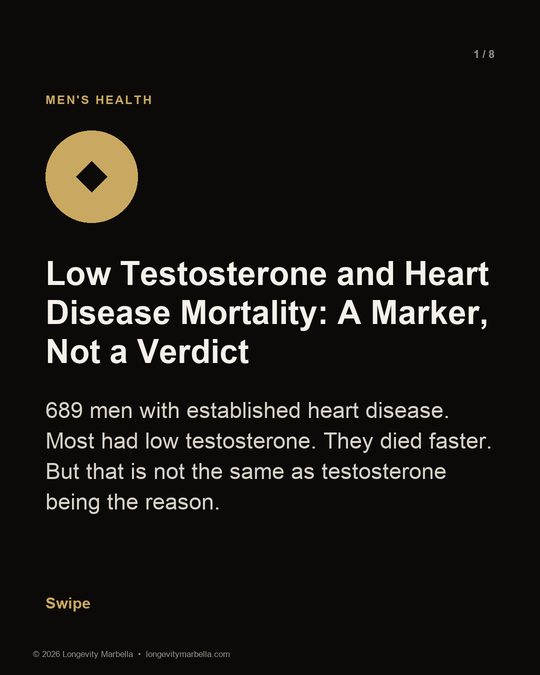
Here is the finding and the warning in the same breath. Among 689 men with established cardiovascular disease in the American NHANES survey, those with a total testosterone at or below 300 ng/dL had a 48 percent higher adjusted risk of dying from any cause. The association is real. It is not evidence that raising testosterone would have saved them, and that gap matters more than the headline.
Not sure if this applies to you? One-minute check.
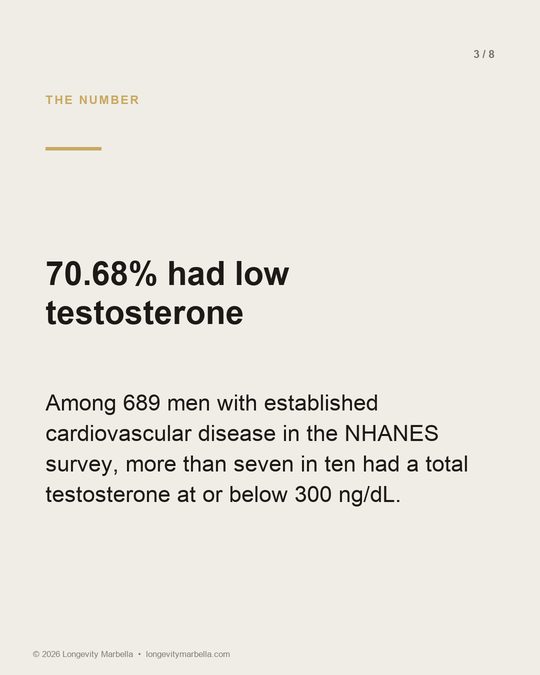
- Among 689 men with established cardiovascular disease in the American NHANES survey, 70.68 percent had total testosterone at or below 300 ng/dL.
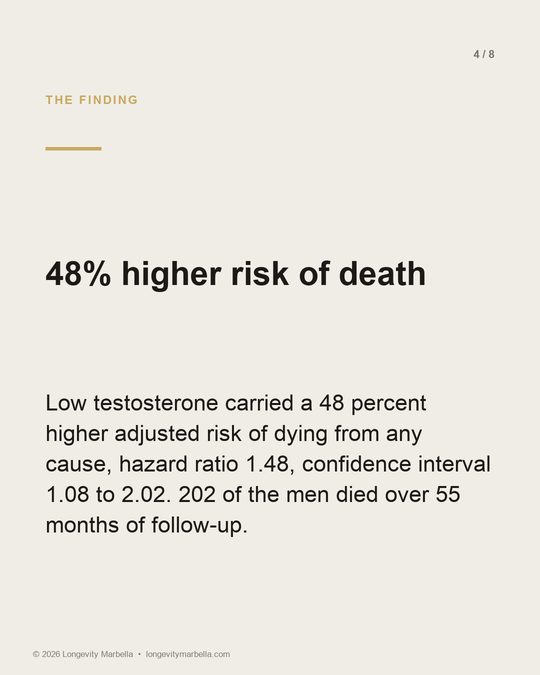
- Low testosterone carried a 48 percent higher adjusted risk of dying from any cause: hazard ratio 1.48, confidence interval 1.08 to 2.02.
- 202 of the men died over 55 months of follow-up.
- It is a marker, not a verdict: an association, not evidence that treating testosterone saves lives.
What the Study Actually Reported
The analysis, published in Cardiovascular Toxicology in 2025, drew on four NHANES cycles: 1999 to 2000, 2003 to 2004, 2011 to 2012 and 2013 to 2014. NHANES is a continuing American survey whose participants can be linked to a national death index, which is what makes a mortality analysis possible.
Of 2,482 adults with cardiovascular disease in those cycles, 1,177 had usable testosterone data: 689 men and 488 women, mean age 66.01 years, standard deviation 12.52. The exclusions were mostly missing hormone data, 676 men and 627 women, plus two pregnant women.
- 487 of the 689 men, 70.68 percent, had a testosterone at or below 300 ng/dL, the threshold the authors used to define low.
- 202 men, 29.32 percent, died during follow-up.
- Median follow-up was 55 months, interquartile range 44 to 71 months.
- In the adjusted model, low testosterone carried a hazard ratio of 1.48, 95 percent confidence interval 1.08 to 2.02, P = 0.013.
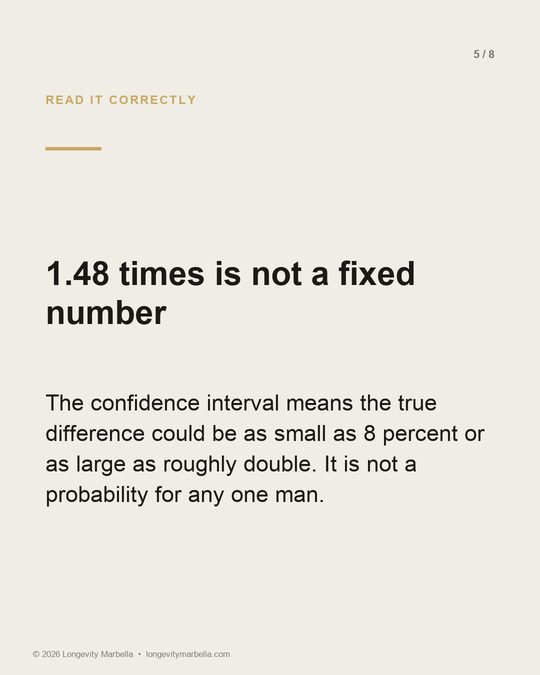
A hazard ratio of 1.48 means that at any point during follow-up, men in the low group were dying at roughly 1.48 times the rate of the rest. The confidence interval is the range of values the data are compatible with. Note where its lower edge sits: 1.08. The true effect could be as small as an 8 percent higher rate. The interval is wide because 202 deaths is not many on which to build a survival model.
Say the Uncomfortable Part First
Low testosterone in a man who already has heart disease may simply be a measure of how ill he is.
Testosterone falls in acute and chronic illness, in heart failure, kidney disease, inflammation, poor nutrition, disrupted sleep, and with several of the medications that accompany them. In men with established cardiovascular disease, a low reading is at least as likely to be a consequence of the disease burden as a cause of anything.
The study hints at exactly this. Among the men, 17.04 percent of the survivors were receiving treatment for their cardiovascular disease, against 32.67 percent of those who died, p less than 0.001. The men who died were also older, mean age 72.09 years against 64.25 years. They were sicker and more heavily treated. The adjusted model corrected for age, SHBG, poverty income ratio, ethnicity, education, hypertension and cardiovascular treatment. It did not correct for ejection fraction, kidney function, cancer, frailty or the severity of the coronary disease, because NHANES does not carry those variables.
An association between low testosterone and death in men who are already ill is not a case for treating the testosterone.
The authors go further than we would. Their discussion states the finding suggests a potential role for testosterone replacement therapy in improving survival. Nothing in their data supports that sentence. They measured a hormone once and counted deaths. They treated nobody.
The Detail the Headline Skips
One result in the paper's own tables belongs alongside the hazard ratio. Median total testosterone was 346.00 ng/dL in the men who survived and 343.06 ng/dL in those who died, a difference that was not statistically significant, p 0.208.
In other words, comparing testosterone as a continuous measurement between survivors and non-survivors produced almost nothing. The mortality signal appeared only once the men were sorted into two boxes at 300 ng/dL. Dichotomizing is legitimate and common, but fragile: a result that depends on where the line is drawn can move when somebody draws it elsewhere.
SHBG behaved more consistently. Median SHBG was 46.61 nmol/L in the men who survived and 53.75 nmol/L in those who died, p 0.002. SHBG is the protein that carries testosterone in the blood, and it rises with age, illness and low body weight. The paper notes that in middle-aged and elderly men total testosterone declines by around 0.8 percent per year while SHBG rises by 1.6 percent per year. Higher SHBG in the men who died is another fingerprint of a frailer group.
One figure does not reconcile, and a reader is entitled to know it. The paper reports a median total testosterone of 345.00 ng/dL across the 689 men, and separately that 487 of them, 70.68 percent, sat at or below 300 ng/dL. Both cannot be true of the same men, since a median of 345.00 ng/dL requires half the group to be at or above it. We cannot tell which figure is the error, and we report it rather than quietly picking whichever suits the argument.
The Women, and Why a Null Result Matters
The analysis also included 488 women, 394 of them, 80.74 percent, below the female threshold of 20 ng/dL. Ninety-four, 19.26 percent, died.
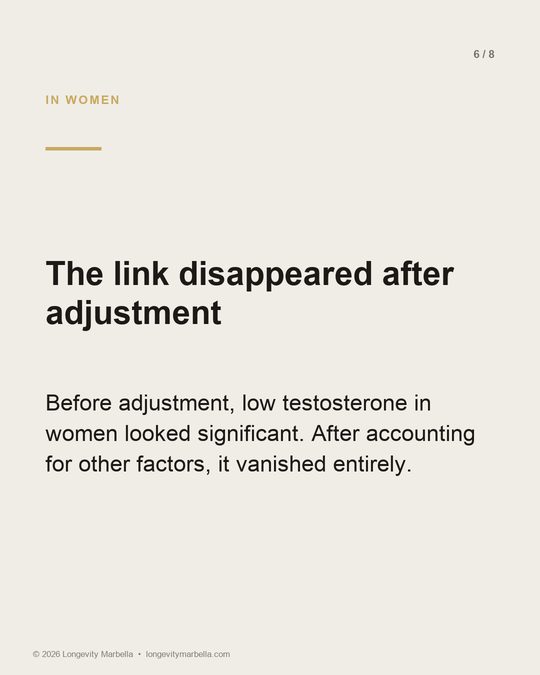
Unadjusted, low testosterone in women looked significant: hazard ratio 1.53, 95 percent confidence interval 1.01 to 2.31, p 0.042. After full adjustment it disappeared: hazard ratio 1.23, confidence interval 0.80 to 1.90, P = 0.341. A hazard ratio of 1.0 would mean the two groups were dying at the same rate, so a confidence interval that crosses 1.0 is compatible with no effect, with a protective effect and with a harmful one. The data cannot tell them apart.
No subgroup rescued it. Among women aged 65 and over the hazard ratio was 0.97 (0.72 to 1.32), under 65 it was 1.14 (0.84 to 1.54), with hypertension 1.02 (0.80 to 1.30) and without hypertension 0.83 (0.53 to 1.32). None came close to significance.
That asymmetry cuts both ways. It argues against the crudest confounding explanation, because if low sex hormones merely marked being unwell you would expect the same signal in women with a similar burden of disease. It also argues for humility, because the authors concede they may lack a defensible threshold for low testosterone in a woman. The study cannot separate those readings.
Where the Association Held in Men
In men, the finding was at least consistent across the obvious splits:
- Aged 65 and over: hazard ratio 1.45, 95 percent confidence interval 1.09 to 1.93, P = 0.010
- Under 65: 1.39, 1.01 to 1.90, P = 0.041
- With hypertension: 1.35, 1.06 to 1.71, P = 0.015
- Without hypertension: 1.93, 1.25 to 2.96, P = 0.003
Consistency across subgroups is a modest point in favor of a real association rather than a statistical accident. It says nothing about causation.
The paper cites supporting context: a Swiss prospective cohort found approximately 40 percent of men presenting with acute coronary syndromes had low testosterone, associated with higher one year mortality, and a Greek cohort with stable coronary heart disease found low testosterone associated with higher five year cardiovascular death. The direction is consistent across countries. The interpretation problem is identical in each.
The Treatment Question Is a Different Question
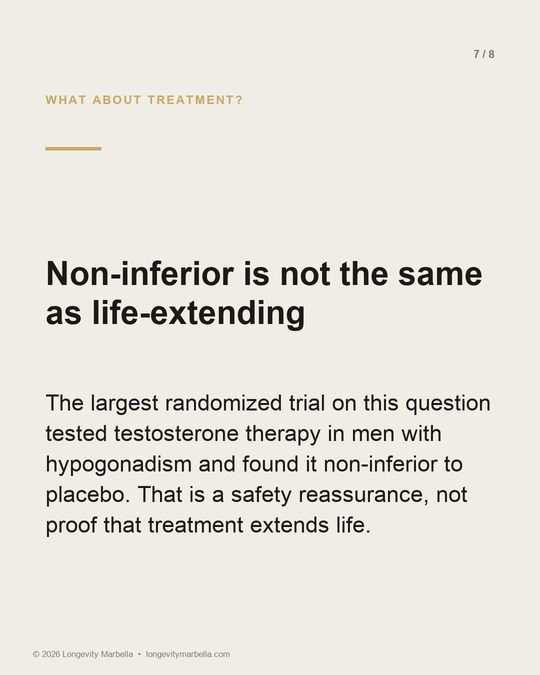
If low testosterone marks worse outcomes, the tempting inference is that correcting it improves them. That inference has been tested. The paper cites the largest randomized controlled study on the subject, which investigated testosterone replacement therapy in 5,246 men with hypogonadism and showed the treatment was non-inferior to placebo. Non-inferior means not worse. It is a meaningful reassurance about cardiovascular safety, and it is not a demonstration that treatment extends life. What that trial does and does not settle is set out in is testosterone therapy safe.
Observational registry data point in a friendlier direction, and registry data are precisely the kind of evidence randomized cardiology trials have overturned again and again. Men who stay on treatment, attend follow-up and normalize their levels differ from men who do not, in ways no adjustment captures. That is the same trap this analysis sits in, seen from the other side.
What a Low Result Should Actually Trigger
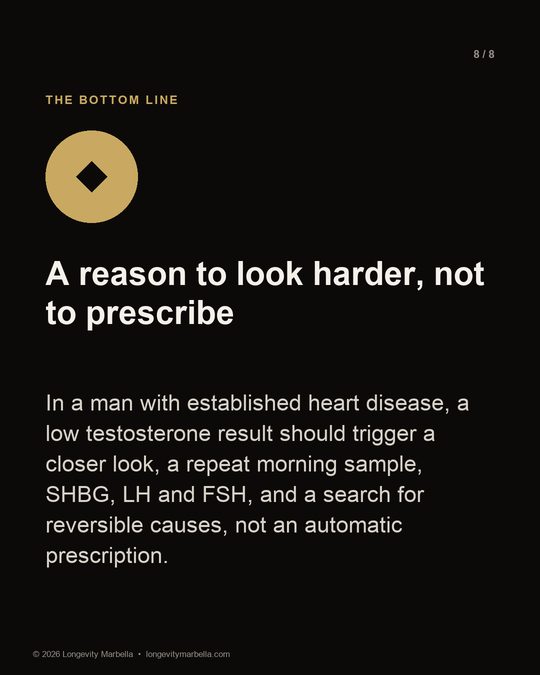
In a man with established heart disease, a testosterone at or below 300 ng/dL is a reason to look harder. It is not a reason to write a prescription.
Looking harder means confirming the result on a second early morning fasting sample, because one measurement is unreliable and levels swing with the clock, a limitation these authors acknowledge. It means SHBG and albumin, so the free fraction, the unbound, active share, is calculated rather than assumed. It means LH and FSH, the pituitary's call for testosterone, which separate a testicular problem from a pituitary one the way a thermostat separates two faults: a call turned up high with output low points to the furnace, the testes; a weak call points to the thermostat, the pituitary. It means hunting the suppressors worth finding anyway: untreated sleep apnea, poor glycemic control, weight gain, thyroid disease, iron overload, opioids and glucocorticoids. And it means asking whether the man has symptoms at all, because a number without symptoms is not a diagnosis. The panel we work from is described in what a proper men's health blood panel measures.
If a treatable cause turns up, treating that cause is the intervention with evidence behind it. If none turns up and the symptoms are genuine and persistent, a conversation about therapy becomes reasonable, held with the cardiovascular history in view and with the goal understood as symptom relief, not life extension.
Where a Specialist Opinion Helps
This question sits between two specialties and is routinely answered by neither. A cardiologist may not want to touch the hormone. A hormone clinic may not look carefully at the heart. Our specialist is double board-certified in Internal Medicine and Endocrinology and consults by private video call or concierge visit across the Costa del Sol, in English or Dutch. Expect a slower conversation, fuller measurements, and quite possibly the conclusion that your testosterone is not what needs treating.
Does low testosterone cause deaths in men with heart disease?
This study cannot show that, and it does not claim to have shown it. It is a retrospective analysis of survey data in which testosterone was measured once and deaths were counted afterward. Men with low testosterone died at 1.48 times the rate of men with normal levels after adjustment, which is an association. Low testosterone is also a well-recognized consequence of serious illness, so a low reading in a man with established heart disease may be reporting how ill he already is rather than adding to his risk.
My testosterone is below 300 ng/dL and I have had a cardiac event. Should I start treatment?
Not on the strength of this study, which tested no treatment at all. The proper next step is a fuller assessment: a repeat early morning fasting measurement, SHBG and albumin so the free fraction, the unbound and active share, can be calculated, LH and FSH, and a deliberate search for reversible causes such as untreated sleep apnea, poor glycemic control, weight gain, thyroid disease or medications that suppress the axis, the brain-to-testes thermostat loop that drives testosterone production. Whether therapy is appropriate afterward is a decision for a doctor who can see your cardiac history, your symptoms and your full panel together.
Why did the finding hold in men but not in women?
Nobody knows, and the authors are candid about it. In women the association was significant before adjustment, hazard ratio 1.53 (1.01 to 2.31, p 0.042), and vanished after full adjustment, hazard ratio 1.23 (0.80 to 1.90, P = 0.341). No age or hypertension subgroup showed a signal. One explanation is that the effect is genuinely male. Another is that the threshold used for women, 20 ng/dL, may not identify anything clinically meaningful, which the authors themselves raise as a possibility. The honest answer is that the study cannot distinguish between them.
What does a hazard ratio of 1.48 mean in plain terms?
It means that at any given moment during follow-up, men in the low testosterone group were dying at about 1.48 times the rate of men in the normal group. It is a comparison of rates, not a probability that any individual will die. The accompanying confidence interval of 1.08 to 2.02 is the range of values consistent with the data, so the underlying difference could be as small as 8 percent or as large as roughly double. A range that wide is a reason to treat the estimate as imprecise, not a reason to dismiss it.
How reliable is a single testosterone measurement?
Not reliable enough to act on alone. Testosterone follows a daily rhythm and is highest in the morning, it falls with acute illness and poor sleep, and it is reported as a total figure that shifts whenever the carrier protein SHBG shifts. The authors of this study list circadian variation among their own limitations. In practice a low result should be confirmed on a second early morning fasting sample, with SHBG measured alongside it, before it is treated as a fact about the man rather than a fact about that particular morning.
This article is for general information only and is not medical advice. Individual dietary and medical decisions should be discussed with a qualified doctor.
Reference. Jiang R, Wang Y. "Association between Low Serum Testosterone Levels and All-cause Mortality in Patients With Cardiovascular Disease: A Study Based on the NHANES Database." Cardiovascular Toxicology 2025;25:604-613 (doi:10.1007/s12012-025-09973-7).
One number is rarely the whole answer
If your hormone results have been read to you as a single figure, our specialist can interpret the full picture alongside your symptoms, on a private video call or a concierge home visit across the Costa del Sol.
A letter from the doctor. A few times a year, when the evidence genuinely changes, I write it down and send it. No schedule, no noise, and you can leave the list whenever you like.