


In about four out of ten cases of male infertility, no cause is ever found, and the file is closed with a single word: idiopathic. A 2024 case-control study in Endocrine examined 214 such men and found that almost a quarter had a total testosterone below the level scientific societies use to call a man normal.
Not sure if this applies to you? One-minute check.
- In about four of ten male infertility cases no cause is found, and the file is closed with one word: idiopathic.
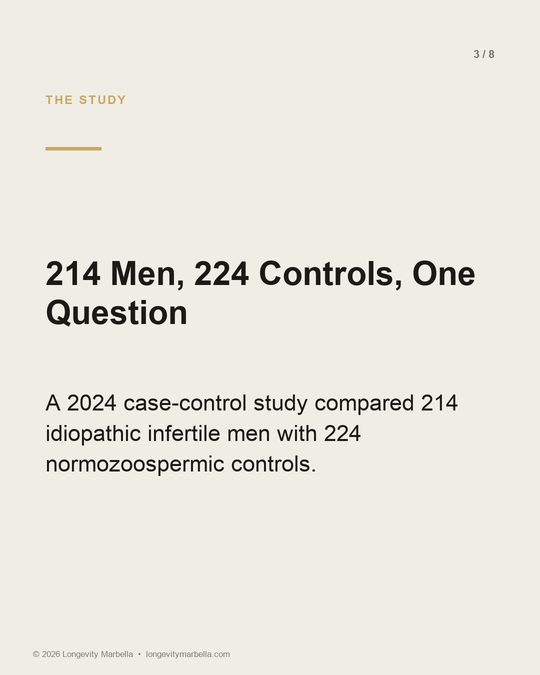
- A 2024 case-control study compared 214 idiopathic infertile men with 224 normozoospermic controls.
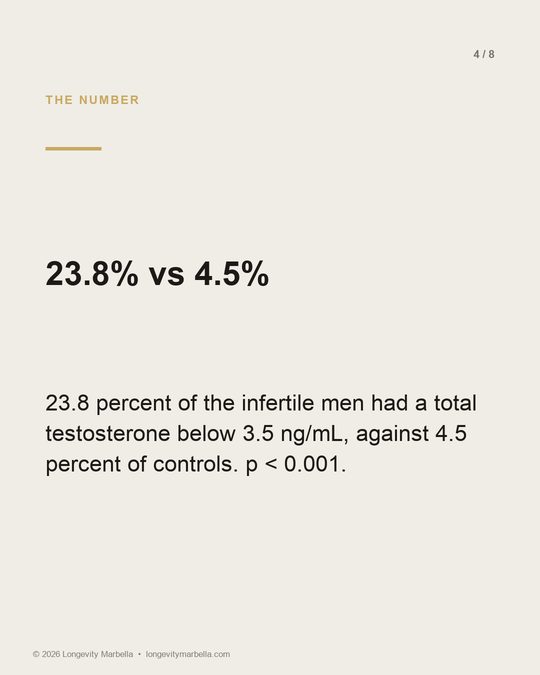
- 23.8 percent of cases had total testosterone below 3.5 ng/mL, against 4.5 percent of controls.
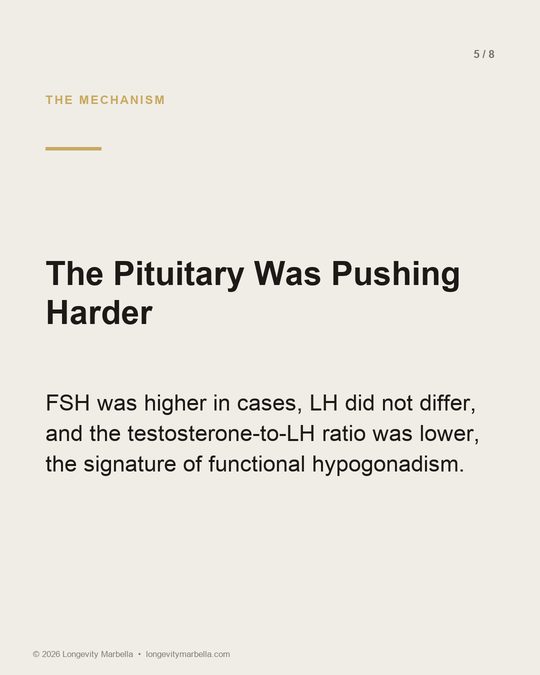
- FSH was higher in cases, LH did not differ, and the testosterone to LH ratio was lower in cases.
What the Word Idiopathic Is Actually Doing
Male factor is involved in about 50 percent of infertile couples of reproductive age in Western countries, and in roughly 40 percent no cause is ever identified. Those men become idiopathic.
The definition is precise and entirely negative. At least one semen parameter must fall below the World Health Organization decision limits, no recognizable cause may be found, and the gonadotropins, meaning the two pituitary hormones that drive the testis, follicle stimulating hormone (FSH) and luteinizing hormone (LH), must sit inside the reference range. A diagnosis of exclusion is only ever as good as the exclusion.
Idiopathic is not a mechanism. It is a record of where the search stopped.
How the Study Was Built
Cases were 214 men with idiopathic infertility, mean age 38.2 years with a standard deviation of 6.2, seen at the Andrology Unit in Modena, Italy between June 2016 and June 2023 in a retrospective real-world study. Each was the male partner of a couple who had not conceived after twelve months of unprotected intercourse, with at least one abnormal semen parameter, FSH between 1 and 12 IU/L, LH between 1 and 9 IU/L, and testosterone above 2.1 ng/mL. Men below 2.1 ng/mL were excluded, since that value identifies hypogonadism beyond doubt: the authors wanted the ambiguous middle, not the obvious cases. Chromosomal alterations, Y chromosome microdeletions, CFTR mutations, varicocele, urogenital infection, obstruction and other endocrine disease were excluded as well. Of the 214, 190 men (88.8 percent) had semen abnormalities and 24 (11.2 percent) were azoospermic, meaning no sperm at all in the ejaculate.
Controls were 224 men with normozoospermia, mean age 33.7 years with a standard deviation of 7.5, referred for screening semen analysis between September 2010 and May 2022.
The Comparison That Should Change the Conversation
Blood was drawn fasting at 8:00 am. Mean total testosterone was 5.2 ng/mL in cases, standard deviation 2.0, against 5.7 ng/mL in controls, standard deviation 1.5, p = 0.002. That gap alone is a footnote. The distribution is the story: neither group was normally distributed, and the case curve was shifted left.
Then the authors applied the threshold scientific societies suggest for a normal level, 3.5 ng/mL, equivalent to 12.1 nmol/L.
- 23.8 percent of cases, 51 of the 214 infertile men, fell below 3.5 ng/mL
- 4.5 percent of controls, 10 of the 224 normozoospermic men, fell below the same line
- The difference reached p < 0.001
Read that with the entry criteria in mind. All 51 had already been declared free of any identifiable cause, and all had a testosterone above 2.1 ng/mL, so none was an obvious hypogonadal case. They sat in the gray zone between 2.1 and 3.5 ng/mL, that is 7.3 to 12.1 nmol/L, and nobody had called it anything.
Why a Gray Zone Level Matters Inside the Testis
The testosterone in your blood is not the testosterone that makes sperm. Sperm production depends on intratesticular testosterone, the concentration inside the testis itself, far higher than the level in the bloodstream: a thermometer in the hallway never reads what the boiler room reads.
The compartments are driven separately. LH stimulates the Leydig cells, which make testosterone, the heat. FSH stimulates the Sertoli cells, which nurse the developing sperm, the work that heat is for. Three findings point the same way:
- FSH was higher in cases, 5.2 against 4.1 IU/L, p < 0.001, suggesting the sperm producing compartment is struggling and the pituitary is pushing harder
- LH did not differ, 4.0 against 3.8 IU/L, p = 0.324
- The testosterone to LH ratio was lower in cases, 1.5 against 1.9, p < 0.001, meaning the testis delivered less testosterone for the same pituitary drive
Within the cases that ratio separated more sharply still, 0.9 below 3.5 ng/mL against 1.7 at or above, p < 0.001. This is what the authors mean by functional hypogonadism: the pituitary signal is nominally within range, but the gland it is aimed at is not answering properly.
The Correlation That Appeared Only in the Low Group
Splitting the cases at 3.5 ng/mL produced the most interesting result. In men at or above the threshold, testosterone correlated with no semen parameter at all. More testosterone bought nothing.
In men below it, testosterone correlated directly with the percentage of sperm of normal shape, known as normal morphology. On multivariate stepwise linear regression this gave R = 0.430, standard error 0.3, p = 0.020, and it survived adjustment for cryptorchidism, varicocelectomy, comorbidities, drug use, smoking and alcohol (R = 0.390, standard error 0.5, p = 0.025).
An R of 0.430 is a moderate association in a subgroup of 51 men. Treat it as a signal, not a law. But the shape matters: below the threshold testosterone tracks with sperm morphology, above it it does not. For scale, normal morphology averaged 2.0 percent in cases against 10.0 percent in controls, p < 0.001, and a normal result requires above 4 percent.
Where the Study Stops, Stated Plainly
The design is retrospective, so it shows association and cannot show cause. A low testosterone here may be contributing to the poor semen quality, may be a consequence of the same testicular problem, or may be incidental.
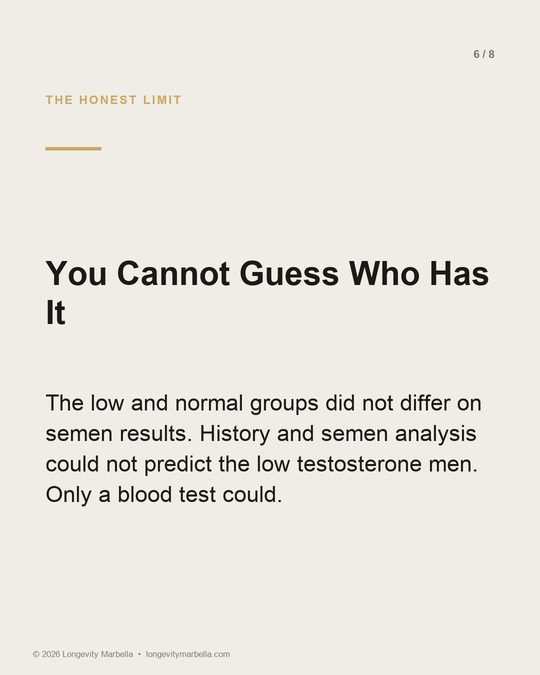
More awkward than that, the two subgroups did not differ on semen parameters. Splitting at 3.5 ng/mL produced no significant difference in sperm concentration, total sperm number or motility, and normal morphology was slightly higher, not lower, in the low testosterone subgroup, 2.3 percent against 1.3 percent, p = 0.064. Only the testosterone to LH ratio separated them. Across the whole cohort, bivariate correlation found no significant relationship between testosterone and any hormone or semen parameter once corrected for multiple testing, and logistic regression, which asks whether a set of readings can sort men into groups, could not pick out who had a low level, whether from clinical characteristics (Chi-squared 6.5, p = 0.588) or from hormones and semen parameters (Chi-squared 128.9, p = 0.063). Nothing measurable from outside identified the struggling boiler.
That last failure is a limitation and also the paper's practical argument. You cannot work out from the history or the semen analysis which of these men has the low level. You have to measure it.
Three further caveats the authors raise themselves. Testosterone was assayed by immunoassay, less accurate than mass spectrometry and least accurate at low values, which is where this finding lives. The 3.5 ng/mL threshold is guideline supported but unproven as the most accurate line between eugonadal and hypogonadal. And the controls had normal semen analyses but unproven fertility, and were younger than the cases, 33.7 against 38.2 years.
The Move That Looks Obvious and Is Wrong
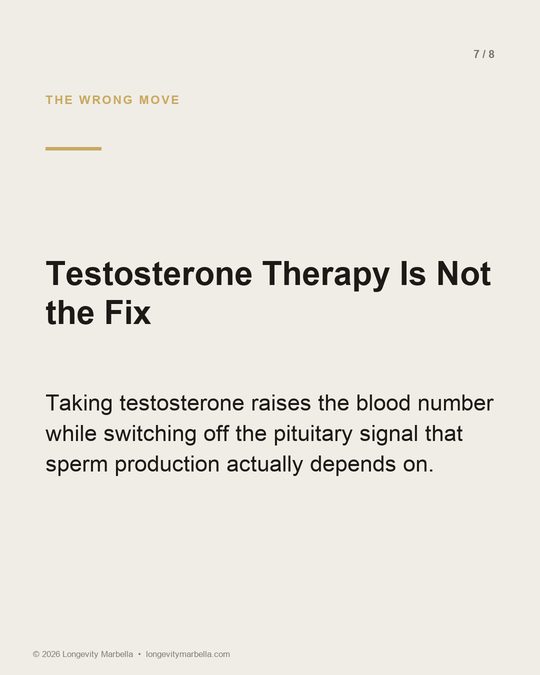
A man reads that a quarter of these cases have low testosterone and reaches the conclusion the internet hands him within thirty seconds: get testosterone. That is precisely backwards, and it is the most important sentence here.
Exogenous testosterone suppresses sperm production. Taking testosterone raises the level in the bloodstream, which is where the pituitary reads it: hold a heater against the thermostat and it shuts the boiler down. The pituitary switches off LH and FSH, the Leydig cells stop making testosterone inside the testis, which is what spermatogenesis actually depends on, and the blood number rises while the boiler room, where sperm are actually made, winds down. In a man who wants children, testosterone therapy works against the goal, which we set out separately in what testosterone therapy does to fertility.
So what does a low level change? The assessment, not the prescription. The authors argue that a testosterone in the gray zone may mark the subgroup in whom stimulating the testis with gonadotropins, rather than replacing testosterone, has a mechanistic rationale, while the other 76 percent probably carry a defect further down the spermatogenesis cascade. They are candid that this remains a hypothesis requiring purpose-designed studies.
Current practice sits loosely by comparison. Across 21 trials FSH raised pregnancy rates overall, but 10 to 18 men had to be treated for a single pregnancy: a great deal of treatment for a category the authors themselves call heterogeneous.
What This Means If You Are the Man in Question
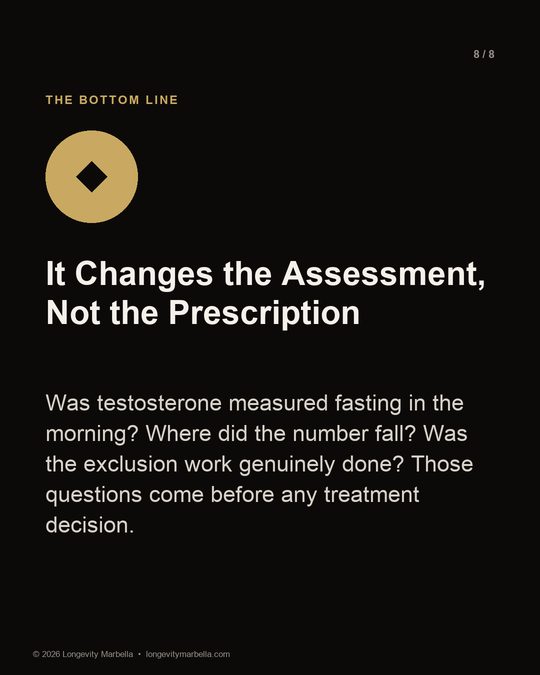
If your semen analysis is abnormal and the cause is said to be unknown, three questions are worth asking before you accept the word idiopathic.
- Was total testosterone measured at all, and drawn fasting in the morning? Testosterone follows a daily rhythm, which is why the samples here were taken at 8:00 am.
- Where did the number fall? Above 3.5 ng/mL this study offers you nothing. Between 2.1 and 3.5 ng/mL you are the man it describes.
- Was the exclusion work genuinely done? Karyotype, Y chromosome microdeletions, CFTR, varicocele, infection, obstruction, other endocrine disease.
Like the paper itself, we promise only what the data support. A testosterone of 3.1 ng/mL is not a fertility treatment waiting to happen. It moves a man out of a category with no mechanism into one with a testable hypothesis, which is the difference between being managed empirically and being investigated. The groundwork of sleep, body composition, metabolic health, alcohol and the medications that quietly interfere matters wherever the number lands, and we cover it in what actually improves male fertility.
Reading the whole hormonal picture alongside the semen analysis and the history, rather than glancing at one number and filing it, is the work our specialist does, double board-certified in Internal Medicine and Endocrinology. If you were handed a word instead of an explanation, that is worth a conversation.
The groundwork is measurable. Book a private consultation
My semen analysis is abnormal but I was told my hormones are normal. Should testosterone be measured?
It should be measured and it should be looked at, which are two different things. In this study every man had gonadotropins inside the reference range, and 23.8 percent of them still had a total testosterone below 3.5 ng/mL, against 4.5 percent of normozoospermic controls (p < 0.001). Neither the clinical history nor the semen analysis predicted who those men were: the logistic regression models failed at p = 0.588 and p = 0.063. The only way to know is a fasting morning measurement.
Does a low testosterone here mean testosterone treatment will help me conceive?
No, and the opposite is closer to the truth. Exogenous testosterone raises the blood level while suppressing LH and FSH, which collapses the intratesticular testosterone that sperm production depends on. In a man trying to father a child, testosterone therapy works against the objective. A low reading in this setting changes what should be investigated, not what should be prescribed, and it is a reason to bring it to a specialist, because what it changes is the investigation.
What does a testosterone between 2.1 and 3.5 ng/mL actually mean?
It is the gray zone, 7.3 to 12.1 nmol/L. Above 3.5 ng/mL guidelines regard a man as eugonadal. Below 2.1 ng/mL hypogonadism is beyond doubt. In between, the number is not frankly pathological but it is not reassuring either, and the authors argue that roughly a quarter of idiopathic infertile men occupy that band and have some form of functional hypogonadism, meaning the pituitary signal looks normal while the testis is not responding properly to it.
Does this study prove that low testosterone is causing the poor semen quality?
No. It is retrospective and real-world, so it can show association and cannot show cause. The correlation between testosterone and normal sperm morphology in the low group was moderate, R = 0.430, standard error 0.3, p = 0.020, in a subgroup of 51 men. And when the cases were split at 3.5 ng/mL the two subgroups did not differ significantly on semen parameters at all: morphology was 2.3 percent below the threshold against 1.3 percent above it, p = 0.064, which is not significant. Treat this as a signal that changes the assessment, not as a demonstrated mechanism.
Why did the study exclude men with testosterone below 2.1 ng/mL?
Because those men are not diagnostically difficult. A value below 2.1 ng/mL identifies hypogonadism beyond any reasonable doubt, so they would never have been labeled idiopathic in the first place. Excluding them made the finding stricter rather than looser: the 23.8 percent were drawn entirely from men whose testosterone sat above the unambiguous cut-off and who had nevertheless been left with no diagnosis.
This article is for general information only and is not medical advice. Individual dietary and medical decisions should be discussed with a qualified doctor.
Reference. Spaggiari G, Costantino F, Dalla Valentina L, Romeo M, Furini C, Roli L, De Santis MC, Canu G, Trenti T, Granata ARM, Simoni M, Santi D. "Are they functional hypogonadal men? Testosterone serum levels unravel male idiopathic infertility subgroups." Endocrine 2024;84:757-767 (doi:10.1007/s12020-024-03717-3).
One number is rarely the whole answer
If your hormone results have been read to you as a single figure, our specialist can interpret the full picture alongside your symptoms, on a private video call or a concierge home visit across the Costa del Sol.
A letter from the doctor. A few times a year, when the evidence genuinely changes, I write it down and send it. No schedule, no noise, and you can leave the list whenever you like.