


A semen analysis carries a date, and almost nobody reads it. A meta-analysis in Andrology pooled every usable study on the question and found that the month on that date shifts the numbers, by enough to matter when a result sits near a reference line.

Not sure if this applies to you? One-minute check.
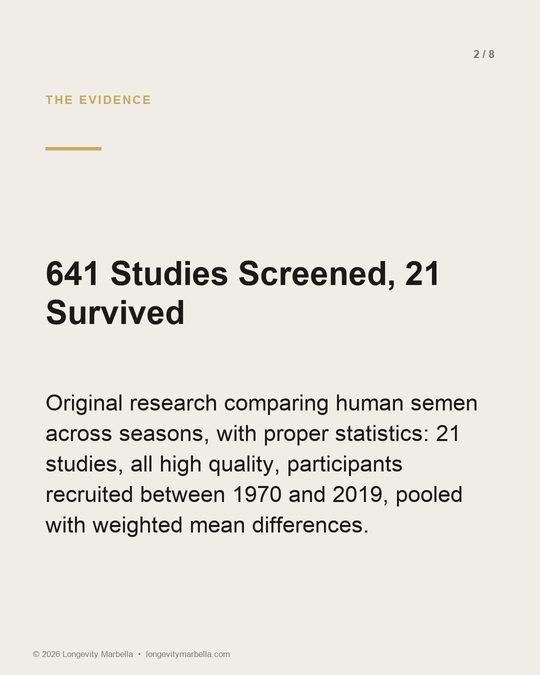
- 21 studies passed the quality bar out of 641 screened, spanning recruitment from 1970 to 2019, all rated high methodological quality.
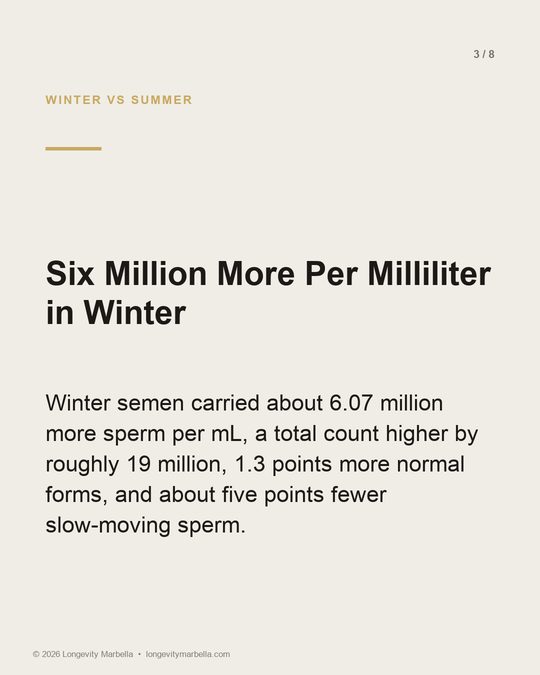
- Winter beat summer: about 6 million/mL more sperm concentration, 19 million more total sperm, and 1.3 percentage points more normal forms.
- Winter and spring outperformed summer and fall across concentration, total count and sluggish motility.
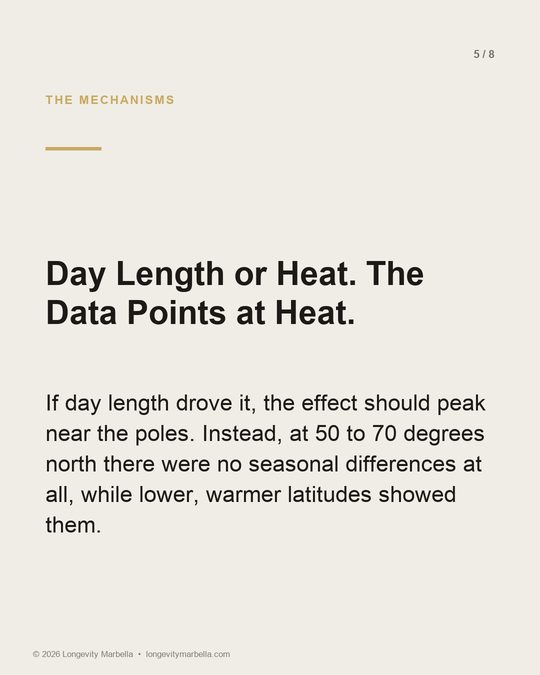
- At 50 to 70 degrees north, no seasonal differences appeared. At lower latitudes, including Spain's, they did.
- The differences are averages with high variability between studies. They matter for reading a borderline result, not for planning a pregnancy.
What they pooled
The team at the University of Utah searched three databases and screened 641 studies down to the ones that could actually answer the question: original research comparing human semen parameters across seasons, with proper statistics. 21 studies survived, every one scoring high on the standard quality scale, with participants recruited between 1970 and 2019, twenty studies from the northern hemisphere and one from the southern.
The populations were mixed on purpose: nine studies followed couples at fertility centers, three followed men with low counts or infertility, two followed healthy men from the general population. The researchers then pooled the results using weighted mean differences, which is simply the average gap between seasons once each study is weighted by its size and precision.
What winter does
The sharpest contrast was winter against summer. Winter semen carried about 6.07 million more sperm per milliliter (95% CI 2.09 to 10.04), a total count higher by roughly 19 million (95% CI 6.38 to 31.59), and 1.3 percentage points more normally shaped sperm. Sluggish, slow-moving sperm were about five percentage points fewer in winter.
Broadening to the full pattern: winter and spring beat summer and fall on concentration by 3.24 to 6.07 million/mL and on total count by 14.63 to 19.74 million. Spring added a higher total motile count than fall or summer. The direction was consistent; cold-season semen was better semen.
For scale: the current WHO reference for concentration sits at 16 million/mL. A six-million swing does not move a healthy man anywhere that matters. It can absolutely move a borderline man across the reference line, in either direction, depending on the month his sample was taken.
Why season could reach the testis
Two mechanisms are plausible, and the paper is careful to call them proposals rather than proof. The first is day length. Melatonin, the hormone the brain secretes in darkness, works like a light-sensitive timer: light exposure shapes melatonin secretion, and higher melatonin has been associated with better sperm quality. The second is temperature. Sperm production runs a few degrees cooler than core body temperature, which is the entire reason for the testis's external anatomy, and hot ambient summers can narrow that margin.
Then comes the finding that complicates the tidy story, and it is the most interesting one in the paper. If day length drove the effect, the pattern should be strongest near the poles, where the difference between the longest and shortest day exceeds 13 hours. Instead, at latitudes between 50 and 70 degrees north the meta-analysis found no seasonal differences at all, while the variation showed up at lower, warmer latitudes. That quietly shifts the suspicion toward heat.
Marbella sits at roughly 36 degrees north. This coast is in the band where the seasons were visible in the data, and the local summer is precisely the kind the temperature hypothesis worries about.
Hold it loosely: the caveats are real
The heterogeneity between studies was enormous, which means the pooled numbers are an average across very different settings rather than a universal constant. The included studies span five decades of laboratory practice, across which the WHO manual for semen analysis was revised repeatedly, changing reference values and counting methods. And the design cannot distinguish innate seasonal biology from environmental exposures that happen to follow the calendar.
Above all: these are group averages. The same man measured twice can swing more than these seasonal gaps for reasons that have nothing to do with the calendar, which is exactly the argument of our companion piece on why a single semen analysis is a photograph, not a portrait.
What this changes in practice
It does not change when you should try for a child. The effect sizes are far too small against everything else that matters, and nobody should schedule a family around a forest plot.
What it changes is how a result gets read. A concentration of 14 million in August is not the same fact as 14 million in February, and neither deserves a verdict on its own. Sperm takes roughly three months to produce, so a repeat analysis a season later is not bureaucracy, it is measurement done properly. When we assess male fertility, the date on the laboratory form is part of the interpretation, along with the weight, the alcohol, the heat exposure and the hormones that the rest of this journal covers one by one.
A number near a line deserves context before it deserves a conclusion. Season, it turns out, is part of the context.
If a borderline result has been worrying you, that worry has probably been doing more damage than the number itself. Send me the result and the date it was taken, and you will know what it actually means.
Frequently Asked Questions
Should we try to conceive in winter, then?
No. The seasonal differences are pooled averages of a few million per milliliter, smaller than the swings a single man shows between his own samples, and far smaller than the effects of weight, smoking or heat exposure. The finding matters for interpreting a semen analysis, not for scheduling a family.
Why would season affect sperm at all?
Two candidate mechanisms: day length, which shapes melatonin secretion, a hormone associated with sperm quality; and ambient temperature, which can raise scrotal temperature, and the testis is deliberately kept cooler than the rest of the body. The meta-analysis could not separate innate biology from environment.
Does this apply on the Costa del Sol?
Marbella sits at roughly 36 degrees north, in the latitude band where the meta-analysis did observe seasonal variation. Interestingly, at 50 to 70 degrees north no seasonal differences were found, the opposite of what the day-length theory predicts.
My summer semen analysis came back below the reference. What now?
A single result is a snapshot and season is one more reason not to over-read it. The standard approach is to repeat the analysis after roughly three months, one full production cycle, and to have abnormal results assessed properly rather than interpreted from a reference table alone.
This article is for general information only and is not medical advice. Fertility and hormone treatments should be guided by a qualified doctor based on your own assessment.
Reference. Dehghanbanadaki H, Randell Z, Cain T, Fendereski K, Horns JJ, Ramsay JM, Gross KX, Pastuszak AW, Hotaling JM. "Seasonal Variations in Human Semen Parameters: A Systematic Review and Meta-Analysis." Andrology 2026;14:1102-1120 (doi:10.1111/andr.70167).
A number near a line deserves a specialist reading it.
Send the result and the date it was taken. A double board-certified specialist in Internal Medicine and Endocrinology reads it with you, in context, by secure video or across the Costa del Sol.
A letter from the doctor. A few times a year, when the evidence genuinely changes, I write it down and send it. No schedule, no noise, and you can leave the list whenever you like.