


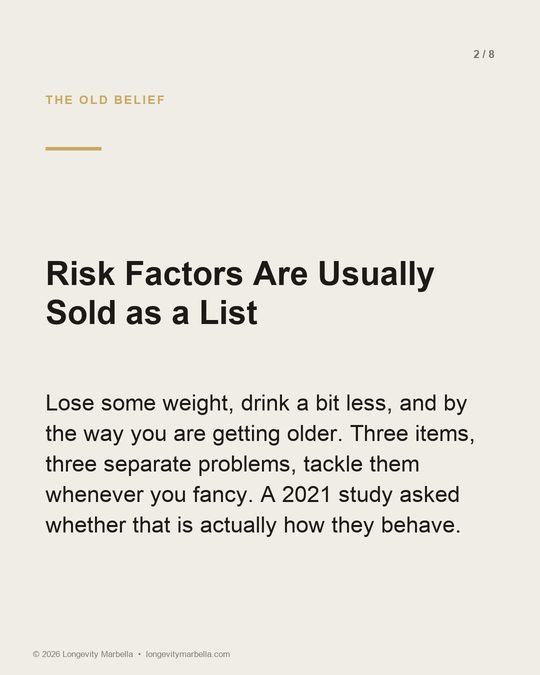
Risk factors are usually sold as a list. Lose some weight, drink a bit less, and by the way you are getting older. Three items, three separate problems, tackle them whenever you fancy.
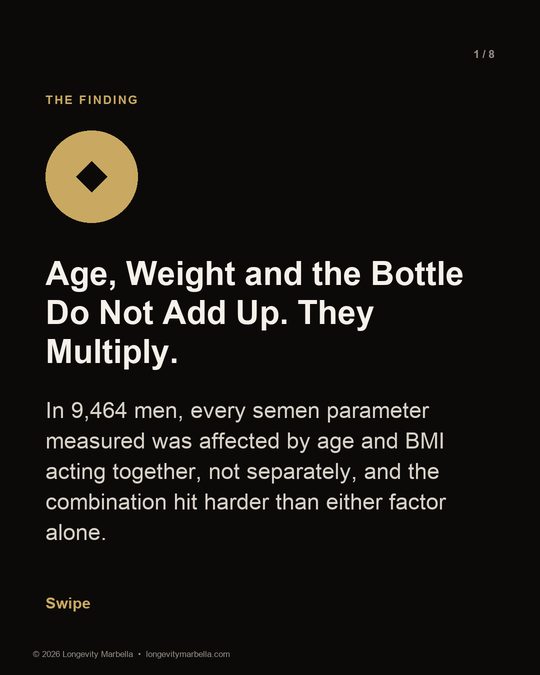
- 9,464 men, nine semen parameters, age and BMI from measurement and alcohol from self-report.
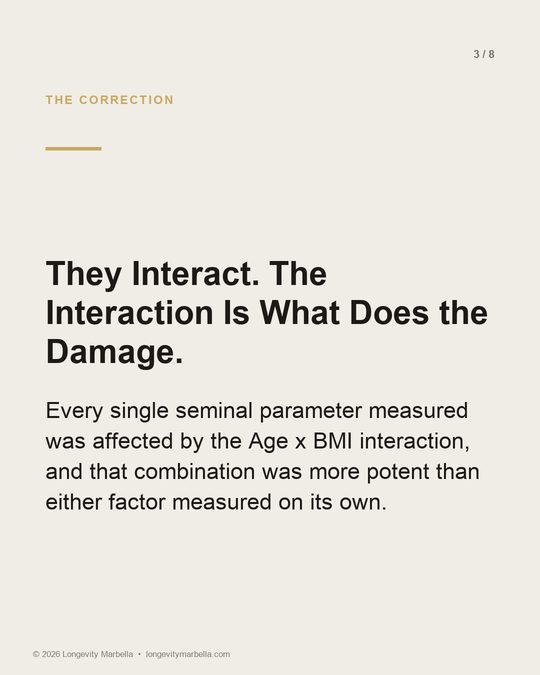
- Every parameter was affected by the Age x BMI interaction, which was stronger than either factor alone.
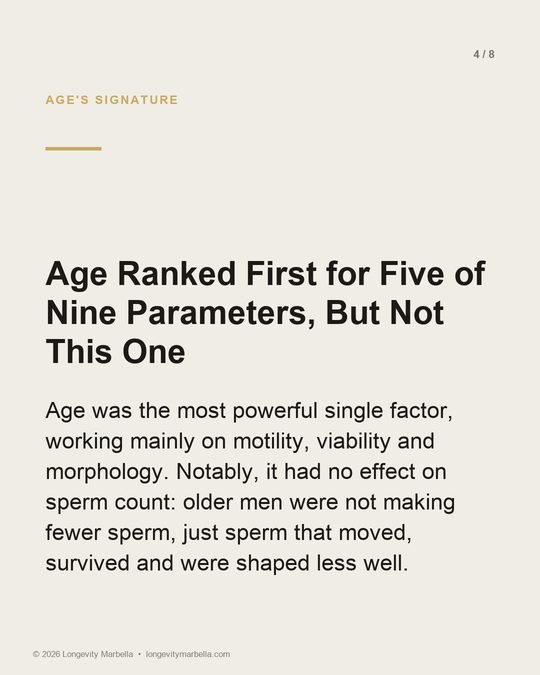
- Age ranked first for five of nine parameters, hitting motility, viability and morphology, with no effect on count.
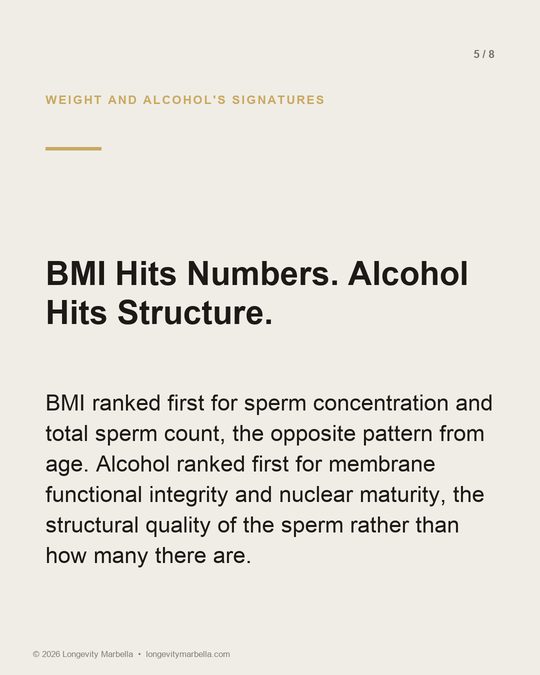
- BMI ranked first for concentration and total count. Alcohol ranked first for membrane integrity and nuclear maturity.
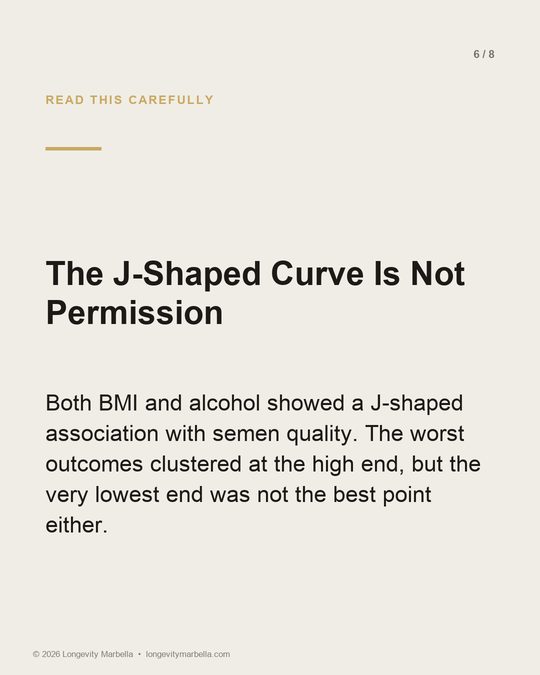
- Both BMI and alcohol showed J-shaped curves, and alcohol dose was self-reported, which the authors call an important limitation.
A 2021 study in the Journal of Assisted Reproduction and Genetics tested whether that is actually how they behave, and the answer is no. They interact, and the interaction is the part that does the damage.
What they did
Researchers in Córdoba analyzed 9,464 men attending an andrology laboratory. Age and daily alcohol intake came from the patients themselves; body mass index was measured in the laboratory. They then examined nine semen parameters: volume, sperm concentration, total count, motility, rapid motility, morphology, viability, nuclear maturity and membrane functional integrity.
The size matters here. Nearly ten thousand men is enough to detect the modest interactions that smaller studies miss entirely.
The finding: age and weight travel together
Every single seminal parameter they measured was affected by the Age x BMI interaction. Not by age alone and weight alone politely taking turns, but by the two of them combined, and that combination was more potent than either was separately.
Two parameters looked especially fragile: sperm morphology and nuclear maturity, both of which were hit by all three synergistic interactions the authors tested. Nuclear maturity describes how properly packaged the DNA inside the sperm head is, which is not something a standard count tells you.
Each factor has its own signature
This is the part that makes the study genuinely useful, because the three factors do not attack the same things.
Age was the most powerful single factor, ranking first for five of the nine parameters, and it worked mainly on motility, viability and morphology. Notably, it had no effect on sperm count. Older men in this dataset were not making fewer sperm; they were making sperm that moved less well, survived less well and were shaped less well.
BMI ranked first for sperm concentration and total sperm count. The opposite pattern. Excess weight was associated with fewer sperm rather than worse ones.
Alcohol ranked first for membrane functional integrity and nuclear maturity, the two parameters that describe the structural quality of the sperm rather than how many there are or how fast they swim.
So the three risks are not interchangeable, and a plan that addresses only one of them leaves the others entirely untouched.
The J-shaped curve, and why it is not permission
In the multivariate analysis, both BMI and alcohol showed a J-shaped association with semen quality. That means the worst outcomes clustered at the high end, but the very lowest end was not the best point either.
This shape appears often in medicine and it is misread just as often. It is worth stating plainly what it is not: it is not a finding that drinking improves your sperm, and it is not an argument for being underweight. A cross-sectional dataset built on self-reported intake is a photograph of the parking lot on one day, and a photograph cannot tell you why a car is parked. The zero-alcohol bottom of a J-curve is exactly where you would expect to find the men who stopped for a reason.
The parameters nobody explains to you
Two of the nine measures here rarely appear in ordinary conversation and both turn out to be central, so they are worth defining properly.
Membrane functional integrity tests whether the sperm's outer membrane is intact and behaving as a living membrane should. A sperm can be present, correctly shaped and even moving, and still have a compromised membrane, which matters because that membrane has to survive a journey and then fuse with an egg.
Nuclear maturity describes how tightly and correctly the DNA has been packaged inside the sperm head during its production. Poor packaging leaves genetic material more exposed to damage. Neither of these appears on a basic count-and-motility report, and in this study both were the parameters most vulnerable to combined exposures.
Alcohol ranking first for exactly these two is a specific finding rather than a general disapproval: it points at the structural quality of what is produced rather than the quantity.
Why the literature disagrees with itself
The authors do something honest and place their result beside the studies that conflict with it.
One earlier study of 1,683 patients scored men on a set of lifestyle factors including BMI above 25, age over 50, high coffee intake, and abstinence patterns, and found that the men scoring as unhealthy had significantly lower sperm quality and reduced motility. A more recent study using a similar scoring idea, but a different list of factors including smoking, exercise, tight underwear, sauna use and years of mobile phone use, found no relationship at all with seminal quality.
Two studies, similar method, opposite conclusions. The likeliest explanation is that the factors are not equal and lumping them into a single score destroys the information. Which is exactly what this larger study demonstrates from the other direction: age, weight and alcohol each attack different parameters, so any score that treats them as interchangeable points will average away the very signal it is looking for.
Where the study is weak, and the authors say so
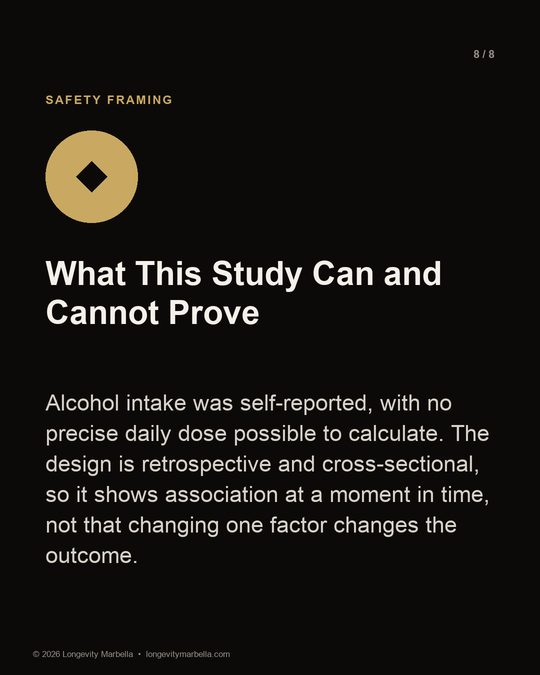
Alcohol intake was self-reported, and the authors name the impossibility of strictly calculating a daily dose as an important limitation. Men reliably understate drinking. The design is retrospective and cross-sectional, so it captures associations at a moment rather than proving that changing one factor changes the outcome.
They also note that previous attempts to score lifestyle risk have disagreed with each other: one study of 1,683 patients found unhealthy men had worse sperm quality, while another using a similar scoring approach found no relationship at all. That disagreement is part of the honest picture.
What "synergistic" does and does not mean
The word is used carefully in this paper and it is worth matching that care.
Synergy here means the combined effect of two factors is larger than what you would predict by adding their separate effects together, the way towing a trailer uphill costs more fuel than the trailer alone plus the hill alone. It is a statistical statement about interaction, drawn from a cross-sectional dataset, not a demonstration that removing one factor produces a specific gain.
What it does establish is that studying these exposures one at a time will systematically understate them. A study of weight alone, in men of mixed ages, would find a modest effect and conclude weight is a modest problem. This dataset says the modest average is hiding two different realities: a smaller effect in younger men and a larger one in older men, blended into a single unremarkable number.
What to take from it
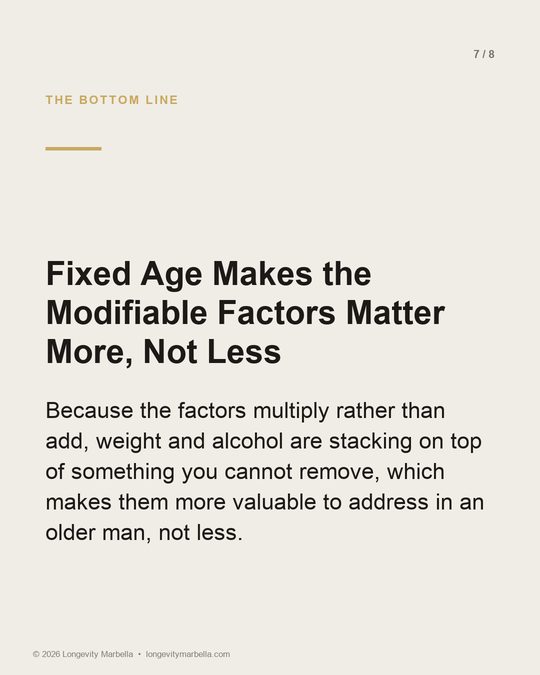
The practical message is not the tired one about lifestyle. It is about sequencing and combination. If age is fixed and it is acting mainly on motility, viability and morphology, then the factors that are not fixed become disproportionately valuable, because they are stacking on top of something you cannot remove.
A 35-year-old carrying extra weight and a 45-year-old carrying the same extra weight are not in the same position, and this study is the arithmetic showing why.
It also explains something men find bewildering: two patients with identical habits and different ages producing very different results, or a man whose count is fine while everything about the quality of those sperm is not. The parameters are not one thing. They come apart, and which of them comes apart tells you something about why.
Frequently Asked Questions
Does losing weight improve sperm quality?
This study is cross-sectional, so it shows association rather than proving that losing weight changes the outcome. What it does show is that BMI ranked first for sperm concentration and total count, and that it compounded with age on every parameter measured.
How much alcohol is safe for fertility?
This study cannot answer that, and its authors say so: intake was self-reported and a precise daily dose could not be calculated. What it identified was where alcohol acts, on membrane functional integrity and nuclear maturity, rather than how much is acceptable.
If age is the strongest factor, is there any point changing the rest?
That is arguably the study's central point. Because the factors multiply rather than add, the modifiable ones matter more in an older man, not less, since they are stacking on top of something fixed.
What is nuclear maturity?
It describes how correctly the DNA inside the sperm head has been packaged. It is not part of a standard count and motility report, and in this dataset it was one of the two parameters vulnerable to all three interactions tested.
This article is for general information only and is not medical advice. Fertility and hormone treatments should be guided by a qualified doctor based on your own assessment.
Reference. Ramirez N, Estofan G, Tissera A, Molina R, Luque EM, Torres PJ, Mangeaud A, Martini AC. "Do aging, drinking, and having unhealthy weight have a synergistic impact on semen quality?" Journal of Assisted Reproduction and Genetics 2021;38:2985-2994 (doi:10.1007/s10815-021-02274-2).
Ready to measure what is actually stacking up?
Speak with a double board-certified specialist in Internal Medicine and Endocrinology about body composition, hormones and fertility assessed together, by secure video or at your residence across the Costa del Sol.
A letter from the doctor. A few times a year, when the evidence genuinely changes, I write it down and send it. No schedule, no noise, and you can leave the list whenever you like.