


Some women cannot take estrogen. A history of breast cancer, a previous clot, a stroke. Others simply do not want to, and that is a legitimate position that deserves a real answer rather than a shrug and a leaflet about layered clothing.
Not sure where you are in this? One-minute check.
- Hormone therapy is still the most effective treatment for hot flashes, but some women cannot or do not want to take estrogen.
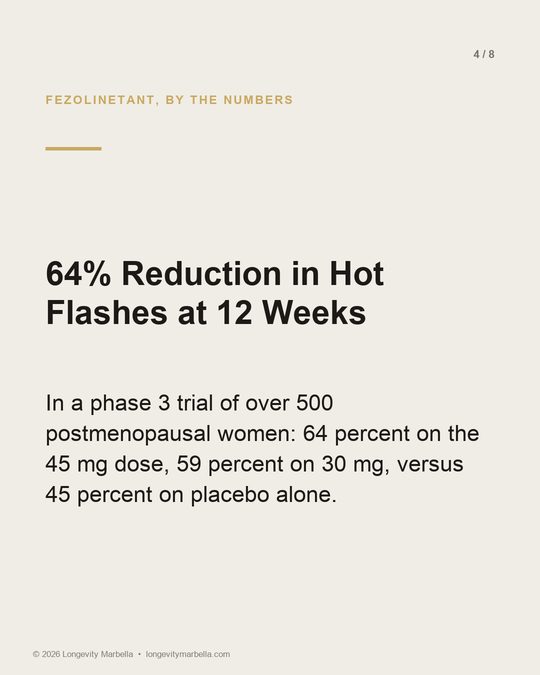
- Fezolinetant targets the KNDy neurons, the actual mechanism of a hot flash. Reductions at 12 weeks: 64 percent on 45 mg, 59 percent on 30 mg, 45 percent on placebo.
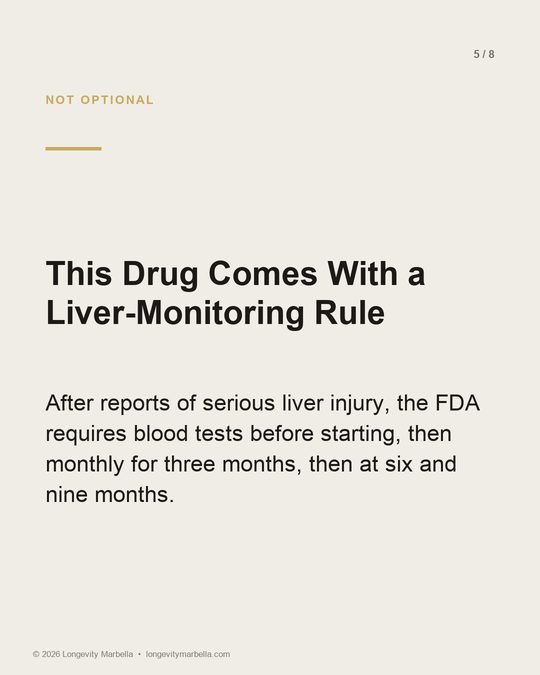
- Its safety condition is not optional: liver tests before starting, then monthly for the first three months.
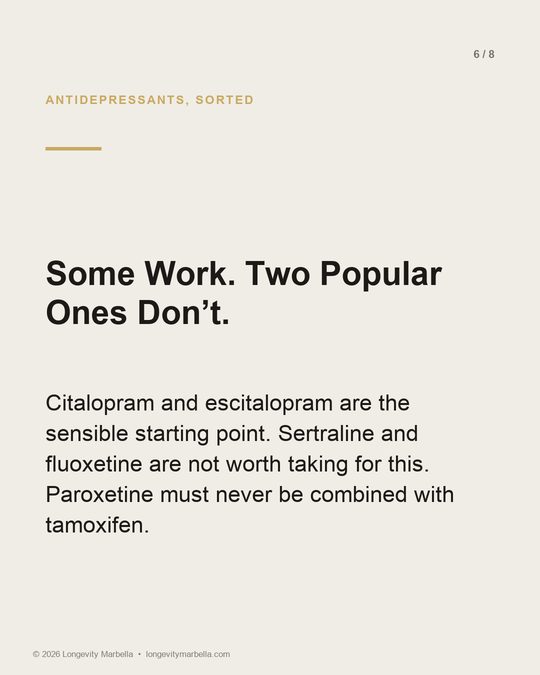
- Citalopram, escitalopram and venlafaxine help. Sertraline and fluoxetine are not worth taking for this. Paroxetine must not be used with tamoxifen.
- Gabapentin at night, oxybutynin and cognitive behavioral therapy all have real evidence.
Until recently the honest answer was thin. It is not thin any more.
A drug class that works on the brain's thermostat itself. Not a supplement. A mechanism.
First, the Sentence That Frames Everything
Hormone therapy is still the most effective treatment for hot flashes. Nothing here beats it. Everything below is for the woman who cannot have it or has decided against it, and she deserves to know she is choosing a good second option rather than being told a second option is just as good.
The New Drugs, and Why They Are Different
For decades the non-hormonal options were medicines borrowed from other conditions: antidepressants, an antiseizure drug, a bladder drug. They helped, modestly, by accident.
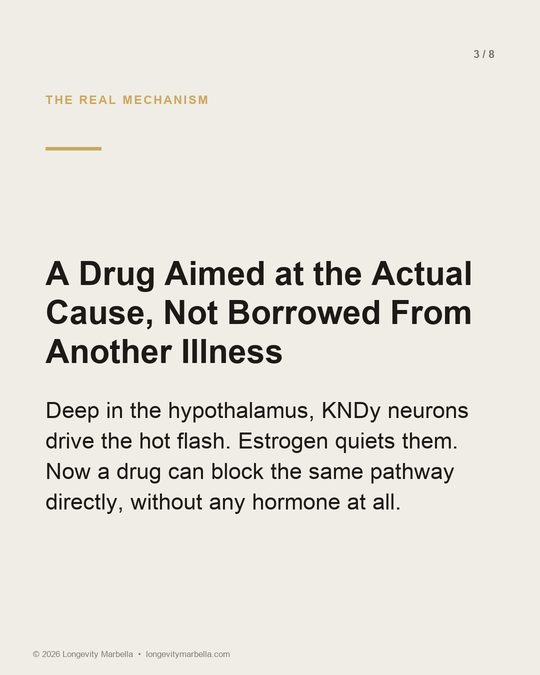
Then researchers worked out what actually causes a hot flash. Deep in the hypothalamus sits a cluster of nerve cells known as KNDy neurons, named for the three signalling molecules they use: kisspeptin, neurokinin B and dynorphin. They sit next to the brain's temperature control center. Estrogen quiets them. When estrogen falls at menopause, neurokinin B signalling rises, the neurons fire without restraint, and the thermostat misreads your body as overheating. It then does what it would do if you really were: flushes the skin and opens the sweat glands.
That is why estrogen works. And it is why blocking the neurokinin 3 receptor works too, without any estrogen at all.
For the first time, a drug aimed at the actual mechanism of a hot flash, rather than borrowed from another illness.
Fezolinetant
The first of the class. In a phase 3 trial of over 500 postmenopausal women with moderate to severe hot flashes, both doses beat placebo significantly. The mean reductions in hot flash frequency at 12 weeks:
The safety condition attached to it is not optional. After cases of serious drug-induced liver injury emerged in postmarketing use, the FDA now requires liver enzymes and bilirubin before starting, then monthly for the first three months, then at six and nine months. It must not be started if any result is at or above twice the upper limit of normal, and must be stopped for any sign of liver trouble, or if transaminases, the liver enzymes in that same panel, exceed five times normal.
If you are offered this drug without blood tests, that is a reason to change doctors.
Elinzanetant
A dual neurokinin 1 and 3 receptor antagonist, taken as 120 mg daily. An antagonist is a blocker: it sits in the receptor so the overheating signal cannot land on the thermostat. It reduces both the frequency and the severity of hot flashes, and baseline liver tests are recommended as with fezolinetant.
It has one property that matters enormously to a particular group: it is effective for hot flashes caused by endocrine therapy for breast cancer. For a woman on tamoxifen or an aromatase inhibitor, drenched at night, previously offered almost nothing, that is a genuine change.
The Older Options, Used Properly
These still have a place, and choosing between them is not arbitrary.
SSRIs and SNRIs. The most effective of the older alternatives. Two things to know. The response is fast, within days rather than the weeks it takes for depression, so you know quickly whether it is working. And the choice of molecule matters:
- Citalopram or escitalopram are usually the sensible starting point, better tolerated with fewer withdrawal problems.
- Sertraline and fluoxetine are not worth taking for this. Sertraline was no better than placebo in three trials.
- Paroxetine must not be used with tamoxifen. It is a strong inhibitor of the CYP2D6 enzyme that converts tamoxifen into its active form. Citalopram or venlafaxine are the safer choices there.
- Venlafaxine is the best studied but causes more nausea and can produce real withdrawal. If used, the sustained-release form starting at 37.5 mg for a week before going to 75 mg, and tapered on the way down.
One trial worth knowing: venlafaxine 75 mg gave similar hot flash relief to low dose oral estradiol 0.5 mg. The difference is what happens next. Pushing the estradiol dose up can abolish flashes altogether; pushing the venlafaxine up generally will not.
Gabapentin, used at night. This is where it is genuinely elegant. Nocturnal hot flashes cluster in the first four hours of sleep, and REM sleep in the later hours suppresses them. So a single bedtime dose covers the window that actually wakes you. Start at 100 mg an hour before bed and increase by 100 mg every three nights until the flashes settle, side effects appear, or you reach 900 mg. Women often report that even when a night sweat happens, they fall back asleep more easily than before.
At much higher doses gabapentin approaches estrogen for efficacy: in one small trial, gabapentin titrated to 2,400 mg, conjugated estrogen 0.625 mg and placebo reduced hot flash severity scores by 72, 71 and 54 percent. But at that dose it caused headache, dizziness and disorientation, which is why nobody uses it that way.
Oxybutynin. Better than placebo at 5 to 10 mg daily, but dry mouth affected 20 to 30 percent in one trial and 50 percent in another, and observational data link anticholinergic drugs to increased dementia risk in older adults. We use it rarely, and for that reason.
Cognitive behavioral therapy. Modest for hot flashes, better for the insomnia around them. In a trial of 106 peri- and postmenopausal women with insomnia and hot flashes, an eight-week telephone-based CBT for insomnia moved 70 percent of women into the "no insomnia" range, against 24 percent with menopause education alone. It reduced how much hot flashes bothered them without reducing how often they occurred, which is a distinction worth understanding before you judge whether it worked.
What Does Not Work, and Why You Believed It Did
This section will annoy some readers. It is also the most valuable part of the page, because it protects your money and your time.
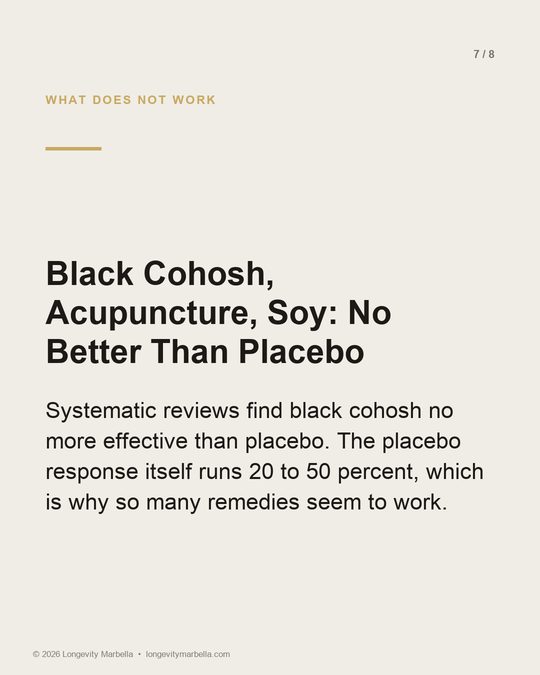
The Menopause Society's 2023 non-hormone position statement explicitly does not recommend: paced respiration, supplements and herbal remedies, cooling techniques, avoiding triggers, exercise, yoga, mindfulness-based intervention, relaxation, soy, cannabinoids, acupuncture, and clonidine.
The specifics:
- Black cohosh. One of the most widely used. Systematic reviews and meta-analyses find it no more effective than placebo.
- Acupuncture. In a randomized sham-controlled trial of 327 peri- and postmenopausal women with moderate to severe hot flashes, real and sham acupuncture both produced about 40 percent improvement, with no difference at the end of treatment.
- Phytoestrogens. A 2013 Cochrane review of 43 trials found no benefit from phytoestrogens of any type, with the possible exception of genistein above 30 milligrams a day, and those trials carried a high risk of bias. Red clover was ineffective.
- Evening primrose oil. In the only randomized trial, 56 women over six months: both groups improved, neither more than the other.
- Exercise. Trials, systematic reviews and a meta-analysis have not found a significant benefit for hot flashes specifically. One likely reason is mechanical: exercise raises core body temperature, which is the trigger.
- Chinese herbal medicine. Two meta-analyses: ineffective.
Now the reason all of these have devoted believers.
Two honorable exceptions worth naming. Exercise remains one of the best things you can do for your body, for bone, muscle, heart and mood; it simply does not treat hot flashes. And weight loss does appear to help: in a six-month trial, an intensive behavioral weight loss program improved hot flashes compared with a health education control among women who were overweight and bothered by symptoms.
How Long Will You Need It
Longer than you have probably been told. In the Study of Women's Health Across the Nation, among 1,449 women with vasomotor symptoms, the median total duration was 7.4 years, persisting a median of 4.5 years after the final period. Women whose symptoms began before their periods stopped had the longest course, over 11.8 years.
For non-hormonal drugs, the usual approach is to taper after about two years and see whether the flashes have gone. If they have not and remain troublesome, treatment resumes and the taper is tried again later. SSRIs and SNRIs must always be tapered rather than stopped abruptly.
If estrogen is not an option for you, there is now a real answer. It just has to be prescribed carefully.
Message us on WhatsAppOne Thing to Rule Out First
Not every flush is menopause. Thyroid overactivity, certain medications, infection, and rarely carcinoid syndrome or a phaeochromocytoma can all cause flushing and sweats. If your symptoms are atypical, if they came with weight loss or palpitations, or if they do not respond to sensible treatment, the diagnosis deserves revisiting rather than the dose being pushed. That is the internal medicine half of this practice, and it is the half most hormone clinics do not have.
Where These Figures Come From
- The 2023 nonhormone therapy position statement of The North American Menopause Society. Menopause, 2023;30:573.
- Johnson KA, Martin N, Nappi RE, et al. Efficacy and safety of fezolinetant in moderate to severe vasomotor symptoms associated with menopause: a phase 3 RCT. J Clin Endocrinol Metab, 2023;108:1981.
- Lederman S, Ottery FD, Cano A, et al. Fezolinetant for treatment of moderate-to-severe vasomotor symptoms associated with menopause (SKYLIGHT 1). Lancet, 2023;401:1091.
- Pinkerton JV, Simon JA, Joffe H, et al. Elinzanetant for the treatment of vasomotor symptoms associated with menopause: OASIS 1 and 2. JAMA, 2024;332:1343.
- Cardoso F, Parke S, Brennan DJ, et al. Elinzanetant for vasomotor symptoms from endocrine therapy for breast cancer. N Engl J Med, 2025;393:753.
- McCurry SM, Guthrie KA, Morin CM, et al. Telephone-based cognitive behavioral therapy for insomnia in perimenopausal and postmenopausal women with vasomotor symptoms. JAMA Intern Med, 2016;176:913.
- Ee C, Xue C, Chondros P, et al. Acupuncture for menopausal hot flashes: a randomized trial. Ann Intern Med, 2016;164:146.
- Lethaby A, Marjoribanks J, Kronenberg F, et al. Phytoestrogens for menopausal vasomotor symptoms. Cochrane Database Syst Rev, 2013.
- Avis NE, Crawford SL, Greendale G, et al. Duration of menopausal vasomotor symptoms over the menopause transition. JAMA Intern Med, 2015;175:531.