


Writing the first prescription is the simple part. Doing testosterone therapy well is a different skill, and "well" means two things at once: working toward a genuinely better result, and keeping you safe while you get there. That combination is where focused, specialist-led care can add the most, building on what a general practitioner provides rather than replacing it.

Not sure if this applies to you? One-minute check.
- Writing the first prescription is the simple part. Doing testosterone therapy well is a different skill.
- Specialist-led care means a real diagnosis first, a protocol built around you, and ongoing monitoring.
- Fertility deserves a strategy from the start, not an apology later.
The drug is simple. The management is not.
The therapy itself is straightforward. What takes skill is everything around it: confirming the diagnosis properly, based on how you actually feel alongside repeat morning bloodwork rather than a single reading (the approach the Endocrine Society recommends), choosing the right dose and form, and then managing how your body responds over months and years. That follow-up includes the parameters guidelines highlight, such as your red blood cell count (hematocrit) and prostate cancer risk, alongside estrogen, cardiovascular and metabolic health, and your fertility. Handled well, testosterone therapy can make a meaningful difference to how appropriately treated men feel. Handled without that structure, results can disappoint, or issues can build up unnoticed.
Generalist training and specialist training are different by design
A general practitioner is trained as a generalist, with broad knowledge across the whole of your health. That breadth is exactly what you want for most everyday medicine. Endocrinology is different by design: it is a focused field built around the hormone systems and the secondary markers that decide whether hormone therapy is both safe and effective. Major guidelines describe testosterone therapy as something that should be diagnosed carefully and then monitored on a structured plan over time. That depth of focus, and the volume of cases that comes with a dedicated practice, is what specialist training is for. This is not a judgment about any individual doctor. It is simply the difference between a generalist's scope and a specialist's.
What a specialist brings
An endocrinologist is a hormone specialist. It is the entire focus of their training. They do not just restore your testosterone to a normal number. They optimize the whole system it sits in: how it affects your estrogen, your blood, your metabolism, your fertility, and your long-term risk, so the goal is not just a number in range, but genuinely feeling and performing better, where your biology allows. They are trained to spot early warning signs and adjust before something becomes a problem. You are treated as a system, not a single value.
Safe is the floor. Optimized is the goal.
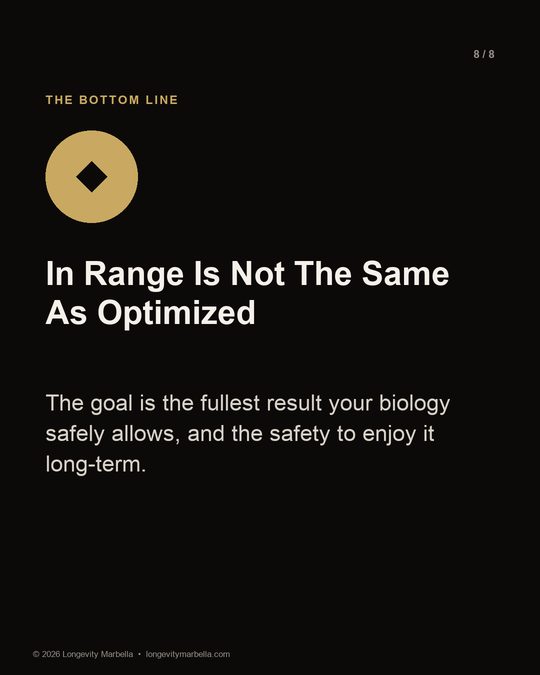
Here is what many men do not realize: a testosterone level inside the laboratory reference range is not automatically the same as feeling your best. Guidelines suggest aiming for the mid-normal range, and within that, how you respond is individual. An experienced specialist works to dial in your dose, form, timing and supporting care so that, where your biology allows, your energy, drive, body composition, mood and recovery improve, not just your numbers. And they do it while staying inside the safety boundaries that good monitoring is designed to protect.
That is the one-two punch, and it comes with experience: the fullest result your biology safely allows. A specialist who concentrates on hormone therapy sees these patterns across many patients and can fine-tune with that experience in mind.
Planning for fertility, if you want it
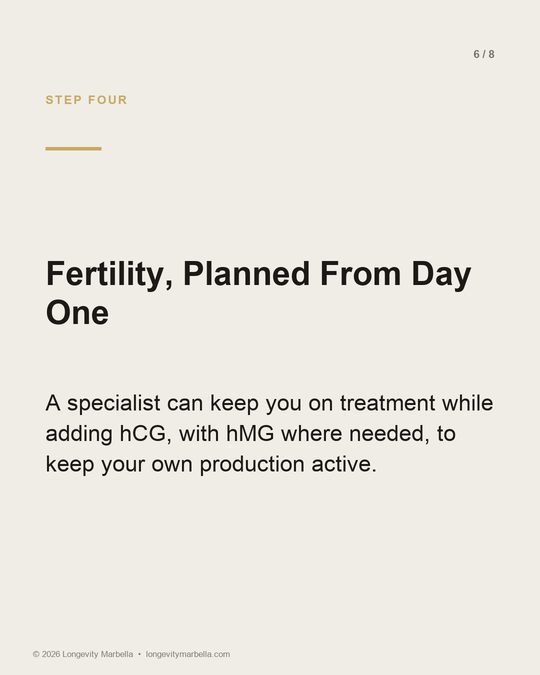
Standard testosterone therapy signals your body to switch off its own production, and with it, your natural fertility. Think of a thermostat: your brain is the thermostat, your testes the furnace, and testosterone from outside reads as a warm room, so the thermostat stops calling and the furnace shuts down. Many men are never warned about this until they are trying to conceive. It does not have to be a trade-off. An experienced specialist plans for this from the start. If you may want children now or later, your protocol can be designed to keep you on testosterone while adding accessory treatments, such as hCG (a hormone that keeps your own testes active, the furnace still burning), with hMG added where needed, so your fertility is protected alongside the benefits of therapy. These approaches are often successful, though no outcome can be guaranteed, which is exactly why planning early, rather than after the fact, matters so much. It is another example of what real experience adds: the same therapy, managed so your options are protected wherever possible.
Why double board-certification matters even more
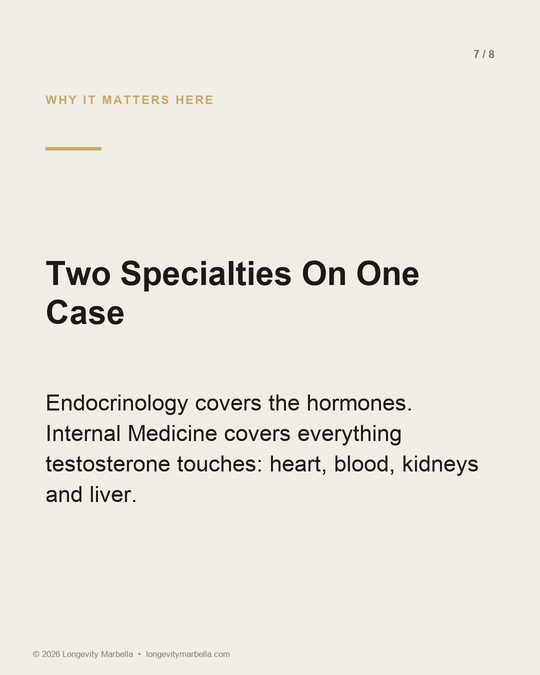
At Longevity Marbella, care is led by a doctor board-certified in two specialties: Internal Medicine and Endocrinology. That combination is the point. Endocrinology covers the hormones. Internal Medicine covers everything testosterone touches: your heart, blood, kidneys and liver. Many of TRT's real risks are less about the hormone itself than about how the rest of the body handles it. Having both lenses on the same case is exactly what safe, well-optimized TRT requires.
What inadequately monitored TRT can look like
When testosterone therapy is not followed closely, certain issues can develop. The ones structured monitoring is designed to catch include a rising red blood cell count (hematocrit), which the Endocrine Society lists among the parameters to track on therapy; estrogen levels that drift too high or are pushed too low; fertility that was not planned for in advance; and underlying thyroid, metabolic or cardiovascular conditions that deserve attention alongside the hormone itself. The common thread is the same: testosterone is best treated as one part of a whole system, with a monitoring plan around it. We cover the evidence on TRT's safety in detail in Is testosterone therapy safe?
What good care looks like
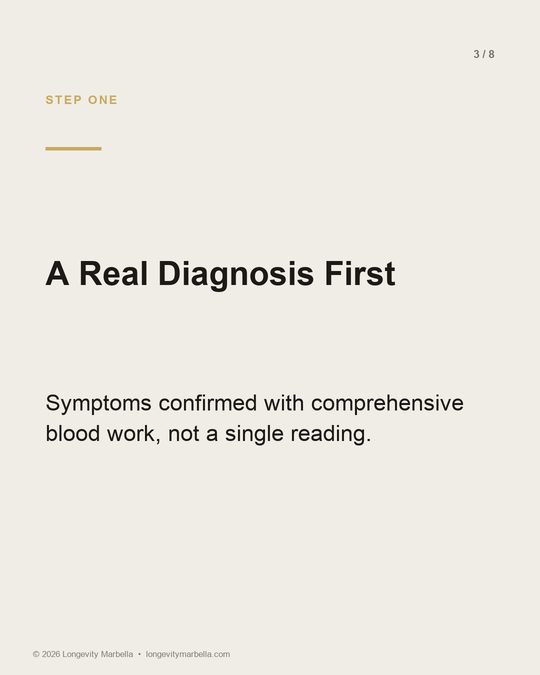
- A real diagnosis first. Symptoms confirmed with comprehensive blood work, not a single reading.
- A protocol built around you. Dose, form and supporting care matched to your biology and goals.
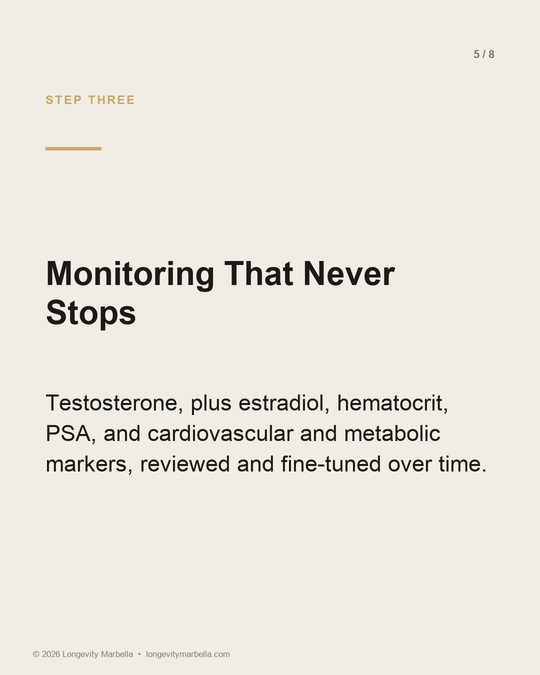
- Ongoing monitoring. Testosterone, plus estradiol, hematocrit, PSA, and cardiovascular and metabolic markers, reviewed and fine-tuned.
- A strategy to take your fertility into account if you may want children, built in from the start rather than bolted on too late.
A candid word on the noise around testosterone. There is no shortage of confident advice about it online, from influencers, coaches, and forums, much of it from people who will also sell you a protocol or the vials themselves. Naming the compounds and reciting doses is the easy part, and plenty of people do it with great confidence. What a physician brings is different in kind: a real understanding of the physiology, of who genuinely needs treatment and who does not, and the training to recognize, diagnose and treat what can go wrong, a climbing hematocrit, blood pressure, fertility, estrogen, cardiovascular strain. That is the whole point, because it is precisely the moment the confident voices tend to fall quiet and tell you to see a doctor. We would simply rather be the doctor who set it up properly than the one you are sent to once something has already gone wrong.
The bottom line
TRT is hormone medicine, and this is where specialist care changes the outcome. An experienced specialist gives you both halves at once: the fullest result your biology safely allows, and the safety to enjoy it long-term. It is the difference between being put "in range" and being genuinely optimized, and between being monitored and being properly cared for. See our approach to testosterone therapy and men's health.