


You started TRT because you wanted to feel different, and right now you are checking the mirror, checking how you feel, and wondering the same thing everyone wonders: when is this actually going to work?


Not sure if this applies to you? One-minute check.
- Around 3 to 6 weeks: sex drive lifts and levels off; mood and low mood start to improve.
- 4 weeks onward: cholesterol and blood fats begin to improve.
- 3 to 4 months: fat starts to fall, muscle and strength start to build (with training and diet).
- Up to 6 months: erections and ejaculation catch up; bone density becomes measurable.
- 4 to 7 months: the biggest lift in mood and quality of life.
- 6 to 12 months: body composition, lipids, and blood-sugar control stabilize; hematocrit peaks by 9 to 12 months.
- About 12 months: PSA settles onto a plateau.
- 3 years and beyond: bone strength keeps building.
Maybe it has been a couple of weeks and nothing has changed yet. Maybe a friend swore he felt like a new man overnight and you are quietly worried something is wrong with you. Here is the honest answer: you are not broken, and you are almost certainly not too late. Testosterone therapy works, but it works on a schedule, and different benefits show up at different times.
The good news is that the timeline is clear and predictable. Sex drive and mood come first, body and metabolism next, bones last. Once you can see the whole map, the waiting gets a lot easier. The clearest version of that map comes from a well-known review by Saad and colleagues, published in the European Journal of Endocrinology in 2011 and indexed on PubMed. Here is what it found, in plain language.
- Sex drive and mood move first, often within a few weeks, not months.
- Body and metabolism come next, with fat loss and muscle building over the first several months.
- Bone strength comes last, building for a year or more, quietly, where you cannot feel it.
- Be patient. Give it a full three to six months before you judge how well it is working.
- Monitoring matters. Regular blood work is what keeps treatment both safe and effective as the months add up.
Not sure your TRT is set up the right way? Let our specialist review your start and your dose.
Message us on WhatsAppThe first weeks
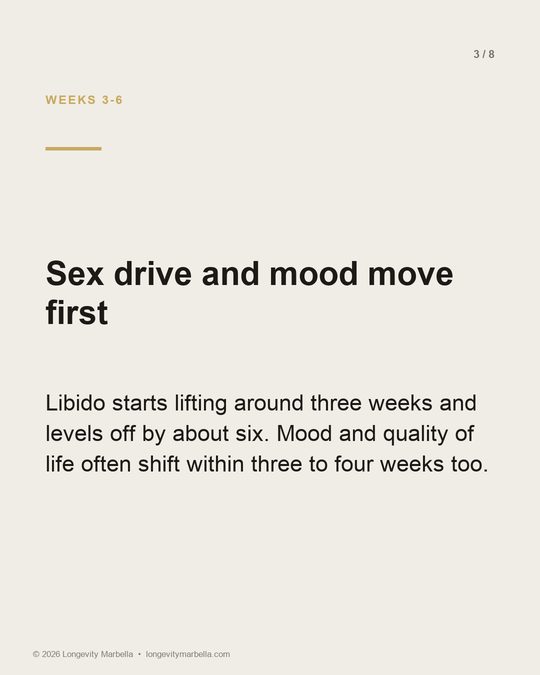
The earliest thing most men notice is a lift in sex drive, what doctors call libido. According to the review, libido starts to improve around three weeks and levels off by about six weeks. Physical sexual function, meaning erections and ejaculation, tends to lag behind desire and can take longer to catch up, up to about six months.
Mood and quality of life also move early. Many men feel a change within three to four weeks, and low mood specifically begins to improve from about three to six weeks.
The first month is mostly about how you feel, not how you look.
The first months
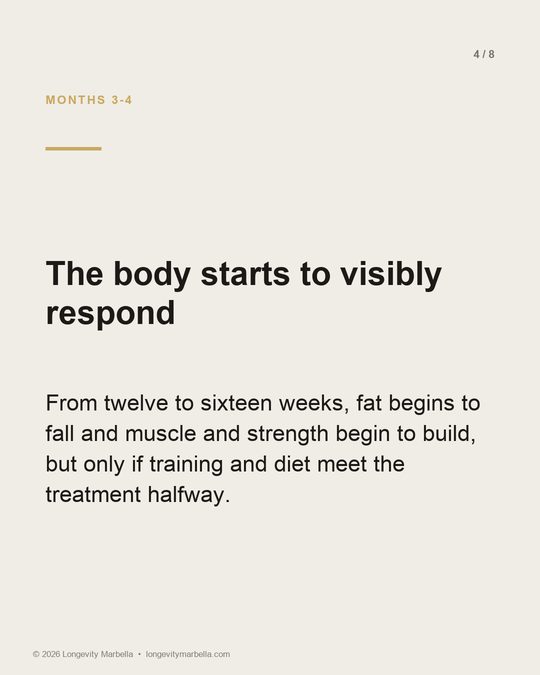
This is when the body starts to visibly respond. From about twelve to sixteen weeks, which is three to four months, fat begins to fall and muscle and strength begin to build. These gains tend to stabilize by six to twelve months, with small further improvements over the years that follow.
One honest caveat: body composition depends heavily on your training and diet. Testosterone restores the hormonal conditions that make building muscle and losing fat possible, but it does not do the work for you. Two men on identical treatment can end up in very different places depending on how they eat and train.
Your metabolism shifts in this window too. Insulin sensitivity, meaning how well your body handles blood sugar, can improve within days, but clear, measurable changes in blood-sugar control take about three to twelve months. Cholesterol and other blood fats (lipids) start to improve from around four weeks, with the biggest benefit by six to twelve months.
Your body starts changing around month three, but only if your training and diet meet it halfway.
The later months
Some of the most important changes are the slowest, and patience pays off here.
Mood keeps deepening well past the early lift. The largest benefit to mood tends to arrive by roughly eighteen to thirty weeks, about four to seven months, while quality of life keeps improving beyond that without a fixed endpoint. If you feel better at week four, expect to feel better still at month six.
Your red blood cells are changing quietly in the background too. Testosterone raises red-blood-cell production, and the marker for how thick your blood is, called hematocrit, rises noticeably by about three months and peaks around nine to twelve months. This is not a side note. Too many red cells thickens the blood and is a real risk, and catching that rise early is one of the main jobs of supervised treatment.
The benefits keep improving for months, but so does one number your doctor needs to watch.
And beyond, the slow-building benefits
A few benefits keep building for a year or more, long after most men have stopped watching the calendar.
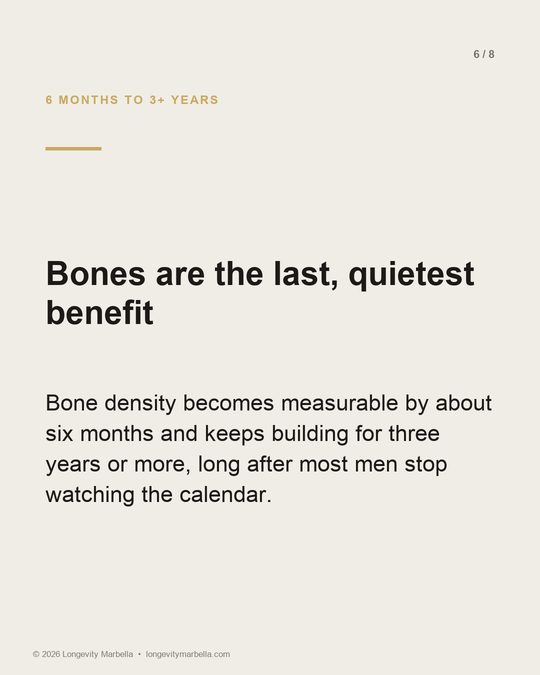
Bone strength is the clearest example. Improvements in bone density become measurable by about six months and keep building for three years or more. This is one of the most valuable long-term effects of properly managed treatment, and one of the most easily overlooked, because you cannot feel it happening.
The prostate marker, known as PSA, typically shows a small early rise that plateaus by about twelve months. This is expected and monitored routinely, part of the same blood work that tracks your hematocrit and testosterone.
The most valuable effects are the ones you cannot feel, which is exactly why they get overlooked.
Setting honest expectations
The single most useful thing to know is that testosterone therapy is not an instant switch. Give it a full three to six months before you judge the sexual, mood, and body effects, and understand that some benefits, bone strength above all, take a year or more to unfold. Two things carry you there: consistency, staying on properly dosed treatment without stopping and starting, and monitoring, having your blood checked on schedule so the treatment stays in the right range.
Stay consistent, stay monitored, and give it a few months. That is what turns the timeline into results.
Why the hematocrit point means this is not a DIY treatment
Look again at the hematocrit timeline: it climbs through the first months and peaks around nine to twelve months. That rise is precisely why supervision by our double board-certified specialist matters, and why testosterone should never be run from a grey-market source or a self-directed protocol. A doctor sees that number climbing on your blood work and adjusts before it becomes a problem. Someone dosing themselves does not, until the problem has already arrived.
The timeline above only becomes a safe and effective treatment when a physician is reading your blood work at the right moments. We walk through exactly how that monitoring works in How Low Testosterone Is Diagnosed and Monitored, we cover the wider safety evidence in Is Testosterone Therapy Safe?, and we explain why the specialist you choose matters in GP vs Endocrinologist for TRT.
Want your hematocrit and hormone levels tracked properly as the months go by? Our specialist can monitor your treatment.
Message us on WhatsApp