


Most of what we know about aging men comes from men who were already ill. Infertility clinics, cardiology wards, diabetes registries. A study published in Andrology did something rarer and harder: it followed healthy men, selected precisely because nothing was wrong with them, and measured what six years of nothing but aging actually does.
Not sure if this applies to you? One-minute check.
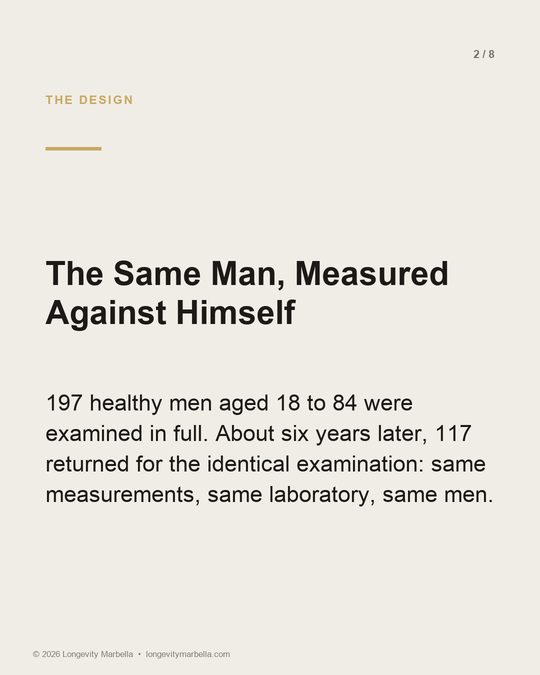
- 197 healthy men aged 18 to 84 were examined in full; 117 returned about six years later for the identical examination.
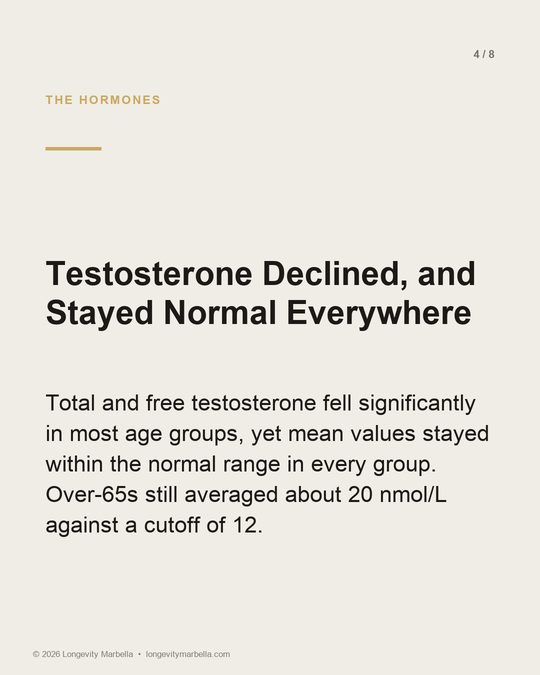
- Total and free testosterone declined significantly in most age groups, yet mean values stayed within the normal range in every group.
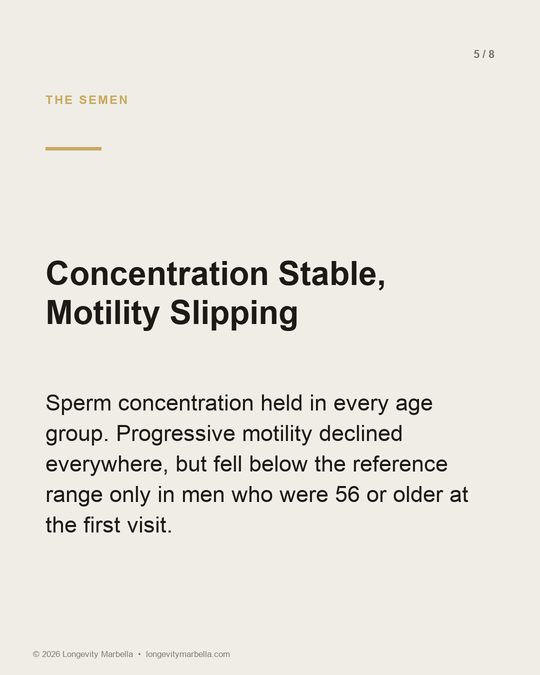
- FSH rose in men over 35, sperm concentration stayed stable, and motility declined, falling below the reference range only in the two oldest groups.
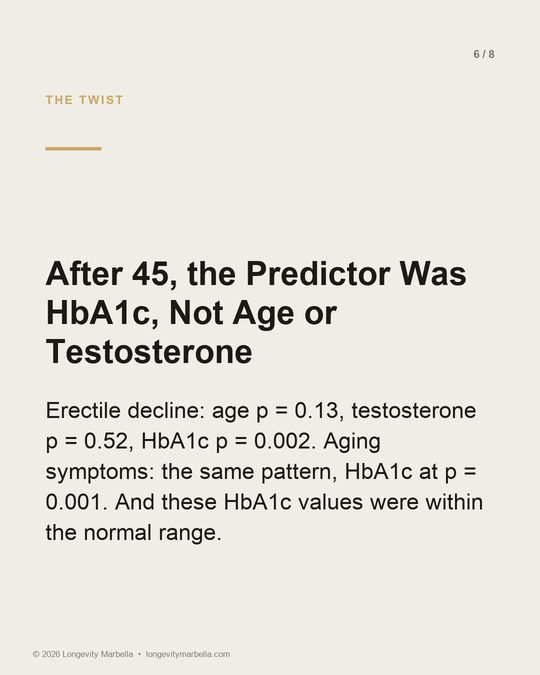
- After 45, neither age nor testosterone predicted the decline in erectile function. HbA1c did. The same was true for aging-male symptoms.
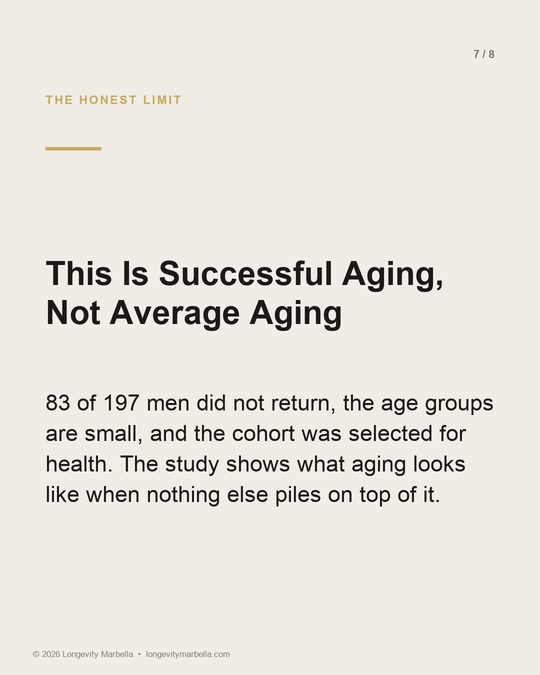
- The cohort was selected for good health, so this is what successful aging looks like, not average aging. That is the study's strength and its limit.
The cohort nobody else has
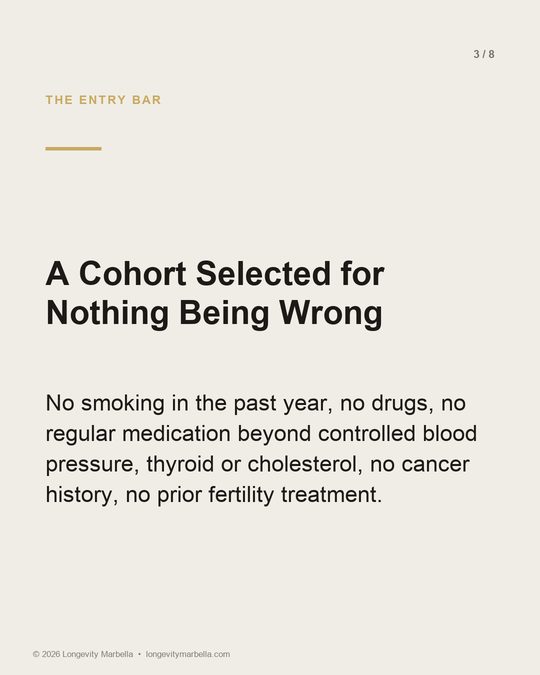
The FAMe cohort, Fertility in Aging Healthy Men, was recruited in Munster between 2014 and 2016. The entry bar was severe: no smoking within the past year, no drug use, no regular medication beyond well-controlled blood pressure, thyroid or cholesterol treatment, no cancer history, no chronic infections, no previous fertility treatment. 197 men aged 18 to 84 made it through and were examined in full: hormones, semen analysis, validated questionnaires on erectile function and aging symptoms.
Then the researchers did the thing that separates a snapshot from a story. In 2020 they invited everyone back, and 117 men returned for the identical examination roughly six years later. Same measurements, same laboratory, same men. Almost every claim you have read about male aging comes from comparing different men of different ages. This is the rarer design: the same man, measured against himself.
What six years did to their hormones
Total and free testosterone fell significantly in most age groups over the six years. That part of the story is real, and it confirms what larger cross-sectional studies suggest. But the size and the destination matter more than the direction: mean total testosterone remained comfortably within the normal range in every single age group, at both time points. In the oldest group, men over 65 at the first visit, the mean was still around 20 nmol/L at follow-up, against a reference cutoff of 12.
FSH rose significantly in men over 35, while LH (the pituitary's signal to the testosterone-making cells) and SHBG (the protein that carries testosterone in the blood) stayed flat. Readers of this journal have seen that pattern before: FSH is the pituitary's signal to the sperm-producing machinery, and a rising FSH against stable output is an engine holding its cruising speed with the accelerator pressed further down, the same output, more effort. It is the hormonal echo of what the same Munster group found inside testicular tissue itself, in the companion study we covered separately.
What six years did to their semen
The semen findings resist the usual doom narrative, and they do it with numbers. Sperm concentration stayed stable over time in every age group. Ejaculate volume declined in most groups, and total sperm count fell significantly in the 36 to 45 and 46 to 55 groups, but mean concentration and count remained within physiological limits across the board.
The one parameter that did move consistently was progressive motility, the fraction of sperm swimming forward. It declined in every age group, and fell below the reference range at follow-up only in the two oldest groups, men who were 56 or older at the first visit. Sperm vitality, oddly, improved over time in two groups, a reminder that biology rarely runs in one direction at once.
Put together: a healthy man's sperm production is not on the cliff edge the internet describes. It ages the way a well-maintained engine ages, gradually, measurably, and mostly within specification.
The twist: what actually drove symptoms
Here is where the study earns its place on this journal. Erectile function, measured with the standard IIEF questionnaire, declined moderately but progressively across the cohort. Aging-male symptom scores crept up too, from a mean of 22.3 to 25.3, which still sits in the "no symptoms" band of the scale. So far, exactly what you would expect.
Then the researchers asked the better question: what predicts which men decline? They restricted the analysis to men 45 and older and ran the candidates against each other.
Age did not predict the deterioration in erectile function (p = 0.13). Testosterone did not either (p = 0.52). HbA1c did (p = 0.002). The identical pattern appeared for aging-male symptoms: not age (p = 0.57), not testosterone (p = 0.18), but HbA1c, at p = 0.001.
HbA1c is glycated hemoglobin, the standard measure of average blood sugar over the preceding three months. And these HbA1c values were within the normal range: the authors are explicit that even in metabolically healthy men, subtle variations in glycemic control tracked with erectile function. Within a cohort of healthy men, the variation in long-term blood sugar control was a stronger predictor of sexual decline than either of the two things men actually worry about.
Symptoms of low testosterone, without low testosterone
The authors put the conclusion carefully, and it deserves quoting in spirit: older men may exhibit hypogonadism-like symptoms in the absence of bona fide hypogonadism. The tiredness, the low drive, the fading function that send men to search engines at two in the morning were present in some of these men, while their testosterone sat within range.
That cuts in two directions, and both matter clinically. First: a man with those symptoms deserves an actual measurement, properly done, before anyone reaches for a diagnosis, because the symptom list alone cannot distinguish a hormone problem from a metabolic one. Second: when the measurement comes back normal, the work is not over. It has just moved. In this cohort the trail led to glycemic control, which is measurable, and unlike age, changeable.
The limitations, stated plainly
Eighty-three of the 197 men did not come back, and men who return for a voluntary six-year follow-up may differ from men who do not. The groups are small once divided by age, twelve to twenty-seven men each. Testosterone was measured by immunoassay, the standard automated laboratory test, albeit one calibrated quarterly against mass spectrometry, the precision reference method, the way a workshop gauge is checked against a certified instrument. And the selection cuts both ways: this study cannot tell you what happens to the average man, because the average man would not have qualified for it.
But that last limitation is also the finding. These men were selected for health, and health is what they kept. The study does not show that aging is harmless. It shows what aging looks like when nothing else is allowed to pile on top of it.
Why this matters for a man in his fifties
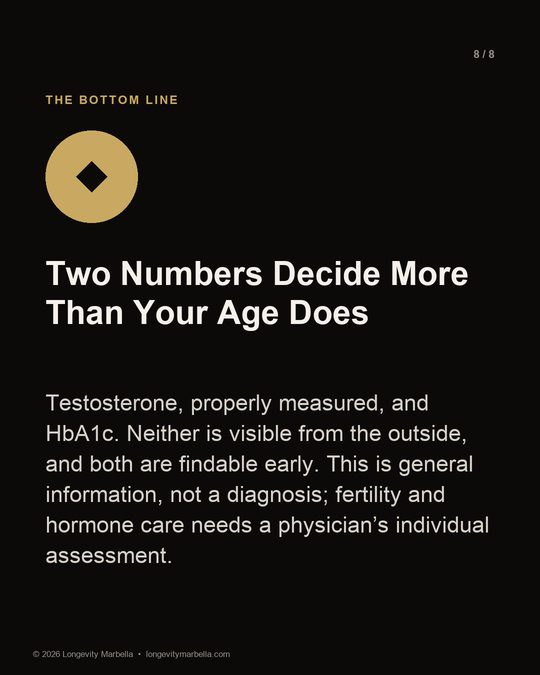
Two numbers from this study belong in every consultation with a man worried about his hormones. The first is his testosterone, measured properly, because genuine deficiency exists and is treatable. The second is his HbA1c, because in the healthiest cohort ever followed this way, that number predicted the decline in function and wellbeing better than age or testosterone did.
Neither number is visible from the outside. A man can carry rising blood sugar for a decade inside a normal-looking body, and the first symptom he notices may arrive in the bedroom rather than on a laboratory form. That is why the assessment we run looks at hormones, metabolic markers and body composition together, as one system, because that is how they behave.
The message of this cohort is genuinely encouraging, and it is not soft: reproductive aging in healthy men is slow, mostly quiet, and largely preserved into the seventies. The variable that separates men within it is metabolic, and metabolic variables can be found early and moved.
Frequently Asked Questions
Does this study mean testosterone does not matter?
No. It means that in men selected for good health, testosterone declined with age yet stayed within the normal range, and within that normal range it was not what predicted erectile function or aging symptoms after 45. Blood sugar control was. Testosterone that is genuinely low is a different situation and still needs proper assessment.
What is HbA1c?
Glycated hemoglobin, a blood marker that reflects average blood sugar over roughly the past three months. It is how long-term glycemic control is measured, and in this cohort it predicted the decline in erectile function and the rise in aging symptoms better than age or testosterone did.
How healthy were these men, really?
Very. The cohort excluded smokers, drug use, most regular medication, cancer history, chronic infections and prior fertility treatment. That selection is the point of the study and also its limit: it shows what aging looks like when health is maintained, not what happens on average.
What happened to their fertility measures?
Ejaculate volume fell over the six years and sperm motility declined in every age group, dropping below the reference range only in the two oldest groups. Sperm concentration stayed stable in all groups, and mean values remained within physiological limits overall.
This article is for general information only and is not medical advice. Fertility and hormone treatments should be guided by a qualified doctor based on your own assessment.
Reference. Bier S, Cremers JF, Schrage P, Körtje A, Krallmann C, Kliesch S, Gromoll J, Laurentino S, Zitzmann M. "Healthy Aging Men Do Not Suffer From Relevant Limitations of Their Reproductive Functions." Andrology 2026 (doi:10.1111/andr.70147).
Two numbers decide more than your age does. Do you know yours?
Speak with a double board-certified specialist in Internal Medicine and Endocrinology about your hormones, your metabolic markers and your body composition, assessed together, by secure video or across the Costa del Sol.
A letter from the doctor. A few times a year, when the evidence genuinely changes, I write it down and send it. No schedule, no noise, and you can leave the list whenever you like.