


Almost everything written about male reproductive ageing is a story about loss. A 2026 paper in GeroScience tells a stranger and better one: about what the ageing testis does to avoid it.
Not sure if this applies to you? One-minute check.
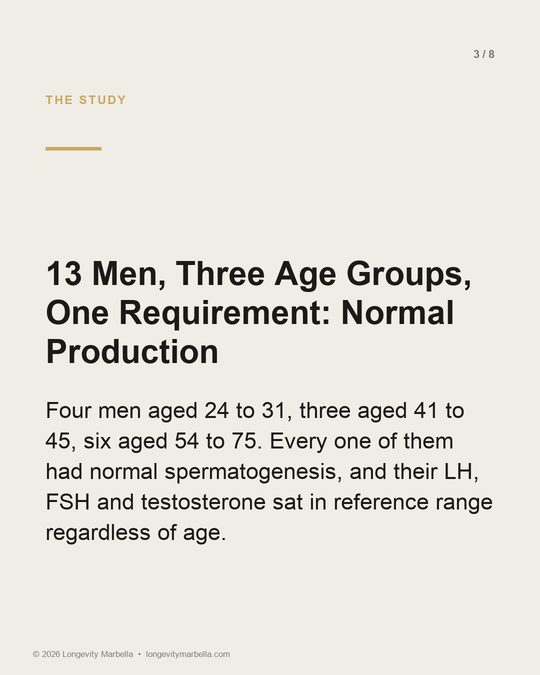
- Testicular tissue from 13 men with normal spermatogenesis: four aged 24 to 31, three aged 41 to 45, six aged 54 to 75.
- LH, FSH and testosterone were within reference range in all of them and did not vary with age.
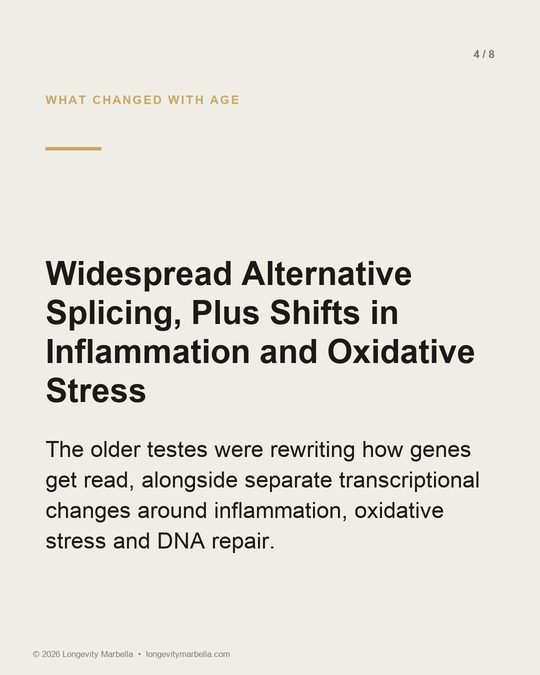
- Older testes showed widespread alternative splicing plus transcriptional changes around inflammation, oxidative stress and DNA repair.
- A separate validation cohort found no age-related accumulation of double-strand breaks, suggesting compensation rather than damage.
- Thirteen men is a small sample, and these were men whose production was already normal, so this describes successful ageing rather than typical ageing.
What they did
The group in Munster took testicular tissue from men with full, normal spermatogenesis, meaning sperm production that was working properly, and sequenced everything the tissue was transcribing: the work orders the cells were printing off their genes. Three age bands: young, 24 to 31 years, four men; middle-aged, 41 to 45, three men; and aged, 54 to 75, six men.
The selection is the clever part. By taking only men whose production was normal, and whose LH, FSH and testosterone all sat within reference range and did not vary with age, they removed the usual confounder. Whatever they found could not simply be the fingerprint of a failing testis, because none of these testes were failing.
What they found
The older testes were not quietly idling. They showed widespread alternative splicing, which is the cell's way of producing different versions of a protein from the same gene, affecting genes involved in metabolic pathways and DNA repair. On top of that sat significant transcriptional changes concentrated around inflammation and oxidative stress.
A subset of the genes that changed with age were involved in the formation and repair of double-strand breaks, the most serious form of DNA damage, and they were expressed during early meiosis, the stage where a cell divides to produce sperm.
That could read as bad news: more DNA damage with age. So they went and checked.
The check that changes the story
In a separate validation cohort, the team quantified gamma-H2AX, a protein marker that appears where double-strand breaks occur. If ageing testes were accumulating unrepaired damage, this is where it would show.
They found no age-related abnormal accumulation.
Which reframes everything above. The DNA repair machinery was not busier because damage was piling up. It appears to have been busier so that damage did not pile up. The authors' own conclusion is that the transcriptional changes are consistent with testicular tissue conserving its function by adjusting gene expression to counteract the effects of age, specifically an increase in DNA damage pressure and a more inflammatory local environment.
An organ compensating, successfully, in real time.
What alternative splicing means, without the jargon
A gene is not a single fixed instruction. The cell reads it, then edits the transcript before building the protein, and by keeping or discarding different segments it can produce several different proteins from the same underlying gene. That editing is alternative splicing.
Finding it "widespread" in older testes is more interesting than finding genes simply switched on or off. It suggests the tissue is not just doing more or less of the same thing; it is producing different versions of its tools, particularly in metabolic pathways and DNA repair. An organ changing its toolkit rather than its output.
The other technical term worth having is meiosis: the specialized cell division that halves the chromosome count to produce sperm. It is a deliberately risky process, because it involves deliberately breaking DNA and rejoining it, which is why the genes flagged in this study, sitting in early meiosis and dealing with double-strand breaks, are exactly where you would look for age-related trouble.
This builds on their own earlier work
The team notes that they had previously shown that healthy ageing is associated with full spermatogenesis, normal sperm production and normal hormonal secretion. That is the foundation this study is built on and it frames the question they were actually asking.
They already knew the older testis could keep working. What they did not know was how, and that is the gap this paper addresses: not whether the ageing testis survives, but what it is doing internally in order to.
They also make the honest observation that runs through this whole field: age-related illnesses so often confound reproductive function that it becomes genuinely difficult to separate systemic ageing from reproductive ageing. Most older men studied are also men with something else going on. Selecting only men with normal spermatogenesis and normal hormones was how they cut that knot, and it is also precisely why the sample is small.
The limitations, and they are real
Thirteen men. Four, three and six. That is a small study by any standard, and it constrains how confidently anything here can be generalised.
The authors also state plainly that they cannot exclude that some of the gene expression changes were caused by minor variations in cell composition between samples, although neither histology nor deconvolution analysis identified any such difference.
And there is a selection point worth being honest about: these were men whose spermatogenesis was normal. This study describes what successful ageing looks like inside the testis. It does not tell you what proportion of men achieve it.
Inflammation as the quiet variable
Of everything found here, the finding with the longest reach is that the transcriptional changes clustered around inflammation and oxidative stress.
Those two words appear in almost every chapter of ageing medicine, which usually makes them sound like filler. In this context they are specific: the older testis in these men was measurably adjusting its gene expression in response to a more inflammatory and more oxidatively stressed local environment, and it was doing so while continuing to produce sperm normally.
The reason that matters beyond the testis is that inflammation is not manufactured locally in isolation. Visceral fat produces it. Poor metabolic health produces it. Interrupted sleep produces it. A tissue already spending part of its capacity managing an inflammatory environment is a tissue with less left over, and unlike age, most of the inputs to that environment are things a person can measure and change.
An organ that ages differently from the rest of you
Most tissues age by losing cells and losing function in a fairly linear way. The picture here is stranger and more encouraging: a tissue holding its output steady while its internal instructions change substantially underneath.
That distinction matters for how a man should read his own numbers. A normal semen analysis at sixty is not the same event as a normal semen analysis at thirty, even when the figures are identical, because the sixty-year-old is producing that result through active compensation. The output looks the same. The effort behind it does not.
Why it matters for a man in his fifties
Two things, and they pull in different directions, which is usually a sign you are near the truth.
The encouraging one: a testis is capable of ageing without failing. Full spermatogenesis, hormones in range, no accumulation of double-strand breaks, in men up to 75. Age alone is not a verdict, and men are routinely told otherwise.
The sobering one: compensation is work. The older testis in this study was maintaining its output by running repair and stress-response machinery harder than the young one. Systems that maintain themselves by working harder are, by definition, operating with less margin. Add inflammation from elsewhere, add metabolic disease, add the weight and the alcohol from the other studies on this journal, and you are asking for that compensation on top of everything else.
That is the most useful way to hold this finding. Not "age does not matter", and not "it is over at fifty", but something more precise: the ageing testis has a budget, and what you do with the rest of your body decides how much of it gets spent elsewhere.
Frequently Asked Questions
Does this mean age does not affect male fertility?
No. It means that in men whose sperm production was still normal, the testis appeared to be actively compensating rather than passively declining, and was not accumulating double-strand DNA breaks. It says nothing about how many men reach their sixties in that condition.
How many men were in this study?
Thirteen, split into three age groups of four, three and six. That is small, and it is the study's main limitation. Its strength is the tissue-level detail, which is not obtainable at scale.
What is a double-strand break?
The most serious form of DNA damage, where both strands of the double helix are cut. The researchers measured a marker called gamma-H2AX that flags where these occur, and found no abnormal age-related build-up.
What does compensation mean in practice?
That the older testis maintained normal output by running repair and stress-response machinery at a higher level. A system holding steady through extra effort has less reserve for additional insults, which is where the rest of a man's health becomes relevant.
This article is for general information only and is not medical advice. Fertility and hormone treatments should be guided by a qualified doctor based on your own assessment.
Reference. Wang Y, Berres S, Krenz H, Tekath T, Woste M, Sandmann S, Kortje A, Henrich A, Terwort N, Tuttelmann F, Neuhaus N, Kliesch S, Wistuba J, Gromoll J, Laurentino S. "Normal spermatogenesis in older men is associated with compensatory transcriptome changes." GeroScience 2026 (doi:10.1007/s11357-026-02403-8).
Ready to know what your own margin looks like?
Speak with a double board-certified specialist in Internal Medicine and Endocrinology about hormones, inflammation and fertility assessed together, by secure video or at your residence across the Costa del Sol.
A letter from the doctor. A few times a year, when the evidence genuinely changes, I write it down and send it. No schedule, no noise, and you can leave the list whenever you like.