


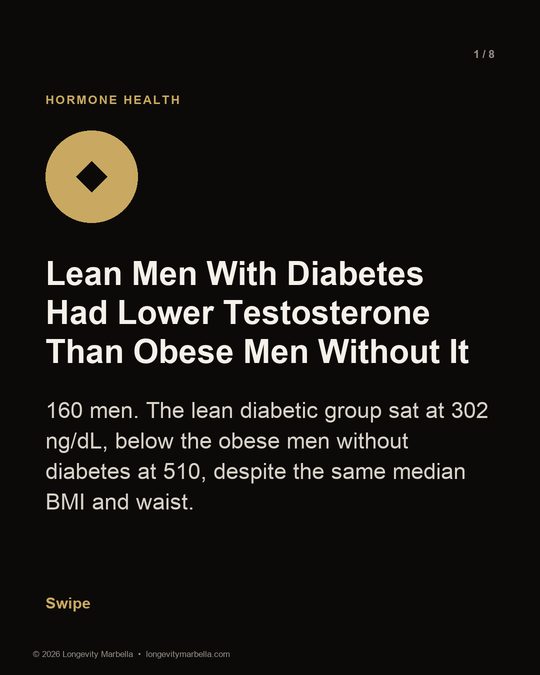
Almost every man who worries about his testosterone blames his waistline first. A case-control study of 160 men published in Diabetology & Metabolic Syndrome in 2024 suggests the waistline is the smaller half of the story. In it, the lean men with type 2 diabetes carried lower total testosterone than the obese men without it.
Not sure if this applies to you? One-minute check.
- A 2024 case-control study of 160 men compared testosterone across weight and diabetes status.
- Median total testosterone: lean with type 2 diabetes 302 ng/dL, obese with diabetes 284.5, lean without diabetes 505, obese without diabetes 510.
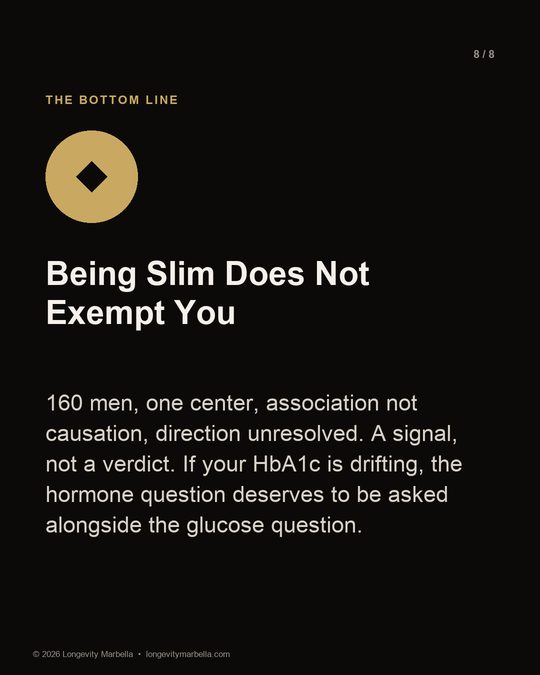
- The lean diabetic men sat below even the obese men without diabetes. Being slim does not exempt you.
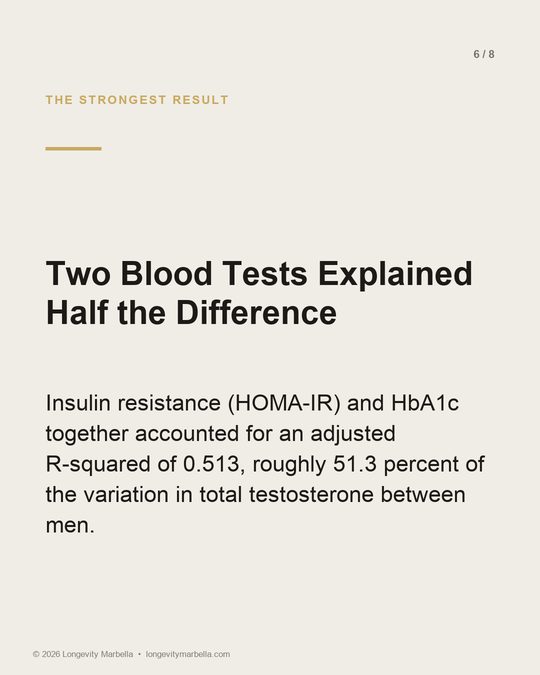
- Insulin resistance and HbA1c accounted for 51.3 percent of the variation.
- Single center, association not causation, and the direction is unresolved.
The Result That Inverts the Usual Assumption
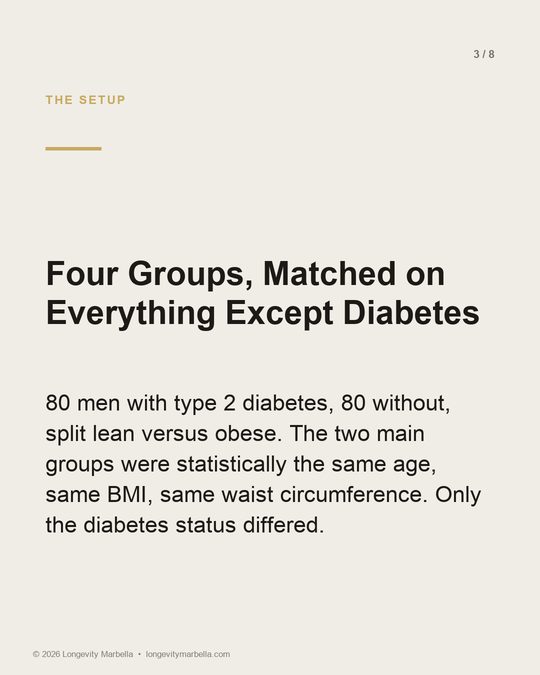
The men were sorted into four groups of forty: lean with type 2 diabetes, obese with type 2 diabetes, lean with normal glucose, obese with normal glucose. If body fat were the dominant force on male hormones you would expect a clean gradient: obese men lowest, lean men highest, diabetes shifting things at the margins.
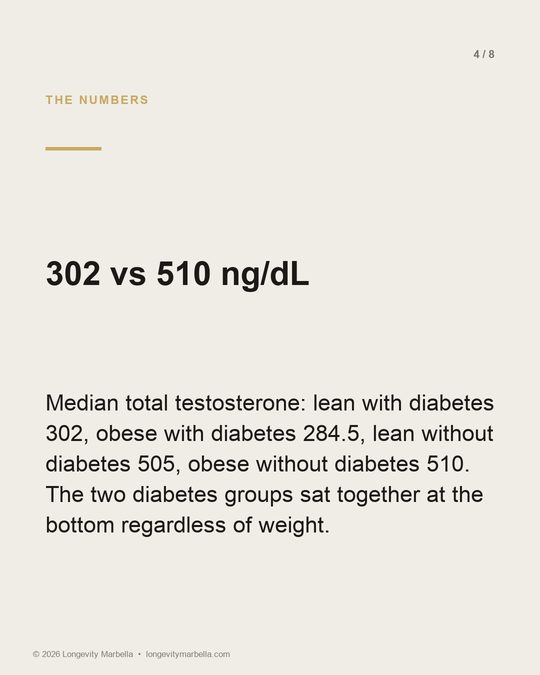
That is not what happened. Median total testosterone came out like this:
- Lean with type 2 diabetes: 302 ng/dL
- Obese with type 2 diabetes: 284.5 ng/dL
- Lean without diabetes: 505 ng/dL
- Obese without diabetes: 510 ng/dL
The lean diabetic group sat significantly below the lean non-diabetic group, and below the obese non-diabetic group as well, both at p less than 0.001. A p value is the probability of a gap that large arising by chance if there were truly no difference, so this one is under one in a thousand.
Read the ordering, not any single figure. The two diabetes groups sat at the bottom together, the two non-diabetes groups at the top together. Within each pair, body fat barely moved the result. Between the pairs, diabetes moved it by roughly two hundred ng/dL.
Knowing whether one of these men had diabetes predicted his testosterone far better than knowing whether he was lean or obese.
How the Study Was Built, and Why the Matching Matters
This was a case-control study run at the diabetes outpatient clinic of Alexandria Main University Hospital in Egypt, between October 2021 and September 2022, enrolling 160 men aged 27 to 45. Lean meant a body mass index below 25 kg/m2, obese meant 30 kg/m2 or above. The men without diabetes were recruited from relatives accompanying the patients.
The exclusions matter, because they remove most of the obvious alternative explanations. Out went men with known hypogonadism, severe liver or kidney failure, severe obstructive sleep apnea, symptomatic depression or any previously diagnosed malignancy. Out too went men on drugs that move testosterone, including clomiphene, tamoxifen, letrozole, GnRH agonists and finasteride, men on insulin, and anyone who had used testosterone or an androgen-containing supplement in the previous three months.
Blood was drawn before 10 am after an eight to ten hour fast, the correct way to measure testosterone. Free testosterone was calculated from total testosterone and SHBG by the Vermeulen method, not measured directly.
Here is the design detail that carries the whole argument. The two main groups, 80 men each, were statistically indistinguishable on the three variables that normally dominate a testosterone result:
- Age: median 43 years versus 42 years, p 0.21
- Body mass index: median 27.45 versus 27.45 kg/m2, p 0.67
- Waist circumference: median 94.5 versus 95.5 cm, p 0.82
Same age, same BMI, same waist. The only systematic difference left was the diabetes.
What Separated the Two Groups
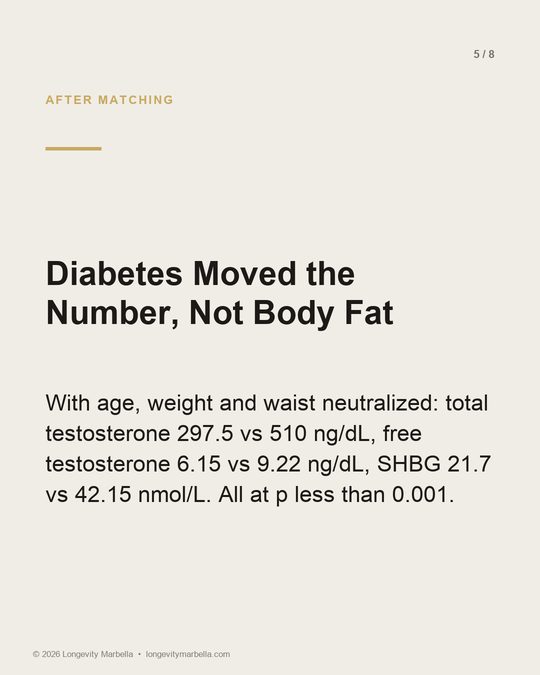
With age, weight and waist neutralized, the measurements still separated cleanly:
- Total testosterone: median 297.5 ng/dL with diabetes versus 510 ng/dL without, p less than 0.001
- Calculated free testosterone: 6.15 versus 9.22 ng/dL, p less than 0.001
- SHBG: 21.7 versus 42.15 nmol/L, p less than 0.001
- HOMA-IR: 3.79 versus 1.1, p less than 0.001
- HbA1c: 8 percent versus 5.2 percent, p less than 0.001
Two of those need translating. HOMA-IR is calculated from fasting glucose and fasting insulin and estimates how hard the pancreas is working to hold blood sugar down. Insulin is the accelerator pedal: in insulin resistance the body answers it sluggishly, the pancreas presses harder, and HOMA-IR rises. HbA1c is the proportion of hemoglobin with sugar stuck to it, and because red cells live around three months it reports average glucose over that period rather than on the test morning.
Body fat did still matter. Total testosterone correlated negatively with BMI at r -0.16 (p 0.04) and with waist circumference at r -0.23 (p 0.003). Free testosterone correlated more strongly, r -0.26 with BMI and r -0.3 with waist, both at p less than 0.001. A correlation coefficient runs from -1 to +1, so these are genuine but weak, and waist outperformed BMI as usual.
Insulin Resistance and HbA1c Accounted for Half the Variation
The strongest single result is a regression model. Using HOMA-IR and HbA1c together to predict total testosterone produced an adjusted R-squared of 0.513. In plain terms, those two diabetes markers accounted for approximately 51.3 percent of the variability in total testosterone across the group. Both coefficients were negative: higher insulin resistance and worse glycemic control each tracked with lower testosterone. The model was highly significant, F(2, 157) = 84.98, p less than 0.001.
A second model, for free testosterone, used duration of diabetes, waist circumference, age and HOMA-IR, reaching an adjusted R-squared of 0.451, roughly 45.1 percent of the variability. All four coefficients were negative.
Half the variance from two blood tests is substantial for any biological measurement. It does not mean those markers cause half of a man's testosterone level, only that here they accounted for about half of why one man's testosterone differed from the next man's.
The SHBG Fall, and Why It Rules Out the Easy Explanation
Sex hormone binding globulin, SHBG, is the protein that carries testosterone through the bloodstream, and bound testosterone cannot enter a cell and act. Picture SHBG as cars and testosterone as passengers: a passenger being driven cannot get out and work. Total testosterone counts everything, bound and free, and with fewer cars less hormone stays on the road, so when SHBG falls the total tends to fall with it even if usable hormone has not changed.
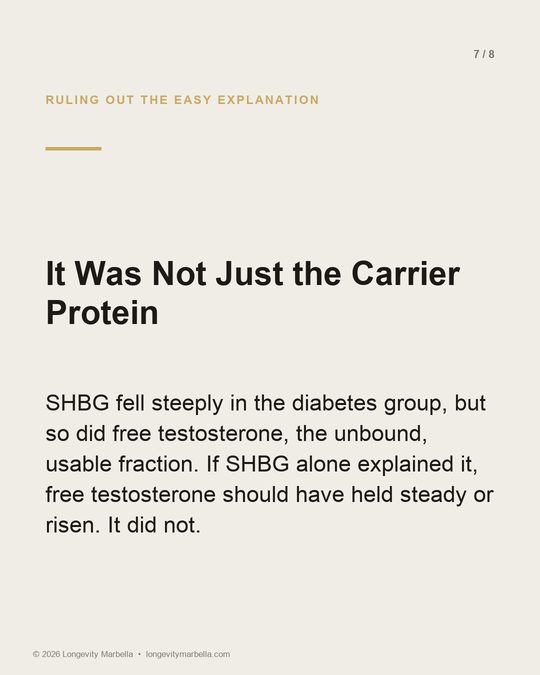
SHBG did fall here, and steeply. Median SHBG was 21.7 nmol/L in the diabetes group against 42.15 nmol/L in the non-diabetes group, p less than 0.001. That is close to half.
The obvious objection is that the whole finding is an SHBG artifact rather than a real androgen deficit: fewer cars, not less hormone. The data answer it. Calculated free testosterone, the passengers on foot, fell too, from a median of 9.22 to 6.15 ng/dL, p less than 0.001. Had falling SHBG been the entire story, free testosterone would have been preserved or risen. It was not. There was genuinely less usable hormone on the street, not just fewer cars to carry it.
The authors also modeled SHBG itself and found HbA1c pushing it down: each one unit rise in HbA1c predicted a 3.43 unit fall in SHBG, in a model with an adjusted R-squared of 0.586, about 58.6 percent of SHBG variability. This is the kind of detail a single testosterone number will never show you. How a hormonal work-up should be sequenced and repeated is set out in low testosterone diagnosis and monitoring.
Now the Honest Limits
This is a modest study and it deserves to be read as a signal, not a verdict.
- The total sample was 160 men, 40 per cell. That is small. Post hoc power was 83 percent, respectable for the main comparison and thin for anything subtler.
- It was single center. Recruitment came from one tertiary hospital in Alexandria, and the authors state their results may not apply elsewhere.
- It shows association, not causation. Nobody was randomized and nobody was followed forward, so it cannot tell you that diabetes lowered these men's testosterone.
- The direction is unresolved. Work cited in the paper reports low testosterone as an independent risk factor for developing type 2 diabetes, and the authors call the relationship bidirectional. In some of these men the low testosterone may have come first.
- The age band was narrow and the diabetes young. Participants were 27 to 45 years old, with a mean diabetes duration of 1.15 years, standard deviation 1.57, range 0 to 6 years. Whether the same holds at 65 after twenty years of diabetes is not answered.
- The controls were a convenience sample, relatives accompanying patients rather than men sampled from the general population.
What This Means If Your HbA1c Is Drifting
Strip the study back and two practical statements survive.
The first is that being slim does not exempt you. If you have type 2 diabetes or prediabetes, or your HbA1c has been creeping up at annual checks, a normal BMI is no reason to assume your testosterone is fine. The lean diabetic men here had a median total testosterone of 302 ng/dL, so half of them fell below that. Their leanness protected them from nothing.
The second is that glycemic control and hormonal health are not separate files. Here they behaved as one problem seen from two angles. A man investigated for fatigue, poor recovery, low libido or blunted morning erections deserves a fasting glucose, a fasting insulin and an HbA1c alongside the hormone panel. A man already managed for diabetes deserves the testosterone question asked out loud rather than waved away because his weight is acceptable. Neither statement is an argument for treatment. Both are arguments for measurement, and for measuring the right things at the right time of day.
Where a Consultation Fits
Most men arrive with one number on one piece of paper, drawn at an inconvenient hour, with no SHBG, no insulin and no HbA1c beside it. Interpreting it anyway is how men end up dismissed or treated without cause.
Our specialist is double board-certified in Internal Medicine and Endocrinology, which is the combination this question demands, because it sits on the seam between metabolic and hormone medicine. Consultations are by private video call or concierge visit across the Costa del Sol, in English or Dutch. If your glucose has been drifting and your energy is not what it was, those two facts may be more closely related than anyone has told you.
I am slim and I have type 2 diabetes. Should I have my testosterone measured?
This study is a reasonable argument for asking the question. In it, lean men with type 2 diabetes had a median total testosterone of 302 ng/dL, lower than both the lean men without diabetes at 505 ng/dL and the obese men without diabetes at 510 ng/dL. A normal body weight did not protect them. If you also have symptoms such as persistent fatigue, low libido, loss of morning erections or poor training recovery, measurement is sensible. It should be an early morning fasting sample, and it should include SHBG so the free fraction can be calculated rather than guessed.
If I get my blood sugar under control, will my testosterone come back up?
This study cannot answer that, and it matters to say so. Nobody in it was treated or followed over time, so it tells you that low testosterone and poor glycemic control travel together, not that fixing one fixes the other. The paper does cite short-term trials in which testosterone supplementation appeared to improve insulin sensitivity and reduce inflammation, but that is the opposite direction of travel and those trials were short. Improving glycemic control is worth doing on its own merits. Treat any hormonal improvement as a possibility to be measured, not as a promise.
SHBG fell in the diabetes group. Does that not explain the whole thing?
It explains part of it and not all of it. SHBG is the carrier protein for testosterone, and total testosterone falls when SHBG falls, so a drop from a median of 42.15 to 21.7 nmol/L would drag the total down by itself. But calculated free testosterone, the unbound fraction that SHBG does not inflate, also fell, from a median of 9.22 to 6.15 ng/dL at p less than 0.001. Both measures moved in the same direction, which is why the authors argue this is not simply an SHBG effect.
How much weight should I give a study of 160 men?
Enough to prompt a blood test, not enough to change a treatment plan. One hundred and sixty men, forty per group, at a single hospital in Alexandria, in a narrow age band of 27 to 45, with a case-control design that cannot establish cause. The authors themselves recommend the question be studied with a larger sample and a stronger design, and state their conclusions may not apply to other populations. What makes the result worth reading is the matching: the two main groups had the same median age, the same median BMI and the same median waist circumference, so the usual explanations were already accounted for.
Does this mean body fat does not matter for testosterone?
No, and the same paper shows it still does. Total testosterone correlated negatively with BMI (r -0.16, p 0.04) and with waist circumference (r -0.23, p 0.003), and free testosterone correlated more strongly with both. Central fat around the organs remains one of the strongest modifiable influences on male hormones. The finding here is narrower and more interesting: within this group of men, diabetes was associated with a larger difference in testosterone than obesity was. Both matter. Only one of them was being routinely asked about.
This article is for general information only and is not medical advice. Individual dietary and medical decisions should be discussed with a qualified doctor.
Reference. Assaad Khalil SH, Dandona P, Osman NA, Assaad RS, Zaitoon BTA, Almas AA, Amin NG. "Diabetes surpasses obesity as a risk factor for low serum testosterone level." Diabetology & Metabolic Syndrome 2024;16:143 (doi:10.1186/s13098-024-01373-1).
One number is rarely the whole answer
If your hormone results have been read to you as a single figure, our specialist can interpret the full picture alongside your symptoms, on a private video call or a concierge home visit across the Costa del Sol.
A letter from the doctor. A few times a year, when the evidence genuinely changes, I write it down and send it. No schedule, no noise, and you can leave the list whenever you like.