


If you used, and you have wondered about your heart, this is the article to read. Not because the news is uniformly bad, but because it is now precise, and precision is what makes it actionable.
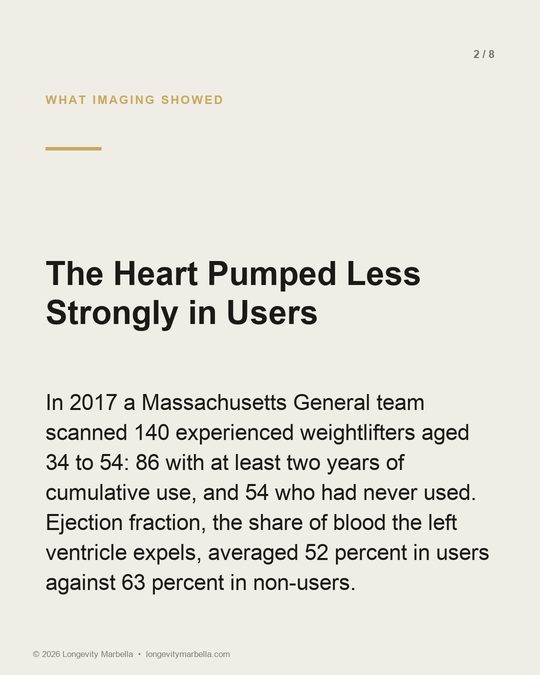
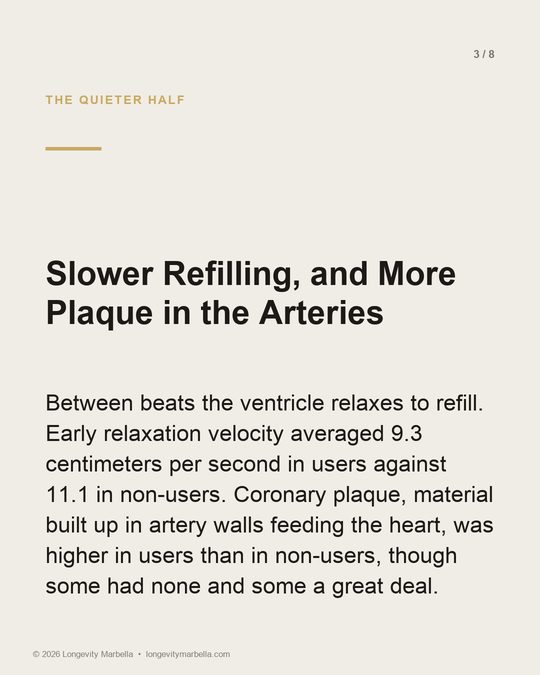
- Imaging in 140 experienced weightlifters found users had a mean left ventricular ejection fraction of 52 percent against 63 percent in non-users, along with impaired relaxation of the heart muscle and more coronary plaque.
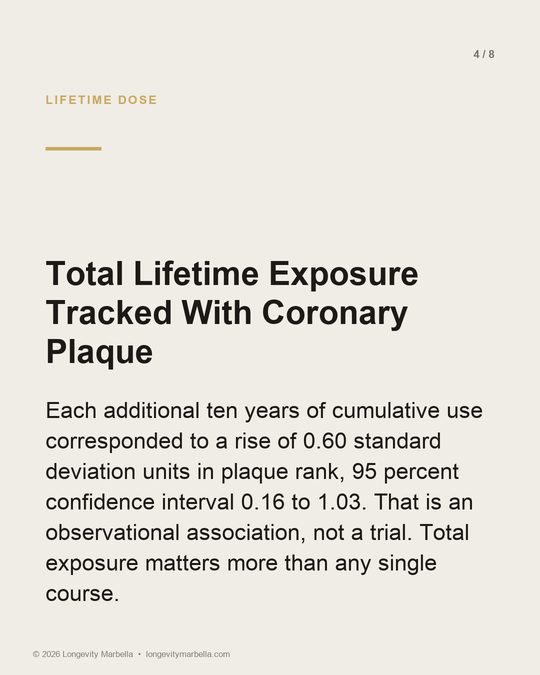
- The effect tracks lifetime exposure. Each additional ten years of cumulative use corresponded to a measurable rise in coronary plaque burden.
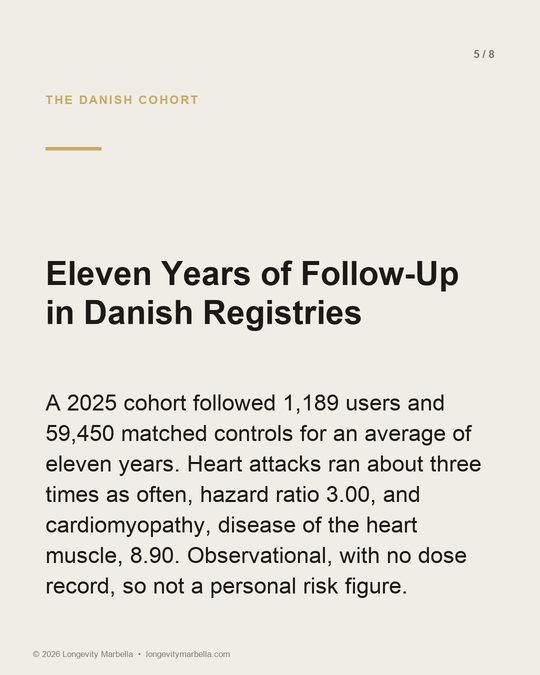
- A Danish national cohort of 1,189 users followed an average of eleven years found substantially higher rates of heart attack, heart failure, arrhythmia, clots and cardiomyopathy than in 59,450 matched controls.
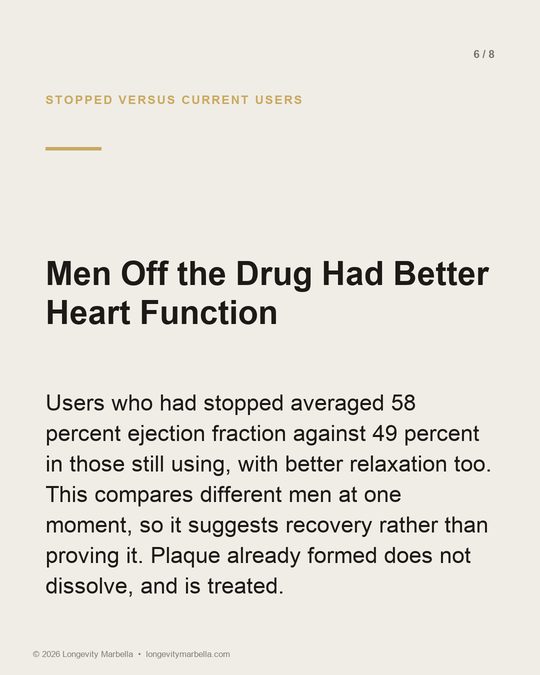
- The encouraging finding: men who had stopped measured better than men still using, with a mean ejection fraction of 58 percent against 49 percent.
- Every driver of this risk, blood pressure, lipids, thickened blood, rhythm and heart muscle structure, is measurable now and most of it is treatable. That is internal medicine, and it is the reason to have it looked at properly.
What the imaging actually showed
For years the honest answer to "what do steroids do to the heart" was that nobody had looked carefully enough to say. In 2017 a group led by Baggish at Massachusetts General Hospital did look, and published it in Circulation.
They recruited 140 experienced male weightlifters between 34 and 54 years old: 86 who reported at least two years of cumulative lifetime anabolic steroid use, and 54 who had never used. Everyone had an echocardiogram, an ultrasound scan of the heart in motion, and a coronary CT angiogram, a scan that shows the arteries supplying the heart muscle and any plaque built up in their walls.
Three findings came out of it.
- The heart pumped less strongly. Ejection fraction is the percentage of blood the left ventricle expels with each beat, the standard measure of pumping function. In users it averaged 52 percent, against 63 percent in non-users (P less than 0.001). Both figures include men who were entirely well, but the gap between the groups is large and it is not the kind of difference that appears by chance.
- The heart relaxed less well. Between beats the ventricle has to relax to refill, and how quickly it does so is measured as early relaxation velocity. In users this averaged 9.3 cm per second against 11.1 in non-users (P less than 0.001). Impaired relaxation is the quieter half of heart function and often the earlier one to change.
- The arteries carried more plaque. Coronary artery plaque volume was higher in users than non-users (P equals 0.012), and the spread was wide, which matters: some users had none at all, and some had a great deal.
The finding that decides how you should read all of this
Short answer: lifetime dose drove the arteries, and stopping was associated with better heart function.
Two results in that paper carry more practical weight than the headline averages.
The first is a dose response. Cumulative lifetime exposure was strongly associated with coronary plaque burden: each additional ten years of cumulative use corresponded to an increase of 0.60 standard deviation units in plaque rank, 95 percent confidence interval 0.16 to 1.03, P equals 0.008. In plain terms, this is not about whether you ever used. It is about how much, across your whole life. A man who ran a few courses in his twenties and a man who used continuously for fifteen years are not in the same position, and the data say so directly.
The second is the one worth sitting with. Within the user group, the researchers compared the 58 men who were taking steroids at the time of the scan against the 28 who had stopped. The men currently off the drug had a mean ejection fraction of 58 percent against 49 percent in those currently on it (P less than 0.001), and better relaxation as well, 10.1 against 8.9 cm per second (P equals 0.035).
State the limitation honestly, because it changes what the finding is worth: this compares different men at a single moment, not the same men before and after. It is consistent with pumping function recovering when the drug stops, and it is not proof of it. What it is not consistent with is the fatalistic reading that the damage is simply done.
Coronary plaque behaves differently. Plaque that has formed does not dissolve because you stopped. It is managed, and it is managed well, with the same treatments used for every other patient with early atherosclerosis, which is a large and mature field of medicine. The distinction is worth holding: the muscle may recover, the arteries need treating.
If you used for years and have never had this looked at, that is the gap worth closing. It is measured discreetly and explained plainly.
Ask the specialist about thisHow often it actually goes wrong
Imaging tells you what is changing. It does not tell you how many people go on to have events. For that, the field waited until March 2025, when Windfeld-Mathiasen and colleagues published a national cohort in Circulation.
They identified 1,189 men sanctioned for anabolic steroid use in Danish fitness centers between 2006 and 2018, matched each against fifty men of the same age from the general population, 59,450 controls, and followed everyone through the Danish national registries for an average of eleven years.
The men averaged 27 years old when the follow-up began, which is the number to keep in mind while reading the rest.
- Heart attack: adjusted hazard ratio 3.00 (95 percent confidence interval 1.67 to 5.39)
- Coronary intervention, stenting or bypass surgery: 2.95 (1.68 to 5.18)
- Venous thromboembolism, clots forming in the veins: 2.42 (1.54 to 3.80)
- Arrhythmias: 2.26 (1.53 to 3.32)
- Heart failure: 3.63 (2.01 to 6.55)
- Cardiomyopathy, disease of the heart muscle itself: 8.90 (4.99 to 15.88)
A hazard ratio of 3.00 means the rate of new heart attacks in the steroid group ran about three times that of matched controls over the same period. It does not mean any individual has a three in one chance of anything.
The authors are careful about what their study cannot do, and so should anyone quoting it. It is observational, not a trial. They had no record of how much anyone used or for how long. And men sanctioned for doping differ from the general population in ways a registry cannot capture, including alcohol and smoking. Nobody can tell you from this study what your personal risk is. What it establishes is that the concern is real and quantitatively serious, which is a different claim and a sufficient one.
What is quietly driving it, and why almost all of it is treatable
Short answer: the mechanisms are ordinary cardiovascular medicine, which is exactly why they respond to it.
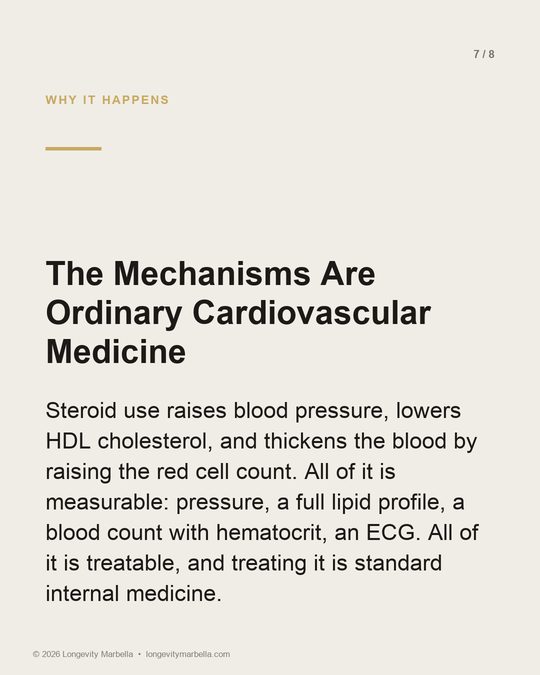
Read the two studies together and the pathway is not mysterious. Steroid use pushes blood pressure up. It distorts the lipid profile characteristically, with a fall in HDL cholesterol that can be profound with oral compounds. It raises the red cell count, thickening the blood and making it clot more readily, which is the plausible route to the clot and stroke figures. It acts directly on receptors in heart muscle cells, which is how the muscle thickens and, over years, how function drifts down. And it accelerates the accumulation of plaque in the coronary arteries in proportion to how much has been used.
Every item on that list is measurable, and the measurements are neither exotic nor expensive: blood pressure, a full lipid profile, a blood count with hematocrit, an ECG, and where the history or the results justify it, an echocardiogram to look at the muscle directly.
More to the point, every item on that list is treatable, and treating them is not experimental. Lowering blood pressure, correcting lipids, managing thickened blood and addressing rhythm disturbance are among the best evidenced interventions in all of medicine. The nine-fold cardiomyopathy figure is alarming as a statistic and useful as a target, because heart muscle that has started to change can be seen long before it fails.
What cannot be treated is what has never been measured. That is the entire practical content of this article.
Blood pressure, lipids, blood count, rhythm, and where it is warranted, the heart muscle itself. One appointment, one physician, and an honest read on where you stand.
Ask the specialist about thisWhy this is an internist's question, not only an endocrinologist's
Men who have used anabolic steroids are usually routed toward a hormone doctor, and the hormones do matter. But look again at what the two studies above actually measured: pumping function, relaxation, coronary plaque, blood pressure, lipids, red cell mass, rhythm, heart failure. None of that is endocrinology. All of it is internal medicine, the specialty of the adult body as a whole and, specifically, of long-run cardiovascular risk: recognizing it, preventing it, and treating it.
The reason this matters practically is that the two halves of the problem are one patient. Your hormonal recovery and your cardiovascular risk are driven by the same history and they are managed on the same set of results. Splitting them between an endocrinologist for the hormones and someone else for the heart means two sets of appointments, two partial pictures, and your history repeated to strangers.
Being double board certified in Internal Medicine and Endocrinology is not a credential ornament in this context. It is the reason the whole assessment happens in one place, with one physician who can read the hormone panel and the cardiovascular picture as a single story, because in you they are one.
And to say the thing that keeps most men from ever making the appointment: how you got here is of no interest whatsoever. Many capable, successful men have used testosterone or steroids at some point, and they arrive expecting a lecture. There is not one. There is a measurement, an honest explanation of what it means, and a plan for protecting what can be protected. We are here to help, and that is the whole of it.
A reasonable first step
If you used, briefly or for years, and it has never been looked at, a single properly chosen assessment answers the question you have been carrying. It covers where your hormones actually sit, and alongside it the cardiovascular picture these studies say matters: pressure, lipids, blood, rhythm, and the heart muscle itself where that is warranted.
Most men leave that appointment reassured about more than they expected, and with something specific and treatable to work on. Both of those are better than wondering.
The broader picture, including hormonal recovery, fertility and the other organ systems, is covered in the main article on steroid use and recovery.