


If you had to pick one number to bet on for a long, active life, cardiorespiratory fitness would be a strong candidate. How well your heart, lungs, and muscles take in and use oxygen is one of the strongest predictors we have of how long you live, stronger than many of the risk factors people worry about far more.
That number has a name: VO2max. And here is the part worth getting excited about. Unlike your age or your genes, which you cannot rewrite, your fitness is genuinely modifiable at almost any point in life. You can measure where you stand today and move that number in the right direction this year.
So what does the evidence actually say, how is fitness measured, and how do you raise it safely? Let us walk through it.
- VO2max, your cardiorespiratory fitness, is among the strongest predictors of how long you live.
- Across hundreds of thousands of people, fitter meant lower mortality, with no observed upper limit of benefit.
- It is one of the few major risk factors you can genuinely improve, at almost any age.
What is VO2max, exactly?
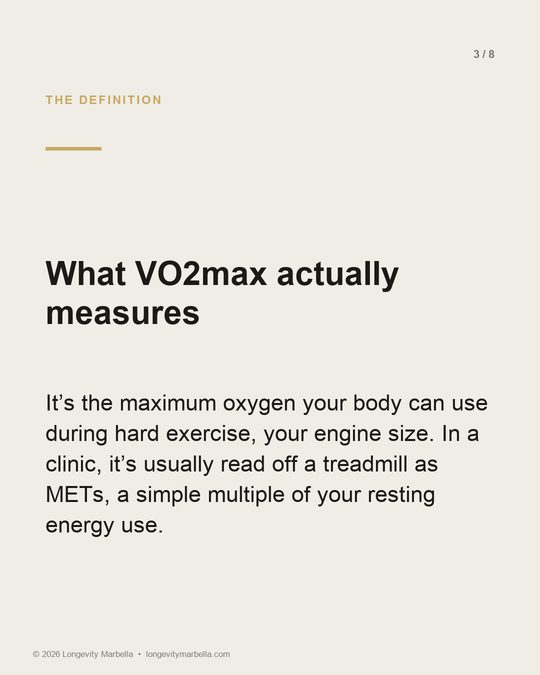
VO2max is the maximum amount of oxygen your body can use during hard exercise. Your muscles run on oxygen the way an engine runs on fuel, so VO2max is essentially your engine size: how much oxygen your heart and lungs can deliver, and how much your muscles can burn, when you are working as hard as you can.
A more practical version of the same idea is the MET, short for metabolic equivalent. One MET is the energy you use sitting quietly at rest, so sustaining 10 METs on a treadmill test means working at ten times your resting rate. Because METs are easy to read off a standard treadmill test, doctors often use them as a hands-on stand-in for VO2max. Roughly, each extra MET is being able to run about 1 km/h faster.
Does fitness really predict how long you live?
Yes, and the link is one of the strongest in medicine. Two large bodies of evidence make the case.
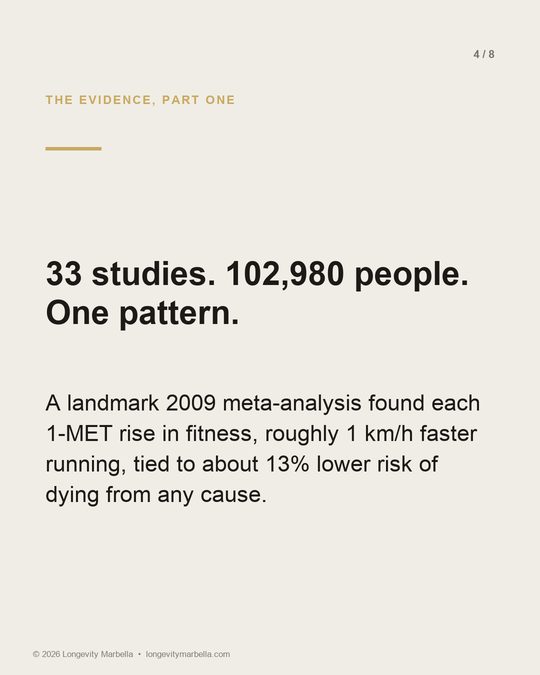
The first is a landmark meta-analysis (a study that pools many earlier studies together) published in JAMA in 2009. It combined 33 studies and about 102,980 people for all-cause mortality (death from any cause). The findings were consistent:
- Each 1-MET higher fitness (about 1 km/h faster running pace) was associated with roughly 13% lower all-cause mortality (relative risk 0.87, 95% confidence interval 0.84 to 0.90). A relative risk of 0.87 simply means the risk was about 13 percent lower in the fitter group.
- Heart-disease and cardiovascular events fell too, by about 15% per extra MET (relative risk 0.85).
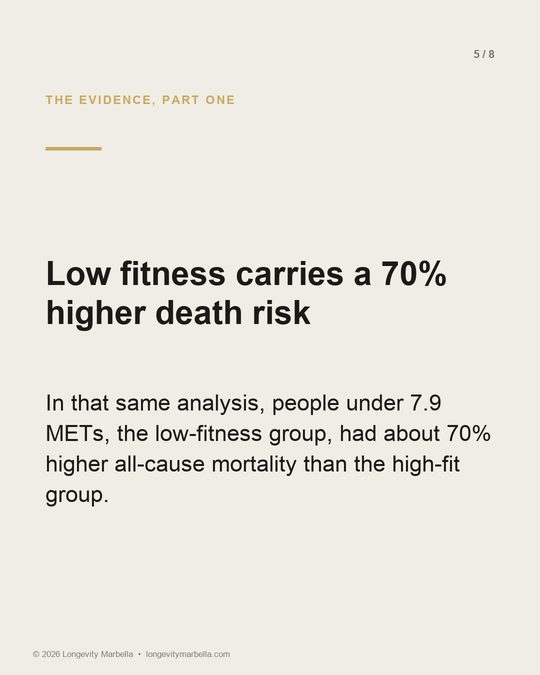
- People with low fitness (under 7.9 METs) had about 70% higher all-cause mortality than high-fit people (relative risk 1.70, meaning about 1.7 times the risk).
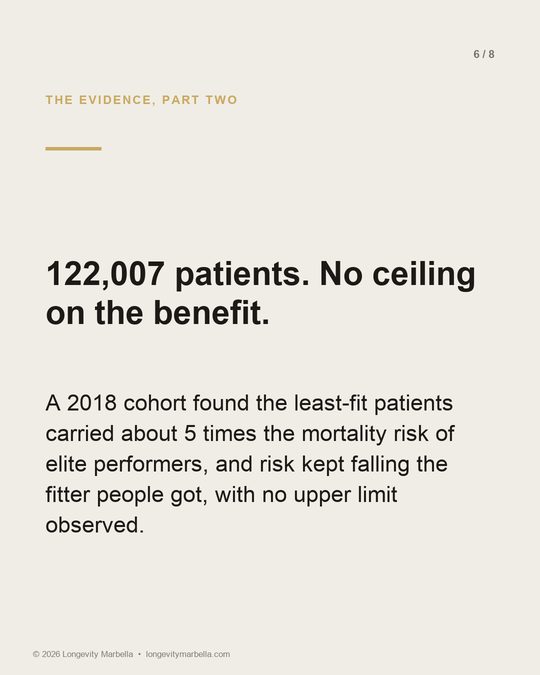
The second is one of the largest studies of its kind, published in JAMA Network Open in 2018. It followed 122,007 patients who had done a treadmill exercise test. As fitness rose, risk-adjusted mortality fell steadily, and the authors reported no observed upper limit of benefit: the fitter people were, the lower their risk kept going.
- The least-fit patients had about 5 times the mortality risk of elite performers (hazard ratio 5.04, meaning roughly five times the risk over follow-up).
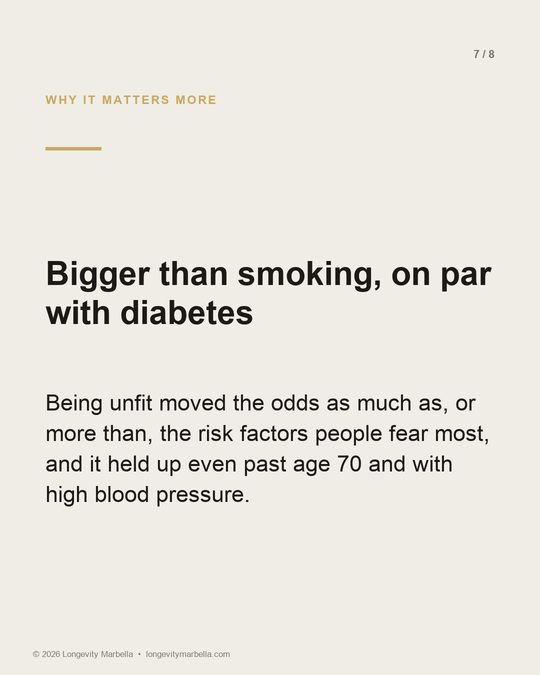
- That effect size was comparable to or greater than smoking, coronary artery disease, or diabetes, which are among the most feared risk factors in medicine.
- The benefit of very high fitness held up even in people aged 70 and older and in those with high blood pressure.
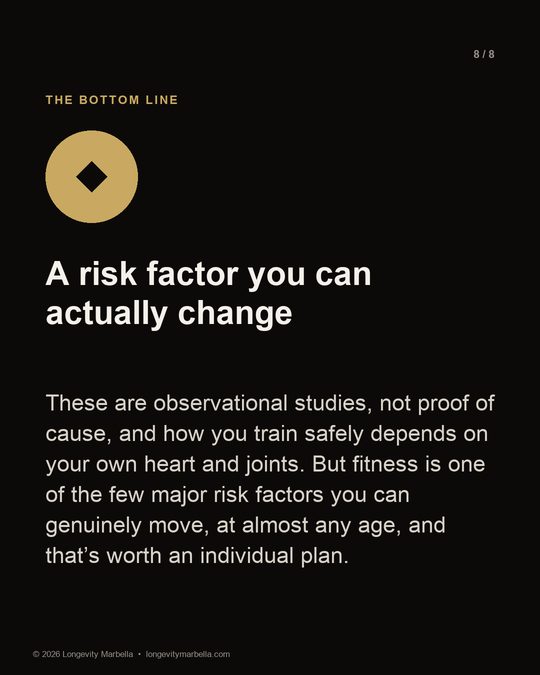
One honest caveat runs through all of this. These are observational studies: you cannot ethically randomize people to be fit or unfit, so researchers can only watch what happens at different fitness levels. That leaves room for reverse causation, where people who are already healthier are also the ones able to be fit. Even so, the size and consistency of the link across hundreds of thousands of people is striking, and fitness has the rare virtue of being something you can actually work on.
Bottom line: fitter people live longer, and the trend holds all the way up.
Why does fitness matter more than most risk factors?
Because it moves your risk as much as the things you already fear, and you can actually change it. In the 2018 data, being in the least-fit group carried a mortality risk on par with, or worse than, smoking or established heart disease. Very few things in medicine move risk that much.
What sets fitness apart is not just the size of the effect. It is that this is one of the few major risk factors you can genuinely change, at almost any age. You cannot un-smoke thirty years or rewrite your family history, but you can raise your fitness this year.
How do you build fitness?
With a mix of regular aerobic training and some higher-intensity work, layered over time. The broad strokes are well supported, even if the exact recipe is individual:
- An aerobic base: easier, sustainable sessions (often called "zone 2," an effort at which you can still hold a conversation).
- A smaller dose of intervals: harder efforts that push your ceiling upward over time.
- Strength training alongside it: muscle is the tissue that ultimately uses the oxygen your heart and lungs deliver, and it protects your independence as you age. We cover that in our companion article, Muscle Is a Survival Organ. Muscle quality and quantity are measured directly at the practice, in the Body Composition Assessment.
What no honest article can do is hand you a fixed protocol or promise you a specific number. How much, how hard, and how fast to progress depend on your current fitness, your heart and joint health, and your goals. That is exactly the kind of thing best assessed individually rather than guessed.
Curious where your own VO2max and metabolic markers stand, and how to move them? We can measure them and build you a safe, personalized plan to improve them.
Message us on WhatsAppHow can a specialist help?
By turning a vague ambition into concrete, measurable numbers you can track. A longevity assessment measures your baseline fitness and your broader metabolic health (how your body handles blood sugar, weight, and energy), then builds a safe, individualized plan to improve them. It is one of the clearest examples of longevity care grounded in evidence rather than vague anti-aging promises.
A longevity assessment establishes where your fitness stands today, puts it in the context of the rest of your health, and maps a realistic path to improve it. A practical, trackable investment in the years ahead, not a leap of faith.
- VO2max is the most oxygen your body can use during hard exercise, the standard summary of cardiorespiratory fitness, often read as METs on a treadmill.
- In a meta-analysis of about 102,980 people, each 1-MET higher fitness was tied to roughly 13% lower all-cause mortality, and low fitness meant about 70% higher risk.
- In a cohort of 122,007 patients, the least-fit had about 5 times the mortality risk of elite performers, with no observed upper limit of benefit.
- That risk rivaled or exceeded smoking, coronary disease, and diabetes, and held even in people 70 and older and those with high blood pressure.
- The data are observational, so fitness is a powerful marker, not proven to be the sole cause, but it is genuinely modifiable.
- A mix of aerobic training and some intervals, plus strength work, builds fitness over time, best planned with an individual assessment.