


No sperm found. Three words on a laboratory report, and the most misunderstood result in male fertility. A 35-page review in Andrology, led by one of the field's most cited authors, maps what can and cannot be done about it with hormones, and it is honest enough to say where the map ends.
- Non-obstructive azoospermia, production failure rather than blockage, affects roughly one in ten men in fertility evaluation.
- Where the cause is hormonal, hypogonadotropic hypogonadism, hCG-based therapy restores sperm production in most cases. That part is established.
- Where the testis itself has failed, surgical sperm retrieval remains the recommended route, and hormonal pre-treatment is a genuine, unresolved debate.
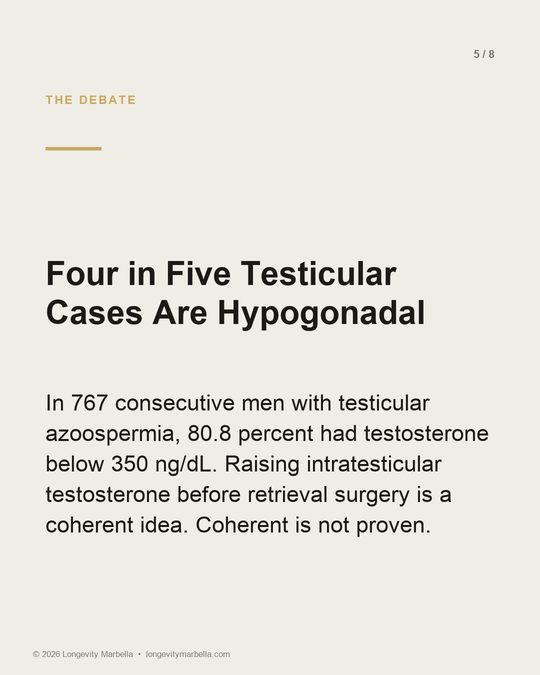
- In a series of 767 men with testicular azoospermia, 80.8 percent were biochemically hypogonadal, which is why the hormonal question refuses to go away.
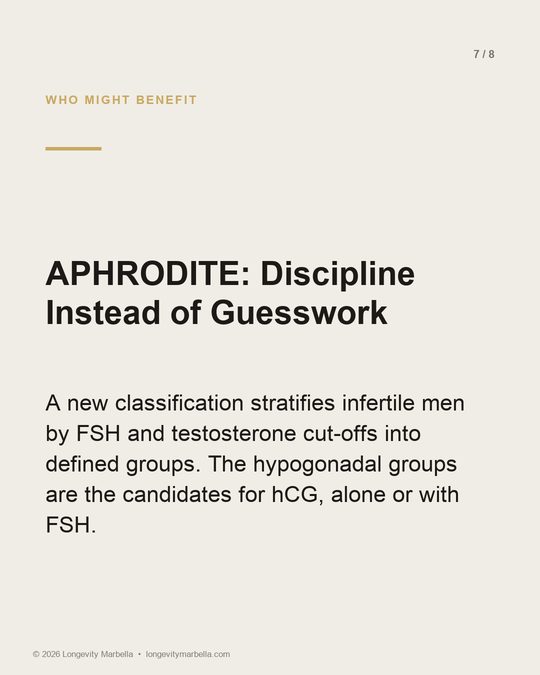
- The new APHRODITE criteria stratify who might benefit. The review is explicit: efficacy in testicular azoospermia still requires large, well-designed studies.
Two very different zeros
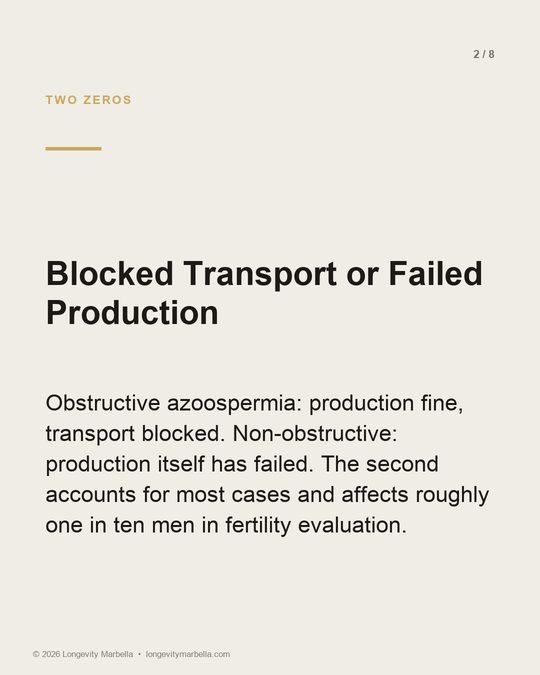
Azoospermia means no sperm in the ejaculate. The first task of the workup is deciding why, because the word covers two opposite situations. In obstructive azoospermia, production is fine and the transport is blocked. This article is about the other one: non-obstructive azoospermia, where production itself has failed. It accounts for most azoospermia and affects roughly one in ten men undergoing fertility evaluation.
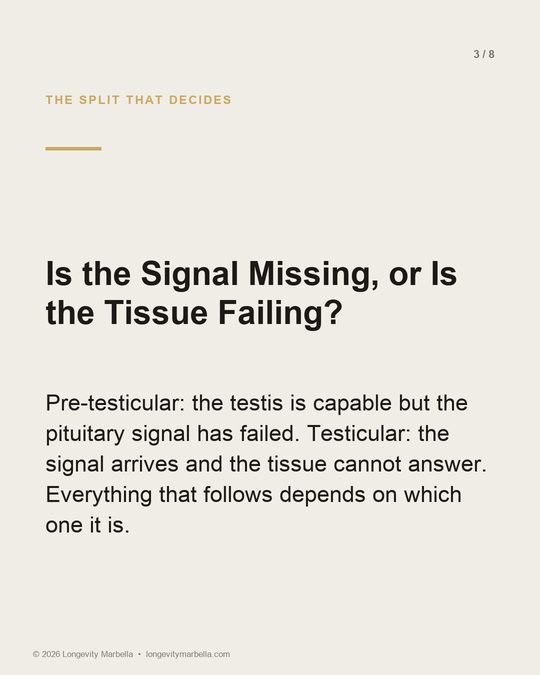
Within it sits a second division that decides everything. In pre-testicular cases, the testis is capable but the hormonal signal driving it has failed, the condition called hypogonadotropic hypogonadism. In testicular cases, the signal arrives and the tissue cannot answer: genetics, past damage, or, frequently, no identifiable reason at all.
The hormone in question
Sperm production is a factory line running on two orders from head office, the pituitary: FSH, acting on the nurse cells that raise sperm, and LH, which drives the Leydig cells to produce testosterone inside the testis, at concentrations far higher than the blood ever sees. That local, intratesticular testosterone is essential to the process. Testosterone injected from outside tells head office the warehouse is full, both orders stop, and with them the local supply, which is exactly why it shuts production down rather than helping it.
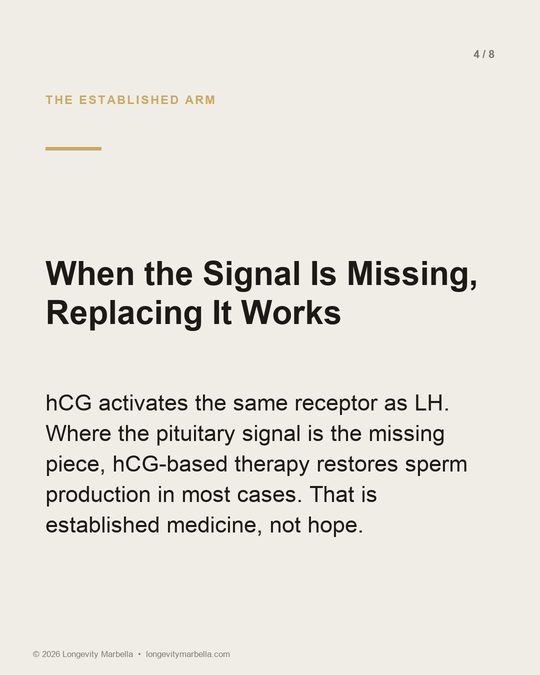
hCG, human chorionic gonadotropin, is a hormone that happens to activate the same receptor as LH, pressing the same start button on the Leydig cells, and pharmaceutical preparations of it have been used for decades to stand in for the LH signal. Where the pituitary signal is the missing piece, replacing it works: the review states plainly that hCG-based therapy effectively restores spermatogenesis in most cases of hypogonadotropic hypogonadism. A man told at twenty that he would never father children can, in this specific situation, often be treated into producing sperm. That part of the story is established medicine, not hope.
The debate: the testis that already hears the signal
Testicular azoospermia is harder, and the review does not pretend otherwise. The recommended route to fatherhood there is surgical sperm retrieval, particularly microdissection TESE, an operation searching the testis itself for pockets of surviving production, with any retrieved sperm used for ICSI, where a single sperm is injected into an egg.
The open question is whether hormonal treatment before the operation improves the odds. The rationale is real: in a series of 767 consecutive men with testicular azoospermia, 80.8 percent were biochemically hypogonadal, testosterone below 350 ng/dL, roughly 12 nmol/L. If intratesticular testosterone matters to production, and four out of five of these men are low, raising it with hCG before surgery is at least a coherent idea.
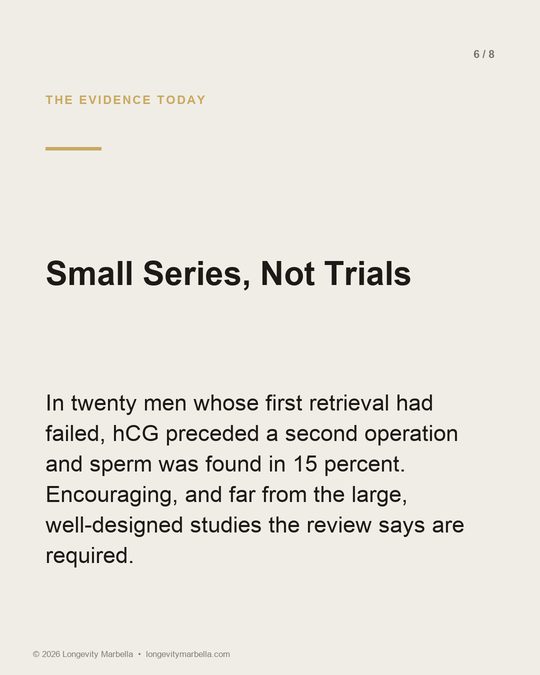
Coherent is not proven. The supporting results are small series, not trials. In one Japanese study of twenty men whose first retrieval had failed, hCG treatment preceded a second operation, and sperm was found in 15 percent of them. Encouraging, worth knowing about, and far from the large, well-designed studies the review itself says are required before this becomes standard practice.
Deciding who might benefit: APHRODITE
The field's answer to "who should even be considered" is a new classification, the APHRODITE criteria, which stratify infertile men by clinical findings and two laboratory cut-offs: FSH at 12 IU/L and testosterone at 350 ng/dL. Pre-testicular cases form one group; testicular cases spread across three more, and the hypogonadal groups are the candidates for hCG-based treatment, alone or combined with FSH.
In the 767-man series, the groups were not exotic edge cases: normal-signal-but-low-testosterone men made up 38.5 percent, and high-signal groups, men whose pituitary head office is already shouting because the floor is not answering, another half. The point of the classification is discipline, replacing "let us try hormones and see" with a defined phenotype, a recognizable patient profile, a defined rationale, and eventually, definable evidence.
What an honest reading looks like
Three statements can be true at once, and in this field they are. First: hormonal-failure azoospermia is genuinely treatable, and missing that diagnosis is the costliest error in the entire workup. Second: in testicular azoospermia, hormones are preparation at best, not a substitute for retrieval surgery, and any clinic implying otherwise is selling past the evidence. Third: the question is live, the biology is plausible, and the classification now exists to test it properly.
For the man holding the report, the practical conclusion is quieter than any of that: a zero on a semen analysis is the beginning of a precise endocrine investigation, not a verdict. Which kind of zero it is, what the hormones show, and which group he actually belongs to, those determine everything that follows, and they are findable.
Most men have carried this report around for weeks before anyone explains it to them, and the fear has been doing its work the whole time. Fear feeds on not knowing, and this particular unknown is findable: which kind of zero, what the hormones say, which group you belong to. You will leave with the answer, and a plan built on it.
And if you are reading this for your partner: that is a normal way for this conversation to start. Either of you can begin it.
Frequently Asked Questions
What is non-obstructive azoospermia?
No sperm in the ejaculate because production in the testis has failed, rather than because the transport routes are blocked. It accounts for most azoospermia and affects roughly one in ten men undergoing fertility evaluation. The causes divide into pre-testicular, where the hormonal signal fails, and testicular, where the tissue itself does.
Can hormone treatment replace surgery?
Not in testicular azoospermia, where surgical sperm retrieval, particularly microdissection TESE, remains the recommended route. The debate is about preparation: whether raising intratesticular testosterone with hCG before retrieval improves the chance of finding sperm. In hormonal-failure azoospermia the situation differs, and gonadotropin therapy genuinely restores production in most cases.
What are the APHRODITE criteria?
A recent classification that stratifies infertile men by clinical and laboratory findings, using FSH and testosterone cut-offs, into groups designed to identify who might benefit from hormonal treatment. The hypogonadal groups are the candidates, and in one series of 767 men with testicular azoospermia, roughly four out of five were biochemically hypogonadal.
Is hCG treatment for azoospermia proven?
In hypogonadotropic hypogonadism, largely yes: restoring the missing hormonal signals restores sperm production in most cases. In testicular azoospermia the review is explicit that efficacy requires validation through large, well-designed studies. Reported results, such as retrieval after previously failed surgery, come from small series.
This article is for general information only and is not medical advice. Fertility and hormone treatments should be guided by a qualified doctor based on your own assessment.
Reference. Esteves SC, Viana MC, Achermann APP, Santi D. "Human chorionic gonadotropin-based clinical treatments for infertile men with non-obstructive azoospermia." Andrology 2026;14:1029-1063 (doi:10.1111/andr.70003).
Bring me the report. I will tell you what it actually says.
Which kind of zero it is has an answer. A double board-certified specialist in Internal Medicine and Endocrinology reads your result with you and builds the investigation from there, by secure video or across the Costa del Sol.
A letter from the doctor. A few times a year, when the evidence genuinely changes, I write it down and send it. No schedule, no noise, and you can leave the list whenever you like.