


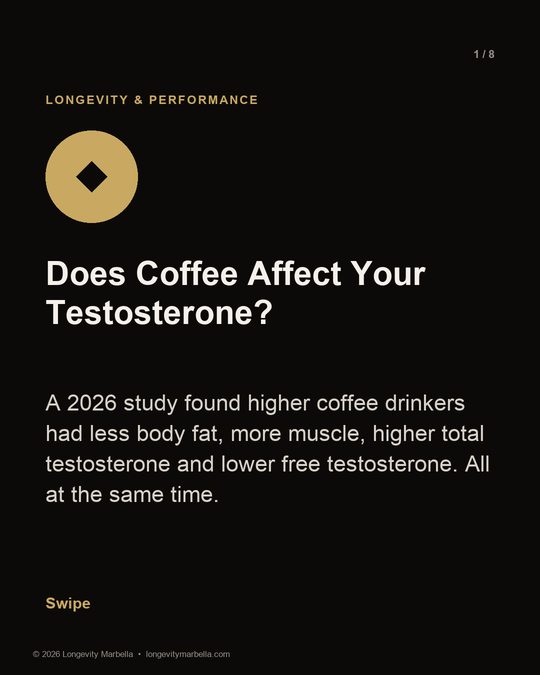
It is one of the most common questions we get, usually asked half seriously: is my coffee habit doing something to my hormones? A study published in the European Journal of Nutrition in 2026 gives the most detailed answer yet, and it is more interesting than either of the answers you will find online.
Not sure if this applies to you? One-minute check.
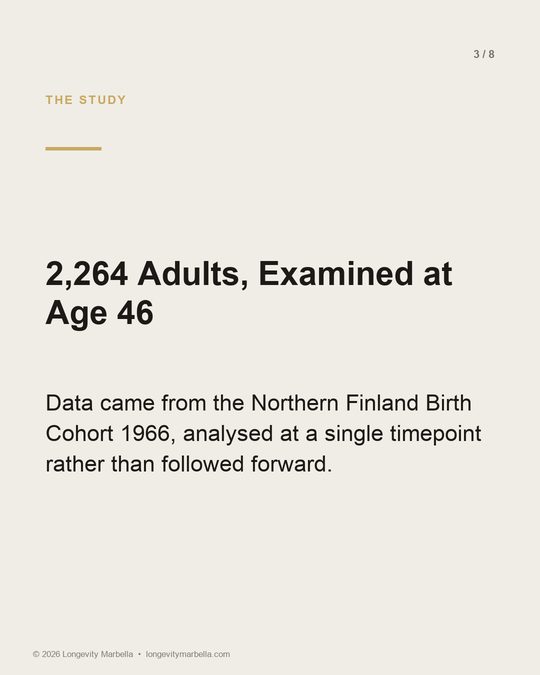
- This is observation, not an experiment: 2,264 adults from the Northern Finland Birth Cohort 1966.
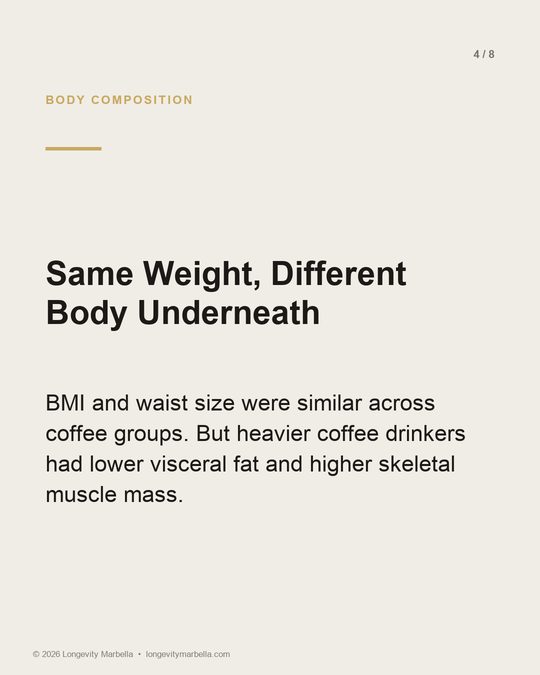
- Men drinking five or more cups a day had similar BMI and waist measurements, but less visceral fat and higher skeletal muscle mass.
- They had higher total and bioavailable testosterone, higher sex hormone binding globulin, and lower free testosterone. Redistribution, not a boost.
- This does not mean drinking more coffee will change your hormones, and there was no association between coffee intake and erectile dysfunction.
What was measured
Researchers analyzed 2,264 adults from the Northern Finland Birth Cohort 1966, all examined at age 46, 47 percent of them men. Finland is a useful place to study this because coffee intake there is high: of the participants, 1,076 drank five or more cups a day, 822 drank three to four, 296 drank one to two, and only 70 drank none at all.
Blood was taken fasting, hormones and metabolites were measured, and body composition was assessed. The analysis was adjusted for body mass index, education, smoking, physical activity and alcohol.
The body composition finding
This is the part that surprised us most. Across coffee groups, BMI, waist circumference and hip circumference were all similar. But the higher coffee drinkers had:
- Lower body fat percentage
- Lower absolute fat mass
- Lower visceral fat, the fat around the organs that carries the metabolic risk
- Higher skeletal muscle mass
Same weight on the scale, different body underneath it, with a dose-related trend. It is a neat illustration of why BMI is a poor instrument on its own, something we return to often in the clinic and wrote about in why muscle matters.
One honest caveat: body composition here was estimated by bioelectrical impedance, which is indirect and rests on assumptions. The authors flag this themselves.
Now the hormones, and the apparent contradiction
In men, after adjustment, higher coffee intake was associated with:
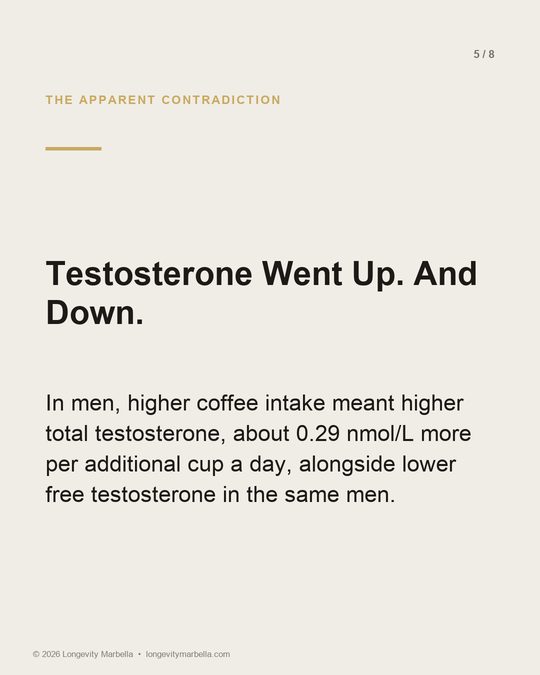
- Higher total testosterone, by about 0.29 nmol per liter for each additional cup per day
- Higher bioavailable testosterone
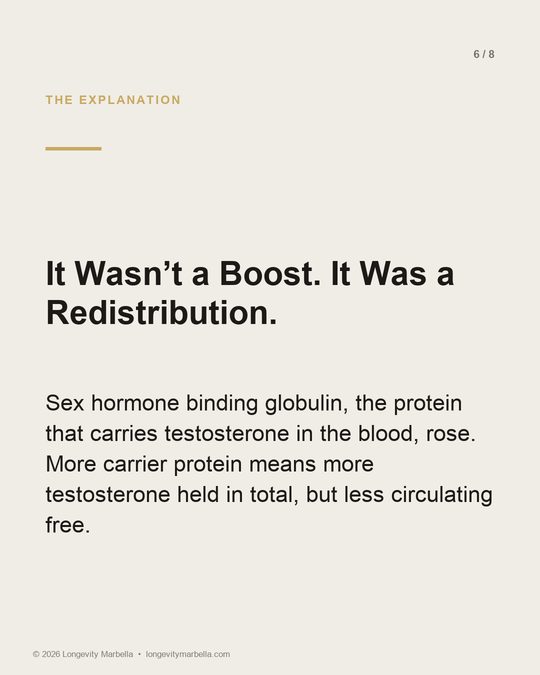
- Higher sex hormone binding globulin
- Lower free testosterone and a lower free androgen index
At first glance that reads as nonsense. Testosterone up and testosterone down in the same men.
It is not nonsense, and the explanation is the whole point of the article. Sex hormone binding globulin is the protein that carries testosterone around your bloodstream, and while testosterone is bound to it, it cannot enter a cell and do anything. Picture SHBG as cars and testosterone as passengers: a passenger in a car is carried, not working. When SHBG rises, more cars are on the road, so the total figure, everything in circulation, goes up. But a larger share rides bound inside the cars, so the unbound free portion, the passengers on foot, goes down.
Nothing contradictory happened. The hormone was redistributed, not simply raised or lowered. This is exactly why we do not read a testosterone result on its own, a point we set out in free testosterone versus total testosterone.
In women the pattern was narrower: higher SHBG, lower free testosterone and lower free androgen index, with no meaningful change in total testosterone. That is consistent with two large American cohorts, the Nurses' Health Study and the Women's Health Study, which both found coffee associated with higher SHBG and largely unchanged sex hormones.
What this does not mean
Here is where most articles about this study will go wrong, so we will be blunt.
This does not mean drinking more coffee will change your hormones. The authors state it plainly: their findings reflect population-level patterns rather than individually detectable clinical changes. Nobody was asked to change their coffee. This was a photograph of people at one moment, not an experiment.
It also cannot rule out the reverse explanation. Leaner, more active, healthier people may simply drink more coffee, rather than coffee making them leaner.
And the wider literature genuinely disagrees with itself. American NHANES analyses have found no linear relationship between caffeine and testosterone, with inconsistent patterns across subgroups, and more recent NHANES metabolite work found inverse associations between caffeine metabolites and testosterone in men. Anyone who tells you the science is settled here has not read it.
The reassuring part
If your worry was that coffee is quietly damaging something, the observational evidence does not support that.
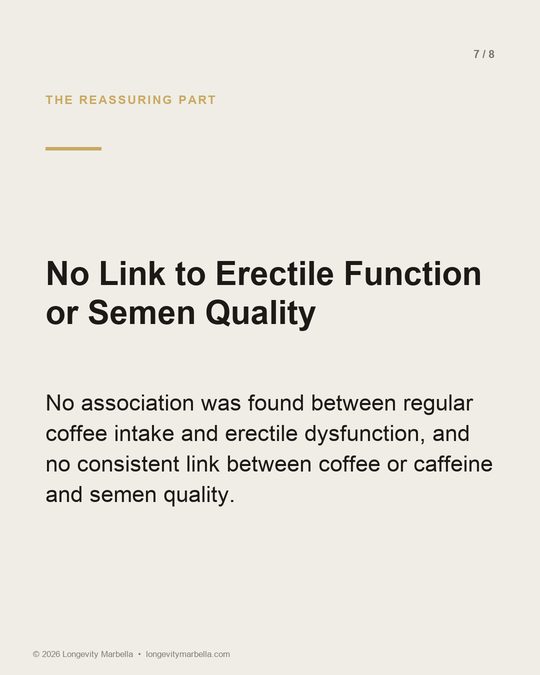
The Health Professionals Follow-up Study found no association between regular coffee intake and erectile dysfunction. A systematic review of 28 studies found no consistent link between coffee or caffeine and semen quality, with negative findings more often traced to soft drinks than to coffee.
In this study the only unfavorable signal was a small difference in systolic blood pressure, roughly 1.6 to 3.6 mmHg higher in the heaviest drinkers, measured after an overnight fast without coffee. Modest, and set against a broader literature in which habitual coffee drinking is associated with lower risk of type 2 diabetes, cardiovascular disease and all-cause mortality.
So what should you actually do
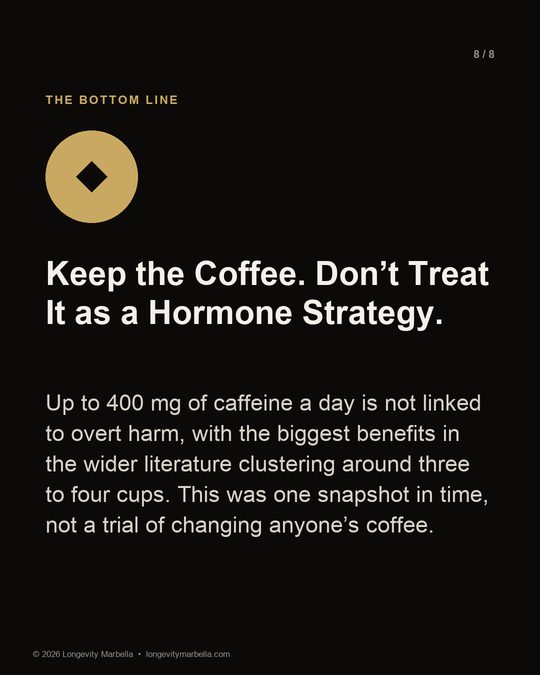
Keep drinking your coffee, and do not treat it as a hormone strategy.
For most adults, up to 400 mg of caffeine a day is not associated with overt adverse effects, and across many outcomes the largest benefits in the wider literature cluster around three to four cups. Two things genuinely worth knowing: unfiltered coffee, French press and similar, contains diterpenes that raise LDL cholesterol, and caffeine interacts with a number of medications. If you have an arrhythmia, uncontrolled blood pressure, or you are pregnant, this is a conversation for your own doctor rather than an article.
The useful lesson here is not about coffee at all. It is that a single testosterone number moves for reasons that have nothing to do with your testicles, and that reading it without SHBG alongside can point you in exactly the wrong direction. That is the case whether the thing shifting your SHBG is coffee, your thyroid, your liver, your weight or your age. It is also why a proper assessment measures more than one number, which we describe in what a proper men's health blood panel measures.
Does coffee raise or lower testosterone?
In this 2026 Finnish study of 2,264 adults, higher coffee intake was associated with higher total testosterone in men, around 0.29 nmol per liter per additional cup per day, and at the same time with lower free testosterone. Both moved because sex hormone binding globulin rose. The wider literature is inconsistent, with some large American datasets finding no clear relationship and others finding inverse associations. There is no basis for saying coffee reliably raises or lowers your testosterone.
Should I change how much coffee I drink to improve my hormones?
No. The authors state directly that their findings reflect population-level patterns rather than individually detectable clinical changes. This was a snapshot of people at one moment, not a trial of changing anyone's coffee, so it cannot tell you what would happen if you drank more or less. Coffee is not a hormone treatment and should not be used as one.
Why did total testosterone go up while free testosterone went down?
Because sex hormone binding globulin also rose. That protein carries testosterone around the bloodstream, and while testosterone is bound to it, it cannot act. More carrier protein means more testosterone is held in the total figure but less is circulating unbound. It is a redistribution rather than a straightforward increase or decrease, and it is a good illustration of why a single testosterone number is difficult to interpret without SHBG alongside it.
Does coffee affect erectile function or fertility?
The observational evidence does not suggest so. The Health Professionals Follow-up Study reported no association between regular coffee intake and erectile dysfunction, and a systematic review of 28 studies found no consistent link between coffee or caffeine and semen quality, with negative findings more often attributed to soft drinks than to coffee.
How much coffee is reasonable?
For most adults, intakes up to 400 mg of caffeine per day are not associated with overt adverse effects, and across many health outcomes the largest risk reductions in the wider literature tend to appear around three to four cups per day. Two caveats worth knowing: unfiltered coffee contains diterpenes that raise LDL cholesterol, and caffeine interacts with some medications. If you have a cardiac arrhythmia, uncontrolled blood pressure or are pregnant, coffee intake is a question for your own doctor.