

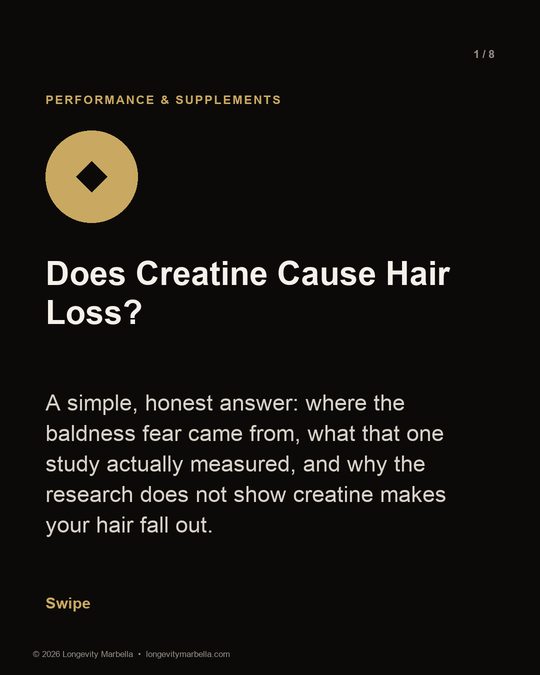
Is creatine going to make you go bald? For a healthy person, the honest answer is that there is no good evidence it does. That is what the research says, and it is worth hearing before you tip your tub of creatine in the bin.

- There is no good evidence that creatine causes hair loss in healthy adults.
- The fear comes from one 2009 study that found a rise in DHT, but it never measured hair loss and has never been replicated.
- Across the wider research, no study reports creatine causing hair loss or baldness in people.
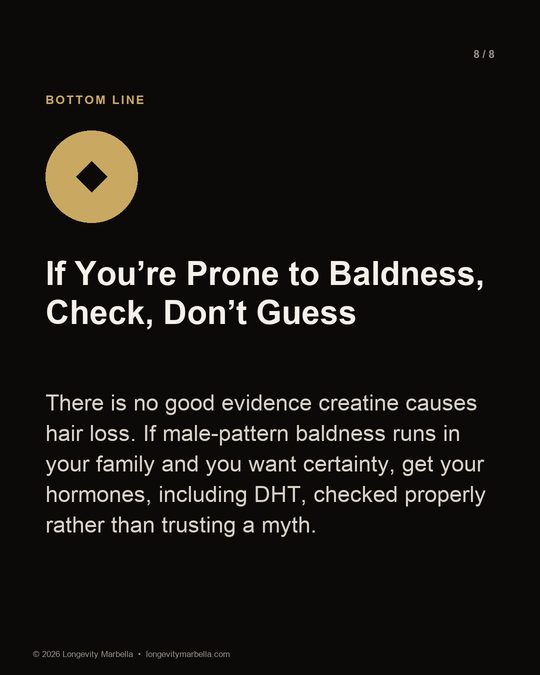
- If you are genetically prone to baldness and want certainty, get your hormones checked properly rather than trusting a myth.
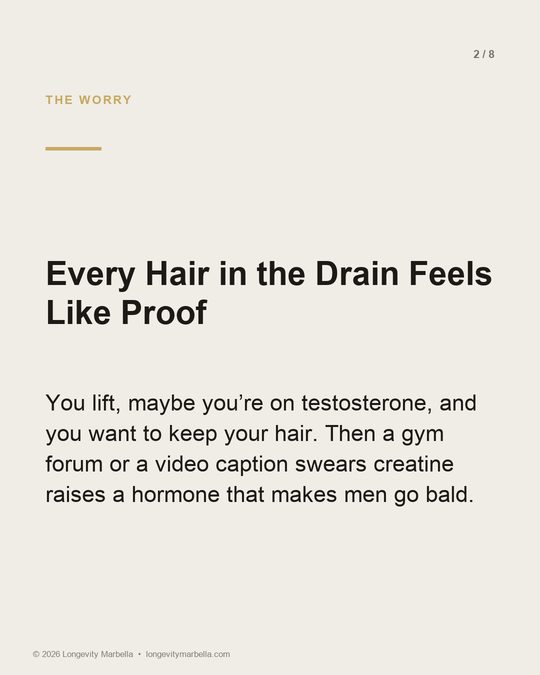
Here is the fear, said plainly. You lift, maybe you are on testosterone, and you want to keep your hair. Then you read a gym forum or a video caption swearing that creatine raises a hormone that makes men go bald. Now every hair in the shower drain feels like proof. That worry is understandable.
But when you follow the claim back to where it actually started, it gets a lot smaller. Let's walk through where the fear came from, what that one study really found, and if you are genetically prone to baldness and want certainty, how to get your hormones looked at properly.
The quick version
- There is no good evidence that creatine causes hair loss in healthy adults.
- The entire fear traces to one 2009 study in rugby players that found a rise in DHT, a hormone linked to some cases of male-pattern baldness.
- That study never measured or showed actual hair loss, and it has not been replicated.
- Across the large body of creatine research, no study reports that creatine causes hair loss or baldness in people.
- If you are genetically prone to male-pattern baldness and want certainty, a doctor can measure your hormones, including DHT, and look at the full picture.
Where did the hair-loss fear come from?
Short answer: almost all of it comes from one single study, not from a pile of evidence.
The vast majority of the speculation linking creatine to hair loss stems from one study by van der Merwe and colleagues, published in 2009. In it, college-aged male rugby players took creatine (25 grams a day for 7 days, then 5 grams a day for another 14 days) and their blood levels of a hormone called dihydrotestosterone, usually shortened to DHT, went up over that time.
DHT is a hormone that, in men who are genetically susceptible, has been linked to some (but not all) cases of male-pattern baldness. So once one study showed creatine nudging DHT upward, the leap to "creatine causes baldness" was easy to make, and the idea spread. The problem is that a leap is exactly what it was.
What did that one study actually find?
Short answer: it measured a hormone going up, not hair falling out, and the numbers were smaller and more fragile than they sound.
It is worth looking at what the study genuinely reported, because the headline and the detail are not the same thing.
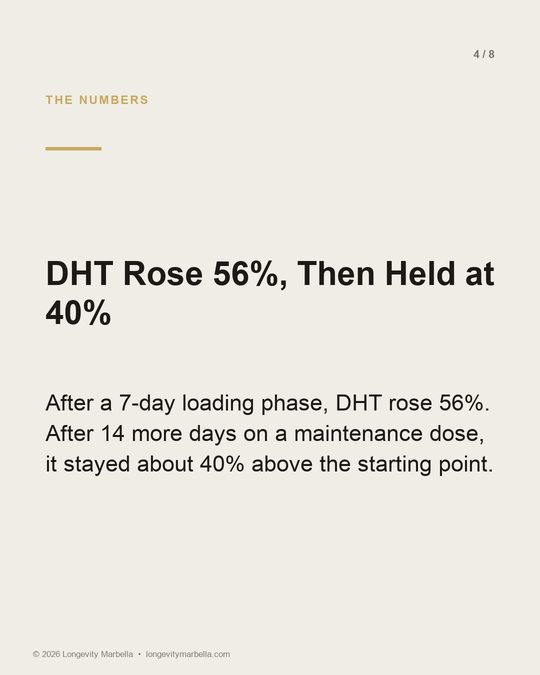
- DHT rose by 56% after the 7-day loading phase and stayed about 40% above the starting point after the 14-day maintenance phase. That sounds dramatic.
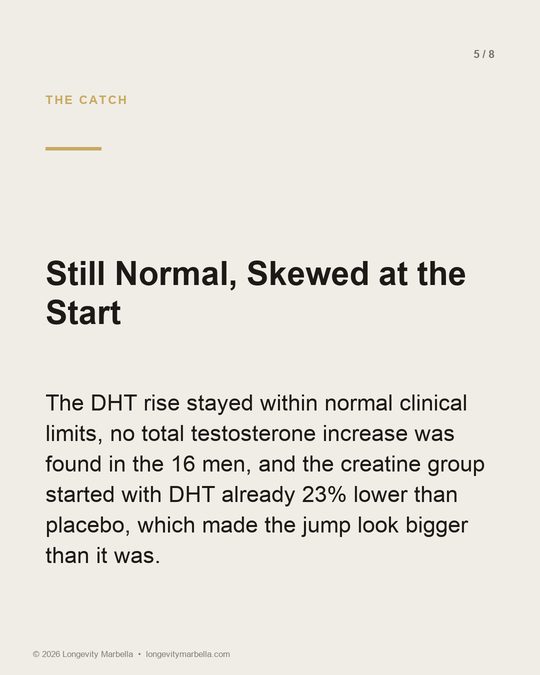
- But the increase in DHT, and the ratio of DHT to testosterone, stayed well within normal clinical limits. Nobody's hormones went out of the normal range.
- There was no rise in total testosterone in the 16 men who finished the study, and free testosterone was not even measured.
- Part of the "statistically significant" jump was a quirk of the groups: the creatine group happened to start with DHT about 23% lower than the placebo group, so a small rise in one group and a small dip in the other made the difference look bigger than it was.
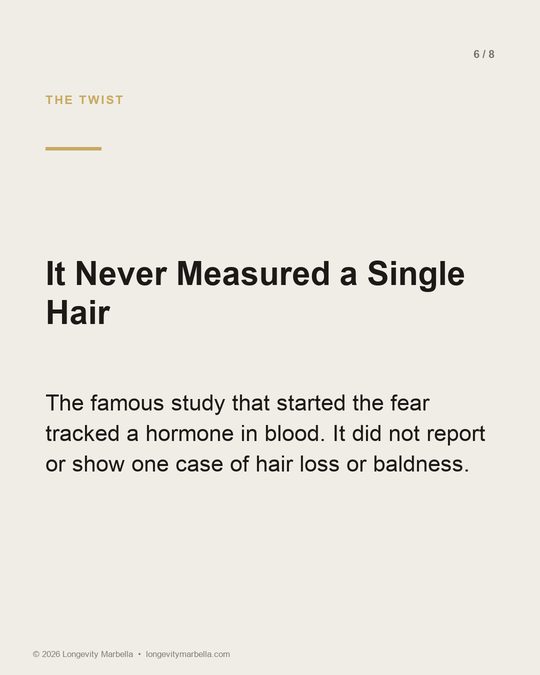
- Most importantly, the study did not measure hair. It did not report or show a single case of hair loss or baldness.
So the famous "creatine causes hair loss" study never actually observed anyone losing their hair. It observed a modest, still-normal shift in a hormone, in one small group of young athletes.
Worried about hair, hormones, or DHT while on testosterone? You do not have to guess. We can get your hormones checked properly and read them with you.
Message us on WhatsAppDoes creatine actually cause hair loss?
Short answer: based on the current evidence, no. No study has shown that creatine causes hair loss or baldness in people.
Two things matter here. First, that 2009 DHT result has never been replicated. When a single small finding stands alone and no other team has reproduced it, that is a signal to be cautious, not to panic. It is also worth noting that intense resistance training on its own can raise these androgenic hormones, so the rugby players' hard training may have played a part.
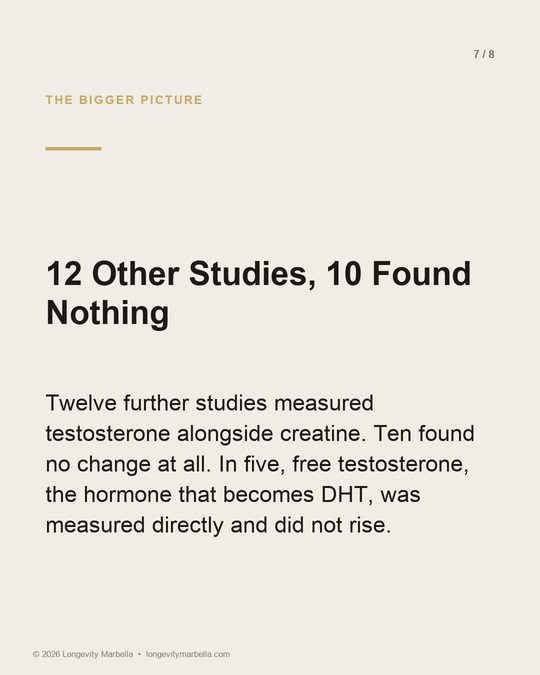
Second, and more to the point, a whole body of research has looked at creatine and these hormones. Twelve other studies have measured testosterone alongside creatine supplementation. Ten found no change at all. The two that found any increase found small ones with no real physiological meaning. In five of those studies, free testosterone, the raw material the body's production line turns into DHT, was measured directly and did not go up: no extra raw material, nothing extra to make DHT.
Put together, the current body of evidence does not indicate that creatine increases total testosterone, free testosterone, DHT, or causes hair loss or baldness. The fear rests on one study of a hormone, not of hair, that nobody has been able to repeat.
Should you worry if you are prone to baldness?
Short answer: if you already carry the genetics for male-pattern baldness and you want certainty, that is a fair thing to check, and it is easy to check properly.
Being honest cuts both ways. The evidence does not support the myth, but it also cannot promise you a specific personal outcome, and DHT genuinely is one of the hormones involved in male-pattern baldness for men who are susceptible. If hair loss runs in your family and it matters to you, you do not have to settle the question with a forum thread.
The sensible move is to get your hormones looked at properly, especially if you are on or considering testosterone therapy, where hormones like DHT are already part of the conversation. A doctor can measure the relevant markers, put them next to your history and your goals, and tell you where you actually stand. That way any decision about creatine, or about your hair, is based on your real numbers rather than a myth.
If hair loss runs in your family, or you want your hormones optimized safely, our specialist can measure DHT and the full picture, then talk it through with you.
Message us on WhatsApp