


If you think creatine is just something bodybuilders scoop into a shaker, you are in good company, and you are also missing most of the story. It is one of the most studied supplements in the world, and the research reaches well beyond the gym.
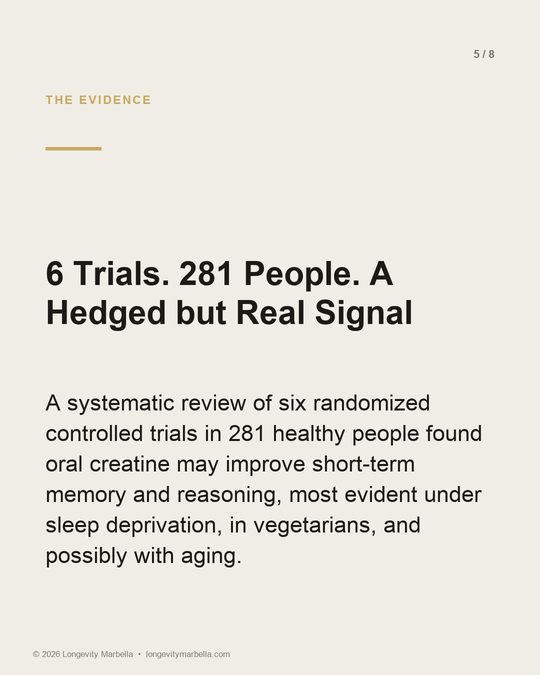
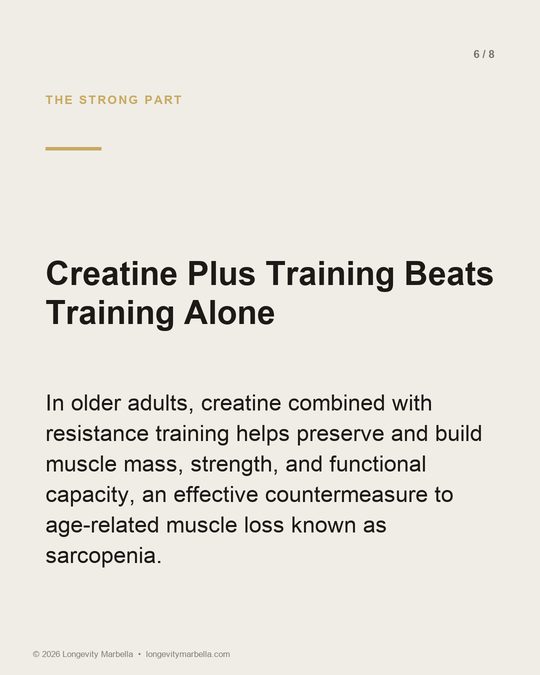
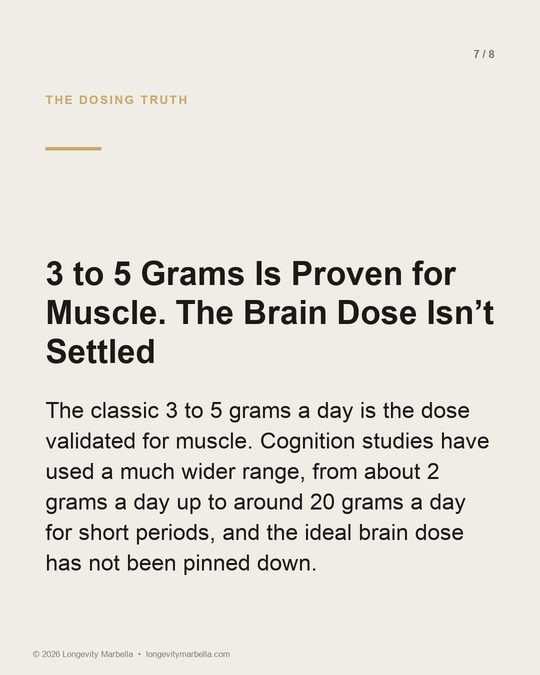
- Creatine is about cellular energy, not just muscle. Your brain uses it too.
- It may support thinking and reduce mental fatigue, with the clearest signal under stress like sleep loss. This evidence is promising but still preliminary.
- The strongest finding: creatine plus resistance training helps older adults preserve muscle and strength, countering sarcopenia.
- It works best as part of a real plan, not as a substitute for training and good nutrition.
Yes, creatine is famous for helping with training. But the same molecule plays a quiet role in how your cells make energy, including in your brain. That has drawn serious interest in what it might mean for thinking, for aging well, and for keeping the muscle that protects your independence later in life.
Here is the honest version, with the strong evidence and the still-forming evidence clearly separated, so you can decide whether creatine belongs in your own longevity plan.
The quick version
- Creatine is not just for muscle. Your brain stores some too, where it helps supply cellular energy.
- It may support thinking, memory, and mental fatigue, and the signal looks clearest under stress such as sleep deprivation. This part is promising but still preliminary.
- For older adults, creatine combined with resistance training helps preserve muscle mass and strength, a real countermeasure to age-related muscle loss.
- The evidence is strongest for muscle plus training. Cognition is the more early-stage story.
- The brain dose may differ from, and be higher than, the classic muscle dose. The 3 to 5 grams a day used for muscle is not necessarily the amount studied for cognition.
- Think of creatine as one tool in a healthy-aging toolkit, not a shortcut. It works best inside a proper plan.
Is creatine only for building muscle?
Short answer: no. Muscle is where most of it lives and where the effects are best proven, but creatine is really about cellular energy, and that matters far beyond the gym.
About 95 percent of your body's creatine is stored in muscle, with a small amount in tissues like the brain. Its main job is to help recycle the energy your cells burn, through the creatine kinase and phosphocreatine system. Phosphocreatine is the reserve fuel can beside the engine; creatine kinase is the enzyme that pours and refills it. When a cell needs a fast top-up of energy, this system delivers it.
That is why creatine helps with short, intense effort in training. But it is also why researchers started asking a different question: if creatine helps supply energy to cells, what does it do in an organ as energy-hungry as the brain?
Can creatine help the brain?
Short answer: possibly. Creatine can raise the brain's energy reserve, and some studies report better thinking, especially when you are stressed or short on sleep. Just keep expectations honest, this is the more preliminary side of the science.
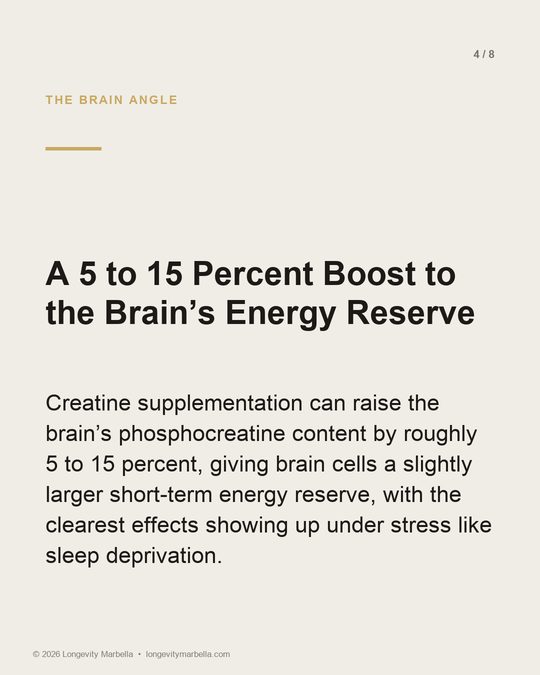
Reviews of the research report that creatine supplementation can increase the brain's phosphocreatine content by roughly 5 to 15 percent. In plain terms, that means a slightly larger short-term energy reserve for brain cells to draw on.
What does that translate to in real life? The findings are encouraging but mixed:
- Some studies report improvements in working memory and processing speed.
- Creatine has been reported to reduce mental fatigue during demanding mental tasks, such as repeated calculations.
- The clearest signal appears under stress. In studies of sleep-deprived participants, creatine helped people hold on to aspects of performance, reaction, and mood that would otherwise slip.
The reviewers are careful, and so are we. They note that more research is needed, that brain uptake of creatine is slow and limited, and that not every study shows a benefit. Their honest conclusion is that creatine may increase brain creatine content and support cognitive function, particularly as one ages. That is a reasonable, hedged position, not a promise that creatine sharpens everyone's mind.
A systematic review of six randomized controlled trials in 281 healthy people reached a similar view. It concluded that oral creatine may improve short-term memory and intelligence or reasoning, while its effect on other cognitive domains stays unclear, and that the benefit looks more evident under stress such as sleep deprivation, in vegetarians, and possibly with aging (Avgerinos and colleagues, 2018, doi:10.1016/j.exger.2018.04.013). The authors are clear that more well-designed studies are still needed.
How much creatine for the brain?
Short answer: the classic 3 to 5 grams a day is really the dose proven for muscle. Cognition studies have used a wider and often higher range, up to about 20 grams a day for short periods, and the best dose for the brain is not settled yet.
The familiar 3 to 5 grams a day is the maintenance dose validated for saturating muscle. When researchers have tested creatine for thinking, they have used a much wider range. In the same systematic review of six randomized controlled trials, daily doses ran from about 0.03 grams per kilogram a day, which is roughly 2 grams for a 70 kilogram adult, and 5 grams a day, up to 8 and even 20 grams a day. Two of the six trials used around 20 grams a day, a loading-level amount, and usually only for a few days to two weeks.
A few concrete examples from that review help make the point. One study used about 20 grams a day in sleep-deprived participants. Another used 8 grams a day for 5 days and reported less mental fatigue. A third used 5 grams a day for 6 weeks and found better reasoning and memory. A study in vegetarians used 20 grams a day for 5 days and saw improved word recall. And a study using 0.03 grams per kilogram a day for 6 weeks found no reaction-time effect. Importantly, the higher doses, up to about 20 grams a day short term, were still well tolerated.
So the honest read is this. The 3 to 5 grams a day figure is the amount proven for muscle, while the ideal dose for brain effects has not been pinned down, and the clearest cognitive benefits have shown up under stress such as sleep deprivation, in vegetarians, and possibly with aging. That is not a reason to reach for a megadose on your own. The right amount is individual, and a doctor can help you match it to your goals and your health picture rather than guessing from a forum.
Building a real longevity and muscle-preservation plan? We help you do it properly, with the right tests and a strategy that fits you, not guesswork from the internet.
Message us on WhatsAppCreatine and healthy aging: the muscle story
Short answer: this is the strong part. In older adults, creatine combined with resistance training helps preserve and build muscle, and muscle is one of the best things you can protect for a long, capable life.
As we age, we tend to lose muscle mass, strength, and balance while gaining body fat. When that loss becomes significant, it has a name: sarcopenia, an age-related decline in muscle quantity, strength, and function. It is one of the quiet forces behind frailty, falls, and lost independence in later years.
This is where creatine earns its place. Multiple studies and pooled analyses have found that when older adults do resistance training and add creatine, they gain more muscle mass, more strength, and better functional capacity than training alone. The pattern shows up across different groups, including older men and postmenopausal women.
The key phrase, and the honest one, is combined with resistance training. Creatine is not a muscle pill you take instead of lifting. It is a helper that lets the training do more. Reviewers describe creatine, when paired with resistance exercise, as an effective countermeasure to help attenuate sarcopenia. For a longevity-minded adult, that is a meaningful, well-supported benefit.
Does it work without exercise?
Short answer: some benefit has been seen without training, but for muscle in older adults the evidence is far stronger when creatine is paired with resistance exercise. It is a multiplier, not a replacement.
A few studies suggest creatine alone can help muscle to a degree, and the brain and general-health effects do not depend on the gym. But when the goal is protecting muscle as you age, the preponderance of the research points the same way: training plus creatine beats creatine on its own.
That is actually good news, because it fits how healthy aging really works. The foundation is resistance training, protein, sleep, and sensible cardiovascular fitness. Creatine sits on top of that foundation and helps it pay off. Reviews even note that roughly 3 grams a day has been discussed to support general health across the lifespan, particularly as one ages, though amounts and suitability are individual.
So the practical takeaway is simple. Do not swap the work for a supplement. Build the plan first, then let creatine support it. That is exactly the kind of thing worth getting right with a doctor rather than from a forum.
Want a healthy-aging strategy that actually fits your body and your bloodwork? Our specialist can build it with you, tests and all, and tell you honestly what belongs in it.
Message us on WhatsApp