


Nothing about low testosterone announces itself. There is no pain, no acute event, no moment a man can point to on a calendar. What there is instead is a slow subtraction: slightly less muscle each year, slightly more fat around the middle, bone thinning silently, and a tiredness that a full night of sleep no longer repairs. Two large trials give us an unusually clear view of what is being subtracted, and it is worth looking at properly.
Not sure if this applies to you? One-minute check.
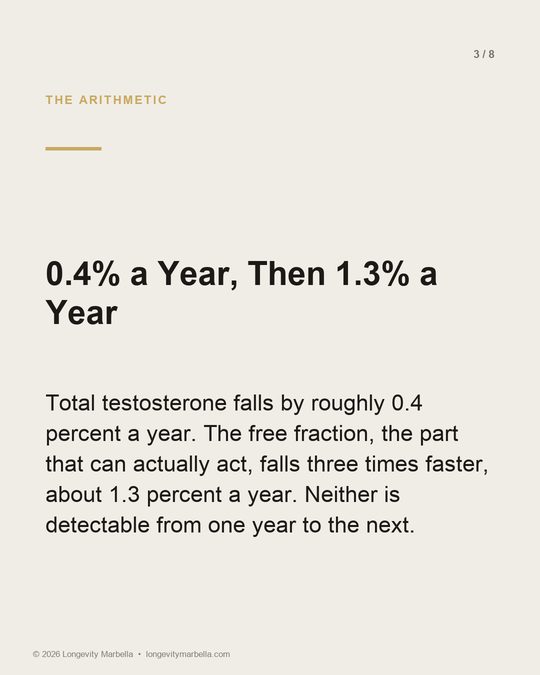
- Total testosterone declines by roughly 0.4 percent per year. The free fraction falls about 1.3 percent per year, three times faster, and neither is detectable year to year.
- In 1,007 men on the same lifestyle program, testosterone gained 0.4 kg of muscle and lost 4.6 kg of fat while placebo lost 1.3 kg of muscle.
- The risk of developing type 2 diabetes fell by around 40 percent.
- The Testosterone Trials, 788 men aged 65 and over, reported improvements in sexual function, anemia and bone mineral density.
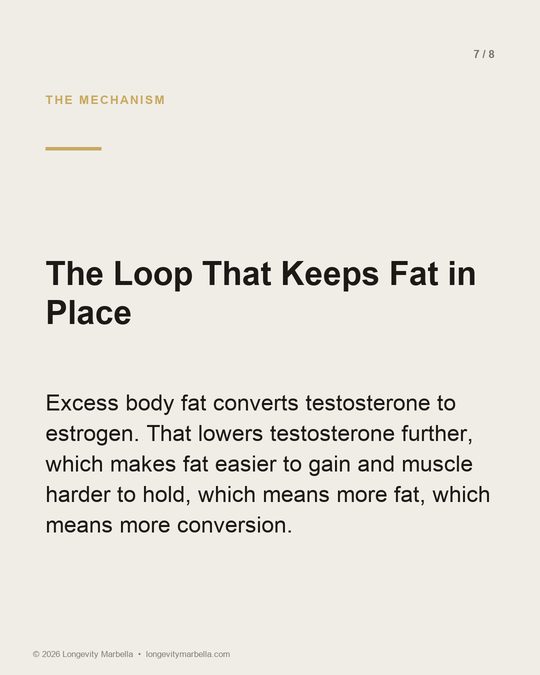
- Excess body fat converts testosterone to estrogen, which is how the subtraction compounds.
The Arithmetic Is Slow, Which Is Exactly Why It Works
Total testosterone declines by roughly 0.4 percent per year. Most of it travels locked to carrier proteins, like factory stock sealed in crates. The free fraction, the small unbound portion that can actually enter a cell and act, declines by roughly 1.3 percent per year, more than three times faster.
Neither figure is detectable from one year to the next. Nobody notices a 0.4 percent change in anything. That is the entire problem. A decline that would be alarming if it arrived in a single week is invisible when it arrives across two decades, and the man living through it adjusts his expectations downward as he goes. He does not think he has lost strength. He thinks he has got older, which he has, and he assumes the two are the same thing, which they are not entirely.
Muscle, and What the T4DM Trial Actually Measured
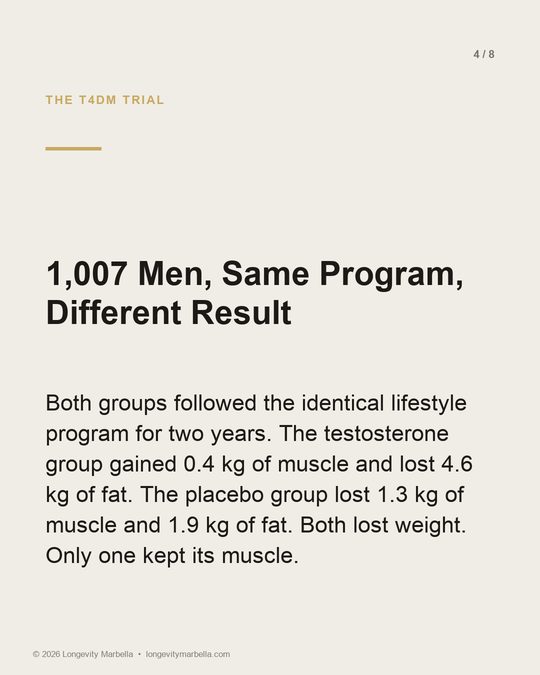
The T4DM trial enrolled 1,007 men aged 50 to 74, all carrying excess weight around the middle, all at high metabolic risk. Both groups, treatment and placebo, were placed on the same lifestyle program and followed for two years.
That design is what makes the trial worth your attention. The comparison is not treatment against nothing. It is treatment plus lifestyle against lifestyle alone, which is a far harder test to pass and a far more honest one.
Over the two years, the testosterone group gained an average of 0.4 kg of muscle and lost 4.6 kg of fat. The placebo group, on the identical program, lost 1.3 kg of muscle and lost 1.9 kg of fat.
Read those two lines side by side and the important detail is not the weight. It is the composition. Both groups lost weight. Only one of them kept its muscle while doing it. A bathroom scale would have reported that both men were succeeding, and the scale would have been concealing the most consequential thing that happened. We have written separately about why that distinction matters so much as men age, in testosterone, muscle and fat in older men.
In the same trial, two years of treatment was associated with around a 40 percent lower risk of developing type 2 diabetes beyond what the lifestyle program achieved on its own, in men who were already at high metabolic risk.
Now the limits, because they are as important as the numbers. These men were specifically selected: aged 50 to 74, carrying excess weight around the middle, at high metabolic risk. The finding describes that population. It says nothing reliable about a lean forty-five-year-old with a normal waist and clean metabolic markers. And two years is a respectable trial length, not a lifetime.
Bone, Blood and Sexual Function
The Testosterone Trials studied 788 men aged 65 and over and reported improvements in three domains: sexual function, anemia and bone mineral density.
Anemia means too few healthy red blood cells to carry oxygen efficiently around the body. It is worth naming plainly because it is one of the genuine mechanical reasons a man can sleep eight hours and still feel emptied out by two in the afternoon. Fatigue that rest does not fix is a symptom that deserves investigation rather than tolerance, and low red cell production is one of several things that can sit underneath it.
Bone is the quietest loss of all. Bone density produces no symptom at any stage. There is no ache that warns you, no stiffness that signals it. The first clinical sign is very often a fracture, and a hip fracture in an older man is a serious event with consequences that reach well beyond the bone itself.
Here is the honest qualifier on that finding, and it should be stated rather than buried. The trial reported an improvement in bone mineral density, which is a measurement of the bone, not a count of fractures prevented. Density is a reasonable proxy and it is not the same thing as broken hips avoided. Anyone who converts a density result directly into a promise about fractures has gone further than the data allows.
It is also worth saying what is not on that list. The three domains above are what we can quote. Energy, mood and concentration sit outside what these trials measured, so those are questions your own assessment answers.
Fat Around the Middle, and the Loop That Keeps It There
This is where the whole thing turns from a straight line into a circle.
Excess body fat converts testosterone to estrogen. That conversion lowers testosterone further. Lower testosterone in turn makes fat easier to gain and muscle harder to hold. More fat then means more conversion, which means less testosterone, which means more fat.
It is a loop, and loops do not resolve themselves by being ignored.
Fat around the middle is not simply stored energy sitting inertly under the skin. It is metabolically active tissue that participates in the hormonal system rather than merely reflecting it. That is why the distribution of weight matters clinically in a way that the total on the scale does not.
Why "Just Lose the Weight" Is Real Advice and Also Harder Than It Sounds
Losing excess fat is genuine advice, not a brush-off. It addresses the loop at its most modifiable point and it should be said clearly rather than apologetically.
But it should also be said with some understanding of what is being asked. A man inside that loop is being told to do a difficult thing with a headwind behind the wrong shoulder. Look at T4DM once more: identical program, both arms, same two years, and the placebo group still lost 1.3 kg of muscle while it was losing fat. Losing weight without shedding muscle is difficult for anybody. It is harder still when the hormonal environment quietly favors fat storage over muscle maintenance.
This is not an argument for reaching for treatment. It is an argument against contempt for men who have already tried and found the results did not match the effort.
Mood, Drive and Concentration, Stated Honestly
Men describe a flatness. A loss of drive that is difficult to articulate to anyone. Concentration that no longer holds through an afternoon. These are among the most common reasons men seek an assessment in the first place, and they are entirely real to the men living with them.
They are also among the least specific symptoms in all of medicine, so no trial figure can honestly be attached to them. What can be quoted from the Testosterone Trials is sexual function, anemia and bone mineral density. That list is the evidence. Everything past it is clinical impression, and clinical impression should be labeled as clinical impression rather than dressed up as a result.
The Point That Matters Most, and It Is Not Treatment
A low testosterone result is sometimes the first visible sign of something else entirely.
Thyroid disease can present that way. So can a problem in the pituitary gland, the small structure at the base of the brain that issues the signal telling the testicles to work at all. So can iron abnormalities, obstructive sleep apnea, and poorly controlled blood sugar. Each of those is a distinct condition with its own consequences and its own management, and each can announce itself through a testosterone figure before it announces itself any other way.
Which leads to the only real conclusion here. The reason to have a low result assessed properly is not that treatment is waiting at the end of it. It is that a number treated as a lifestyle complaint, or treated as a hormone problem without anyone asking why the hormone is low, is a number that can hide a diagnosis for years.
What to Take From This
What the trials observed is worth knowing: in selected higher-risk men, muscle held rather than lost, fat down substantially, and lower progression to type 2 diabetes in T4DM; sexual function, anemia and bone density improved in men over 65 in the Testosterone Trials. Those are observations from defined populations under trial conditions, not a description of what will happen to any individual reader.
What is quietly lost when the question goes unasked is also worth knowing: muscle and strength, bone density accumulating silently over years, red cell production and the fatigue that sleep does not repair, fat settling around the middle, and a general dimming that is easy to attribute to age and stop investigating.
Our specialist, double board-certified in Internal Medicine and Endocrinology, assesses the whole picture rather than a single figure, by private video consultation or in person across the Costa del Sol. The purpose of that assessment is to find out what is actually going on. What follows from it is a separate conversation, and it is one that should only ever come second.
If I lose weight, will my testosterone come back up?
It can move in the right direction, because excess body fat converts testosterone to estrogen and that conversion lowers testosterone further. Reducing fat mass addresses the loop at its most modifiable point. What we cannot tell you is by how much in your particular case, because that depends on why your testosterone is low in the first place. If the cause is a thyroid problem, a pituitary problem, iron, sleep apnea or poorly controlled blood sugar, weight loss alone will not settle it, which is why the cause needs establishing rather than assuming.
Does low testosterone affect my bones?
Bone is one of the tissues involved. The Testosterone Trials, in 788 men aged 65 and over, reported improvement in bone mineral density alongside improvements in sexual function and anemia. The honest qualifier is that bone mineral density is a measurement of the bone rather than a count of fractures prevented, so it is a reasonable proxy and not a promise. What makes bone worth raising at all is that its loss is completely silent. There is no symptom until something breaks.
I sleep eight hours and I am still exhausted. Is that my testosterone?
It might be, and it might well be something else. Anemia, meaning too few healthy red blood cells to carry oxygen efficiently, is one mechanical explanation for fatigue that rest does not fix, and it improved in the Testosterone Trials. But obstructive sleep apnea, thyroid disease, iron problems and poorly controlled blood sugar all produce the same complaint, and all of them can also lower testosterone. Fatigue is the least specific symptom you can present with, which is precisely why it should not be attributed to one hormone without the others being excluded.
Does this mean I should start testosterone therapy?
Not by itself: the trials describe defined populations, and what applies to you comes out of your own assessment. What is described here is what two trials observed in defined populations: T4DM in 1,007 men aged 50 to 74 with excess weight around the middle and high metabolic risk, and the Testosterone Trials in 788 men aged 65 and over. Whether any of that applies to you depends on what your assessment shows, what your symptoms are, and above all why your level is low. That is a decision made after a proper workup, with a doctor, and never on the strength of an article.
What else should be checked if my testosterone comes back low?
A low result is sometimes the first visible sign of something else. Thyroid function, pituitary function, iron status, obstructive sleep apnea and blood sugar control all belong in the assessment, because each can lower testosterone and each is a separate condition needing its own management. Treating the testosterone figure without asking why it is low risks leaving the actual diagnosis in place and unnoticed.
This article is for general information only and is not medical advice. Individual dietary and medical decisions should be discussed with a qualified doctor.
Reference. Wittert G et al. "Testosterone treatment to prevent or revert type 2 diabetes in men enrolled in a lifestyle programme (T4DM)." Lancet Diabetes and Endocrinology 2021;9:32-45 (doi:10.1016/S2213-8587(20)30367-3). Snyder PJ et al. "Effects of Testosterone Treatment in Older Men." New England Journal of Medicine 2016;374:611-624 (doi:10.1056/NEJMoa1506119).
One number is rarely the whole answer
If your hormone results have been read to you as a single figure, our specialist can interpret the full picture alongside your symptoms, on a private video call or a concierge home visit across the Costa del Sol.
A letter from the doctor. A few times a year, when the evidence genuinely changes, I write it down and send it. No schedule, no noise, and you can leave the list whenever you like.