


Give a healthy man a single dose of testosterone and he stops being generous for an audience. That is the result of a double-blind, placebo-controlled experiment in 192 men, and one of the strangest and most carefully built studies in the hormone literature. It is also, for reasons we will be precise about, not a study about character.
Not sure if this applies to you? One-minute check.
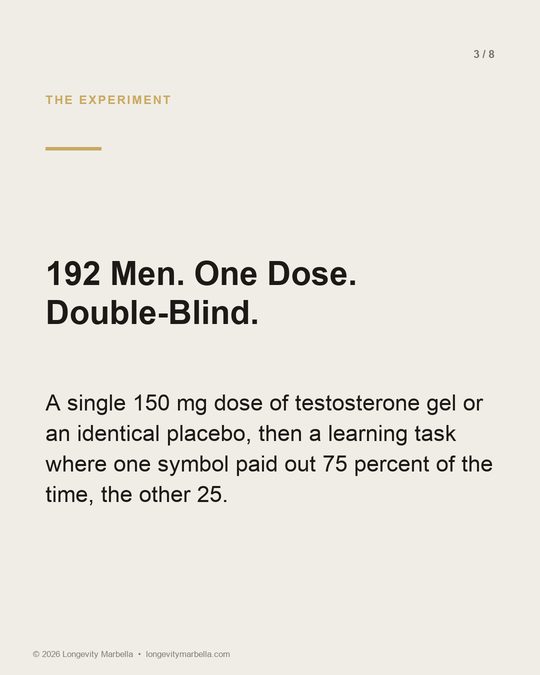
- A double-blind, placebo-controlled experiment: a single 150 mg dose of testosterone gel, 190 men analyzed, playing a learning task where one symbol paid out 75 percent of the time and the other 25.
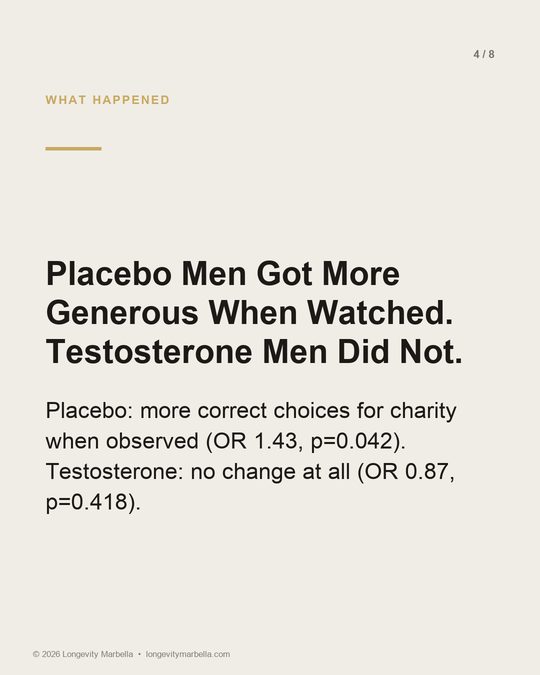
- Placebo men showed the classic audience effect, more generous choices for others when someone watched. Testosterone men showed none of it.
- Choices for themselves were untouched, and computational modeling showed learning itself was untouched.
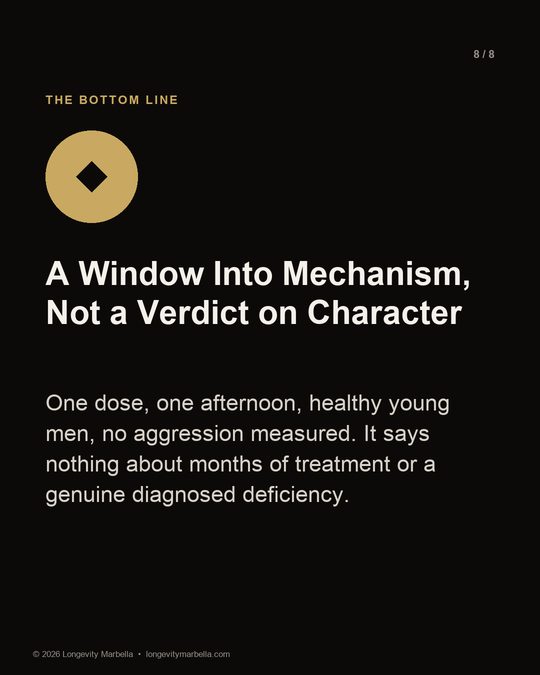
- One dose, one task, healthy young men. A window into mechanism, not a personality verdict.
The Behavior Nobody Admits To
People are measurably more generous when someone is watching. Researchers call it the audience effect, or strategic prosociality, and it has been shown in blood donations, church offerings and charitable donations. Evolutionarily it makes sense: visible generosity advertises your value as a partner or a group member.
Where testosterone fits into that had two competing predictions. Under the social dominance hypothesis the hormone reduces submission to what others expect of you, so it should shrink the audience effect. Under the rival account, in which testosterone drives status-seeking through reputation, it should increase socially desirable behavior when someone is watching. This study, published in Neuropsychopharmacology in 2023, was the first built to tell the two apart.
How the Experiment Was Built
192 healthy men aged 18 to 40, mean age 24.89 years with a standard deviation of 4.08. Exclusions were strict: neurological or psychiatric disorder, endocrine or other internal disease, substance dependence, steroid use, or a body mass index outside 18.5 to 24.9.
Each man was randomly assigned, double-blind, to a single dose of testosterone gel containing 150 mg of testosterone or to an identical placebo gel whose only difference was that it contained none. The gel went onto the upper arms and shoulders, then came a two-hour wait, and the task began 1 hour and 50 minutes after application, timed to published pharmacokinetic work on gel preparations.
Two participants were excluded for pressing the same key regardless of what appeared on screen, leaving 190 men analyzed. No side effects or adverse events were reported, and the manipulation worked: salivary testosterone was higher in the treated group 110 minutes after the gel and stayed higher to the end.
The Task, and the Audience
The men played a probabilistic reinforcement learning task. On each trial two abstract symbols appeared, one paying out 75 percent of the time and the other 25 percent, and nobody was told which. You find out by trying, which is what reinforcement learning means: learning an option's value from its outcomes.
Six blocks of 16 trials: three earning money for the participant himself, marked YOU on screen, three for a non-governmental organization, marked NGO, chosen at the end from six charities. The points became real money.
In the private condition men were told their performance was completely anonymous and that nobody, the experimenter included, would know what they earned. In the observed condition two female observers, introduced as NGO association representatives, entered and watched, a red frame appeared around the screen, and each display was transmitted to their laptop.
The check worked. Observed men reported feeling watched far more than private ones, and testosterone did not change how watched they felt, p = 0.997.
What Happened
The central result is a three-way interaction, meaning whether the drug changed anything depended on visibility and on who the money was for, both at once, predicting correct choices: odds ratio 0.94, interval 0.89 to 1.00, p = 0.043. Broken apart, the pattern is clean.
- Placebo men showed the classic audience effect. They made relatively more correct choices for the charity when watched than in private: odds ratio 1.43, interval 1.01 to 2.02, p = 0.042.
- Testosterone men showed none of it. Odds ratio 0.87, interval 0.62 to 1.22, p = 0.418. The audience made no difference to them at all.
- Compared directly under observation, testosterone reduced correct choices made for the charity: odds ratio 0.69, interval 0.50 to 0.94, p = 0.019.
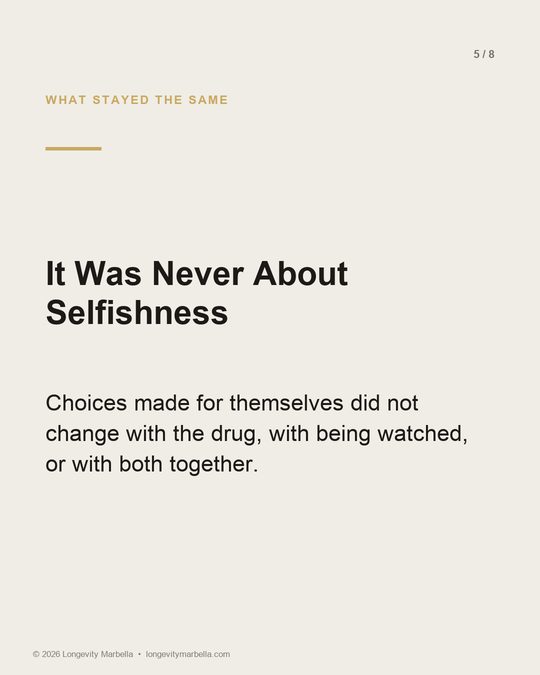
- Choices for themselves were untouched. Not by drug, odds ratio 0.98. Not by visibility, 1.00. Not by the two together, 0.88, with every interval crossing 1.00.
That last line matters most. The men on testosterone were not worse at the game. They earned for themselves as well as anyone. What vanished was the specific lift in performance for someone else that appears when other people are in the room.
Now the honesty. The two central effects sit just inside conventional significance, at p = 0.043 and p = 0.042, and their confidence intervals reach 1.00 and 1.01. The design is properly randomized and adequately powered, but this is a signal to build on rather than a settled fact.
The Interesting Part: Which Mental Step Changed
Then the authors did something most pharmacology studies never attempt. Rather than stopping at the behavior, they fitted a computational model that takes the decision apart, combining reinforcement learning with a drift diffusion model of how evidence builds until a choice is triggered. Picture a driver learning a route and then steering it. Five parameters:
- The learning rate for positive prediction error, how much you redraw the route when the outcome beats expectation. A prediction error is the gap between what you expected and what you got.
- The learning rate for negative prediction error, how much you redraw it when the outcome is worse than expected.
- Choice consistency, how faithfully what you learned becomes the button you press, the steering rather than the map.
- The decision threshold, how much evidence you need at the junction before committing.
- The drift-scaling parameter, how strongly the learned value difference drives that accumulation.
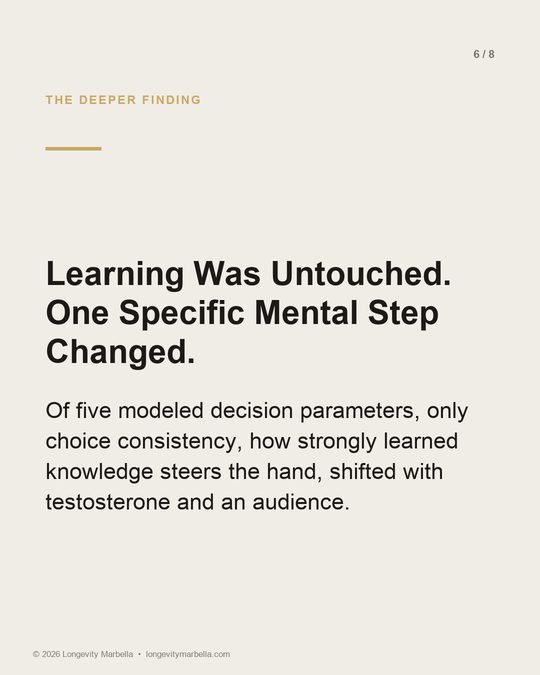
Of those five, only choice consistency showed the three-way interaction of drug, visibility and recipient, p below 0.001, and only choice consistency predicted the behavioral difference after Bonferroni correction, B = 3.82, interval 2.64 to 5.01, p below 0.001.
The direction matters. Under placebo, being watched increased the relative consistency of choices made for the charity, B = 1.09, interval 1.05 to 1.14. Under testosterone it decreased, B = 0.90, interval 0.84 to 0.98. Head to head under observation, testosterone diminished that consistency, odds ratio 0.91, interval 0.84 to 0.99, p = 0.025.
Read that slowly. Testosterone did not damage learning. The learning rates were unaffected. These men knew which symbol paid the charity. What changed was how strongly that knowledge steered the hand while an audience was present.
The hormone did not stop them learning what was good for the charity. It stopped what they had learned from governing the choice while someone was watching.
Dominance, Genes and Cortisol
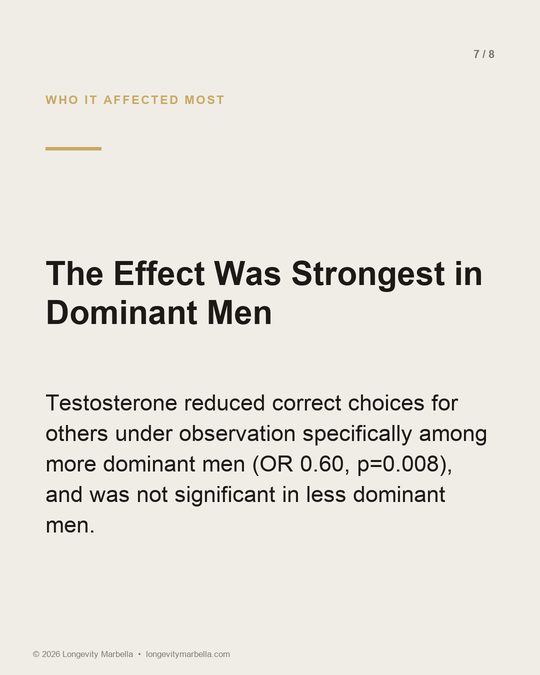
The effect was not uniform. Trait dominance interacted with it, p = 0.026: testosterone reduced correct choices made for others under observation specifically among the more dominant men, odds ratio 0.60, interval 0.42 to 0.87, p = 0.008, and was weaker and not significant among the less dominant, odds ratio 0.77, p = 0.132.
The negative findings deserve equal attention. Neither the androgen receptor CAG repeat nor the DAT1 dopamine transporter polymorphism, two common inherited differences in the equipment itself, interacted with the drug effect, all p above 0.091, and neither did baseline cortisol or cortisol reactivity, all p above 0.052. The authors had an attractive alternative explanation available, that testosterone simply reduces social fear, and they report that their own data do not support it. Their value orientation analyses were exploratory and, they say, need independent confirmation.
What This Study Does Not Say
This is where coverage of a paper like this goes wrong, so we will be blunt.
- These were not patients. Healthy young men, body mass index 18.5 to 24.9, one dose, one afternoon. Nothing here describes what months of treatment do.
- It says nothing about aggression. None was measured, in any form. What was measured was how often a man picked the higher paying symbol.
- It does not show selfishness. Choices made for the man himself did not change, and nothing was taken from anybody. What disappeared was an increase that only appears when someone is watching.
- Only men, and only female observers. The authors are explicit that generalization to women needs separate work, and that the gender, number and salience of observers were not varied.
- The literature disagrees with itself. An earlier study in a Chinese sample, using a modified dictator game, found the opposite: testosterone increased audience effects. The authors discuss cultural differences in how status is attained, and frame their conclusion as applying to a Western student sample.
Why an Endocrinologist Reads a Laboratory Game Carefully
Not because of what it says about generosity, but because of where it places the hormone.
This experiment puts testosterone inside reward processing and social cognition, not just muscle and libido. The authors point to animal work in which it raised dopamine in the ventral striatum, a core reward structure, and to human work linking the hormone with reward. Their contribution is to identify which step in that chain it touched, and it was not learning. It was the translation of learning into action under observation.
That has a practical consequence in a consulting room. Men arrive with a printed figure and expect a verdict on it. But the complaints that bring them in, flat motivation, blunted drive, social withdrawal, a sense of having become passive, sit in the territory this experiment probes and do not map onto one number. Reading a result properly means reading it against the pituitary hormones that drive it, the binding protein that carries it, the hour it was drawn, and the person describing the symptoms. We cover the measurement side in free testosterone versus total testosterone and the symptom side in the low testosterone symptom check.
That is the argument for having the endocrine picture read by a specialist in Internal Medicine and Endocrinology rather than off a printout. Our specialist consults by video and at a private partner clinic on Avenida Ricardo Soriano, Marbella, in English and Dutch.
Does testosterone make men selfish?
No, and the study is careful about this. Choices made for the men themselves were completely unaffected by testosterone, by being watched, or by the two combined. What testosterone removed was the extra effort placebo men put in on behalf of a charity specifically while being observed. Nothing was taken from anyone, and the men on testosterone still learned the task perfectly well.
Was this a study of men on testosterone therapy?
No, and that is the most important limitation. The participants were 190 healthy men aged 18 to 40 with a body mass index between 18.5 and 24.9, given a single 150 mg dose of testosterone gel or an identical placebo and tested the same afternoon. It says nothing about what treatment does over months in men with a genuine, properly diagnosed deficiency.
Does this mean testosterone causes aggression?
No. Aggression was not measured, in any form. The outcome was the number of correct choices in a learning game with reward probabilities of 75 percent and 25 percent. Reading it as evidence about aggression would be a straightforward misuse of the study.
What does choice consistency actually mean?
It is the degree to which what you have learned about the value of an option translates into you actually choosing it. Low consistency means you sometimes pick the option you already know is worse. In this experiment testosterone left both learning rates untouched and altered only this translation step, and only when someone was watching.
Should this change how I think about my own testosterone level?
Not on its own, but it is a good reason to stop treating the hormone as a muscle and libido molecule. Testosterone participates in reward processing and social decision-making, which is part of why symptoms such as flat motivation or lost drive do not map cleanly onto a single laboratory figure, and why a result of that kind belongs inside a full endocrine assessment rather than being read in isolation.
This article is for general information only and is not medical advice. Individual dietary and medical decisions should be discussed with a qualified doctor.
Reference. Kutlikova HH, Zhang L, Eisenegger C, van Honk J, Lamm C. "Testosterone eliminates strategic prosocial behavior through impacting choice consistency in healthy males." Neuropsychopharmacology 2023;48:1541-1550 (doi:10.1038/s41386-023-01570-y).
One number is rarely the whole answer
If your hormone results have been read to you as a single figure, our specialist can interpret the full picture alongside your symptoms, on a private video call or a concierge home visit across the Costa del Sol.
A letter from the doctor. A few times a year, when the evidence genuinely changes, I write it down and send it. No schedule, no noise, and you can leave the list whenever you like.