


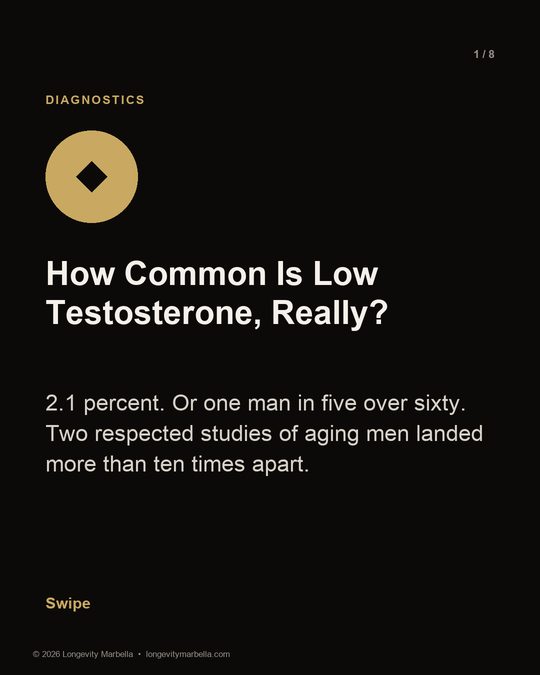
Ask how many men have low testosterone and you can be handed two answers that differ by more than a factor of ten, both from serious research groups, both published in major journals. One says 2.1 percent. The other says roughly one man in five over the age of sixty. Neither is wrong. The reason they disagree is the most useful thing you can understand before you look at your own result.
Not sure if this applies to you? One-minute check.
- Two serious answers differ by more than a factor of ten: 2.1 percent, or one man in five over sixty. Neither is wrong.
- The strict definition, from 2,966 men, requires low total and free testosterone plus at least three sexual symptoms: 2.1 percent overall, from 0.1 percent in the youngest band to 5.1 percent in the oldest.
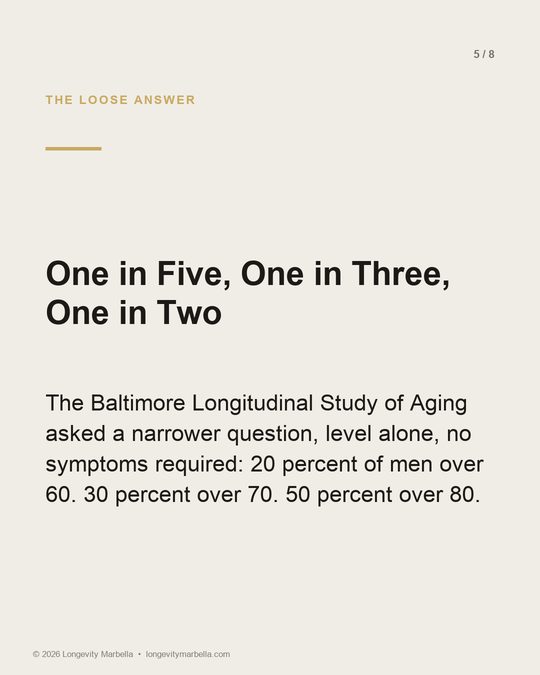
- The laboratory-only definition finds low numbers in 20 percent of men over 60, 30 percent over 70, and 50 percent over 80.
- The difference between a laboratory finding and a diagnosis is the whole story.
The Strict Answer, 2.1 Percent
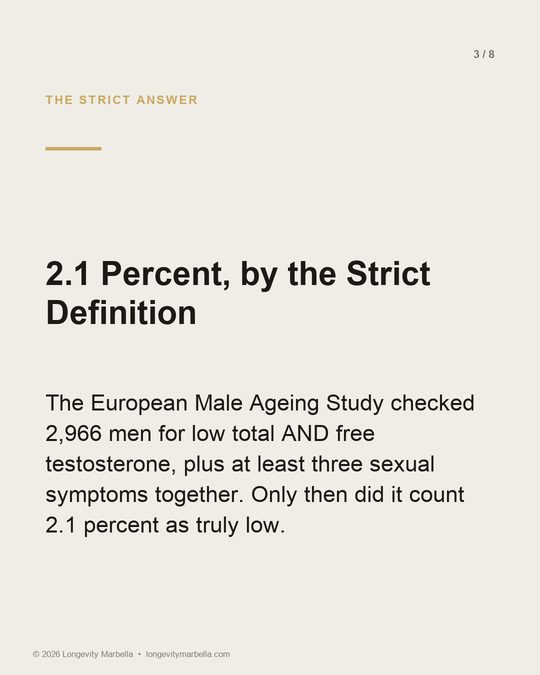
The European Male Ageing Study assessed 2,966 men and did something that sounds obvious but happens far less often than you would hope: it defined the condition before it counted it. To be called hypogonadal in that study, a man had to fail on two fronts at the same time.
First, the blood. He needed a total testosterone below 11 nmol per liter together with a free testosterone below 220 pmol per liter. Total testosterone is everything circulating in the bloodstream, most of it bound to carrier proteins and therefore unable to act: fuel still sitting in the tank. Free testosterone is the small unbound share that can enter a cell and do work: the fuel actually reaching the engine. Both had to be low. One low figure sitting next to a normal one did not qualify.
Second, the man himself. He needed at least three sexual symptoms, present together. Not fatigue. Not a flat mood. Not a hard year at work. Three sexual symptoms.
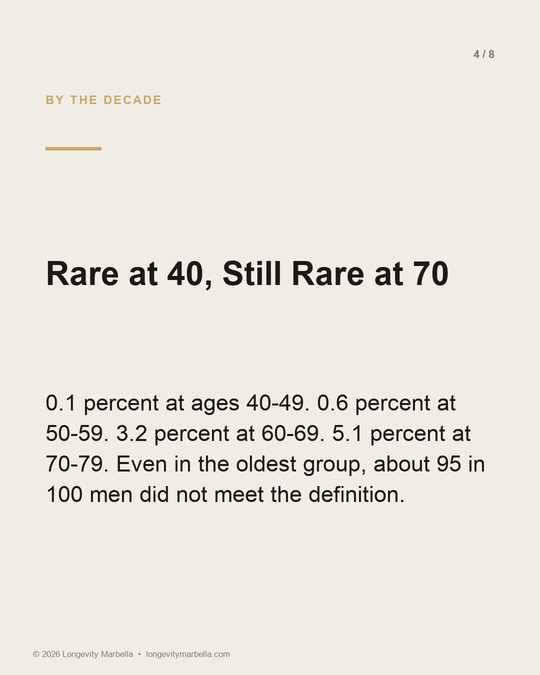
On that definition, the study found late onset hypogonadism, the formal name for the age-related form of the condition, in 2.1 percent of the men overall. Broken down by decade, it rose steeply with age:
- 0.1 percent of men aged 40 to 49
- 0.6 percent of men aged 50 to 59
- 3.2 percent of men aged 60 to 69
- 5.1 percent of men aged 70 to 79
The age pattern is real and it is steep. A man in his seventies is many times more likely to qualify than a man in his forties. But look at the absolute size of those numbers. Even in the oldest group, roughly ninety-five men in every hundred did not meet the definition.
The Loose Answer, One Man in Five Over Sixty
The Baltimore Longitudinal Study of Aging examined 890 men and asked a narrower question: how many of them have a testosterone level that falls in the hypogonadal range? Level alone. No symptom requirement whatsoever.
Judged that way, it found hypogonadal levels in about 20 percent of men over 60, about 30 percent of men over 70, and about 50 percent of men over 80.
Half of all men over eighty. That figure has circulated for two decades, and it is almost always quoted without the four words that govern it: on blood levels alone.
Why the Two Figures Fall So Far Apart
They are not in conflict. They asked different questions and each got the answer its question deserved.
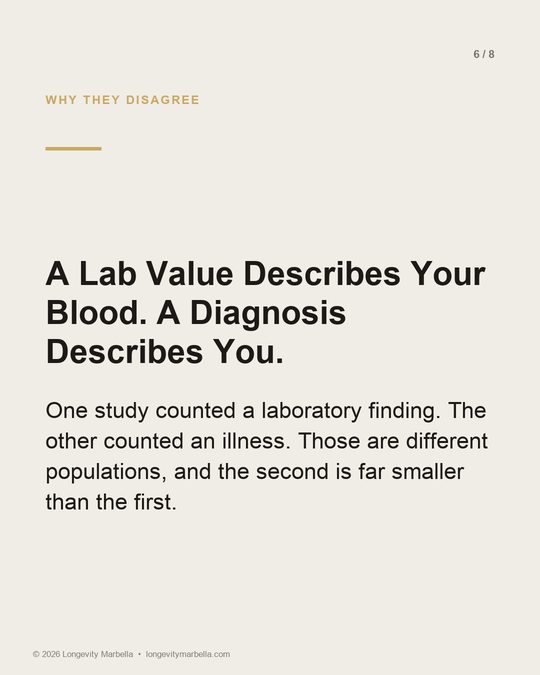
The Baltimore number counts a laboratory finding. The European number counts an illness. One tells you how many men would have a result flagged by the lab. The other tells you how many men are genuinely unwell in the specific way that testosterone deficiency makes men unwell. Those are different populations, and the second is much smaller than the first.
A laboratory value describes your blood. A diagnosis describes you.
One honesty point, because it matters. These were two separate cohorts, recruited in different countries at different times, using different assays and different cut-offs. You cannot subtract one percentage from the other and treat the remainder as a clean count of men with a low number who are perfectly well. The comparison is instructive, not arithmetic. What it does establish firmly is the direction of the gap: the group with low readings is far larger than the group with the syndrome.
What Is Actually Falling, and How Fast
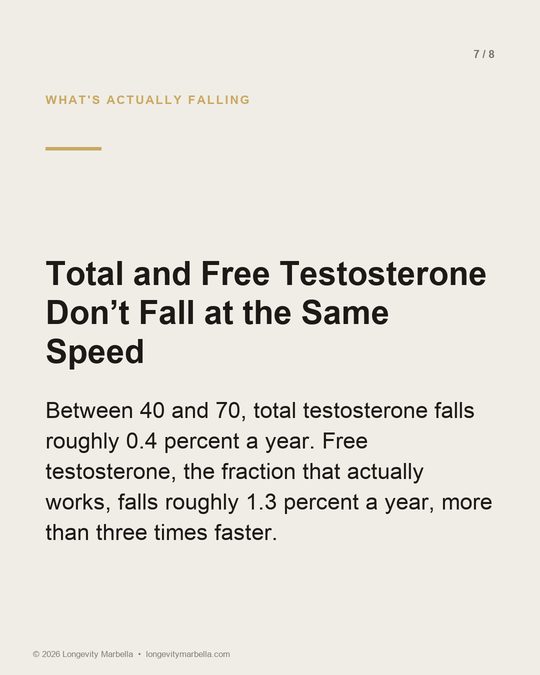
Behind both sets of figures sits the same slow biology. In men aged 40 to 70, total testosterone falls by roughly 0.4 percent per year, and the drift starts gradually from around the age of 35.
Four tenths of one percent a year is almost nothing on any given birthday. That is precisely why it goes unnoticed. Nobody detects a 0.4 percent change in anything.
The free fraction behaves differently. Free testosterone falls by roughly 1.3 percent per year, more than three times faster than the total.
That divergence matters more than any single percentage in this article. It means the two measurements pull apart as a man ages. Total testosterone is the fuel gauge; free testosterone is the fuel actually reaching the engine. A total testosterone that still reads comfortably inside the reference range can be sitting on top of a free testosterone that has traveled a great deal further down: a gauge showing half a tank while the line to the engine runs thin. If your blood panel measured only the total, it can look reassuring at exactly the point where the biologically active fraction has moved the most.
A Low Number on Its Own Is Not a Diagnosis
This is the part that costs men money, and occasionally costs them a correct diagnosis. A single low reading is not a verdict. It is a prompt to look harder.
Testosterone is not a stable quantity. It varies across the day. It falls during acute illness. It falls with poor sleep, with weight gain, with alcohol, with opioid painkillers and with glucocorticoids. A sample drawn at four in the afternoon after a broken night is not the same measurement as one drawn fasting at eight in the morning, and it should never be read as though it were.
The European study makes the same point structurally. It applied both a level requirement and a symptom requirement, and the count collapsed to 2.1 percent. The overwhelming majority of men whose blood looks low do not have the syndrome. Being flagged by a laboratory puts you into a very large group. It does not put you into a diagnosis.
Symptoms on Their Own Are Not a Diagnosis Either
The mistake runs in the opposite direction just as often. A man arrives already certain that testosterone is the problem, because he is tired, heavier around the middle, short-tempered, and no longer interested in much.
Every one of those complaints is real, and not one of them is specific. An underactive thyroid produces them. Untreated obstructive sleep apnea produces them. So do iron deficiency, poorly controlled blood sugar, depression, heavy alcohol use, chronic under-recovery from training, and a long list of ordinary prescription medicines.
It is worth noticing what the European study chose to anchor its definition on: sexual symptoms, three of them, present together. Not fatigue, and not mood. That is a fair reflection of clinical reality. The general complaints have too many competing explanations to point reliably at one hormone. Build a diagnosis on tiredness alone and you will be wrong a great deal of the time, and the thing you missed will still be there.
Only the Two Read Together Settles It
So a number without symptoms is not a diagnosis. Symptoms without a number are not a diagnosis. The only thing that settles the question is the two read together, by someone competent to read them.
In practice that means a morning sample, taken fasting, and confirmed on a second occasion before anything at all is concluded. It means a free testosterone, or the sex hormone binding globulin needed to calculate one, rather than a total figure standing alone. It means LH and FSH, the two pituitary signals, whose pattern tells you whether the problem sits in the testicles or higher in the brain, whether the engine is failing or the control unit has gone quiet, because those are different diseases with different consequences. And it means a deliberate search for the other conditions that produce an identical set of symptoms. We set out that full sequence in our guide to how low testosterone is diagnosed and monitored.
Notice that this is a diagnostic sequence, not a treatment plan. Its purpose is to establish whether a man has a condition at all, and if he does, which one it actually is.
If You Are the Man Holding the Result
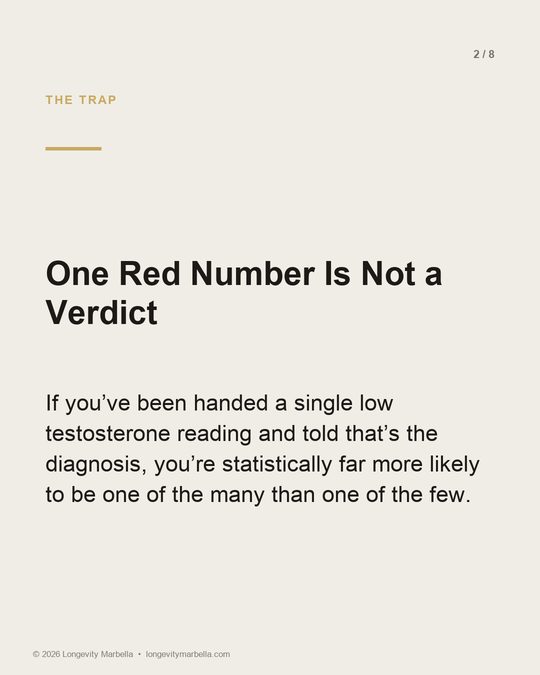
If you have a printout with one figure underlined in red and nothing else to go on, you are statistically far more likely to be one of the many than one of the few. That is a starting position, not a dismissal.
If that figure is sitting alongside three sexual symptoms that have persisted, the picture is different, and it deserves a proper workup rather than a repeat of the same single test.
Either way, the honest answer to the question in the title is that low readings are common and the diagnosis is not. Our specialist, double board-certified in Internal Medicine and Endocrinology, reads the number and the man together, by private video consultation or in person across the Costa del Sol, and will tell you plainly which of the two you are.
How common is low testosterone, really?
It depends entirely on the definition used. The European Male Ageing Study, which required both low blood levels and at least three sexual symptoms in 2,966 men, found late onset hypogonadism in 2.1 percent overall: 0.1 percent at ages 40 to 49, 0.6 percent at 50 to 59, 3.2 percent at 60 to 69 and 5.1 percent at 70 to 79. The Baltimore Longitudinal Study of Aging, which judged on blood level alone in 890 men, found hypogonadal levels in about 20 percent of men over 60, 30 percent over 70 and 50 percent over 80. Low readings are common. The full syndrome is not.
Why do some sources say half of all men over eighty have low testosterone?
Because that figure comes from the Baltimore Longitudinal Study of Aging and refers to blood levels only, with no symptom requirement attached. It is an accurate statement about laboratory values in 890 men. It is not a statement about how many men over eighty are ill because of their testosterone, and it is routinely quoted as though it were.
My total testosterone is normal but I still have symptoms. Is that possible?
Yes, and the reason is in the rate of decline. Total testosterone falls by roughly 0.4 percent per year in men aged 40 to 70, while the free fraction falls by roughly 1.3 percent per year, more than three times faster. The two measurements pull apart over the decades, so a total that still reads inside the reference range can be sitting on top of a considerably lower free level. A panel that measured only the total cannot see that. It is also entirely possible that your symptoms have a different cause altogether, which is why the other explanations need excluding rather than assuming.
Does one low result mean I need treatment?
No. One low result means one low result. Testosterone varies through the day and falls with acute illness, poor sleep, weight gain, alcohol, opioids and glucocorticoids, so a single sample taken at the wrong hour or during a bad week can mislead badly. Standard practice is a fasting morning sample confirmed on a second occasion, alongside free testosterone or sex hormone binding globulin, LH and FSH, and a deliberate search for the other conditions that produce the same symptoms.
At what age does testosterone start to fall?
The gradual drift begins from around age 35. Between 40 and 70 the total falls by roughly 0.4 percent per year and the free fraction by roughly 1.3 percent per year. Neither is perceptible from one year to the next, which is exactly why the change is usually noticed only in retrospect, and why the prevalence figures climb so sharply from the sixties onward.
This article is for general information only and is not medical advice. Individual dietary and medical decisions should be discussed with a qualified doctor.
Reference. Wu FC et al. "Identification of late-onset hypogonadism in middle-aged and elderly men." New England Journal of Medicine 2010;363:123-135 (doi:10.1056/NEJMoa0911101). Harman SM, Metter EJ, Tobin JD, Pearson J, Blackman MR. "Longitudinal effects of aging on serum total and free testosterone levels in healthy men. Baltimore Longitudinal Study of Aging." Journal of Clinical Endocrinology and Metabolism 2001;86:724-731 (doi:10.1210/jcem.86.2.7219).
One number is rarely the whole answer
If your hormone results have been read to you as a single figure, our specialist can interpret the full picture alongside your symptoms, on a private video call or a concierge home visit across the Costa del Sol.
A letter from the doctor. A few times a year, when the evidence genuinely changes, I write it down and send it. No schedule, no noise, and you can leave the list whenever you like.